Friday Night Kirtan
March 13, 2026 — The Bhakti House, Jackson, Michigan
Last weekend, we awakened spiritual desire.
Through chanting, reflection, and association, we felt something stir within the heart — a longing for something deeper than temporary pleasure.
Tonight we anchor that longing in truth.
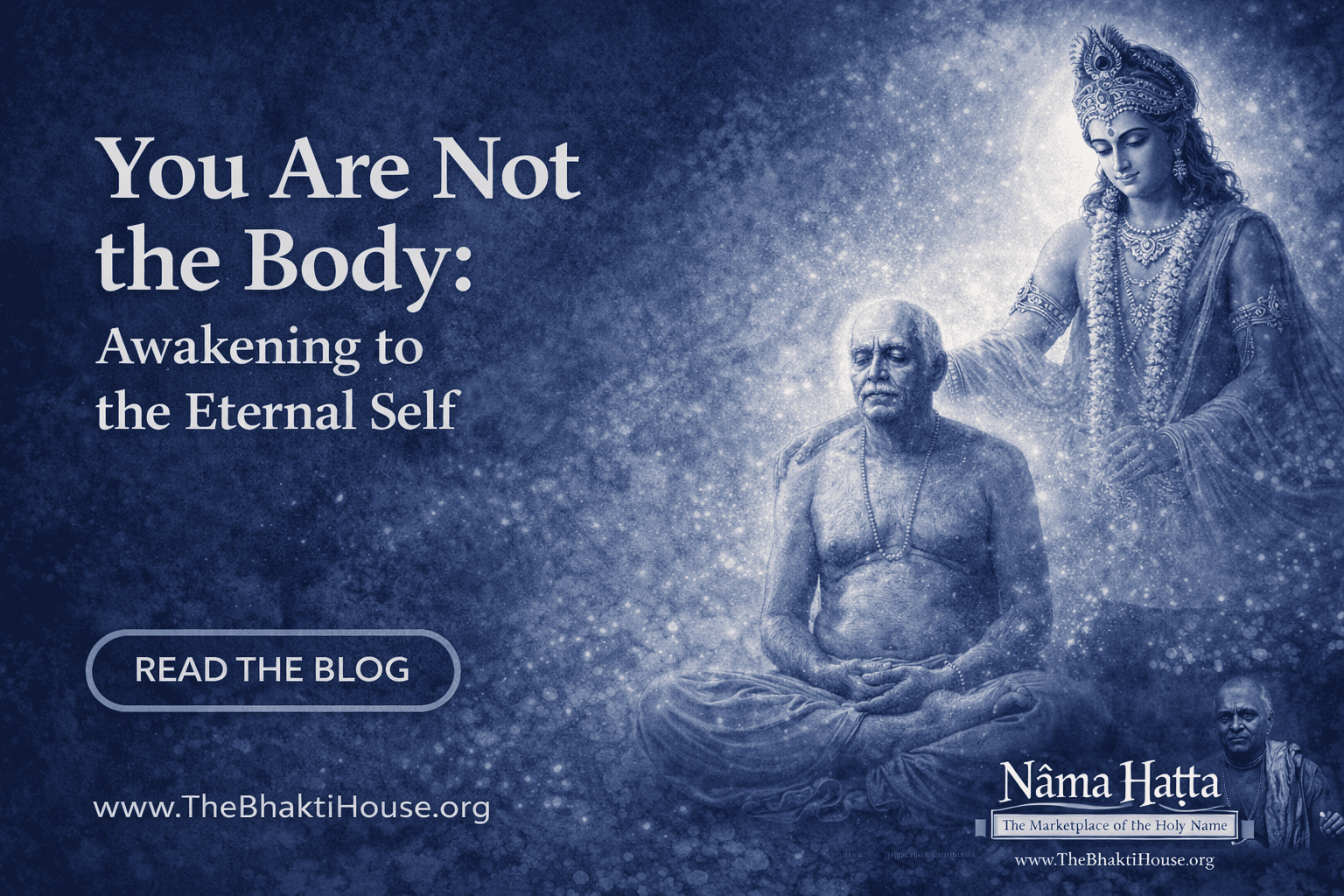
Spiritual life begins with a fundamental realization:
I am not this body.
Without this knowledge, devotion becomes sentimental. With this knowledge, devotion becomes stable.
The Bhagavad-gītā opens its spiritual instruction with this exact teaching.
Bhagavad-gītā 2.13 — The Soul Within the Changing Body
Devanāgarī
देहिनोऽस्मिन्यथा देहे
कौमारं यौवनं जरा ।
तथा देहान्तरप्राप्तिर्
धीरस्तत्र न मुह्यति ॥
Roman Transliteration
dehino ’smin yathā dehe
kaumāraṁ yauvanaṁ jarā
tathā dehāntara-prāptir
dhīras tatra na muhyati
Translation (Vedabase.io)
“As the embodied soul continuously passes, in this body, from boyhood to youth to old age, the soul similarly passes into another body at death. A sober person is not bewildered by such a change.”
Theological Reflection
This verse is revolutionary.
Kṛṣṇa does not begin with ritual.
He does not begin with morality.
He begins with identity.
The body changes continuously — from childhood to youth to adulthood to old age.
Yet the conscious self observing those changes remains constant.
You remember being a child.
But that child’s body is gone.
You remember your teenage years.
That body is gone.
Cells have replaced themselves thousands of times.
Yet you — the observer — persist.
That unchanging witness is the ātmā, the soul.
The Illusion of Identification
The root of suffering is misidentification.
We say:
“I am tired.”
“I am old.”
“I am attractive.”
“I am successful.”
But these are bodily conditions.
When we identify with the temporary, we inherit its anxiety.
The body ages.
The body becomes diseased.
The body dies.
If we believe we are the body, fear becomes inevitable.
But the verse ends with a powerful word:
dhīraḥ — the sober person.
One who understands this truth is not bewildered.
Not because death disappears.
But because identity clarifies.
Bhagavad-gītā 2.20 — The Soul Is Never Born Nor Dies
Tonight we deepen the realization.
Devanāgarī
न जायते म्रियते वा कदाचिन्
नायं भूत्वा भविता वा न भूयः ।
अजो नित्यः शाश्वतोऽयं पुराणो
न हन्यते हन्यमाने शरीरे ॥
Roman Transliteration
na jāyate mriyate vā kadācin
nāyaṁ bhūtvā bhavitā vā na bhūyaḥ
ajo nityaḥ śāśvato ’yaṁ purāṇo
na hanyate hanyamāne śarīre
Translation (Vedabase.io)
“For the soul there is neither birth nor death at any time. He has not come into being, does not come into being, and will not come into being. He is unborn, eternal, ever-existing and primeval. He is not slain when the body is slain.”
Theological Reflection
This is not poetic exaggeration.
It is ontological fact.
The soul is:
• Unborn
• Eternal
• Ever-existing
• Primeval
• Indestructible
When the body dies, the soul continues.
Fear of death is rooted in bodily identification.
Spiritual strength is rooted in spiritual identity.
Kīrtan becomes different when we understand this.
We are not trying to escape reality.
We are awakening to it.
Why This Matters for Bhakti
Devotion requires stability.
If I believe I am the body, my devotion fluctuates with bodily comfort.
If I am sick, I feel spiritually weak.
If I am praised, I feel spiritually inflated.
If I am criticized, I feel spiritually crushed.
But if I know I am the soul, service becomes steady.
Praise and blame become temporary waves.
The ocean beneath remains unchanged.
Bhakti deepens when identity stabilizes.
The Psychological Shift
When you deeply internalize “I am not this body,” several changes occur:
- Envy decreases.
You no longer compare bodily conditions obsessively. - Fear decreases.
Loss feels temporary rather than absolute. - Gratitude increases.
Life becomes an opportunity for growth rather than competition. - Service becomes natural.
The soul’s constitutional nature is service.
This prepares us for Sunday’s theme — our eternal relationship with Kṛṣṇa.
Chanting with Knowledge
Tonight’s kīrtan is different from last week.
Last week, we chanted to awaken longing.
Tonight, we chant from identity.
When we sing:
Hare Kṛṣṇa Hare Kṛṣṇa
Kṛṣṇa Kṛṣṇa Hare Hare
Hare Rāma Hare Rāma
Rāma Rāma Hare Hare
We are not chanting as bodies.
We are chanting as eternal souls calling to the Supreme Soul.
The vibration is spiritual.
The chanter is spiritual.
The connection is eternal.
Practical Application for The Bhakti House
Tonight’s structure reflects this realization:
• Opening meditation: “I am the witness within.”
• Slow kīrtan to internalize identity
• Gradual increase in tempo as spiritual confidence rises
• Silent reflection at the end
Devotion must be both emotional and philosophical.
Feeling without knowledge becomes unstable.
Knowledge without feeling becomes dry.
Gaudiya Vaiṣṇavism harmonizes both.
Reflection Questions
- When difficulties arise, do I react from bodily identity or spiritual awareness?
- Do I meditate daily on the difference between body and soul?
- How would my week change if I consistently remembered I am eternal?
Assignment
For the next seven days:
Each morning, before checking your phone, say aloud:
“I am not this body. I am an eternal servant of Kṛṣṇa.”
Repeat it slowly.
Let it anchor your consciousness before the world pulls it outward.
Preparing for Tomorrow
Tomorrow’s Rest & Retreat will deepen this further.
We will explore:
The Nature of the Eternal Self
Beyond birth and death
Beyond temporary designations
And Sunday will culminate in the most important revelation of all:
The soul’s eternal relationship with Kṛṣṇa.
Identity leads to relationship.
Relationship leads to love.
Bhakti is not sentiment.
It is the awakening of the eternal self.