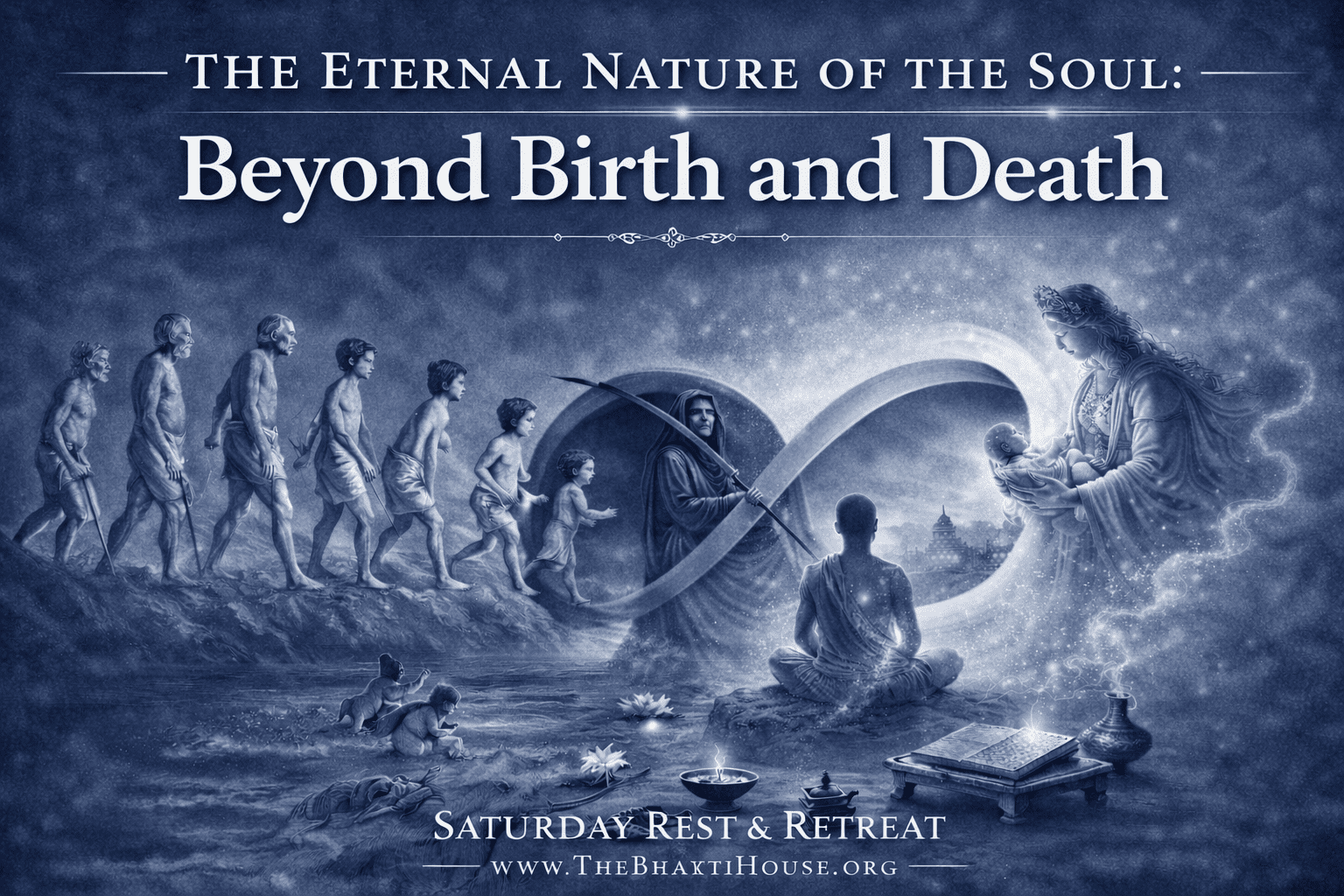
Saturday Rest & Retreat
March 14, 2026 — The Bhakti House, Jackson, Michigan
Last night we established a foundational truth:
We are not the body.
But today we go further.
It is one thing to intellectually accept that the body changes while the self remains.
It is another thing to deeply meditate on what that means.
If I am not the body, then:
Who am I?
Where did I come from?
Why am I here?
Where am I going?
Today’s Rest & Retreat invites us into stillness — to contemplate the eternal nature of the soul.
We return to the Bhagavad-gītā.
Bhagavad-gītā 2.20 — The Soul Is Eternal
Devanāgarī
न जायते म्रियते वा कदाचिन्
नायं भूत्वा भविता वा न भूयः ।
अजो नित्यः शाश्वतोऽयं पुराणो
न हन्यते हन्यमाने शरीरे ॥
Roman Transliteration
na jāyate mriyate vā kadācin
nāyaṁ bhūtvā bhavitā vā na bhūyaḥ
ajo nityaḥ śāśvato ’yaṁ purāṇo
na hanyate hanyamāne śarīre
Translation (Vedabase.io)
“For the soul there is neither birth nor death at any time. He has not come into being, does not come into being, and will not come into being. He is unborn, eternal, ever-existing and primeval. He is not slain when the body is slain.”
Theological Reflection
This verse dismantles the greatest illusion of material existence: that we begin at birth and end at death.
Kṛṣṇa declares that the soul:
• Is never born
• Never dies
• Has always existed
• Will always exist
The body appears and disappears.
The soul persists.
Birth is not the beginning of consciousness.
Death is not the end of existence.
This realization changes everything.
Fear and the False Self
Most anxiety stems from bodily identification.
We fear aging because we identify with the body.
We fear loss because we identify with possessions.
We fear death because we identify with material continuity.
But the soul is not fragile.
It cannot be cut, burned, drowned, or dried.
When this truth is deeply understood, life becomes lighter.
Not careless — but fearless.
Bhagavad-gītā 2.22 — The Changing of Bodies
To deepen this meditation, we turn to another powerful verse.
Devanāgarī
वासांसि जीर्णानि यथा विहाय
नवानि गृह्णाति नरोऽपराणि ।
तथा शरीराणि विहाय जीर्णान्
अन्यानि संयाति नवानि देही ॥
Roman Transliteration
vāsāṁsi jīrṇāni yathā vihāya
navāni gṛhṇāti naro ’parāṇi
tathā śarīrāṇi vihāya jīrṇān
anyāni saṁyāti navāni dehī
Translation (Vedabase.io)
“As a person puts on new garments, giving up old ones, the soul similarly accepts new material bodies, giving up the old and useless ones.”
Theological Reflection
This analogy is compassionate and clear.
Just as a person discards old garments and puts on new ones, the soul gives up an old body and accepts another.
Death is transition.
The terror of death comes from ignorance of identity.
When identity shifts from body to soul, death becomes relocation — not annihilation.
This is not speculative philosophy.
It is the direct instruction of Kṛṣṇa.
Retreat Contemplation
Today’s Rest & Retreat is structured differently than Friday’s kīrtan.
We slow down.
We breathe.
We observe the witness within.
Exercises:
- Guided Meditation
Sit quietly and observe your thoughts.
Notice that thoughts appear and disappear.
Ask: Who is observing them? - Body Scan
Observe sensations in the body.
Notice they change moment to moment.
Ask: Who is aware of these changes? - Reflection Journal
If I am eternal, what truly matters?
What am I clinging to that is temporary?
What fears are rooted in bodily identity?
The goal is not intellectual debate.
The goal is realization.
The Difference Between Knowledge and Realization
Many people can recite “I am not the body.”
Few live it.
Realization occurs when:
• Reaction slows
• Fear softens
• Perspective widens
• Gratitude increases
The realized soul sees life as temporary service, not permanent possession.
This transforms how we relate to:
• Career
• Relationships
• Success
• Failure
• Health
• Aging
Everything becomes contextualized within eternity.
Why This Matters for Bhakti
Devotion requires courage.
Without understanding eternity, surrender feels dangerous.
If I think this life is all there is, I cling tightly to control.
If I know I am eternal, surrender becomes rational.
The eternal soul naturally seeks eternal relationship.
This prepares us for tomorrow’s Satsang:
The soul’s constitutional identity as servant of Kṛṣṇa.
Eternity without relationship feels abstract.
Eternity with relationship becomes love.
Practical Application for The Bhakti House
Tonight’s closing meditation will include:
• Soft kīrtan
• Extended repetition of the Mahā-mantra
• Silent intervals for internal absorption
We chant not as bodies seeking comfort.
We chant as eternal souls seeking reconnection.
Knowledge stabilizes emotion.
Emotion animates knowledge.
Together they produce steady bhakti.
Reflection Questions
- Do I still unconsciously identify primarily with the body?
- What fears dominate my thinking?
- How would my decisions change if I truly understood I am eternal?
- What temporary concerns am I overvaluing?
Assignment
For the next week:
When anxiety arises, pause and say:
“This is a bodily condition. I am eternal.”
Repeat until the emotional intensity decreases.
Practice this consciously.
Preparing for Sunday
Tomorrow we complete this arc.
Friday: You are not the body.
Saturday: You are eternal.
Sunday: You are an eternal servant of Kṛṣṇa.
Identity leads to relationship.
Relationship leads to devotion.
Devotion leads to Love.