

If you are coming to your first kīrtan, you may feel a mixture of curiosity, hope, nervousness, and maybe even a little uncertainty. That is completely natural.
Kīrtan is simple, but it can also feel new. People may be singing Sanskrit mantras. Some may close their eyes. Some may clap, sway, dance, or sit quietly. There may be drums, harmonium, cymbals, and voices rising together in devotion.
At The Bhakti House, we want you to know this from the beginning: you do not have to be “spiritual enough,” musical enough, experienced enough, or from any particular background to join. Kīrtan is for everyone.
Bhakti Yoga is the path of love and devotion. The word bhakti means loving devotion, and yoga means connection. So Bhakti Yoga is the practice of reconnecting the heart with God through love, chanting, prayer, service, friendship, and spiritual growth.
Kīrtan is one of the most joyful and accessible practices of Bhakti Yoga. It is a sacred gathering where we chant the names of God together, often in a call-and-response style. You can participate fully by singing loudly, softly, listening prayerfully, or simply being present.
This guide will help you know what to expect at your first kīrtan so you can arrive with an open heart and feel at home.
Kīrtan is a form of devotional chanting, usually done in a group. The Sanskrit word kīrtan means “praising” or “glorifying.” In Bhakti Yoga, kīrtan most often means singing the holy names of God together.
A Simple Practice of Sacred Sound
In kīrtan, a leader sings a mantra, and the group responds by singing it back. This call-and-response pattern makes it easy for everyone to join, even if you have never heard the mantra before.
A mantra is a sacred sound or phrase that helps focus the mind and awaken the heart. The word mantra can be understood as “that which frees the mind.” Instead of letting the mind wander endlessly through worry, planning, or distraction, mantra gives the mind a spiritual resting place.
One of the most well-known mantras in Bhakti Yoga is the Hare Kṛṣṇa mahā-mantra:
Hare Kṛṣṇa, Hare Kṛṣṇa
Kṛṣṇa Kṛṣṇa, Hare Hare
Hare Rāma, Hare Rāma
Rāma Rāma, Hare Hare
The word mahā means “great,” so mahā-mantra means “the great mantra.” In this prayer, we call out to God through sacred names: Hare, Kṛṣṇa, and Rāma. These names invite us into loving relationship with the Divine.
Not a Performance, but a Prayer
Kīrtan is not a concert in the usual sense. The musicians are not there to entertain, and the guests are not merely an audience. Everyone present becomes part of the offering.
Some people have beautiful trained voices. Others sing off-key with sincerity. Some do not sing at all and simply listen. In Bhakti, sincerity matters more than musical perfection.
The great Bhakti tradition teaches that God hears the heart. Kīrtan is a place where we can offer that heart honestly—joyful, tired, broken, grateful, confused, hopeful, or longing.
Rooted in Ancient Wisdom
Kīrtan is deeply rooted in the Bhakti scriptures and the lives of saints who taught that chanting God’s names is a powerful practice for spiritual awakening.
In the Bhagavad-gītā, one of the foundational texts of yoga, Śrī Kṛṣṇa says:
“Always chant My glories, endeavor with determination, bow down before Me, and worship Me with devotion.”
— Bhagavad-gītā 9.14
This verse describes the heart of Bhakti Yoga: remembering God, chanting, offering respect, and living with devotion.
Kīrtan makes these teachings practical. We gather, sing, listen, remember, and allow the heart to soften.
Arriving at Your First Kīrtan
Walking into a new spiritual space can feel vulnerable. You may wonder what to wear, where to sit, whether you need to know the words, or if there are expectations you might not understand.
Please be at ease. A sincere heart is enough.
What to Wear
You do not need special clothing to attend kīrtan. Wear something comfortable and respectful—something you can sit in, breathe in, and perhaps move in if the chanting becomes lively.
Some people may wear traditional Indian clothing, yoga clothes, or simple casual clothing. All are welcome. The main thing is to come as you are.
If the gathering takes place in a temple room or devotional space, guests may be asked to remove their shoes. This is a simple sign of respect and also helps keep the sacred space clean.
Where to Sit
At many kīrtans, people sit on the floor, often on cushions, rugs, or yoga mats. Chairs are usually available for those who need them. Please never feel shy about using a chair. Spiritual life is not about forcing the body into discomfort.
You can sit near the front if you want to feel immersed in the sound, or closer to the back if you prefer to observe quietly at first.
There is no “wrong” place to sit. Find a place where your body can relax and your heart can be present.
Do I Need to Know the Mantras?
No. You do not need to know the mantras before you arrive.
Kīrtan is designed to be easy to follow. The leader sings a line, and the group repeats it. Often the mantra is sung many times, so even if it feels unfamiliar at first, it usually becomes natural after a few rounds.
Some gatherings provide mantra sheets or display the words. But even if you do not know the pronunciation perfectly, that is okay.
In Bhakti, the mood is more important than external perfection. Your sincere effort is beautiful.
What Happens During Kīrtan?
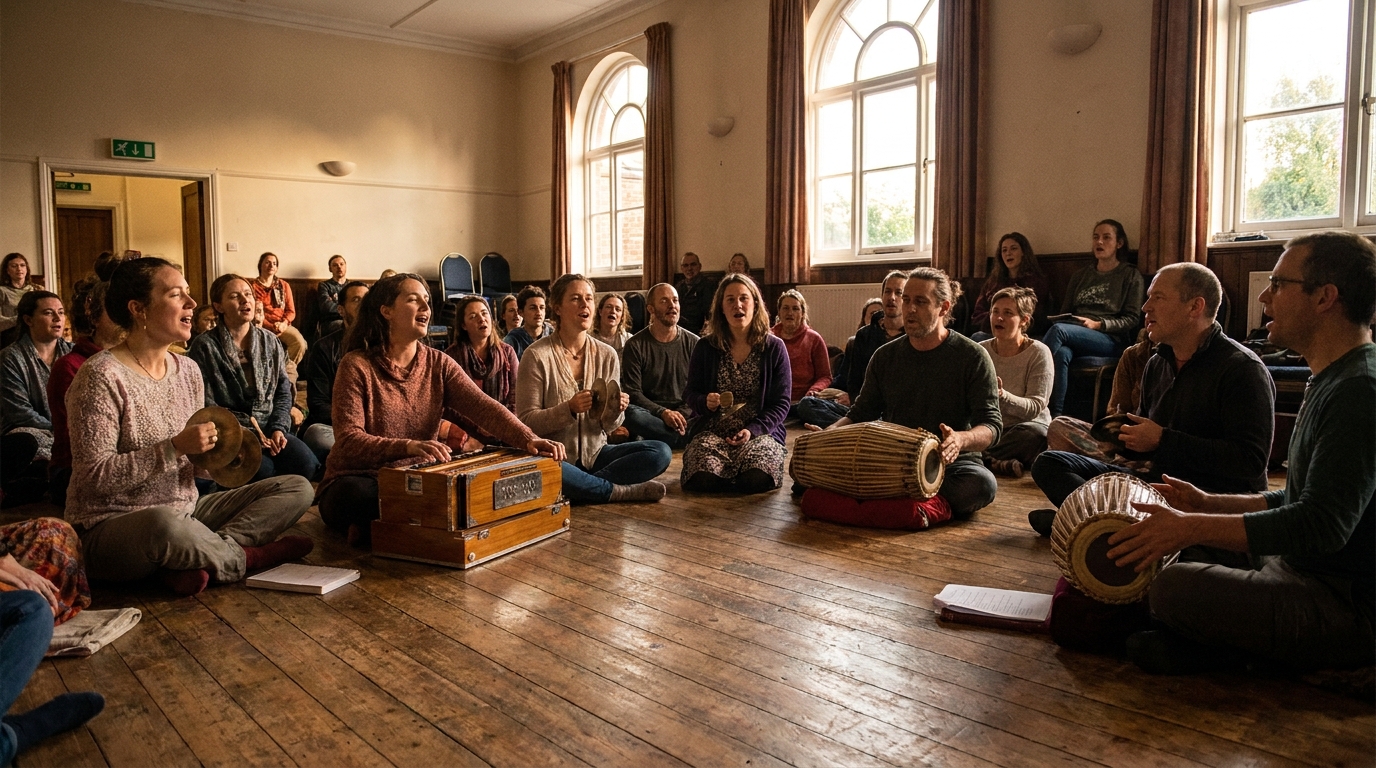
Every kīrtan is a little different, depending on the community, the leaders, and the mood of the evening. Still, most kīrtans share a few common elements.
Opening the Space
A kīrtan may begin with a short welcome, a prayer, or a few moments of silence. Sometimes the leader explains the meaning of the mantra or shares a reflection from Bhakti wisdom.
This helps everyone remember why we are gathering. We are not just singing songs. We are entering a sacred practice of connection.
At The Bhakti House, the mood is warm, humble, and welcoming. Whether you have practiced Bhakti Yoga for years or are simply curious about chanting meditation, you are invited to participate in a way that feels sincere for you.
Call and Response Chanting
The most common structure of kīrtan is call and response.
The leader sings first. Then everyone sings the same line back. This continues, often slowly at first. As the chanting deepens, the tempo may rise. The drums may become more energetic. The room may fill with clapping, dancing, and joyful sound.
Then, just as naturally, the kīrtan may slow down again and return to a peaceful, prayerful mood.
This movement—from gentle to joyful, from quiet to full-hearted, then back to stillness—can feel like a journey inward.
Instruments You May Hear
Traditional kīrtan often includes instruments such as:
- Harmonium: a small hand-pumped keyboard instrument often used to lead melodies
- Mṛdaṅga: a two-headed clay or wooden drum used in devotional music
- Kartālas: small hand cymbals that keep rhythm
- Guitar, violin, flute, or other instruments, depending on the gathering
The instruments support the chanting, but the true heart of kīrtan is the holy name itself.
In the Bhakti tradition, sacred sound is not considered ordinary sound. The holy name is understood to carry divine presence. When we chant with sincerity, we are not simply singing about God—we are calling out to God.
Check out our latest posts at https://thebhaktihouse.org/blog.
How to Participate
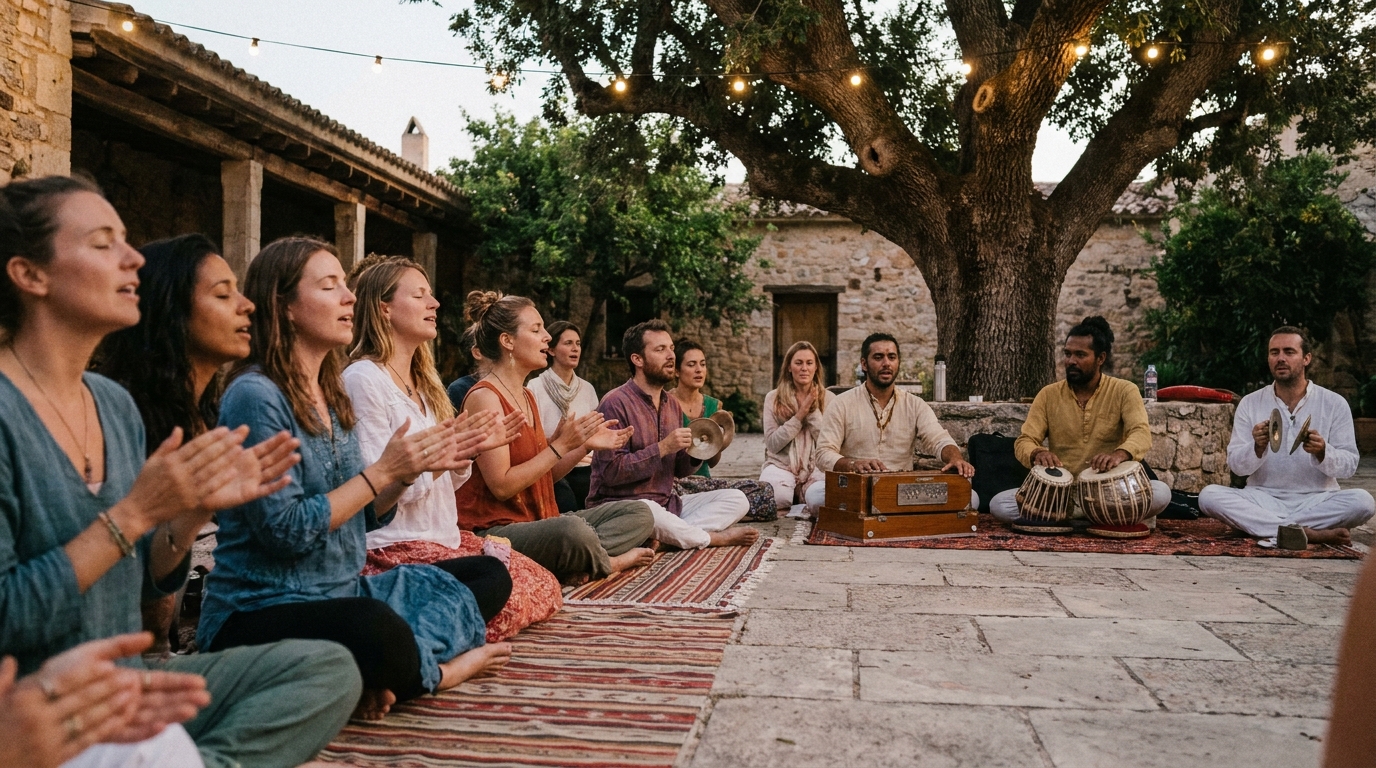
You can participate in kīrtan in many ways. There is no pressure to behave in a certain style. Bhakti is personal. Your offering may look different from someone else’s, and that is perfectly fine.
Singing
If you feel comfortable, sing along. You can sing softly, loudly, confidently, or shyly. The group sound will carry you.
Many people worry, “What if I don’t have a good voice?” But kīrtan is not about being impressive. It is about being honest.
A humble voice offered with love is deeply meaningful.
The Śrīmad-Bhāgavatam, another treasured Bhakti scripture, describes hearing and chanting about God as a powerful process for purifying the heart:
“To hear about, glorify, and remember the Supreme Lord is the highest perfection.”
— based on Śrīmad-Bhāgavatam 2.1.5
In practical terms, chanting helps redirect the mind from anxiety and self-centered thought toward remembrance, gratitude, and love.
Listening
Listening is also full participation.
In Sanskrit, śravaṇam means hearing or listening. It is one of the main practices of Bhakti Yoga. Sometimes the most sincere thing we can do is sit quietly and receive the sound.
If you are tired, grieving, overwhelmed, or unsure, you may simply close your eyes and listen. Let the mantra wash over you. Let the sound hold what you cannot put into words.
Many people find that even without singing, kīrtan brings peace to the heart.
Clapping, Swaying, or Dancing
As the kīrtan becomes lively, some people may clap, sway, stand, or dance. This is a natural expression of joy in Bhakti Yoga.
You are welcome to join if you feel moved. You are also welcome to remain seated.
There is no need to imitate others. Let your participation be genuine. Some hearts dance quietly. Some hearts dance with raised arms. Both can be offerings of devotion.
Prayerful Reflection
You may use the kīrtan as a time of personal prayer.
You can pray for guidance, healing, forgiveness, gratitude, or strength. You can offer your worries to God. You can ask to grow in love. You can simply say inwardly, “Please help me remember You.”
In Bhakti, prayer does not need to be complicated. It can be honest and simple.
Understanding the Mood of Bhakti
Bhakti Yoga is often described as the yoga of the heart. While some forms of yoga emphasize physical postures, breath control, or philosophical analysis, Bhakti emphasizes loving relationship with the Divine.
Love Is the Center
The essence of Bhakti is love.
This love is not sentimental or temporary. It is the soul’s natural love for God, gradually uncovered through practice. Chanting, prayer, service, and sacred community help awaken that love.
In the Bhagavad-gītā, Kṛṣṇa offers a beautiful and accessible teaching:
“If one offers Me with love and devotion a leaf, a flower, fruit, or water, I will accept it.”
— Bhagavad-gītā 9.26
This verse shows that God is not looking for wealth, status, or perfection. The offering may be simple, but if it is given with love, it is accepted.
Kīrtan is like that. We offer our voices, our attention, our time, our longing. Even if the offering feels small, it becomes sacred when given with devotion.
The Holy Name as Shelter
A central teaching of Bhakti is that the names of God are spiritually powerful and merciful. The holy name is not limited by our qualification. We may come distracted, doubtful, or weary, and still the name can touch us.
In the tradition of Śrī Caitanya Mahāprabhu, the great teacher who spread congregational chanting widely in India over 500 years ago, kīrtan is especially emphasized as the recommended practice for this age.
Śrī Caitanya taught that chanting the holy names cleanses the mirror of the heart. This means that over time, chanting helps remove layers of fear, ego, confusion, and forgetfulness, allowing our original spiritual nature to shine.
Community and Spiritual Friendship
Kīrtan is not only an individual meditation. It is also a shared spiritual experience.
When people chant together, something beautiful happens. Voices blend. Differences soften. People from many backgrounds sit together in a common prayer.
You may meet lifelong practitioners, yoga students, seekers, families, musicians, skeptics, and people who simply felt drawn to come. Bhakti community reminds us that spiritual life is not meant to be walked alone.
In Sanskrit, sādhu-saṅga means association with spiritually minded people. This kind of company nourishes faith and helps us keep going.
Common Feelings During Your First Kīrtan
Because kīrtan works through the heart, people can experience many different emotions. All of them are welcome.
Peace and Stillness
Many people feel calm during or after kīrtan. The repetition of mantra can quiet mental noise. The sound gives the mind something sacred to rest on.
If you have been carrying stress, the kīrtan may feel like a deep exhale.
Joy and Energy
Kīrtan can also be joyful and energizing. As the rhythm builds, you may feel uplifted. You may smile without trying. You may feel inspired to clap or sing louder.
This joy is not forced. It comes from connection—connection with sacred sound, with others, and with God.
Emotion or Tears
Sometimes people cry during kīrtan. This does not mean anything is wrong. The heart may feel touched, softened, or relieved.
Sacred sound can reach places inside us that ordinary conversation cannot. If tears come, let them come gently. If they do not, that is also fine.
There is no “right” emotional experience.
Uncertainty or Resistance
You may also feel awkward or unsure. Sanskrit may feel unfamiliar. Group singing may feel vulnerable. You may wonder if you belong.
Please know that many people feel this way at first. You can take your time. You do not have to understand everything immediately.
Bhakti grows through sincere steps, not pressure.
Practical Tips for Your First Kīrtan
A little preparation can help you feel more comfortable, especially if this is your first time attending a Bhakti Yoga gathering.
Arrive a Little Early
Arriving early gives you time to settle in, remove your shoes if needed, find a seat, and meet a few people. It can feel easier than entering after the chanting has already begun.
If you do arrive late, that is okay too. Come in quietly and find a place to sit.
Turn Off Your Phone
Kīrtan is a rare opportunity to be fully present. Consider silencing your phone and putting it away.
Let this be a small gift to yourself: a break from notifications, messages, and constant stimulation.
Follow the Room Gently
If you are unsure what to do, simply observe. When the group responds, you can respond. If people stand, you may stand or remain seated. If there is a moment of silence, rest in it.
There is no need to perform spirituality. Just be present.
Ask Questions Afterward
If you are curious about the meaning of a mantra, the instruments, Bhakti Yoga, or how to begin a chanting practice at home, please ask.
Sincere questions are welcome. Spiritual life becomes more meaningful when we learn together.
Receive Prasāda if Offered
Many Bhakti gatherings include prasāda, which means “mercy” or “grace.” It usually refers to vegetarian food that has been lovingly offered to God before being shared.
Receiving prasāda is a beautiful part of Bhakti culture. It reminds us that eating can also become spiritual when done with gratitude and devotion.
If prasāda is offered, you are welcome to receive it. If you have dietary restrictions, feel free to ask.
What If I Am Not Hindu or Not Religious?
You are still welcome.
Kīrtan comes from the Bhakti tradition, which is rooted in the sacred wisdom of India. We honor that tradition deeply. At the same time, the practice of chanting God’s names is open-hearted and accessible to people from many walks of life.
Respectful Participation
You do not need to identify as Hindu to attend kīrtan. You do not need to convert, sign up, or claim beliefs you are still exploring.
We simply invite you to come respectfully, listen sincerely, and participate as you feel comfortable.
Many people experience kīrtan as a form of meditation, prayer, healing, or spiritual nourishment. Others come because they are seeking community or a deeper relationship with God.
Wherever you are beginning from, you are welcome.
Different Names, One Sincere Search
In Bhakti Yoga, we chant names such as Kṛṣṇa, Rāma, Govinda, Gopāla, and Hari. These are personal names of God, each revealing beautiful qualities of the Divine.
- Kṛṣṇa means “the all-attractive one”
- Rāma means “the source of joy”
- Hari refers to the Lord who removes suffering and illusion
- Govinda means the one who gives pleasure to the senses, the cows, the land, and the heart
- Gopāla means the loving protector of the cows and the simple-hearted
If these names are new to you, you can approach them as sacred invitations. You can chant with openness and humility, praying, “Please reveal Yourself to me.”
No Pressure, Only Invitation
True spiritual life cannot be forced. Bhakti is built on love, and love grows through freedom.
At your first kīrtan, you are not expected to have all the answers. You are simply invited to take one sincere step.
The Spiritual Benefits of Kīrtan
Kīrtan is joyful, but it is also deeply transformative. The benefits unfold gradually through regular practice.
It Calms the Mind
The mind often jumps from one thought to another. Mantra gives the mind a sacred focus. As you chant and hear, the mind becomes steadier.
This does not mean every thought disappears. Rather, the heart begins to experience a deeper center beneath the noise.
It Opens the Heart
Kīrtan softens the heart. It can help us become more grateful, forgiving, compassionate, and honest.
Bhakti is not only about feeling peaceful during chanting. It is about becoming more loving in daily life—with family, friends, coworkers, strangers, and even those who challenge us.
It Connects Us With God
The deepest purpose of kīrtan is relationship with God.
In Bhakti, God is not distant or impersonal. God is the supreme beloved, the source of all love, beauty, and joy. Through chanting, we call out and remember that we belong to Him.
The Bhagavad-gītā teaches:
“Always think of Me, become My devotee, worship Me, and offer your homage unto Me.”
— Bhagavad-gītā 18.65
Kīrtan helps make this instruction practical. We may not be able to think of God always at first, but we can begin with one evening, one mantra, one sincere prayer.
It Inspires Service
Real chanting naturally inspires service.
In Sanskrit, seva means loving service. Service may be helping clean up after kīrtan, cooking prasāda, welcoming guests, offering a skill, caring for others, or simply living with more kindness.
Bhakti Yoga is not meant to stay only in the temple room or meditation space. It is meant to shape how we live.
When the heart is touched by sacred sound, we begin to ask, “How can I serve? How can I love better? How can my life become an offering?”
After the Kīrtan Ends
When the final mantra fades, the experience may continue in a quiet way. You may feel peaceful, thoughtful, energized, or tender.
Take a Moment
Before rushing back into the world, take a moment to notice how you feel. Let the sound settle. Offer a simple prayer of gratitude.
Even one minute of reflection can help the experience go deeper.
Connect With Others
If you feel comfortable, say hello to someone. Ask a question. Share your experience. Bhakti community grows through simple, sincere exchanges.
You may find that people are happy to welcome you, explain things, and help you feel at home.
Continue at Home
If kīrtan touched your heart, you can continue the practice at home in a simple way.
You might begin with five minutes of chanting each day. You can chant softly, sing along with a recording, or repeat the mantra on prayer beads, known as japa mālā. Japa means quiet, personal repetition of mantra, and mālā means a strand of beads.
A simple daily practice could be:
- Sit in a quiet place
- Take a few deep breaths
- Chant the Hare Kṛṣṇa mantra or another sacred name of God
- Listen carefully to each sound
- End with a short prayer
Small, steady steps are powerful.
You Are Welcome Here
Your first kīrtan does not need to be perfect. You do not need to understand every word, know every custom, or feel a certain emotion.
Just come with sincerity.
Kīrtan is a gift of Bhakti Yoga: a practical path of love through chanting, prayer, service, sacred friendship, and spiritual growth. It welcomes the whole person—the questions, the wounds, the hopes, the longing, and the joy.
Whether you sing loudly, listen quietly, dance freely, or sit in stillness, you can make your presence an offering.
At The Bhakti House, we humbly invite you to come as you are. Everyone is welcome to take one sincere step toward God—one mantra, one prayer, one act of service, one open-hearted moment at a time.
FAQs
What is Kīrtan?
Kīrtan is a form of devotional chanting that originates from the Bhakti yoga tradition in India. It involves the repetition of sacred mantras, often accompanied by music and rhythmic clapping.
What happens at a Kīrtan event?
At a Kīrtan event, participants gather to chant mantras, sing devotional songs, and immerse themselves in the music and the spiritual atmosphere. The leader of the Kīrtan, known as the kīrtankar, guides the chanting and music, creating a communal experience of devotion and meditation.
Do I need to have any prior experience to attend a Kīrtan?
No prior experience is necessary to attend a Kīrtan. Kīrtan is open to people of all backgrounds and levels of experience, and newcomers are often welcomed and encouraged to participate.
What should I wear or bring to a Kīrtan event?
Attendees are encouraged to wear comfortable clothing that allows for easy movement, as Kīrtan often involves singing, clapping, and swaying to the music. Some people also bring a cushion or yoga mat for sitting during the event.
Is Kīrtan a religious practice?
Kīrtan is rooted in the Bhakti yoga tradition and is often associated with Hinduism, but it is not limited to any specific religious tradition. People from various spiritual backgrounds and beliefs participate in Kīrtan as a form of devotional expression and meditation.

