
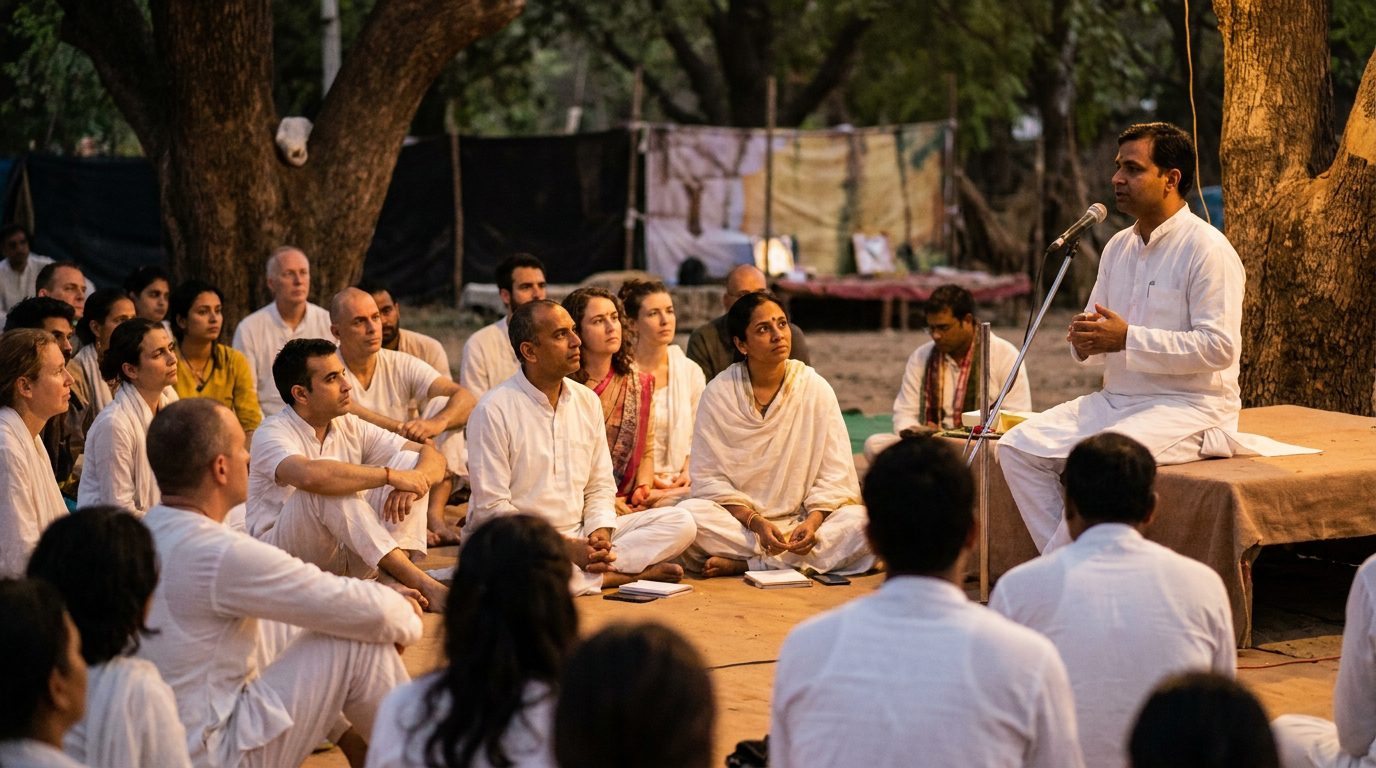
A satsang is a sacred gathering where people come together to remember God, hear spiritual wisdom, chant holy names, pray, reflect, and grow in loving community.
The word satsang comes from Sanskrit. Sat means “truth,” “eternal reality,” or “that which is spiritually real.” Sang means “association” or “company.” So, satsang means “the company of truth” or “gathering with those who are seeking the Divine.”
In the Bhakti Yoga tradition, satsang is not only a meeting or event. It is a loving space where the heart is invited to soften. It is a place where we can pause from the noise of daily life and reconnect with what matters most: our relationship with God, with one another, and with our own soul.
You do not need to be Hindu, Indian, religious, or experienced in yoga to attend a satsang. You do not need to know Sanskrit, understand philosophy, or have any particular background. Satsang is for sincere seekers from all walks of life.
Some people come with deep faith. Some come with questions. Some come carrying grief, uncertainty, or spiritual hunger. Some simply come because they feel drawn to chanting or peaceful community.
All are welcome.
At its heart, satsang is a practical expression of Bhakti Yoga, the path of love and devotion. In Bhakti, we approach spiritual life not as a performance, but as a relationship. We learn to offer our voice, our time, our service, our prayers, and our hearts to God.
The Heart of Satsang in Bhakti Yoga
Satsang as Spiritual Association
In Bhakti Yoga, spiritual association is considered very powerful. The people we spend time with influence our thoughts, desires, habits, and direction in life.
The ancient Bhakti scriptures repeatedly encourage seekers to keep company with those who inspire remembrance of God. In the Bhagavad Gita, Lord Krishna teaches that when we absorb our minds in Him and lovingly share spiritual wisdom with one another, we experience joy and nourishment.
In Bhagavad Gita 10.9, Krishna says:
“The thoughts of My devotees dwell in Me, their lives are surrendered to Me, and they derive great satisfaction and bliss from enlightening one another and conversing about Me.”
This verse beautifully describes the mood of satsang. People gather not to impress each other, debate endlessly, or escape life, but to remember the Divine together. Through sacred sound, wisdom, and loving connection, the heart becomes uplifted.
Why Community Matters on the Spiritual Path
Spiritual growth can feel difficult when we try to walk alone. The world offers many distractions, and the mind can easily become restless, doubtful, or discouraged.
Satsang gives us support.
When we chant with others, our own prayer becomes stronger. When we hear someone share sincerely, our own faith may awaken. When we serve alongside others, we remember that devotion is not separate from daily life. When we see people trying to live with compassion, humility, and faith, we feel encouraged to keep going.
Community does not mean everyone is perfect. A satsang is not a gathering of flawless people. It is a gathering of people who are practicing, learning, and growing. We come as we are, and by grace, we leave a little more connected, a little more peaceful, and a little more willing to love.
The Mood of Bhakti
The word bhakti means devotion, love, or loving service to God. Bhakti Yoga is the path of awakening that love through practices such as chanting, prayer, hearing sacred wisdom, serving others, worship, and remembering the Divine throughout the day.
A satsang carries this mood of bhakti. It is not dry religion. It is not only intellectual study. It is not simply music or meditation. It is a living, devotional environment where the mind, heart, body, and soul are all invited into relationship with God.
In Bhakti, God is not seen as distant or impersonal only. God is also understood as loving, personal, and deeply near. Different traditions may use different names for God—Krishna, Rama, Vishnu, Radha, Govinda, Allah, Yahweh, Christ, the Divine Mother, the Supreme, the Beloved. In a Bhakti satsang, we honor the sincerity of each person’s journey while sharing practices rooted in the Bhakti tradition.
What Usually Happens at a Satsang?
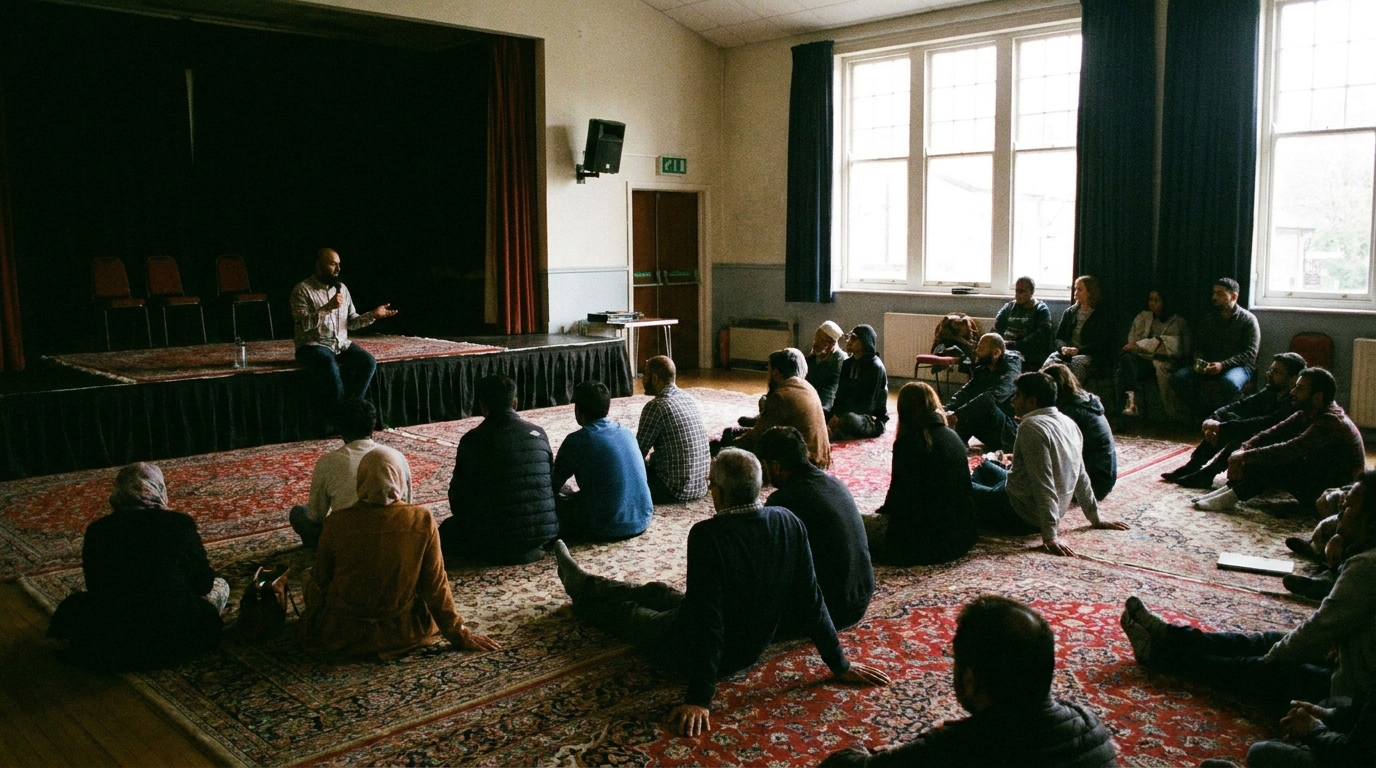
Every satsang may look a little different depending on the community, teacher, temple, home, or ashram hosting it. Still, most Bhakti satsangs include several common elements: welcoming, chanting, spiritual discussion, prayer, service, and often sacred food.
A Warm Welcome and Settling In
When you arrive at a satsang, you may be greeted by friendly hosts or community members. Some gatherings take place in yoga studios, temples, homes, meditation spaces, or community centers. You may see an altar with pictures or sacred forms of Krishna, Radha, Rama, saints, teachers, or spiritual symbols.
If you are new, it is normal to feel unsure. You might wonder where to sit, whether you need to bow, how to participate, or if you will understand what is happening.
Please know: it is completely okay to simply observe.
In many Bhakti spaces, people sit on cushions, mats, or chairs. Shoes may be removed before entering a sacred space. There may be flowers, incense, candles, instruments, or scripture books. The atmosphere is often peaceful, joyful, and devotional.
You do not have to pretend to know anything. A sincere heart is enough.
Kirtan: Chanting the Holy Names
One of the most beloved parts of satsang is kirtan, which means devotional chanting, often in a call-and-response style.
A leader sings a mantra, and the group responds. Instruments such as harmonium, mridanga drum, kartals, guitar, or hand cymbals may accompany the chanting. Sometimes the kirtan is soft and meditative. Sometimes it becomes joyful and energetic. People may clap, sway, dance, or simply sit quietly with eyes closed.
A mantra is a sacred sound or prayer that helps focus the mind and awaken the heart. In Bhakti Yoga, the most common mantra is the Maha Mantra:
Hare Krishna Hare Krishna
Krishna Krishna Hare Hare
Hare Rama Hare Rama
Rama Rama Hare Hare
Maha means “great,” so the Maha Mantra is known as the “great mantra.” It is a prayer calling upon God through the names Hare, Krishna, and Rama.
A simple meaning is: “O Divine Energy of the Lord, O all-attractive Lord, O source of spiritual joy, please engage me in Your loving service.”
You do not need to have perfect pronunciation. You do not need a trained singing voice. Kirtan is not a performance. It is prayer through sound. The beauty is in sincerity.
Japa: Personal Meditation with Mantra
Some satsangs may also include japa, which is personal mantra meditation. In japa, a person softly repeats a mantra, often using prayer beads called mala or japa beads.
While kirtan is communal chanting, japa is more personal and inward. Both are important in Bhakti Yoga. Kirtan helps us chant together in shared devotion, and japa helps us cultivate a private, steady relationship with God.
A teacher or host may guide the group in a few minutes of mantra meditation, especially if the satsang is designed for beginners. If you do not have beads, you can simply listen or repeat the mantra quietly in your heart.
Sure, here is the sentence with the clickable link:
Check out our latest posts on posts.
Hearing Sacred Wisdom
A Talk from Scripture
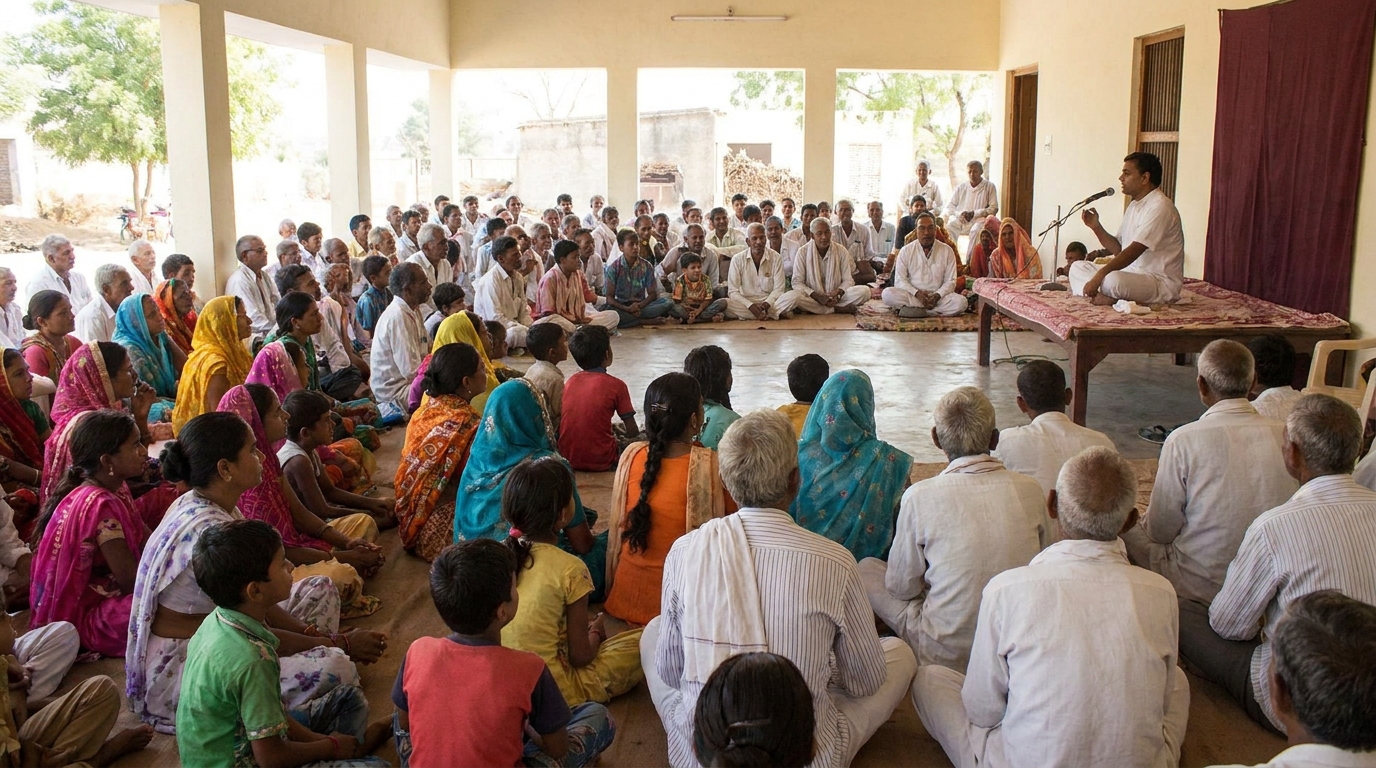
Most satsangs include a spiritual talk or discussion based on Bhakti scriptures. These may include the Bhagavad Gita, Srimad Bhagavatam, Bhakti-rasamrita-sindhu, or teachings of saints such as Srila Prabhupada, Chaitanya Mahaprabhu, Mirabai, Tulsidas, Narada Muni, and many others.
Scripture in Bhakti is not meant to be merely academic. It is meant to be lived. A good satsang helps us understand how ancient wisdom can guide our modern lives—our relationships, work, emotions, struggles, choices, and spiritual practice.
For example, in the Bhagavad Gita, Krishna teaches Arjuna in the middle of a battlefield. This setting reminds us that spiritual life is not separate from real life. We may not be standing on a literal battlefield, but we face inner battles every day: fear, anger, doubt, selfishness, distraction, loneliness, and confusion.
Satsang helps us remember that God is present with us in those battles.
Questions and Honest Reflection
Many satsangs include time for questions, sharing, or reflection. You may hear people ask about karma, prayer, relationships, suffering, spiritual discipline, chanting, or how to apply Bhakti in family life.
A healthy satsang welcomes sincere questions. Doubt is not the enemy of devotion when it is approached humbly. Questions can become doorways to deeper understanding.
You might ask:
- How do I begin a chanting practice?
- What if I do not feel devotion yet?
- Can I practice Bhakti Yoga if I come from another faith background?
- How do I serve God in ordinary daily life?
- Why do we chant Sanskrit mantras?
- What does surrender really mean?
In Bhakti, spiritual growth is gradual. We learn by hearing, asking, practicing, and receiving grace.
Practical Teachings for Daily Life
A satsang is not meant to stay only in the room where it happens. The purpose is to help us live with more love, awareness, humility, and devotion.
A speaker may offer practical reflections such as:
- Begin your day with a simple prayer.
- Chant one round or even one minute of mantra with sincerity.
- Offer your food to God before eating.
- Speak more kindly.
- Serve someone without expecting recognition.
- Read a few verses of sacred wisdom each day.
- Remember that every person is a soul, beloved by God.
These small practices can transform ordinary life into a path of devotion.
Prayer, Offering, and Worship
Simple Prayer from the Heart
Satsang often includes prayer. Sometimes prayers are sung in Sanskrit. Sometimes they are spoken in English. Sometimes the whole group may sit quietly and offer personal prayers within the heart.
Prayer does not have to be complicated. In Bhakti Yoga, prayer is honest communication with God.
You might pray:
“Please help me remember You.”
“Please guide me.”
“Please make my heart softer.”
“Please let me serve with love.”
“Please help me forgive.”
“Please accept this small offering.”
The Srimad Bhagavatam teaches that sincere hearing and chanting about God purifies the heart. This purification is not about becoming harsh or judgmental. It means that the dust covering our natural love begins to clear. We become more compassionate, more truthful, and more willing to live in harmony with the Divine.
Arati: Offering Light to the Divine
Some satsangs include arati, a devotional ceremony where offerings such as incense, lamp, water, flowers, and sound are offered before the Lord.
The word arati refers to worship through offerings, especially the waving of a lamp. It can be very beautiful to witness. Bells may ring, devotees may sing, and a flame may be offered to sacred images or deities of God.
For newcomers, arati can feel unfamiliar, but its meaning is simple and tender. We are offering the elements of creation back to their source. We are saying, “Everything belongs to You. My life, my senses, my home, my time, my heart—let these be offered in love.”
At the end of arati, the lamp may be brought around, and people may place their hands over the flame and touch their hands to their head or heart. This is a way of receiving the blessing, or prasada, of the offering.
Prasada: Receiving Grace
The word prasada means “mercy” or “grace.” In Bhakti communities, prasada often refers to vegetarian food that has been lovingly prepared and offered to God before being shared.
Many satsangs end with prasada. This may be a full meal, a simple sweet, fruit, tea, or a small snack.
Eating prasada is not just eating. It is receiving. The food has been prepared with devotion, offered with prayer, and shared as a blessing. In the Bhagavad Gita 9.26, Krishna says:
“If one offers Me with love and devotion a leaf, a flower, fruit, or water, I will accept it.”
This verse shows the heart of Bhakti. God is not asking for wealth or grandeur. He is asking for love. Even a leaf or a little water becomes sacred when offered sincerely.
The Role of Music, Mantra, and Sacred Sound
Why Chanting Is So Central
Chanting is central to Bhakti Yoga because sound touches the heart deeply. We may struggle to control the mind through willpower alone, but sacred sound gives the mind a beautiful place to rest.
In the Bhakti tradition, God’s names are understood to be non-different from God. This means that when we chant divine names, we are not merely making sound; we are entering spiritual contact.
Chaitanya Mahaprabhu, a great saint who spread the chanting of Krishna’s names widely, taught that the holy name cleanses the mirror of the heart. This image is simple and powerful. The heart is like a mirror, but it becomes covered by dust—ego, fear, distraction, selfish desires, and old wounds. Chanting gently clears that dust so we can see ourselves and God more clearly.
You Do Not Need to Be Musical
Many people worry: “What if I cannot sing?”
Please do not worry.
Kirtan is not about musical talent. It is about participation, listening, and intention. Some people sing loudly. Some whisper. Some just listen. Some cry. Some smile. Some feel nothing at first, and that is okay too.
In Bhakti, even listening to the holy names is spiritually nourishing. If you are tired, grieving, shy, or unsure, you can simply let the sound wash over you.
The Healing Power of Repetition
Modern life often pulls the mind in many directions. We scroll, compare, rush, plan, regret, and worry. Mantra brings us back.
Repeating a sacred name again and again is not empty repetition. It is like returning home. Each repetition is another gentle knock on the door of the heart.
Over time, chanting can bring peace, clarity, humility, joy, and strength. It can help us become less reactive and more prayerful. It can help us remember that we are not alone.
Service: Love in Action
Seva: Devotional Service
Another important part of satsang is seva, which means service. In Bhakti Yoga, love is not only a feeling. Love becomes action.
Seva may look very simple:
- Setting up chairs
- Cooking prasada
- Cleaning the space
- Welcoming guests
- Playing instruments
- Washing dishes
- Offering flowers
- Helping children
- Donating time or resources
- Listening kindly to someone who is struggling
No service is too small when done with devotion.
Bhakti scriptures explain that serving God and serving God’s children purifies the heart. It helps us move away from “How can I be seen?” toward “How can I be useful?” This shift is deeply healing.
Everyone Has Something to Offer
Sometimes people think, “I am too new to serve,” or “I do not know enough.” But service does not require expertise. It requires willingness.
Maybe your first service is simply showing up with respect. Maybe it is helping put away cushions. Maybe it is bringing fruit. Maybe it is smiling at someone who looks nervous. Maybe it is praying for the well-being of the community.
In Bhakti, God sees the heart behind the offering.
The offering itself may appear small, but if it is given with love, it becomes spiritually meaningful.
Service Beyond the Satsang Room
A true satsang inspires service beyond the gathering. After chanting and hearing wisdom, we return to our homes, workplaces, families, and neighborhoods with a renewed intention to live differently.
We may ask:
- How can I speak with more kindness?
- How can I make my work an offering?
- How can I care for my family with devotion rather than resentment?
- How can I use my gifts to serve others?
- How can I remember God in ordinary moments?
Bhakti Yoga is practical. It meets us in the kitchen, the car, the office, the hospital room, the classroom, and the quiet hours of the night.
What Should You Expect If You Are New?
Come As You Are
If you are attending your first satsang, the most important thing to know is this: you are welcome as you are.
You do not need special clothing, though modest and comfortable clothing is helpful. You do not need to bring anything, though some people like to bring flowers, fruit, or a donation if they feel inspired. You do not need to know the songs. You do not need to understand every word.
Just come with openness.
If you are from another spiritual tradition, you do not have to abandon your background to appreciate satsang. Many people experience Bhakti practices as a way to deepen their love for God, prayer, and service, while honoring the faith journey that brought them here.
Participate at Your Own Pace
At a satsang, you may be invited to chant, clap, stand, bow, dance, read, or share. You can participate at the level that feels sincere and comfortable.
If you do not want to sing, you can listen.
If you do not know how to bow, you can simply place your hands at your heart.
If you do not understand a ritual, you can quietly observe.
If emotions come up, let them be held gently. Sacred spaces can sometimes open the heart in unexpected ways.
There is no need to force anything.
Ask Questions Humbly
If something feels confusing, ask someone kind and experienced. Most Bhakti communities are happy to explain.
You might ask:
“What does this mantra mean?”
“Why do people bow?”
“What is the meaning of the altar?”
“How can I start chanting at home?”
“Is there a book you recommend for beginners?”
Questions asked with sincerity are part of spiritual growth.
How Satsang Supports Spiritual Growth
It Helps Cleanse the Heart
Bhakti Yoga teaches that the soul is naturally loving, joyful, and connected to God. But our awareness becomes covered by many layers—stress, ego, fear, material desires, and forgetfulness.
Satsang helps cleanse the heart through sacred sound, wisdom, prayer, and service. This cleansing is often gradual. We may not become peaceful overnight. But with regular association, something begins to shift.
We may notice we are less lonely.
We may feel drawn to pray more.
We may become more aware of our habits.
We may forgive more easily.
We may feel nourished by spiritual practice instead of only external success.
This is growth.
It Gives Strength During Difficult Times
Life brings challenges to everyone. Satsang does not promise that pain will disappear. But it offers spiritual strength and loving support.
When we are grieving, satsang reminds us that the soul is eternal.
When we are anxious, chanting gives the mind a sacred anchor.
When we are confused, scripture offers guidance.
When we feel unworthy, devotional community reminds us that God’s mercy is greater than our weakness.
The Bhagavad Gita teaches that the soul is not destroyed by the changes of the body. This wisdom can bring comfort during loss and change. Bhakti adds another layer: not only are we eternal souls, but we are loved by God and invited into a relationship of service and devotion.
It Awakens Love for God
The ultimate purpose of satsang is not simply relaxation, cultural experience, or social connection—though these may also be present. The deeper purpose is to awaken love for God.
This love may begin quietly. Perhaps as a moment of peace during kirtan. A tear during prayer. A sentence from scripture that feels personally meant for you. A desire to become kinder. A feeling of gratitude while receiving prasada.
Bhakti grows through sincere practice. Like a seed watered regularly, devotion gradually takes root and blossoms.
Bringing Satsang Into Your Daily Life
Create a Small Sacred Space
You can bring the spirit of satsang into your home. A small sacred space can help you remember God daily.
It may include:
- A picture of Krishna, Radha, Rama, Jesus, a saint, or a sacred symbol meaningful to you
- A candle or lamp
- Fresh flowers
- A scripture or prayer book
- Japa beads
- A clean cloth
- A small offering bowl
This space does not need to be elaborate. Even a simple corner can become sacred when approached with love.
Begin with a Simple Practice
If you are new to Bhakti Yoga, start small and steady. You might choose one daily practice:
- Chant the Maha Mantra for five minutes.
- Read one verse from the Bhagavad Gita.
- Offer your food with a short prayer.
- Listen to kirtan while cooking or driving.
- Begin the day by saying, “God, please guide me today.”
- End the day with gratitude.
The goal is not perfection. The goal is connection.
Keep Good Association
Try to attend satsang regularly if you can. Spiritual association helps us stay inspired. If you cannot attend in person, you may join online satsangs, listen to kirtan recordings, read Bhakti books, or connect with sincere practitioners.
But whenever possible, gather with others. There is a special grace in chanting together, hearing together, serving together, and sharing prasada together.
We are strengthened by one another.
Common Questions About Satsang
Do I Have to Be Religious to Attend?
No. You can attend satsang if you are religious, spiritual, curious, uncertain, or simply seeking peace. Satsang is a welcoming space for sincere exploration.
Bhakti Yoga is rooted in devotion to God, and the practices are offered in that spirit. But you are not pressured to believe everything immediately. You are invited to experience, reflect, and take what helps you move closer to truth, love, and God.
Is Satsang the Same as a Yoga Class?
Not exactly. Many people know yoga as physical postures, or asana. Bhakti Yoga focuses on devotion. A satsang usually does not center on exercise or stretching. Instead, it centers on chanting, wisdom, prayer, service, and community.
Both can support spiritual well-being, but satsang is especially meant to nourish the heart and awaken love for the Divine.
What If I Feel Emotional During Kirtan?
That is completely okay. Sacred chanting can touch deep places within us. Some people feel joy, peace, sadness, longing, gratitude, or release.
You do not need to analyze it too much. Let the experience be held in prayer. Tears in devotional practice are often seen as a sign that the heart is softening.
Can Children Come to Satsang?
In many communities, yes. Children are often welcomed into Bhakti gatherings. They may enjoy the music, dancing, prasada, and loving atmosphere. Some satsangs may have specific family programs or children’s activities.
It is helpful to check with the organizers if you are unsure.
What Should I Bring?
You can bring yourself. That is enough.
If you wish, you may bring:
- A notebook
- A water bottle
- Comfortable clothing
- Flowers or fruit as an offering
- A donation to support the gathering
- An open heart
But none of these are required. Sincerity is the real offering.
The Blessing of Gathering Together
A satsang is a sacred pause in the middle of life. It is a place to breathe, chant, listen, pray, serve, and remember that we are souls on a journey back to love.
In a world that often teaches us to compete, satsang teaches us to serve.
In a world that often keeps us distracted, satsang helps us remember.
In a world that can feel lonely, satsang gives us spiritual family.
In a world where many hearts are tired, satsang offers the healing sound of God’s names.
The Bhakti tradition reminds us that God is not far away. The Divine is present in the holy name, in sacred wisdom, in the offering of food, in the heart of every living being, and in the sincere gathering of seekers.
If you have never attended a satsang before, you do not need to wait until you feel ready, pure, knowledgeable, or spiritually advanced. Just come gently. Sit. Listen. Chant if you can. Receive. Ask. Serve in some small way.
Bhakti begins with one sincere step.
Everyone is welcome—wherever you come from, whatever you carry, and however much or little you know. May your next step toward satsang be a step toward peace, love, and a deeper relationship with God.
FAQs
What is a Satsang?
A Satsang is a gathering or meeting where individuals come together to engage in spiritual discourse, meditation, chanting, and singing.
What happens at a Satsang?
At a Satsang, participants engage in spiritual discussions led by a spiritual leader or teacher. There may also be meditation, chanting, singing, and sometimes silent contemplation.
What is the purpose of a Satsang?
The purpose of a Satsang is to create a supportive and uplifting environment for individuals to deepen their spiritual practice, gain spiritual knowledge, and connect with like-minded individuals on a spiritual path.
Who can attend a Satsang?
Satsangs are typically open to anyone who is interested in spirituality, regardless of their religious or spiritual background. People from all walks of life are welcome to attend and participate.
Are there any specific rules or etiquette to follow at a Satsang?
While specific rules may vary depending on the Satsang, common etiquette includes being respectful, attentive, and open-minded during the discussions and practices. It is also customary to dress modestly and to maintain a quiet and peaceful atmosphere during the gathering.

