
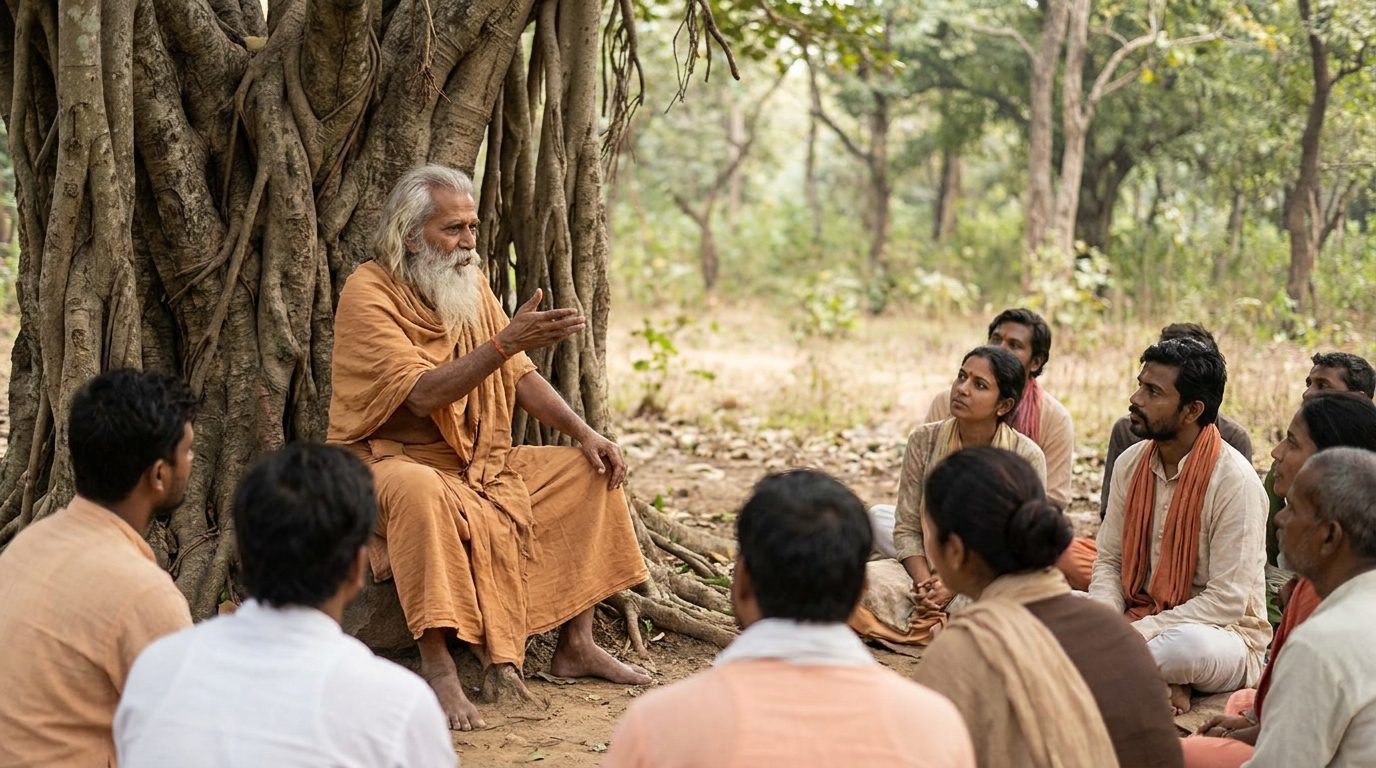
There are moments in history when the Divine chooses to speak through a soul so pure, so utterly free from worldly attachment, that every word carries the fragrance of the spiritual world. Śukadeva Gosvāmī is one such soul. His teachings, delivered over the course of seven days to the devoted King Parīkṣit, form the heart of the Śrīmad-Bhāgavatam — one of the most treasured scriptures in the Bhakti tradition.
Whether you are brand new to spiritual life or have been walking this path for many years, the words of Śukadeva Gosvāmī hold something precious for you. His teachings are not dry philosophy. They are an outpouring of love, a roadmap for the soul longing to return home to God.
Let us sit together, as if at his feet, and explore what this extraordinary teacher shared with the world.
Śukadeva Gosvāmī is the son of Vyāsadeva, the great sage who compiled the Vedic scriptures. But Śukadeva was no ordinary child. Even from birth, he was completely self-realized — detached from the material world and absorbed in spiritual consciousness. He had no desire for fame, wealth, or even a home. He wandered freely, appearing to the world like a madman, but inwardly he was swimming in an ocean of divine bliss.
A Soul Beyond Material Attachment
What makes Śukadeva so special as a teacher is precisely this freedom. He had nothing to gain from speaking. He had no students to impress, no institution to build, no reputation to protect. When he finally chose to speak the Śrīmad-Bhāgavatam, it was purely out of compassion and out of the irresistible sweetness of Lord Kṛṣṇa’s pastimes.
The Śrīmad-Bhāgavatam itself describes his unique position:
> “Śrīla Śukadeva Gosvāmī was already on the path of self-realization, and thus he was pleased with his own self. So why did he take the trouble to undergo the study of such a vast literature?”
> — Śrīmad-Bhāgavatam 1.7.1 (vedabase.io)
The answer is beautiful: even a liberated soul becomes attracted to the qualities and pastimes of the Supreme Lord. The sweetness of Kṛṣṇa’s love is so powerful that it draws even those who have no material needs whatsoever. This tells us something profound — Bhakti, or devotional love, is not just a means to an end. It is the ultimate end itself.
The Perfect Speaker for the Perfect Listener
When King Parīkṣit was cursed to die within seven days, he renounced his kingdom, sat on the bank of the Ganges, and asked the most important question any human being can ask: “What should a person do who is about to die?” By divine arrangement, Śukadeva Gosvāmī arrived to answer him.
This pairing — the perfectly surrendered listener and the perfectly liberated speaker — created the sacred setting for the Śrīmad-Bhāgavatam to be spoken. It reminds us that spiritual knowledge flows most powerfully when both the teacher and the student are sincere.
The Central Message: Love of God Is the Highest Goal
At the heart of everything Śukadeva Gosvāmī teaches is a single, radiant truth: the purpose of human life is to awaken our dormant love for God. Not just to know about God, not just to fear God, but to genuinely, tenderly, wholeheartedly love God.
This is the essence of Bhakti Yoga — the yoga of love and devotion. It is the simplest and most accessible path, open to every single person regardless of background, education, or past mistakes.
Beyond Liberation
One of the most revolutionary aspects of Śukadeva’s teaching is that he places pure devotion above even liberation (mokṣa — freedom from the cycle of birth and death). Many spiritual traditions teach that liberation is the highest goal. But Śukadeva Gosvāmī reveals something higher: prema, or pure love of God.
He describes this beautifully:
> “Pure devotees, who have no desire for self-benefit, do not even accept the five kinds of liberation, even when offered by the Supreme Lord.”
> — Śrīmad-Bhāgavatam 3.29.13 (vedabase.io)
Why would someone refuse liberation? Because a pure devotee finds so much joy in serving and loving God that they don’t want anything else — not even freedom from suffering. This is the extraordinary depth of Bhakti.
For us in our daily lives, this means that our spiritual practice doesn’t have to be motivated by fear or by wanting to escape something. It can be motivated by something far more beautiful — simple, sincere love.
Chanting as the Path
Śukadeva Gosvāmī repeatedly emphasizes the power of hearing about and chanting the names and glories of the Lord. This practice, called śravaṇaṁ kīrtanaṁ (hearing and chanting), is the foundation of Bhakti Yoga.
He shares:
> “The Supreme Lord is so kind to the conditioned souls that if they call upon Him by speaking His holy name, even unintentionally or unwillingly, the Lord is inclined to destroy innumerable sinful reactions in their hearts.”
> — Śrīmad-Bhāgavatam 6.2.7 (vedabase.io)
This is such an encouraging teaching. You don’t have to be perfect to begin. You don’t have to chant with flawless concentration. Even one sincere utterance of God’s holy name — Hare Kṛṣṇa, Hare Rāma, or however you call upon the Divine — begins to purify the heart and draw you closer to the source of all love.
Practical Teachings for Everyday Spiritual Life
Śukadeva Gosvāmī’s teachings are not meant only for monks living in forests. They are for all of us — parents, students, workers, artists, anyone with a beating heart and a longing for something deeper.
The Nine Processes of Devotion
Within the Śrīmad-Bhāgavatam, we find the famous description of nine processes of devotional service, often quoted from the teachings of Prahlāda Mahārāja but echoed throughout Śukadeva’s narration:
> “Hearing and chanting about the transcendental holy name, form, qualities, paraphernalia and pastimes of Lord Viṣṇu, remembering them, serving the lotus feet of the Lord, offering the Lord respectful worship, offering prayers, becoming His servant, considering the Lord one’s best friend, and surrendering everything unto Him — these nine processes are accepted as pure devotional service.”
> — Śrīmad-Bhāgavatam 7.5.23 (vedabase.io)
Let’s make these practical:
- Hearing (Śravaṇam): Listen to spiritual talks, read sacred texts, or simply sit quietly and listen to devotional music (kīrtana).
- Chanting (Kīrtanam): Sing God’s names aloud. Join a chanting circle. Let your voice become a prayer.
- Remembering (Smaraṇam): Throughout your day, gently bring your mind back to God — while cooking, walking, or even waiting in line.
- Serving (Pāda-sevanam): Offer your daily actions as service to God. Cook with love, care for others with devotion.
- Worshiping (Arcanam): Create a small sacred space in your home. Light a candle, offer a flower, say a prayer.
- Praying (Vandanam): Speak to God from your heart. No fancy words needed — just honesty.
- Being a Servant (Dāsyam): Cultivate humility. Serve others selflessly, seeing every being as connected to God.
- Friendship (Sakhyam): Develop a personal, intimate relationship with the Divine. God is not distant — He is your dearest friend.
- Surrender (Ātma-nivedanam): Offer your whole self — your joys, struggles, hopes, and fears — to God’s loving care.
You don’t have to practice all nine at once. Even one, done with sincerity, can transform your life.
Check out our website for more articles: more articles.
The Story of Ajāmila: Grace Beyond Measure
One of the most beloved stories Śukadeva Gosvāmī narrates is the story of Ajāmila, found in the Sixth Canto of the Śrīmad-Bhāgavatam. This story is a powerful illustration of divine mercy and the extraordinary potency of the holy name.
A Life Gone Astray
Ajāmila was once a devout brāhmaṇa (a person dedicated to spiritual learning and practice). But through bad association, he fell into a life of dishonesty and moral failure. He abandoned his family, his duties, and his spiritual practices. By all material standards, he was lost.
Calling Out in the Final Moment
At the moment of death, overwhelmed with affection for his youngest son — whose name happened to be Nārāyaṇa, a name of God — Ajāmila called out, “Nārāyaṇa! Nārāyaṇa!”
Even though he was calling for his child and not consciously praying, the power of the holy name was so great that the messengers of Lord Viṣṇu arrived to protect him from being carried away to a place of suffering. He was given another chance, and he used that chance to fully dedicate himself to God.
What This Means for Us
This story is not an excuse to delay our spiritual life. Rather, it is a profound reassurance: no one is too fallen, too broken, or too far gone for God’s mercy. The holy name is so powerful, so full of grace, that it can reach us even in our darkest moments.
As Śukadeva Gosvāmī explains:
> “One who chants the holy name of the Lord is immediately freed from the reactions of unlimited sins, even if he chants indirectly, jokingly, for musical entertainment, or even neglectfully.”
> — Śrīmad-Bhāgavatam 6.2.14 (vedabase.io)
If this is the power of the name spoken carelessly, imagine what happens when we chant with love, attention, and devotion!
The Descriptions of Kṛṣṇa’s Pastimes: Nourishment for the Heart
Perhaps the most enchanting portions of Śukadeva Gosvāmī’s teachings are his descriptions of Lord Kṛṣṇa’s transcendental pastimes — His childhood adventures in Vṛndāvana, His playful interactions with the cowherd boys and gopīs (the devoted milkmaids), His lifting of Govardhana Hill, and His tender exchanges of love with His devotees.
Why Do Pastimes Matter?
In Bhakti Yoga, God is not an abstract concept or impersonal force. God is a person — the Supreme Person — with unlimited beauty, charm, kindness, and love. When we hear about Kṛṣṇa’s pastimes, our hearts are drawn toward Him naturally, the way a flower turns toward the sun.
Śukadeva Gosvāmī spoke these pastimes with such relish and absorption that the entire assembly of sages listening was transported into spiritual ecstasy. The Śrīmad-Bhāgavatam records:
> “Śrīmad-Bhāgavatam is the spotless Purāṇa. It is most dear to the Vaiṣṇavas because it describes the pure and supreme knowledge of the paramahaṁsas [the most elevated souls].”
> — Śrīmad-Bhāgavatam 12.13.18 (vedabase.io)
Hearing as a Devotional Practice
You don’t need to understand every detail of Vedic culture to benefit from these pastimes. Simply hearing them with an open heart is itself a powerful spiritual practice. Each story carries the energy of divine love. Each description of Kṛṣṇa’s smile, His flute-playing, or His care for His devotees plants seeds of devotion in our hearts — seeds that will grow in their own time.
Living the Teachings of Śukadeva Gosvāmī Today
Śukadeva Gosvāmī spoke thousands of years ago on the bank of the Ganges, but his words are alive and relevant right now — in your home, in your neighborhood, in whatever chapter of life you find yourself in.
Start Where You Are
You don’t need to renounce the world like Śukadeva did. You don’t need to be a scholar or a saint. Bhakti Yoga meets you exactly where you are. It asks only for sincerity.
Try chanting the Hare Kṛṣṇa mantra softly in the morning:
Hare Kṛṣṇa, Hare Kṛṣṇa, Kṛṣṇa Kṛṣṇa, Hare Hare / Hare Rāma, Hare Rāma, Rāma Rāma, Hare Hare
Read a verse from the Śrīmad-Bhāgavatam before bed. Offer your meal to God with a simple prayer of gratitude. Look for opportunities to serve others with kindness and without expectation.
Find Community
Śukadeva didn’t speak into a void. He spoke to a community gathered with shared intention. Spiritual growth blossoms beautifully in the company of like-hearted souls. Whether online or in person, finding a sangha (spiritual community) can support and inspire your journey in ways you might never expect.
Trust the Process
The path of Bhakti is gentle. It doesn’t demand perfection — it invites progress. Every sincere chant, every heartfelt prayer, every act of kindness offered in a spirit of devotion brings you one step closer to the love that has always been waiting for you.
You Are Welcome Here
The teachings of Śukadeva Gosvāmī carry a message that echoes across all traditions and all time: you are a spiritual being, deeply loved by God, and you have the capacity to love God in return. That love is your birthright.
No matter where you come from, no matter what you’ve been through, no matter how far away you feel from the Divine — you are welcome. You belong on this path. And the very fact that something in you is searching, reading, wondering — that itself is a sign of grace already at work in your life.
Take one sincere step today. Chant one name. Offer one prayer. Open your heart just a little. And trust that God, who is infinitely kind, will take a hundred steps toward you.
With love and encouragement from The Bhakti House — we are walking this path together. 🙏
FAQs
Who is Śukadeva Gosvāmī?
Śukadeva Gosvāmī is a revered sage and spiritual teacher in the Bhakti tradition of Hinduism. He is known for his profound knowledge of the Bhagavata Purana and is considered one of the greatest exponents of devotional service to Lord Krishna.
What is the significance of Śukadeva Gosvāmī in Hinduism?
Śukadeva Gosvāmī is highly respected for his teachings on the path of devotion (bhakti) and his ability to impart spiritual wisdom. His recitation of the Bhagavata Purana to King Parikshit is considered a pivotal moment in the text and has been revered for centuries.
What are some key teachings of Śukadeva Gosvāmī?
Śukadeva Gosvāmī’s teachings emphasize the importance of cultivating a loving relationship with Lord Krishna through devotional practices such as chanting, hearing and remembering the divine pastimes of the Lord. He also stresses the significance of detachment from material desires and the pursuit of spiritual knowledge.
What is the historical background of Śukadeva Gosvāmī?
Śukadeva Gosvāmī is believed to have lived during the time of the Mahabharata, approximately 5,000 years ago. He was the son of the sage Vyasa and is known for his renunciation and wisdom. His teachings were later recorded in the Bhagavata Purana.
How is Śukadeva Gosvāmī honored in the present day?
Śukadeva Gosvāmī is revered by followers of the Bhakti tradition, who study his teachings and celebrate his life through festivals and devotional gatherings. His wisdom continues to inspire spiritual seekers and practitioners of bhakti yoga around the world.

