Sunday Satsang & Feast
March 15, 2026 — The Bhakti House, Jackson, Michigan
On Friday, we realized we are not the body.
On Saturday, we contemplated the eternal nature of the soul.
Today we take the final and most important step.
Eternity alone is incomplete.
The soul is not merely eternal — it is relational.
Who are we eternally?
What is our constitutional identity?
Lord Caitanya answers this question directly in the Caitanya-caritāmṛta.
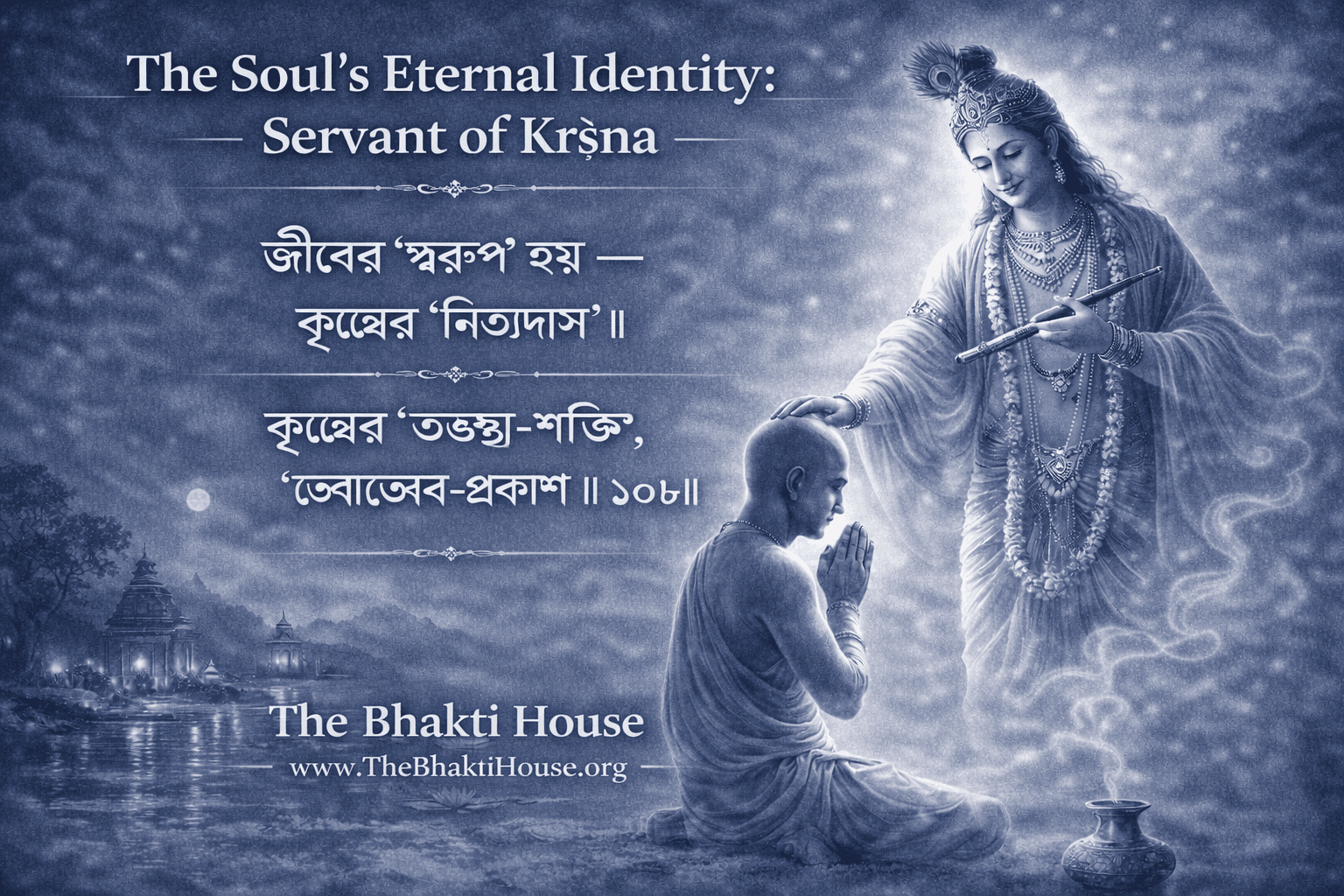
Caitanya-caritāmṛta Madhya 20.108 — The Constitutional Nature of the Soul
Devanāgarī
जीवेर स्वरूप हय — कृष्णेर नित्य-दास
कृष्णेर तटस्थ-शक्ति भेदाभेद-प्रकाश ॥
Bengali
জীবের স্বরূপ হয — কৃষ্ণের নিত্য-দাস
কৃষ্ণের তটস্থ-শক্তি ভেদাভেদ-প্রকাশ ॥
Roman Transliteration
jīvera svarūpa haya — kṛṣṇera nitya-dāsa
kṛṣṇera taṭasthā-śakti bhedābheda-prakāśa
Translation (Vedabase.io)
“It is the living entity’s constitutional position to be an eternal servant of Kṛṣṇa because he is the marginal energy of Kṛṣṇa and a manifestation simultaneously one with and different from the Lord, like a molecular particle of sunshine or fire. Kṛṣṇa has three varieties of energy.”
Theological Reflection
This single verse contains the essence of Gaudiya Vaiṣṇava theology.
The living entity’s constitutional identity (svarūpa) is to be an eternal servant of Kṛṣṇa.
Not temporarily.
Not metaphorically.
Eternally.
We are not independent enjoyers.
We are not isolated consciousness units floating aimlessly.
We are taṭasthā-śakti — marginal energy.
Simultaneously one with and different from Kṛṣṇa.
This is acintya-bhedābheda-tattva.
Why “Servant” Is Not Diminishing
In material consciousness, the word “servant” implies inferiority.
In spiritual reality, service is love expressed.
Consider:
The hand serves the body — not out of oppression, but harmony.
When the hand disconnects from the body, it loses nourishment.
Similarly, when the soul attempts to enjoy independently of Kṛṣṇa, it experiences suffering.
Service reconnects us to our source.
Service restores wholeness.
Supporting Verse: Śrīmad-Bhāgavatam 1.2.6
To deepen our understanding of pure devotional identity, we turn to Śrīmad-Bhāgavatam.
Devanāgarī
स वै पुंसां परो धर्मो
यतो भक्तिरधोक्षजे ।
अहैतुकी अप्रतिहता
ययाऽत्मा सुप्रसीदति ॥
Roman Transliteration
sa vai puṁsāṁ paro dharmo
yato bhaktir adhokṣaje
ahaitukī apratihatā
yayātmā suprasīdati
Translation (Vedabase.io)
“The supreme occupation [dharma] for all humanity is that by which men can attain to loving devotional service unto the transcendent Lord. Such devotional service must be unmotivated and uninterrupted to completely satisfy the self.”
Theological Reflection
The supreme occupation for all humanity is that which awakens loving devotional service unto the transcendent Lord.
Such devotion must be:
• Ahaitukī — without selfish motive
• Apratihatā — uninterrupted
When devotion reaches this level, the soul becomes fully satisfied.
Notice the phrase: yayā ātmā suprasīdati — the soul becomes completely satisfied.
Not the mind.
Not the ego.
The soul.
Why?
Because service aligns us with our eternal nature.
When identity and action align, peace emerges.
From Knowledge to Relationship
Weekend 2 has been progressive.
Friday: I am not the body.
Saturday: I am eternal.
Sunday: I am eternally related to Kṛṣṇa.
This transforms spiritual life from abstraction to intimacy.
If I am Kṛṣṇa’s eternal servant, then:
• Chanting becomes conversation.
• Prayer becomes relationship.
• Service becomes natural expression.
Bhakti is not performance.
It is identity in motion.
Practical Application for The Bhakti House
Today’s Satsang will focus on:
• Understanding service as love
• Identifying personal service inclinations
• Aligning talents with devotion
Discussion prompts:
- What service brings me closest to Kṛṣṇa?
- Where do I resist surrender?
- Do I still attempt to enjoy independently?
Tonight’s Feast reflects service in action.
Cooking is devotion.
Serving is devotion.
Cleaning is devotion.
Eating sanctified food together is devotion.
Community life becomes training in eternal identity.
The Shift From Ego to Service
Material life revolves around:
“What do I want?”
Spiritual life revolves around:
“How can I serve?”
This shift is subtle but revolutionary.
Ego says:
“I am the center.”
Bhakti says:
“Kṛṣṇa is the center.”
When Kṛṣṇa becomes the center, the heart relaxes.
Competition decreases.
Comparison fades.
Gratitude grows.
Service becomes joy.
Reflection Questions
- Do I still identify primarily as an independent enjoyer?
- What fears arise when I consider surrender?
- What practical service can I deepen this week?
- How can I make chanting relational rather than mechanical?
Assignment
For the next seven days:
Before chanting japa, say:
“O Kṛṣṇa, I am Your eternal servant. Please engage me in Your service.”
Mean it.
Let it reshape your consciousness.