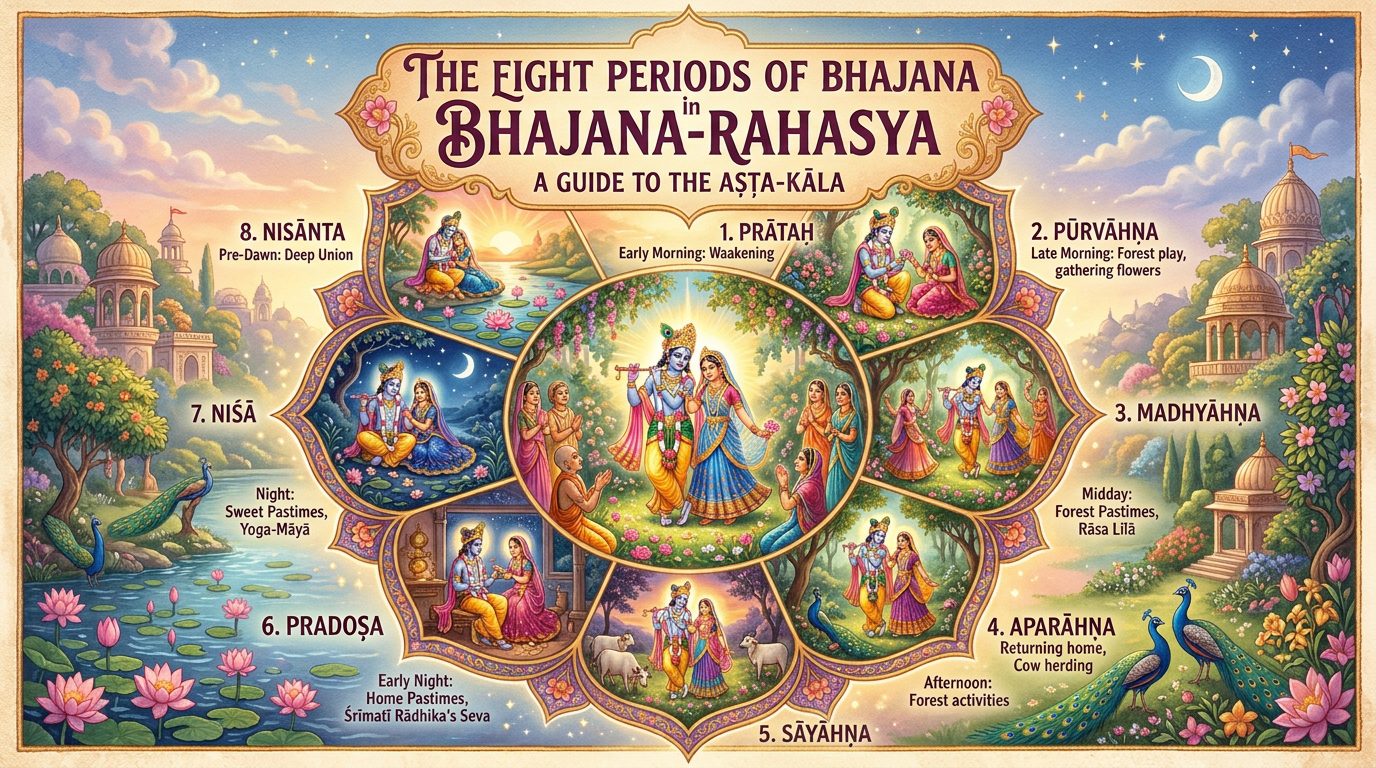
Short answer: Bhajana-rahasya is organized into eight chapters. Each chapter corresponds to one yāma, a period of roughly three hours, so that together they cover a full 24-hour day and night. This scheme is called the aṣṭa-kāla (“eight times”). In the sources reviewed, each period is linked to one verse of Śikṣāṣṭaka and to a stage of bhakti, moving from faith (śraddhā) toward love of God (prema). (See the Bhaktivinoda Institute’s Bhajana-rahasya topic page and the book overview.)
Key terms
- Bhajana: loving devotional practice and meditation directed toward Krishna.
- Yāma: a period of the day, about three hours.
- Aṣṭa-kāla: the “eight times” of the day and night, the scheme that organizes the book.
- Śikṣāṣṭaka: the eight verses of instruction attributed to Sri Caitanya Mahaprabhu.
- Anartha: an unwanted tendency or obstacle in the heart that hinders devotion.
The eight periods at a glance
The times below are approximate. Each period is paired with one verse of Śikṣāṣṭaka and one stage of bhakti, following the sources consulted. The chapter pages I could verify are linked where available.
- Niśānta-bhajana (end of night, about 3:30–6:00 A.M.): śraddhā, faith. See Chapter 1.
- Prātaḥ-kālīya-bhajana (morning or dawn, about 6:00–8:30 A.M.): removing anarthas in the association of sādhus (saintly devotees). See Chapter 2.
- Pūrvāhna-kālīya-bhajana (before noon, about 8:30–11:00 A.M.): niṣṭhā, steady determination. See Chapter 3.
- Madhyāhna-kālīya-bhajana (midday, about 11:00 A.M.–3:30 P.M.): ruci, spiritual taste. See Chapter 4.
- Aparāhna-kālīya-bhajana (afternoon, about 3:30–6:00 P.M.): kṛṣṇāsakti, attachment to Krishna. One source words this as attachment to bhajana and to the object of bhajana. This is Chapter 5.
- Sāyaṁ-kālīya-bhajana (dusk or twilight, about 6:00–8:30 P.M.): bhāva, the awakening of spiritual emotion. See Chapter 6.
- Pradoṣa-kālīya-bhajana (evening, about 8:30 P.M. to midnight): prema-vipralambha, love felt in separation. This is Chapter 7.
- Rātra-līlā (also written Rātri-līlā-bhajana; night, about midnight to 3:30 A.M.): prema-bhajana in union (sambhoga). See Chapter 8.
How the structure works
The sequence is both a clock and a map of spiritual growth. The first chapters correspond to the early stages familiar from the Gaudiya Vaishnava path: faith, association with devotees, the clearing of obstacles, and steadiness. Later chapters correspond to deeper stages: taste, attachment, spiritual emotion, and finally love of God, first felt in separation and then in union. The day therefore also serves as a symbolic outline of progress in devotion. That reading is my explanatory synthesis of the stage-by-stage correspondence given in the sources, not a separate claim made by them.
Because the eight chapters also correspond one-to-one with the eight verses of Śikṣāṣṭaka, the book can be read as a gradual unfolding of those verses across the course of a day.
Points of caution about the details
- The times are approximate. The sources describe the periods as roughly three hours each, but the clock times given for them are uneven. Midday, for example, spans a longer window (about 4.5 hours) than the early periods. Treat the hours as a general guide, not a strict timetable.
- Printed times vary. Some pages in the chapter sequence show mixed start and end times, such as 3:30 A.M. and 12:00 A.M. at the boundaries of the night chapters. The Chapter 7 page prints its end time as “12:00 P.M.”, which looks like a typo for midnight. I read it as 12:00 A.M. and did not check it further. For precise wording, consult the chapter text itself.
- Descriptions of the stages differ slightly. The fifth period is described in one source as attachment to Krishna and in another as attachment to bhajana and the object of bhajana. These are close in meaning, but the wording is not identical. Other sources also name some periods only loosely (for example “dawn” or “dusk”) without giving the stage in the same terms.
- I did not verify every chapter page. Direct links are given only for the chapters I could confirm. Chapters 5 and 7 are described here from the overview material, so check them in the full text through the book overview.
What this does and does not tell us
The eight-period outline tells us how Bhaktivinoda Thakura structured Bhajana-rahasya (a work attributed to him; see this introduction). It does not by itself prescribe a daily schedule for every reader, and the sources here do not establish who is ready to follow the later, more intimate meditations. The later chapters deal with advanced states of devotion. In the Gaudiya Vaishnava tradition, such meditations are generally approached with the guidance of qualified teachers and experienced practitioners.
Practical next steps for beginners
These are suggestions, not requirements. Many newcomers find it more helpful to begin with the foundations the early chapters point to: faith, good association, and steady basic practices such as chanting, prayer, reading and offering food. The Bhakti House article Bhajana-kriyā: Cultivating a Daily Bhakti Practice explains this stage of regular practice in accessible language. Reading Bhajana-rahasya slowly, one chapter at a time and in the company of experienced devotees, is a natural way to approach the book.
Conclusion
The eight periods of bhajana in Bhajana-rahasya are the eight yāmas of the day and night: niśānta (end of night), prātaḥ (morning), pūrvāhna (before noon), madhyāhna (midday), aparāhna (afternoon), sāyaṁ (twilight), pradoṣa (evening) and rātra-līlā (night). Each has its own chapter, its own verse of Śikṣāṣṭaka, and its own stage of bhakti, from faith through determination, taste, attachment and spiritual emotion to love in separation and in union. The clock times are approximate and differ slightly between pages, so the chapter texts are the best reference for exact wording. The structure is best understood as a map of devotional growth, to be approached step by step and with good guidance.
Recommended Reading
- Bhajana-kriyā: Cultivating a Daily Bhakti Practice (The Bhakti House)
Sources and References
- Bhaktivinoda Institute: Bhajana-rahasya topic page. Overview of the work.
- Bhaktivinoda Institute: Bhajana-rahasya book page. Book overview and chapter access.
- Chapter 1, Chapter 2, Chapter 3, Chapter 4, Chapter 6 and Chapter 8 at the Bhaktivinoda Institute. Primary text for the period names, approximate times and stage correspondences.
- Introduction to Bhajana-rahasya (isvara.org). Background on the work and its author.
- The Bhakti House: Bhajana-kriyā: Cultivating a Daily Bhakti Practice. Beginner-oriented context on daily devotional practice.