

Time and creation are two of the great mysteries that every thoughtful heart eventually meets.
Where did everything come from? Why does time move forward? Is life only a brief moment between birth and death, or is there a deeper purpose behind the journey?
In the Bhakti Yoga tradition, these questions are not asked only for philosophy. They are asked with humility, prayer, and longing. We seek to understand the world so that we may live in it with more love, wisdom, and devotion to God.
Bhakti Yoga, the yoga of loving devotion, offers a beautiful and practical vision of time and creation. It teaches that the universe is not random or meaningless. It is created, sustained, and transformed under the guidance of the Divine. It is a sacred field where the soul can learn, grow, remember God, and return to love.
The Sanskrit word bhakti means devotion or loving service. It is not limited to one background, nationality, or culture. Bhakti is the natural movement of the heart toward the Supreme Person, known in many traditions by many names. In the Bhakti scriptures, God is often called Krishna, which means “the all-attractive one.”
This guide welcomes everyone—new seekers, lifelong practitioners, people of faith, people with questions, and anyone who feels drawn toward a more sacred way of seeing time, life, and creation.
The Nature of Time in Bhakti Yoga
Time as a Sacred Energy
In Bhakti wisdom, time is not merely a clock on the wall or a calendar full of appointments. Time is understood as a powerful energy of God.
In Sanskrit, time is called kāla. Kāla moves everything forward. It brings birth, growth, maturity, decline, and transformation. Nothing material can escape the influence of time.
The Bhagavad-gītā, one of the central scriptures of Bhakti Yoga, describes time as one of the ways the Divine acts within the world. In Bhagavad-gītā 11.32, Krishna says, “Time I am, the great destroyer of the worlds.” This may sound intense at first, but it carries deep wisdom.
Time reminds us that material things are temporary. Bodies change. Seasons change. Relationships change. Success and struggle both come and go. But behind all these changes, the soul remains eternal, and God remains our constant shelter.
Time as a Teacher
Time teaches us humility.
We may make plans, but time reveals what is truly in our hands and what is not. We may try to hold on to beauty, youth, wealth, or position, but time gently—and sometimes strongly—shows us that nothing material can be possessed forever.
This is not meant to make us hopeless. Rather, it invites us to become wise.
When we understand time spiritually, we begin to ask better questions:
What is truly lasting?
How can I use my time meaningfully?
How can I love better today?
How can I remember God in the middle of ordinary life?
Bhakti Yoga teaches that time becomes sacred when we use it in service, prayer, chanting, study, compassion, and remembrance of God.
The Eternal Soul Beyond Time
The body lives within time, but the soul is eternal.
In Sanskrit, the soul is called ātman. The Bhagavad-gītā explains that the soul is never born and never dies. It cannot be destroyed by weapons, burned by fire, dried by wind, or drowned by water. The body changes from childhood to youth to old age, but the conscious self—the “I” within—continues.
This understanding brings comfort and responsibility.
We are not temporary bodies trying to have a spiritual experience. We are eternal souls having a temporary human experience, with the opportunity to awaken divine love.
The Bhakti View of Creation
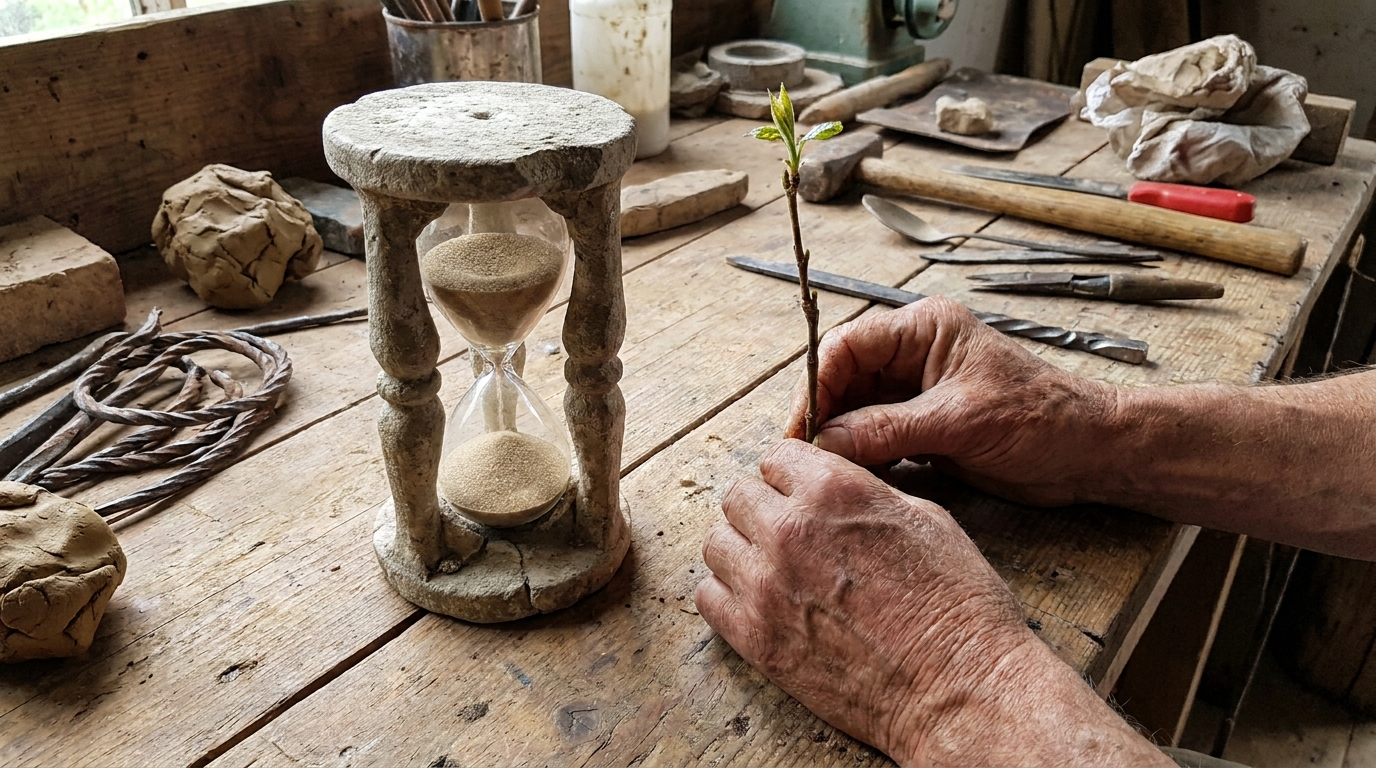
Creation Begins with the Supreme
Bhakti scriptures describe creation as coming from the Supreme Lord, not from emptiness or accident. The universe is understood as an expression of divine energy, guided by divine intelligence.
The Śrīmad-Bhāgavatam, a beloved Bhakti scripture also known as the Bhāgavata Purāṇa, offers profound descriptions of creation. It teaches that before the material universe appears, the Supreme Lord exists eternally. God is not created by the universe. Rather, the universe rests upon God’s energy.
This vision is deeply personal. Creation is not simply a machine. It is connected to a loving source.
In the Bhagavad-gītā 10.8, Krishna says, “I am the source of all spiritual and material worlds. Everything emanates from Me.” For a devotee, this verse is not only a philosophical statement. It is an invitation to see everything as connected to God.
The sun, the moon, the rivers, the trees, the earth, the breath within our lungs—all can become reminders of the Divine.
Material Energy and Spiritual Energy
Bhakti Yoga explains that God has many energies. Two important categories are material energy and spiritual energy.
Material energy is called prakṛti. It includes earth, water, fire, air, ether, mind, intelligence, and ego. These elements form the temporary world we experience through the senses.
Spiritual energy is eternal, conscious, and full of divine nature. The soul belongs to this spiritual energy. Though we currently live in the material world, our deepest identity is spiritual.
This is why material things alone never fully satisfy the heart. We may have comfort, entertainment, and achievements, yet still feel an inner longing. That longing is not a mistake. It is the soul’s memory of its relationship with God.
Creation as a Place for Growth
In Bhakti, the material world is not seen as evil. It is temporary, and it can be confusing when we forget God, but it is also a place of learning and awakening.
Creation becomes sacred when we use it in devotion.
Food becomes sacred when offered with love.
Music becomes sacred when used for chanting God’s names.
Work becomes sacred when done as service.
Relationships become sacred when centered in kindness, truth, and spiritual growth.
Time becomes sacred when used to remember and serve the Divine.
This is the heart of practical Bhakti Yoga.
Sure, here is the sentence with the clickable link:
I love to visit The Bhakti House for spiritual inspiration.
The Cycles of Creation, Maintenance, and Dissolution

A Cyclical Universe
Many modern people think of time as a straight line: beginning, middle, and end. Bhakti scriptures often describe time as cyclical.
The universe goes through repeated cycles of creation, maintenance, and dissolution. Creation appears, exists for a period, dissolves, and then is created again.
This cycle is not random. It unfolds under divine order.
In Sanskrit, creation is sometimes described with three functions:
- Sṛṣṭi — creation or manifestation
- Sthiti — maintenance or preservation
- Pralaya — dissolution or withdrawal
These cycles remind us that everything material has phases. A flower blooms and fades. A day begins and ends. A body is born and dies. Even universes arise and dissolve.
Yet the soul and God remain beyond these temporary changes.
The Role of Brahmā, Viṣṇu, and Śiva
Bhakti scriptures describe divine administration within the universe through great cosmic personalities.
Brahmā is associated with creation. He is the first created being within the universe and receives knowledge from the Supreme Lord to shape the cosmos.
Viṣṇu is associated with maintenance and preservation. In Bhakti Yoga, Viṣṇu is understood as a form of the Supreme Lord who lovingly sustains all beings.
Śiva is associated with dissolution and transformation. He helps bring the universe toward its ending phase so that creation may begin again.
These are not merely mythological symbols. They represent deep spiritual truths: everything manifests, is sustained for some time, and is eventually transformed.
Dissolution Is Not the End of the Soul
The idea of dissolution can feel frightening. But Bhakti wisdom reassures us that the eternal self is not destroyed.
When the body dies, the soul continues. When a universe dissolves, the souls continue. The journey of consciousness continues according to karma and divine arrangement.
Karma means action and reaction. It is the principle that our choices have consequences. Bhakti does not teach karma as a cold punishment system. Rather, it is a compassionate structure meant to educate the soul and gradually guide us toward wisdom.
Most importantly, Bhakti teaches that sincere devotion can transform karma. Through loving service, prayer, chanting, and surrender to God, the heart becomes purified, and the soul moves toward freedom.
The Vast Scale of Time in the Vedic Scriptures
Human Time and Cosmic Time
The Bhakti scriptures describe time on a scale much larger than ordinary human history. This can be humbling and awe-inspiring.
What feels long to us may be only a brief moment from a cosmic perspective. A human life may last eighty or ninety years, but cosmic cycles extend for vast ages.
These descriptions are not meant to make us feel small in a negative way. They help us see that the universe is grand, mysterious, and held within divine intelligence.
At the same time, Bhakti makes something very beautiful clear: even within this vast creation, every soul matters to God.
You are not lost in the universe. You are known. You are accompanied. Your sincere prayer is heard.
The Four Yugas
Vedic time is often described through four repeating ages called yugas. A yuga is a great age or era.
The four yugas are:
- Satya-yuga — an age of truth, spiritual clarity, and virtue
- Tretā-yuga — an age where virtue remains strong but begins to decline
- Dvāpara-yuga — an age of further spiritual decline but still with powerful sacred culture
- Kali-yuga — the current age, marked by confusion, conflict, distraction, and spiritual forgetfulness
According to Bhakti tradition, we are living in Kali-yuga. This age is challenging. People often feel anxious, divided, overworked, lonely, or spiritually disconnected.
But there is also a special blessing.
The scriptures teach that in Kali-yuga, the simplest and most powerful spiritual practice is chanting the holy names of God.
The Gift of Chanting in This Age
Chanting is called kīrtan when done together with music, and japa when done softly or personally, often on prayer beads. The Sanskrit word mantra means a sacred sound that frees and protects the mind.
One of the most loved mantras in the Bhakti tradition is the Hare Krishna maha-mantra:
Hare Krishna Hare Krishna
Krishna Krishna Hare Hare
Hare Rama Hare Rama
Rama Rama Hare Hare
“Maha-mantra” means “great mantra.” This chant is a prayer asking to be engaged in loving service to God.
You do not need to be perfect to chant. You do not need to understand everything before beginning. You can chant with sincerity, curiosity, or even a humble request: “God, please help me remember You.”
In a world where time feels rushed and the mind feels scattered, chanting brings the heart back to its eternal center.
Why Creation Exists
The Soul’s Freedom and Love
One of the deepest questions is: why did God create the world?
Bhakti Yoga explains that love requires freedom. The soul has a natural relationship with God, but love cannot be forced. The material world provides a place where souls who desire independence can experience life apart from direct awareness of God.
This independence is not permanent exile. It is part of a larger journey.
God accompanies every soul as the Paramātmā, the Supersoul, the divine presence within the heart. Paramātmā means “the Supreme Self,” the form of God who lovingly witnesses, guides, and waits for our turning.
The Lord does not abandon us. Even when we forget God, God does not forget us.
The World as a Classroom
Creation can be understood as a classroom for the soul.
Through joy, we learn gratitude.
Through loss, we learn detachment.
Through relationships, we learn forgiveness.
Through responsibility, we learn service.
Through suffering, we may begin to seek deeper shelter.
Through beauty, we may remember the source of all beauty.
This does not mean suffering is easy or that pain should be dismissed. Bhakti is not cold philosophy. It honors the reality of human struggle.
But Bhakti also offers hope: every experience can become part of our spiritual awakening when brought into relationship with God.
The Purpose Is Love
The final purpose of creation is not fear, achievement, or endless rebirth. The purpose is love.
The soul’s natural perfection is called prema, pure love of God. Prema is not ordinary emotion. It is the fully awakened state of the heart, where the soul lives in joyful, selfless loving relationship with the Divine.
All Bhakti practices are meant to awaken this love.
Chanting softens the heart.
Prayer opens the heart.
Scripture guides the heart.
Service purifies the heart.
Community supports the heart.
Grace transforms the heart.
Time, Karma, and Reincarnation
The Journey of the Soul
Bhakti scriptures teach reincarnation, the journey of the soul through many bodies. The Sanskrit word often used is saṁsāra, the cycle of birth and death.
Just as we pass through different stages in one lifetime—babyhood, childhood, adulthood, old age—the soul passes from one body to another. The Bhagavad-gītā 2.22 compares this to changing clothes: as a person puts on new garments and gives up old ones, the soul accepts new bodies and gives up old ones.
This teaching encourages us to live with compassion. Every living being is a soul on a journey. Humans, animals, and all creatures are part of God’s creation.
When we see others as souls, we naturally become more gentle.
Karma and Responsibility
Karma reminds us that our actions matter.
Our words matter.
Our choices matter.
Our intentions matter.
Our habits matter.
But karma is not meant to trap us in guilt. Bhakti Yoga offers a path beyond karma through devotion. When we act for God’s pleasure rather than selfish gain, our work becomes purified.
This is called karma-yoga, the yoga of offering our actions. In Bhakti, karma-yoga matures into loving service, or seva.
Seva means service offered with devotion. It can be as simple as cooking with love, helping someone in need, cleaning a sacred space, singing in kīrtan, caring for family, sharing wisdom, or offering your talents for a higher purpose.
Using Time Wisely
Because time is precious, Bhakti encourages us not to waste this human life.
The human form is considered especially valuable because it gives us the ability to ask spiritual questions, make conscious choices, and practice devotion.
This does not mean we must reject ordinary life. Rather, we spiritualize ordinary life.
We can begin the day with prayer.
We can chant while walking or driving.
We can offer our food before eating.
We can pause before speaking and choose kindness.
We can read a few verses of scripture.
We can serve our family, community, and world with humility.
We can remember God before resting at night.
Small sincere practices, done regularly, gradually transform the heart.
Creation and the Three Modes of Nature
Understanding the Guṇas
Bhakti scriptures explain that material nature works through three qualities called guṇas. Guṇa means “strand” or “quality.” These three modes influence our thoughts, emotions, habits, and environment.
They are:
- Sattva — goodness, clarity, harmony, wisdom
- Rajas — passion, ambition, restlessness, desire
- Tamas — ignorance, heaviness, confusion, inertia
These modes shape life in the material world. Sometimes we feel peaceful and clear. Sometimes restless and driven. Sometimes dull, discouraged, or stuck. The guṇas help us understand these inner movements without becoming hopeless.
Growing Toward Clarity
A Bhakti practitioner tries to cultivate sattva, or goodness, because it supports spiritual life. This may include clean habits, honest speech, nourishing food, sacred music, uplifting association, and study of scripture.
But Bhakti does not stop at goodness. The goal is to rise beyond all three modes through loving devotion.
The Bhagavad-gītā teaches that one who engages in steady devotional service can transcend the modes of nature and come to the spiritual platform.
This means that love of God is more powerful than our conditioning. We are not permanently defined by our past, our moods, or our struggles. By grace and practice, the heart can change.
Practical Ways to Spiritualize Daily Life
To live spiritually within creation, we can begin with simple practices:
Create a small sacred space in your home with a picture, candle, scripture, or prayer beads.
Chant a mantra for a few minutes each day.
Offer your food to God with gratitude before eating.
Read one verse from the Bhagavad-gītā or another sacred text and reflect on how it applies to your life.
Spend time with people who encourage your spiritual growth.
Serve someone without expecting recognition.
Notice nature as God’s energy and respond with care.
These practices bring timeless wisdom into real life.
The Spiritual World Beyond Material Creation
Beyond Birth and Death
Bhakti scriptures describe a spiritual reality beyond the temporary material universe. This realm is eternal, full of consciousness and bliss. In Sanskrit, it is sometimes called Vaikuṇṭha, meaning the place without anxiety, or Goloka Vṛndāvana, Krishna’s supreme abode of intimate love.
These descriptions are not meant as fantasy. They point to the soul’s true home, where love is not interrupted by time, fear, envy, or death.
In the material world, love is often mixed with insecurity. We fear losing those we love. We struggle with ego and misunderstanding. But in the spiritual world, love is pure, joyful, and ever-expanding.
God as a Person
A central teaching of Bhakti is that the ultimate truth is personal.
God is not less than us. If we have personality, love, beauty, creativity, and relationship, these qualities must exist perfectly in the source of everything.
Bhakti describes the Supreme as full of names, forms, qualities, and loving activities. Krishna is known as the all-attractive Lord, the friend of all beings, the source of beauty, wisdom, strength, and compassion.
This personal understanding allows devotion to become intimate. We do not only meditate on divine energy. We can speak to God, sing to God, serve God, remember God, and develop a loving relationship with God.
Returning Through Love
The way back to the spiritual world is not mechanical. It is not achieved by pride, scholarship alone, or external identity. It is awakened through sincere devotion.
Krishna says in the Bhagavad-gītā 18.66, “Abandon all varieties of dharma and simply surrender unto Me. I shall deliver you from all sinful reactions. Do not fear.”
This surrender does not mean becoming passive or losing oneself. It means offering the heart to the One who loves us completely. It means trusting God’s guidance while continuing to live responsibly, compassionately, and sincerely.
How to Live Devotionally in Time and Creation
Begin with Remembrance
The first step is remembrance.
We can remember that this day is a gift. This breath is a gift. This body is a temporary but sacred instrument. This world is God’s energy. The people we meet are souls. The time we have can be offered.
A simple morning prayer might be:
“Dear Lord, please guide me today. May my thoughts, words, and actions become pleasing to You. Please help me serve with humility and love.”
This prayer can change the mood of the whole day.
Chant with Sincerity
Chanting is one of the most accessible Bhakti practices.
You can chant the Hare Krishna mantra, or any sincere name of God from your tradition. The essential principle is to call upon the Divine with humility and openness.
Even five minutes of daily chanting can create a sacred rhythm. Over time, the holy name cleanses the heart, steadies the mind, and awakens devotion.
Chanting is not about performance. It is about relationship.
Serve with Love
Service is where devotion becomes visible.
We serve God by serving God’s children. We serve through kindness, hospitality, generosity, teaching, listening, cooking, cleaning, protecting nature, caring for animals, supporting spiritual community, and offering our skills.
In Bhakti, no sincere service is small.
A flower offered with love, a meal cooked with devotion, a floor swept in a temple, a kind word spoken to a hurting person—all can become offerings.
Study Sacred Wisdom
Scripture gives direction when the mind becomes confused.
The Bhagavad-gītā, Śrīmad-Bhāgavatam, and other Bhakti texts help us understand who we are, who God is, how the universe works, and how to live with purpose.
Reading even a little each day can nourish the soul. The goal is not to collect information but to invite transformation.
After reading, we can ask: “How can I live this today?”
Keep Devotional Association
Spiritual life becomes easier in loving community.
In Sanskrit, uplifting spiritual company is called sādhu-saṅga. A sādhu is a sincere spiritual person, and saṅga means association.
When we spend time with people who chant, pray, serve, and seek God, our own faith becomes strengthened. We remember what matters. We feel encouraged to continue.
The Bhakti path is personal, but it is not meant to be lonely.
The Hope of Bhakti in a Temporary World
Time moves quickly. Creation is vast. Life is uncertain.
But Bhakti Yoga offers a gentle and powerful hope: we can use this temporary life to awaken eternal love.
We do not need to master every detail of cosmic time before beginning. We do not need to become perfect before praying. We do not need to understand all mysteries before chanting the holy names.
We can begin where we are.
If we feel grateful, we can offer gratitude.
If we feel broken, we can offer our brokenness.
If we feel curious, we can offer our questions.
If we feel joyful, we can offer our song.
If we feel lost, we can ask to be guided.
God receives sincerity.
Creation is the sacred field. Time is the precious opportunity. The soul is the eternal traveler. Bhakti is the path of love. And the destination is a restored relationship with the Supreme Lord, who has been with us all along.
Wherever you come from, whatever your background, and however near or far you may feel from spiritual life, you are welcome. Take one sincere step toward God today—chant one mantra, say one prayer, offer one act of service, or open your heart for one honest moment. That step matters, and by grace, it can begin a beautiful journey home.
FAQs
What is the concept of time and creation?
The concept of time and creation refers to the philosophical and scientific exploration of the nature of time and the origins of the universe. It encompasses theories and ideas about the beginning of time, the creation of the universe, and the passage of time.
What are some theories about the creation of time and the universe?
Some theories about the creation of time and the universe include the Big Bang theory, which suggests that the universe began as a singularity and has been expanding ever since. Other theories include the multiverse theory, the cyclic universe theory, and various religious and mythological creation stories.
How do different cultures and religions view time and creation?
Different cultures and religions have their own beliefs and stories about the creation of time and the universe. These beliefs often shape the way people understand the passage of time and their place in the universe. For example, some cultures believe in a cyclical view of time, while others believe in a linear progression of time.
What are some current scientific understandings of time and creation?
Current scientific understandings of time and creation are based on theories and evidence from fields such as cosmology, physics, and astronomy. Scientists continue to explore the origins of the universe and the nature of time through experiments, observations, and theoretical models.
How does the concept of time and creation impact our understanding of the world?
The concept of time and creation has profound implications for our understanding of the world and our place in it. It shapes our understanding of the origins of the universe, the nature of reality, and the passage of time. It also influences our philosophical, religious, and scientific perspectives on existence.

