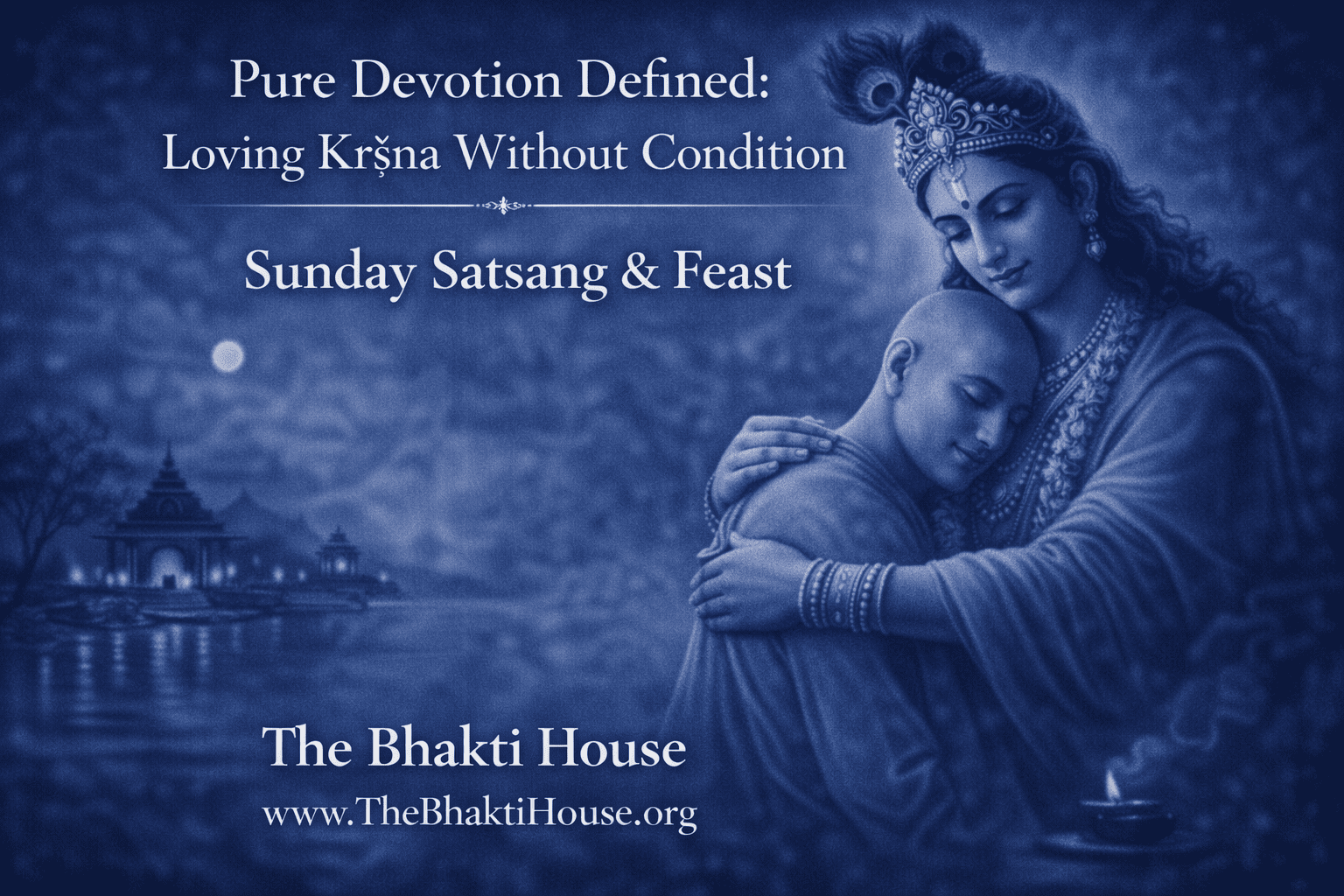
Sunday Satsang & Feast
March 29, 2026 — The Bhakti House, Jackson, Michigan
We have arrived at the culmination of our March journey.
Over the past four weekends, we have:
Awakened longing through chanting.
Realized we are not the body.
Established steady devotional discipline.
Learned to offer our actions and our hearts.
Now we ask the final question:
What is the goal of all this?
Not ritual.
Not identity alone.
Not even discipline.
The goal is pure love.
Today we anchor that goal scripturally.
Bhakti-rasāmṛta-sindhu 1.1.11 — The Definition of Pure Devotion
Devanāgarī
अन्याभिलाषिताशून्यं
ज्ञानकर्माद्यनावृतम् ।
आनुकूल्येन कृष्णानुशीलनं
भक्तिरुत्तमा ॥
Roman Transliteration
anyābhilāṣitā-śūnyam
jñāna-karmādy-anāvṛtam
ānukūlyena kṛṣṇānuśīlanaṁ
bhaktir uttamā
Translation (Vedabase.io)
“The highest bhakti is defined as continuous service or emotions directed towards Kṛṣṇa, His expansion forms or others related to Him, with a pleasing attitude towards Kṛṣṇa. It should be devoid of desires other than the desire to please the Lord, and unobstructed by impersonal jñāna, the materialistic rituals of karma or other unfavorable acts.”
Theological Reflection
This verse defines the summit of devotion.
Pure devotion is:
• Free from ulterior motives
• Uncovered by speculative knowledge
• Uncovered by fruitive ambition
• Performed favorably for Kṛṣṇa’s pleasure
Notice what is absent:
Self-centered desire.
Spiritual pride.
Hidden expectation.
Pure devotion does not ask:
“What do I get?”
It asks:
“What pleases You?”
This is the final refinement of surrender.
From Discipline to Love
Weekend 3 taught us steadiness.
Weekend 4 taught us offering.
But love is deeper than discipline and offering.
Discipline trains the mind.
Offering trains intention.
Love transforms identity.
When devotion becomes free from selfish desire, service becomes natural and joyful.
The soul recognizes its eternal alignment.
Supporting Verse: Śrīmad-Bhāgavatam 1.2.6
Let us anchor this in the Bhāgavatam once more.
Devanāgarī
स वै पुंसां परो धर्मो
यतो भक्तिरधोक्षजे ।
अहैतुकी अप्रतिहता
ययाऽत्मा सुप्रसीदति ॥
Roman Transliteration
sa vai puṁsāṁ paro dharmo
yato bhaktir adhokṣaje
ahaitukī apratihatā
yayātmā suprasīdati
Translation (Vedabase.io)
“The supreme occupation [dharma] for all humanity is that by which men can attain to loving devotional service unto the transcendent Lord. Such devotional service must be unmotivated and uninterrupted to completely satisfy the self.”
Theological Reflection
True devotion is:
Ahaitukī — without selfish cause
Apratihatā — uninterrupted
When devotion reaches this level, the soul becomes fully satisfied.
Not temporarily entertained.
Not emotionally stimulated.
Satisfied.
Why?
Because the soul’s eternal identity is loving service.
When love becomes the motive, peace naturally follows.
The Difference Between Conditional and Pure Devotion
Conditional devotion says:
“I will serve as long as things go well.”
Pure devotion says:
“I will serve because I belong to You.”
Conditional devotion fluctuates with circumstance.
Pure devotion remains steady through:
Praise and criticism
Gain and loss
Comfort and discomfort
This does not mean emotion disappears.
It means identity stabilizes.
Sunday Satsang: The Culture of Pure Devotion
Today’s gathering focuses on cultivating purity of intention.
Discussion themes:
• Identifying subtle motives
• Recognizing ego in service
• Deepening sincerity
We grow by honesty.
Pure devotion does not emerge through pretending to be pure.
It emerges through steady practice and sincere introspection.
Feast as Expression of Love
Today’s Feast celebrates the sweetness of devotional community.
Cooking is no longer duty.
It is offering.
Serving is no longer obligation.
It is affection.
Eating prasādam together is no longer routine.
It is shared grace.
Pure devotion transforms even simple acts into expressions of love.
Reflection Questions
- Do I still carry hidden expectations in my service?
- Would I continue serving if no one noticed?
- Is my devotion steady in difficulty?
- What does loving Kṛṣṇa practically look like in my daily life?
Assignment
For the next 30 days:
Before every act of service, ask:
“Is this favorable for Kṛṣṇa’s pleasure?”
Let that question guide decisions.
Purity grows through awareness.
March Complete
We began with awakening.
We end with love.
Spiritual growth is not dramatic.
It is progressive.
Desire → Identity → Steadiness → Surrender → Love
This is the natural arc of bhakti.
And this is the culture The Bhakti House is building in Jackson, Michigan.
Not performance.
Not spectacle.
But steady, sincere devotion.