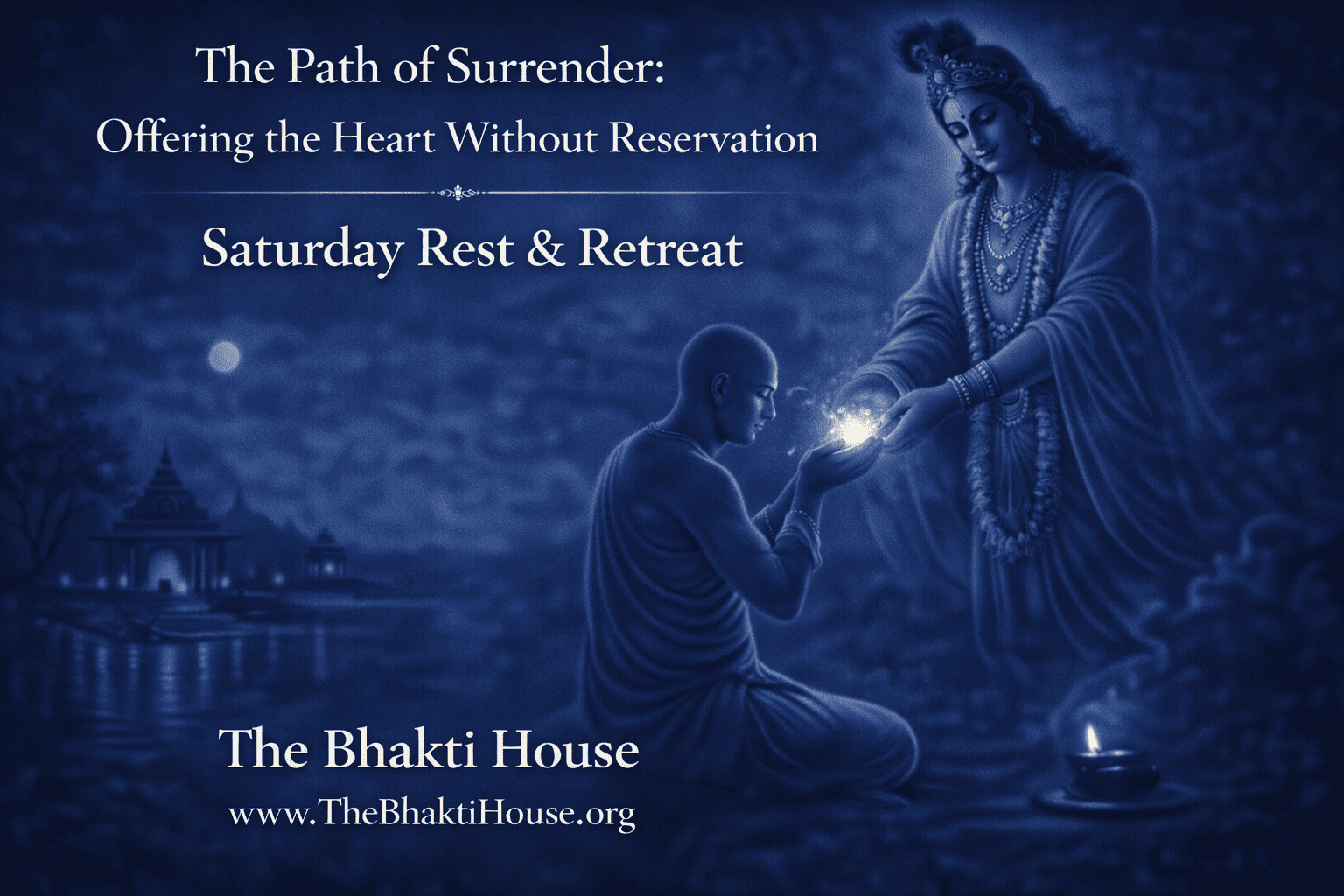
Saturday Rest & Retreat
March 28, 2026 — The Bhakti House, Jackson, Michigan
Last night we explored a powerful instruction from the Bhagavad-gītā:
Whatever you do — offer it to Kṛṣṇa.
But today we go deeper.
Offering actions is the beginning.
Offering the heart is surrender.
Many can adjust external behavior.
Few are willing to release internal resistance.
Today’s Rest & Retreat invites us into a more vulnerable question:
Have I truly surrendered?
The Bhagavad-gītā concludes with Kṛṣṇa’s most intimate instruction — the essence of all spiritual teachings.
Bhagavad-gītā 18.66 — The Call to Complete Surrender
Devanāgarī
सर्वधर्मान्परित्यज्य
मामेकं शरणं व्रज ।
अहं त्वां सर्वपापेभ्यो
मोक्षयिष्यामि मा शुचः ॥
Roman Transliteration
sarva-dharmān parityajya
mām ekaṁ śaraṇaṁ vraja
ahaṁ tvāṁ sarva-pāpebhyo
mokṣayiṣyāmi mā śucaḥ
Translation (Vedabase.io)
Abandon all varieties of religion and just surrender unto Me. I shall deliver you from all sinful reactions. Do not fear.
Theological Reflection
This verse is not a rejection of morality.
It is a call beyond external religiosity.
“Abandon all varieties of dharma and simply surrender unto Me.”
Dharma here includes all separate conceptions of identity.
“I am this role.”
“I am this status.”
“I am this achievement.”
“I am this failure.”
Surrender means:
Let Kṛṣṇa define you.
Let Kṛṣṇa protect you.
Let Kṛṣṇa guide you.
The promise that follows is profound:
“I shall deliver you from all sinful reactions. Do not fear.”
The final instruction of the Gītā is not command.
It is reassurance.
The Nature of Śaraṇāgati (Surrender)
In the Vaiṣṇava tradition, surrender includes six elements:
- Accepting what is favorable for devotion
- Rejecting what is unfavorable
- Believing firmly in the Lord’s protection
- Embracing the Lord as guardian and maintainer
- Cultivating humility
- Fully offering oneself
Surrender is active, not passive.
It requires discernment.
It requires courage.
It requires trust.
Supporting Insight: The Mood of Dependence
To deepen this meditation, we reflect on a foundational devotional verse from the Bhakti tradition.
Bhakti-rasāmṛta-sindhu 1.1.11
Devanāgarī
अन्याभिलाषिताशून्यं
ज्ञानकर्माद्यनावृतम् ।
आनुकूल्येन कृष्णानुशीलनं
भक्तिरुत्तमा ॥
Roman Transliteration
anyābhilāṣitā-śūnyam
jñāna-karmādy-anāvṛtam
ānukūlyena kṛṣṇānuśīlanaṁ
bhaktir uttamā
Translation (Wisdom Library)
“The highest bhakti is defined as continuous service or emotions directed towards Kṛṣṇa, His expansion forms or others related to Him, with a pleasing attitude towards Kṛṣṇa. It should be devoid of desires other than the desire to please the Lord, and unobstructed by impersonal jñāna, the materialistic rituals of karma or other unfavorable acts.”
Theological Reflection
Pure devotion is free from ulterior desires.
It is not covered by speculative knowledge or fruitive activity.
It is performed favorably for Kṛṣṇa’s pleasure.
This is surrender refined.
Not:
“I serve so I get something.”
But:
“I serve because I belong to You.”
Offering the heart means examining motive.
Even subtle ego can hide inside service.
Surrender purifies motive.
Retreat Practice: The Inner Offering
Today’s Rest & Retreat is quiet.
Gentle.
Reflective.
Exercises include:
- Silent Meditation
Ask inwardly:
“What am I afraid to give to Kṛṣṇa?” - Resistance Mapping
Write honestly:
• Where do I resist surrender?
• What do I try to control?
• What outcome do I fear losing? - Trust Exercise
Choose one anxiety.
Consciously offer it through prayer.
Surrender grows through honesty.
Kṛṣṇa does not require performance.
He invites authenticity.
Why Surrender Feels Risky
The ego survives through control.
Surrender feels like vulnerability.
But consider:
Control was always partial.
Outcomes were never guaranteed.
Security was always fragile.
Surrender replaces fragile control with divine trust.
And trust produces peace.
Application for The Bhakti House
The Bhakti House is not merely a place to attend.
It is a place to grow.
Growth requires letting go.
Letting go of:
• Self-image
• Spiritual comparison
• Performance anxiety
• Hidden ambition
Community provides support for surrender.
When we admit vulnerability together, surrender deepens together.
Reflection Questions
- What am I still clinging to?
- Do I trust Kṛṣṇa’s protection fully?
- Is my service motivated by love or subtle ego?
- What would wholehearted surrender look like in my life?
Assignment
For the next seven days:
Before sleeping, say:
“Kṛṣṇa, I place this day in Your hands.”
Release control consciously.
Practice trust.
Preparing for Sunday
Tomorrow we conclude March.
Friday: Offer your actions.
Saturday: Offer your heart.
Sunday: Offer your very self in love.
Surrender is not loss.
It is reunion.