
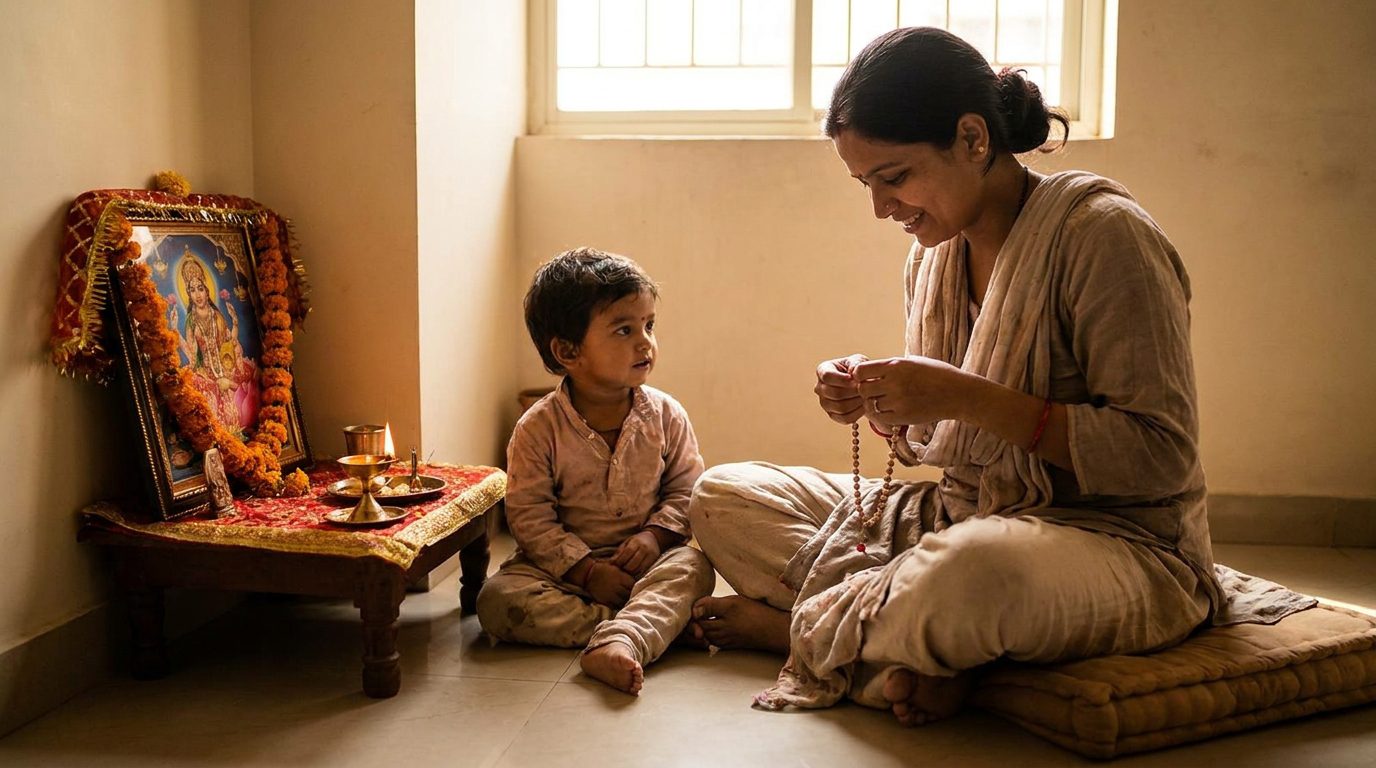
Parenthood is one of life’s most sacred journeys. It stretches the heart, humbles the ego, and invites us to love in ways we may never have imagined. There are sleepless nights, endless questions, tender moments, and seasons when we wonder if we are doing enough. In the middle of it all, Bhakti Yoga offers a gentle, practical, and deeply spiritual approach.
Bhakti means loving devotion. Yoga means connection. So Bhakti Yoga is the path of reconnecting with God through love—through chanting, prayer, service, hearing sacred wisdom, remembering the Divine, and offering our daily life with sincerity.
For parents, Bhakti is not another task to add to an already full list. It is a way to bring sacredness into what is already happening: feeding a child, listening with patience, cleaning up a mess, singing before bedtime, apologizing when we fall short, and beginning again with humility.
Whether you are a new parent, an experienced parent, a grandparent, a caregiver, or someone preparing for family life, Bhakti can help transform the home into a place of spiritual nourishment. You do not have to be perfect. You do not have to know everything. You are warmly welcome to begin where you are.
In Bhakti Yoga, service is called seva. Seva means loving service offered for the pleasure of God and the welfare of others. Parenting is full of seva. Much of it is quiet, unseen, and repetitive. Yet from a devotional perspective, these acts can become sacred offerings.
Changing diapers, cooking meals, driving to school, comforting tears, and guiding a child’s heart can all become part of spiritual life when offered with love.
Seeing the Child as a Soul
Bhakti teachings remind us that each living being is more than the body and mind. In the Bhagavad Gita, Krishna explains that the soul is eternal, spiritual, and never destroyed. This means our children are not simply “ours” in a possessive sense. They are souls entrusted to our care for a time.
This understanding softens parenting. We begin to see children not as projects to control, but as sacred persons to guide. Their gifts, struggles, questions, and personalities are all part of their journey.
When we remember, “This child belongs to God,” our love becomes less controlling and more prayerful. We still set boundaries. We still teach responsibility. But we do so with reverence.
Parenting Without Perfectionism
Many parents carry a heavy burden: the fear of failing. Bhakti offers another way. It teaches sincerity over perfection.
In the Bhagavad Gita, Krishna says that if someone offers Him even a leaf, a flower, fruit, or water with devotion, He accepts it. The offering is simple, but the love makes it meaningful.
Likewise, God receives our sincere parenting efforts. We may lose patience. We may not always know the right words. But if we return to humility, pray for guidance, and keep offering our love, our home becomes a place where grace can enter.
Daily Care as Worship
Worship does not only happen in a temple, church, mosque, synagogue, meditation room, or sacred gathering place. Worship can also happen at the kitchen sink, beside a crib, in the carpool line, or during homework time.
A simple prayer can change the mood of ordinary duties:
“Dear Lord, please help me serve this child with patience and love.”
This small prayer can turn daily care into devotion.
Creating a Bhakti-Inspired Home
A Bhakti home does not need to look perfect. It does not require expensive decorations or an elaborate routine. A Bhakti-inspired home is one where love for God is gently remembered and practiced.
The goal is not to force spirituality, but to create an atmosphere where devotion feels natural, joyful, and safe.
A Sacred Space for the Family
Many families find it helpful to create a small sacred space. This may be a simple shelf, table, or corner with a picture of Krishna, Radha, Rama, Sita, Lord Chaitanya, a beloved saint, or another form of God that inspires devotion. You may also include flowers, a candle, incense, sacred books, or meaningful symbols from your tradition.
This space can become the heart of the home—a place to pause, pray, chant, or simply breathe.
Children often respond beautifully to sacred spaces when they are invited with warmth. They may enjoy offering a flower, ringing a bell, placing a drawing there, or sitting quietly for a few moments.
Simple Morning Rituals
Morning can set the tone for the whole day. But family mornings are often busy. Bhakti practice does not have to be long to be powerful.
A simple morning ritual might include:
- Lighting a candle or offering a flower
- Chanting one mantra together
- Reading one verse or short spiritual reflection
- Saying a family prayer
- Offering the day to God
A mantra is a sacred sound or prayer that helps focus the mind and awaken the heart. One beloved mantra in the Bhakti tradition is the Hare Krishna maha-mantra:
Hare Krishna, Hare Krishna, Krishna Krishna, Hare Hare
Hare Rama, Hare Rama, Rama Rama, Hare Hare
Maha-mantra means “great mantra.” It is a prayer calling upon the Divine energy of God and the all-attractive Lord, Krishna, and Rama, the source of spiritual joy. Parents and children can chant it softly, musically, or even while walking around the house.
Bedtime as a Spiritual Anchor
Bedtime is a tender opportunity for spiritual connection. Children often open their hearts at night. A Bhakti bedtime routine may include:
- Gratitude: “What are we thankful for today?”
- Prayer: “Who shall we pray for tonight?”
- Kirtan: a simple devotional song
- Sacred story: a story from Krishna’s pastimes, the Ramayana, or the lives of saints
- Blessing: placing a hand on the child’s head and asking God to protect and guide them
Kirtan means devotional singing, often with call-and-response chanting. It does not require musical talent. Children care more about sincerity than skill. A parent’s loving voice can become a lifelong memory of spiritual warmth.
Teaching Children Through Love and Example
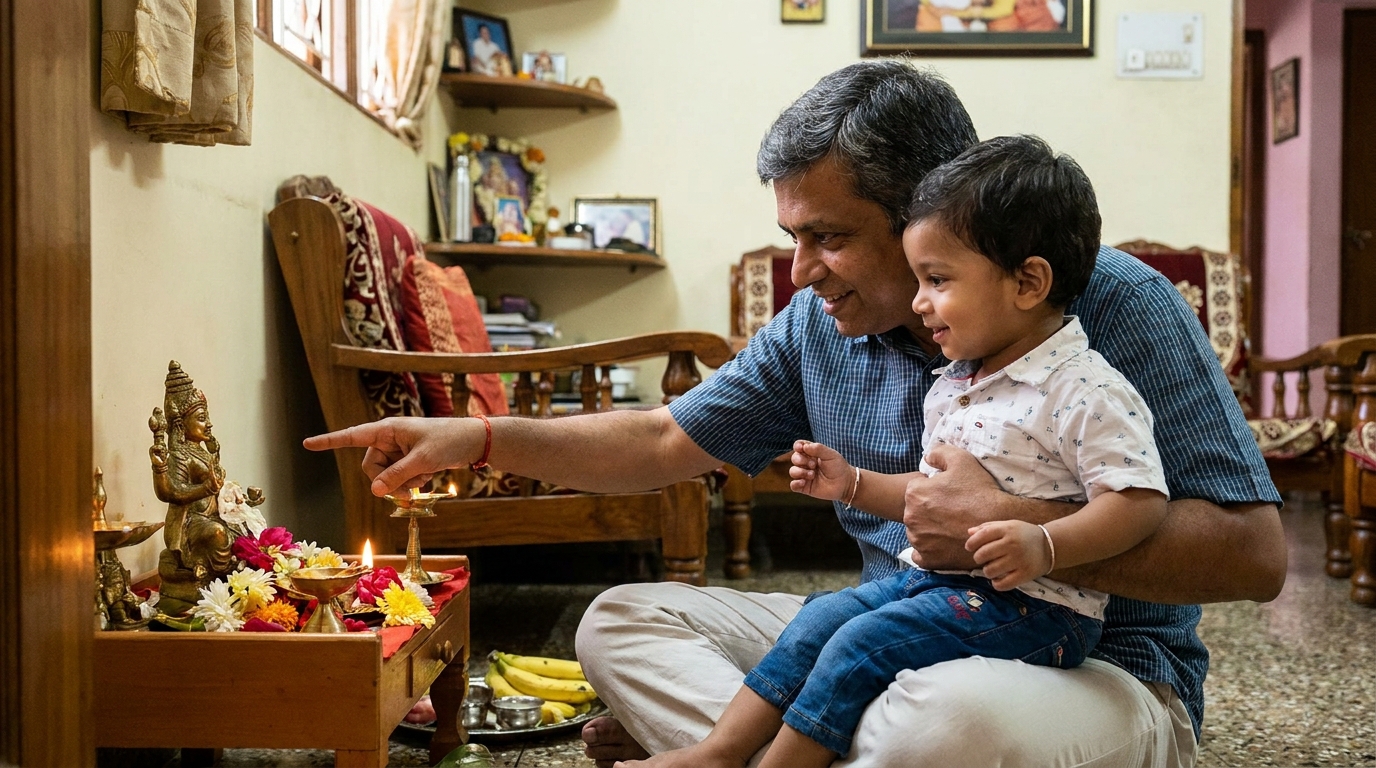
Children learn far more from who we are than from what we say. In Bhakti parenting, the parent’s example becomes one of the most powerful teachings.
If children see us pray when we are overwhelmed, apologize when we make mistakes, chant when our hearts need shelter, and serve others with compassion, they learn that spiritual life is real and practical.
Modeling Humility
Humility is central to Bhakti. It does not mean thinking badly of ourselves. It means recognizing that we are dependent on God’s grace and connected with all beings.
One of the most beloved teachings from Lord Chaitanya, a great teacher of Bhakti Yoga, is that one should chant the holy names of God with humility, tolerance, and respect for others. This is not only advice for monks or scholars. It is deeply relevant for parents.
Parenting gives us many opportunities to practice humility. We may need to say:
“I’m sorry I raised my voice.”
“I was tired, but that doesn’t make it okay.”
“Let’s try again.”
“I am learning too.”
These words do not weaken parental authority. They strengthen trust. They show children that spiritual growth is a lifelong path.
Encouraging Questions
Children are naturally curious. They may ask, “Who is God?” “Why do we pray?” “Why do bad things happen?” “Where was I before I was born?” Sometimes parents feel pressure to have perfect answers.
Bhakti invites us to welcome questions with gentleness. If we do not know, we can say, “That is a beautiful question. Let’s explore it together.”
This keeps spirituality alive and relational. Faith becomes a shared journey, not a rigid lecture.
Sacred texts like the Bhagavad Gita are full of questions. Arjuna, a warrior and seeker, asks Krishna sincere questions about duty, fear, confusion, the soul, and the purpose of life. Krishna does not shame him. He guides him with compassion.
This gives parents a wonderful model: listen first, then guide.
Making Spiritual Practice Joyful
Children often connect to devotion through beauty, music, food, stories, and celebration. Bhakti is naturally rich with these elements.
You might invite children to:
- Help prepare a simple offering of fruit or food
- Decorate the sacred space with flowers
- Dance during kirtan
- Act out stories of Krishna, Hanuman, Prahlada, or Mirabai
- Make devotional art
- Learn simple Sanskrit words and their meanings
- Participate in festivals
Prasadam is another important Bhakti practice. Prasadam means “mercy” or “grace.” It refers to food that has been lovingly offered to God and then received with gratitude. Preparing and sharing prasadam teaches children that eating can be sacred, not just physical.
Even a piece of fruit offered with love can become prasadam.
Please visit our website for more information on our articles: articles.
Discipline with Compassion and Spiritual Wisdom

Every parent faces the challenge of discipline. Children need guidance, structure, and boundaries. Bhakti does not mean passive parenting. It means discipline rooted in love, respect, and the desire to help the child grow.
The word discipline is related to disciple, one who learns. In a devotional home, discipline is not mainly about punishment. It is about teaching.
Boundaries as an Expression of Love
Children feel safer when they know what to expect. Clear boundaries help them develop self-control, empathy, and responsibility.
A Bhakti approach might ask:
- Is this boundary helping my child grow?
- Am I responding from love or reacting from anger?
- Have I explained the reason clearly?
- Am I willing to be consistent?
- Can I correct the behavior while honoring the soul?
A child is not “bad” because they behave poorly. They are learning. Their behavior may need correction, but their worth remains untouched.
This distinction is essential.
Responding Instead of Reacting
Parenting can bring out our deepest triggers. A child’s tantrum, defiance, or emotional outburst may awaken our own impatience, fear, or past wounds.
Bhakti offers tools for pausing. Before responding, we can silently chant a mantra, take a breath, or pray:
“Krishna, please guide my words.”
Even one breath can create space between reaction and response.
In the Bhagavad Gita, Krishna teaches about the restless mind and the need for practice and detachment. For parents, this is very practical. We practice returning to calm. We practice not being ruled by every emotion. We practice seeing the bigger picture.
This does not happen overnight. But each attempt matters.
Repair After Conflict
No family avoids conflict completely. What matters is how we repair.
Repair may include apology, affection, conversation, prayer, or simply sitting together again. In Bhakti, relationships are sacred because every person is connected to God. Repair honors that sacred connection.
A parent might say:
“We had a hard moment. I love you. Let’s talk about what happened.”
Or:
“I needed to correct your behavior, but I never want you to feel unloved.”
These moments teach children that love is stronger than mistakes.
Bhakti Practices for Busy Parents
Many parents long for spiritual practice but feel they do not have time. Bhakti is merciful because it can be woven into daily life. Even small practices, done with sincerity, can nourish the heart.
You do not need hours of silence to begin. You can start with what is possible.
Chanting in Real Life
Chanting the names of God is one of the central practices of Bhakti Yoga. In Sanskrit, this is often called nama-japa or nama-sankirtana. Nama means “name.” Japa means personal, meditative repetition. Sankirtana means congregational or shared chanting.
For busy parents, chanting can happen:
- While preparing breakfast
- During a walk with the stroller
- In the car
- Before waking the children
- While folding laundry
- Softly before sleep
- During moments of stress
A parent may chant on beads, known as japa mala, or simply repeat a mantra silently in the heart.
The holy name is not dependent on perfect circumstances. It meets us wherever we are.
Prayer Throughout the Day
Prayer is honest conversation with God. It can be formal or spontaneous. Parents can pray while holding a baby, washing dishes, waiting at a doctor’s appointment, or sitting in the quiet after everyone has gone to sleep.
Some simple prayers include:
“Please help me be patient.”
“Please protect my child.”
“Please teach me how to love better.”
“Please let our home be filled with kindness.”
“Please guide this child toward truth and joy.”
Prayer reminds us that we are not parenting alone.
Hearing Sacred Wisdom
In Bhakti, hearing spiritual truth is called shravanam. It means listening to sacred teachings, stories, and wisdom. This practice nourishes faith and helps us remember our deeper purpose.
Parents can hear Bhakti wisdom through:
- Audiobooks
- Podcasts
- Kirtan recordings
- Bhagavad Gita classes
- Family scripture reading
- Short daily reflections
- Community gatherings
Even ten minutes of hearing can change the mood of the heart.
The Srimad Bhagavatam, a treasured Bhakti scripture, shares stories of devotees who remembered God in many circumstances—kings, children, mothers, sages, and householders. These stories remind us that spiritual life is not limited to one type of person or one life stage.
Parenthood can be a powerful setting for devotion.
Caring for the Parent’s Inner Life
Parents often pour so much into their children that they forget their own hearts need care. Bhakti encourages self-care not as selfishness, but as stewardship. Your mind, body, and soul are also gifts from God.
When parents are spiritually nourished, they can serve with more steadiness and joy.
Letting Go of Comparison
Modern parenting can be filled with comparison. We may compare our child, our home, our routines, our spiritual practice, or our emotional capacity with others.
Bhakti gently turns us away from comparison and toward sincerity.
God is not asking you to parent someone else’s child or live someone else’s life. You have your particular family, your particular gifts, your particular struggles, and your particular opportunities to love.
In the Bhagavad Gita, Krishna encourages Arjuna to follow his own dharma. Dharma means sacred duty, the path of responsibility aligned with truth. For parents, this means honoring the real duties in front of us—not an imagined life of perfection.
Your dharma may look different in different seasons. Parenting a newborn is different from parenting a teenager. Single parenting is different from co-parenting. Parenting a child with special needs may ask for a unique form of surrender and strength.
Bhakti meets every situation with compassion.
Finding Support in Spiritual Community
Satsanga means association with those who seek truth. Sat means truth, and sanga means company. Spiritual community can be a lifeline for parents.
A Bhakti community can offer:
- Encouragement
- Shared chanting
- Wisdom from elders
- Friendship for children
- Help during difficult seasons
- A reminder that you are not alone
No family is meant to thrive in isolation. We need each other. We need people who can celebrate with us, pray with us, and gently remind us of our spiritual center.
Resting in Grace
Sometimes the most spiritual thing a parent can do is rest. Rest can be an act of trust.
We are not the ultimate controllers. We can guide, protect, teach, and love, but we cannot control every outcome. Bhakti invites us to do our best and offer the results to God.
This is called surrender. Surrender does not mean giving up responsibility. It means releasing the illusion that everything depends only on us.
A simple surrender prayer might be:
“Dear Lord, I offer this child to You. I offer my efforts to You. Please guide us, protect us, and help us grow in love.”
There is deep peace in remembering that God loves our children even more than we do.
Raising Children with Devotional Values
Bhakti parenting is not only about rituals. It is about cultivating values that reflect love for God and compassion for all beings.
These values can be taught through daily life, stories, service, and conversation.
Gratitude
Gratitude helps children see life as a gift. Families can practice gratitude at meals, bedtime, or during prayer.
You might ask:
“What is one thing you received today?”
“Who helped you today?”
“How did God show kindness to us today?”
Gratitude turns attention away from entitlement and toward wonder.
Compassion for All Living Beings
Bhakti teaches that every living being is part of God’s creation and worthy of respect. This includes people of all backgrounds, animals, plants, and the earth.
Children can learn compassion by caring for pets, helping younger siblings, feeding others, offering kind words, avoiding cruelty, and serving those in need.
In the Bhagavad Gita, Krishna describes a wise person as one who sees with equal vision—recognizing the spiritual nature in all. This can be explained simply to children: “Everyone has a soul, and everyone matters to God.”
Service as a Family Practice
Family service can be simple and joyful. You might:
- Cook extra food for someone in need
- Visit someone who is lonely
- Help clean a community space
- Offer support to another family
- Donate clothes or toys thoughtfully
- Participate in temple or community service
- Pray for people who are suffering
Service teaches children that love is active. It moves through our hands, words, and choices.
Truthfulness and Integrity
Children need to see that spiritual life includes honesty. Truthfulness does not mean harshness. It means living with integrity.
Parents can encourage children to tell the truth by responding with steadiness rather than fear. When children know they are loved, even when they make mistakes, they are more likely to be honest.
Bhakti teaches that God is present in the heart. We are never truly hidden from Divine love. This can inspire children to live with sincerity, not shame.
Navigating Challenges with Faith
Parenthood includes seasons of uncertainty. Illness, financial stress, behavioral struggles, grief, separation, school concerns, or spiritual doubts may arise. Bhakti does not promise a life without difficulty. It offers shelter in the midst of difficulty.
Faith does not mean pretending everything is easy. It means turning toward God with honesty.
When Children Struggle
When a child is struggling emotionally, socially, academically, or spiritually, parents may feel helpless. Bhakti encourages both prayer and practical action.
We can seek support from teachers, counselors, doctors, elders, and trusted community members. We can also pray deeply.
Spirituality and practical care belong together.
A devotional parent might pray:
“Please help me understand what this child needs. Please send the right support. Please help my child feel loved and guided.”
When Parents Feel Spiritually Dry
There may be times when parents feel disconnected from spiritual life. The chanting feels mechanical. Prayer feels difficult. The heart feels tired.
This too can be part of the path.
In Bhakti, we are encouraged to keep a small connection alive. Even one sincere name of God, one tearful prayer, one moment of gratitude, or one act of service can reopen the heart.
Do not judge your season harshly. Bring it to God.
“Lord, I feel far away, but I want to come closer.”
That prayer is already Bhakti.
When Children Choose Their Own Path
As children grow, they may question or even reject the spiritual practices they were raised with. This can be painful for parents.
Bhakti invites us to continue loving without force. Faith cannot be controlled. Love can be offered. Example can be lived. Prayers can continue quietly.
A child who feels respected is more likely to keep a soft place in the heart for spiritual life. The seeds of devotion may sprout later, in ways we cannot predict.
Our role is to plant with love, water with prayer, and trust God with the growth.
Bringing Krishna into Everyday Family Life
For those drawn to Krishna Bhakti, family life can be filled with sweet remembrance of Krishna, whose name means “the all-attractive one.” Krishna is worshiped as the Supreme Person, full of beauty, wisdom, playfulness, compassion, and love.
Remembering Krishna does not have to be complicated. It can be woven into the natural rhythms of home.
Sacred Stories for Children
Children often love stories of Krishna’s childhood in Vrindavan—His playful adventures, His love for the cows, His friendships with the cowherd boys and girls, and His tender relationship with Mother Yashoda.
These stories are not only entertaining. They reveal deep spiritual truths: God is not distant and cold; God is personal, loving, playful, and eager for relationship.
Mother Yashoda’s love for Krishna is especially meaningful for parents. She serves Krishna as her child, feeding Him, protecting Him, and even correcting Him. In Bhakti, this shows the sweetness of devotional love. God allows Himself to be bound by love.
This can help parents see their own caregiving as spiritually meaningful.
Offering Food with Love
One simple way to bring Bhakti into family life is to offer food before eating. You may prepare vegetarian food with care, place a small portion before God, and say a prayer.
A simple offering prayer could be:
“Dear Lord, thank You for this food. Please accept it with our love. May it nourish our bodies and help us serve with kind hearts.”
Then the food is honored as prasadam, God’s mercy.
Children can participate by placing a flower, helping set the offering plate, or saying thank you.
Celebrating Holy Days
Bhakti traditions include many beautiful festivals, such as Janmashtami, the appearance day of Lord Krishna; Gaura Purnima, honoring Lord Chaitanya; Rama Navami, celebrating Lord Rama; and Kartik, a sacred month of offering lamps and prayers.
Families can celebrate in simple ways:
- Singing kirtan
- Telling the story of the holy day
- Preparing prasadam
- Making crafts
- Offering candles or flowers
- Joining community gatherings
- Inviting friends of all backgrounds
Festivals help children experience spiritual life as joyful, colorful, and shared.
A Gentle Daily Rhythm for Bhakti Parenting
Every family is different, but a simple rhythm can help. The goal is not rigidity. The goal is remembrance.
Here is one possible Bhakti-inspired family rhythm:
Morning
Begin with one prayer or mantra. Offer the day to God. If possible, read one short verse or devotional thought.
“May our words be kind today. May we remember You.”
Mealtime
Offer food with gratitude. Take a moment to remember that nourishment is a gift.
“Thank You for this prasadam.”
Transitions
Use short chants or prayers during transitions—before school, before work, before travel, or when emotions are high.
“Please guide us. Please protect us.”
Evening
Share one gratitude and one prayer. Sing softly or read a sacred story.
“What did we learn today? Who can we pray for?”
Difficult Moments
Pause. Breathe. Chant silently. Respond with as much compassion as possible.
“Let me see this child as Your beloved soul.”
This kind of rhythm, even imperfectly practiced, can gradually shape the heart of the home.
The Parent’s Heart as a Place of Pilgrimage
In many spiritual traditions, pilgrimage means traveling to a sacred place. In Bhakti, the heart itself can become a sacred place when filled with remembrance of God.
Parenthood is a pilgrimage of the heart. It asks us to walk through fatigue, joy, fear, tenderness, frustration, wonder, and surrender. It reveals our attachments and expands our capacity to love.
Each child teaches us something. Each season invites us to grow. Each challenge can become a doorway to prayer.
Bhakti Yoga does not remove the responsibilities of parenthood. It illuminates them. It helps us see that the home can be an ashram—a place of spiritual practice. Ashram simply means a place where spiritual growth is cultivated. Your home, however busy or imperfect, can become such a place.
When love is offered to God, ordinary life becomes sacred.
Everyone Is Welcome on the Path of Bhakti
Bhakti Yoga is a practical path for real people living real lives. It welcomes parents who are tired, hopeful, grieving, joyful, uncertain, devoted, questioning, beginning again, or simply curious.
You do not need to know Sanskrit. You do not need to have a perfect home. You do not need to be raised in a particular culture or tradition. Bhakti begins with sincerity.
Chant one holy name. Say one honest prayer. Offer one meal. Read one verse. Serve one person. Apologize with humility. Bless your child. Sit quietly before God. Take one step.
The beautiful promise of Bhakti is that God sees the heart. And when we take one sincere step toward God, grace meets us there.
May your parenting be strengthened by devotion, softened by compassion, and guided by Divine love. May your home become a place of prayer, service, chanting, forgiveness, and joy. And may every child feel, through your care, that they are deeply loved by God.
Everyone is welcome to take one sincere step toward God today.
FAQs
What is Bhakti in the context of parenting?
Bhakti is a concept in Hinduism that refers to the path of devotion and love towards a personal god. In the context of parenting, Bhakti emphasizes the importance of nurturing a loving and devotional relationship with one’s children.
How does Bhakti influence parenting practices?
Parenting through the lens of Bhakti encourages parents to prioritize love, compassion, and understanding in their interactions with their children. It emphasizes the importance of instilling moral and spiritual values in children through loving guidance and example.
What are some practical ways to incorporate Bhakti into parenting?
Practical ways to incorporate Bhakti into parenting include teaching children about the principles of love, compassion, and service, engaging in devotional practices together as a family, and fostering a nurturing and supportive environment for children to grow and develop.
What are the benefits of parenting through the lens of Bhakti?
Parenting through the lens of Bhakti can lead to stronger parent-child relationships, a deeper sense of connection and understanding, and the cultivation of positive values and virtues in children. It can also contribute to a more harmonious and loving family dynamic.
Are there any challenges associated with parenting through the lens of Bhakti?
Challenges associated with parenting through the lens of Bhakti may include navigating differing beliefs or values within the family, finding a balance between discipline and love, and addressing external influences that may conflict with Bhakti principles.

