
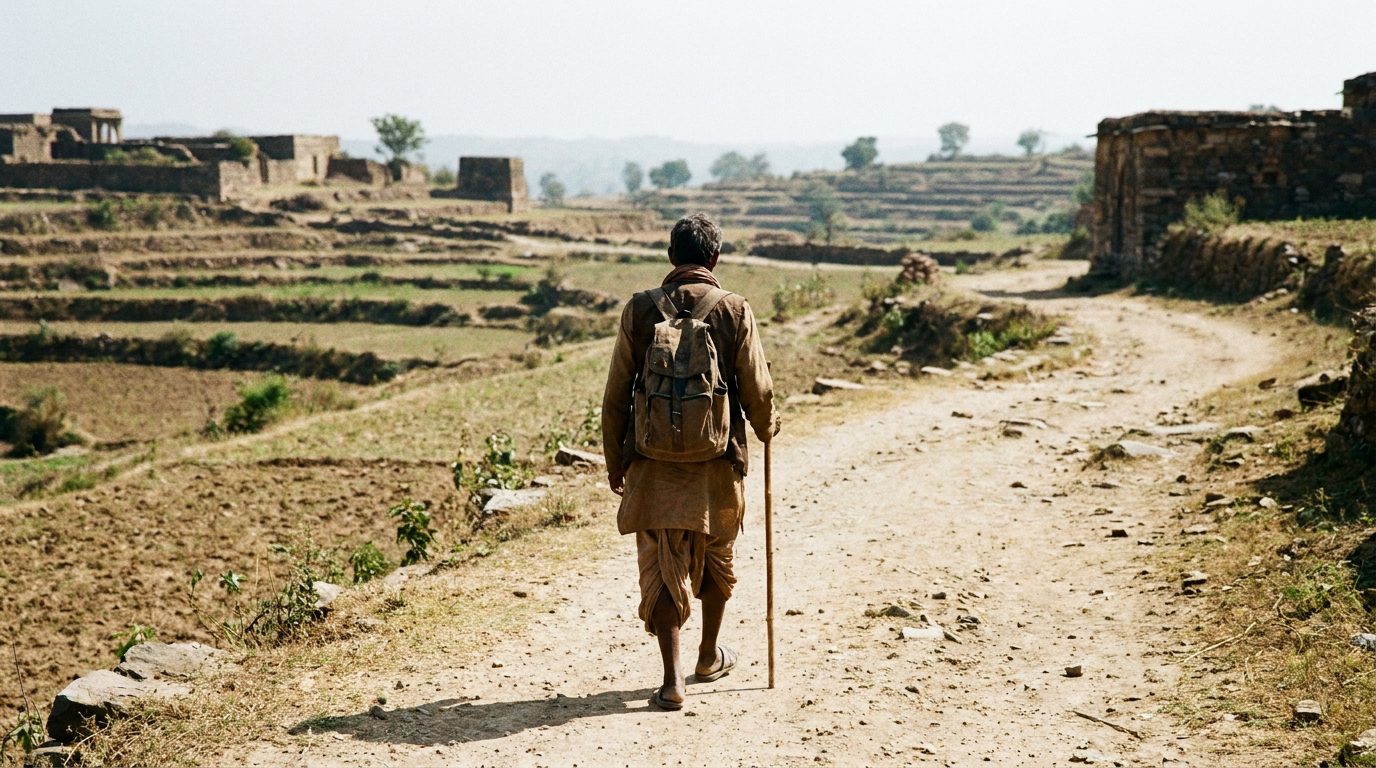
Have you ever longed for a spiritual adventure — not one that takes you to distant lands, but one that transforms your heart from the inside out? What if the greatest journey you could ever take was one of love, devotion, and rediscovering your relationship with the Divine?
Welcome, dear friend. Whether you’re brand new to Bhakti or you’ve been walking this path for years, the story of Sri Caitanya Mahaprabhu is an invitation that reaches across every background, every tradition, and every heart. His life is not just history — it’s a living adventure that continues to unfold in the lives of those who embrace it.
At The Bhakti House, we believe that everyone belongs at the table of devotion. So grab a cup of tea, settle in, and let’s journey together with one of the most extraordinary spiritual figures the world has ever known.
Sri Caitanya Mahaprabhu (1486–1534) appeared in Navadvipa, a town in West Bengal, India. In the Bhakti tradition, He is understood to be the Supreme Lord Himself appearing in the mood of a devotee — specifically, in the loving mood of Srimati Radharani, the divine feminine counterpart of Lord Krishna.
But what does that actually mean for us practically?
It means that Sri Caitanya came not to demand worship, but to show us how to love God. He didn’t sit on a golden throne issuing commands. He danced in the streets. He wept in prayer. He embraced people whom society had rejected. He chanted the holy names with such feeling that entire crowds were swept up in waves of spiritual joy.
The Golden Avatar
Sri Caitanya is sometimes called the “Golden Avatar” because of His radiant golden complexion. The Sanskrit word avatara simply means “one who descends” — referring to God appearing in this world. Ancient Bhakti scriptures foretold His appearance. In the Srimad Bhagavatam (11.5.32), it is stated:
> “In the age of Kali, intelligent persons perform congregational chanting to worship the incarnation of Godhead who constantly sings the names of Kṛṣṇa. Although His complexion is not blackish, He is Kṛṣṇa Himself. He is accompanied by His associates, servants, weapons and confidential companions.”
This verse beautifully points to Sri Caitanya — the Lord who came not with weapons of war, but with the weapon of love: the chanting of the holy names.
A Devotee’s Heart in God’s Form
What makes Sri Caitanya so accessible and so deeply moving is that He lived as a devotee. He experienced longing for God. He cried out in separation. He showed us that the spiritual path isn’t about having all the answers — it’s about having a heart that yearns sincerely.
His famous prayer, found in the Siksastakam (verse 6), reveals this tender vulnerability:
> “I know no one but Kṛṣṇa as my Lord, and He shall remain so even if He handles me roughly by His embrace or makes me brokenhearted by not being present before me. He is completely free to do anything and everything, for He is always my worshipful Lord, unconditionally.”
This kind of unconditional love is the summit of Bhakti Yoga. And Sri Caitanya lived it with every breath.
The Sankirtan Movement: Chanting That Changes Everything
One of the most beautiful and practical gifts Sri Caitanya gave to the world is the sankirtan movement — the practice of congregational chanting of God’s holy names.
Sankirtan comes from the Sanskrit word kirtana, which means “to glorify” or “to sing praise,” and the prefix sam, meaning “together” or “completely.” So sankirtan is the complete, communal glorification of the Divine.
Why Chanting Matters
Sri Caitanya taught that in our current age — called Kali Yuga in the Vedic tradition, an era marked by confusion, conflict, and spiritual forgetfulness — chanting the holy names is the most accessible and powerful spiritual practice available.
The Brhan-naradiya Purana states:
> “In this age of quarrel and hypocrisy, the only means of deliverance is the chanting of the holy names of the Lord. There is no other way. There is no other way. There is no other way.”
Notice the repetition — three times. This isn’t casual advice. It’s an urgent, compassionate call to each one of us.
And the beautiful thing is this: you don’t need to be a scholar, a monk, or a saint to chant. You just need a willing heart. The Maha Mantra — Hare Krishna, Hare Krishna, Krishna Krishna, Hare Hare / Hare Rama, Hare Rama, Rama Rama, Hare Hare — is an open invitation. It’s a prayer that says, “Dear Lord, dear Divine Energy, please engage me in Your loving service.”
Chanting in the Streets
Sri Caitanya didn’t keep this practice behind closed doors. He took it into the streets of Navadvipa, and later throughout India during His extensive travels. He chanted with such ecstasy that people of all castes, all backgrounds, and all walks of life were drawn in.
Imagine the scene: a golden-complexioned young man, arms raised, tears streaming down His face, singing God’s names with complete abandon. Around Him, thousands join in — rich and poor, learned and simple, young and old. No one is turned away. No one is asked for their credentials. The only requirement is sincerity.
This is the heart of The Bhakti House vision, too. Everyone is welcome. Come as you are.
Sri Caitanya’s Travels: Transforming Hearts Across India
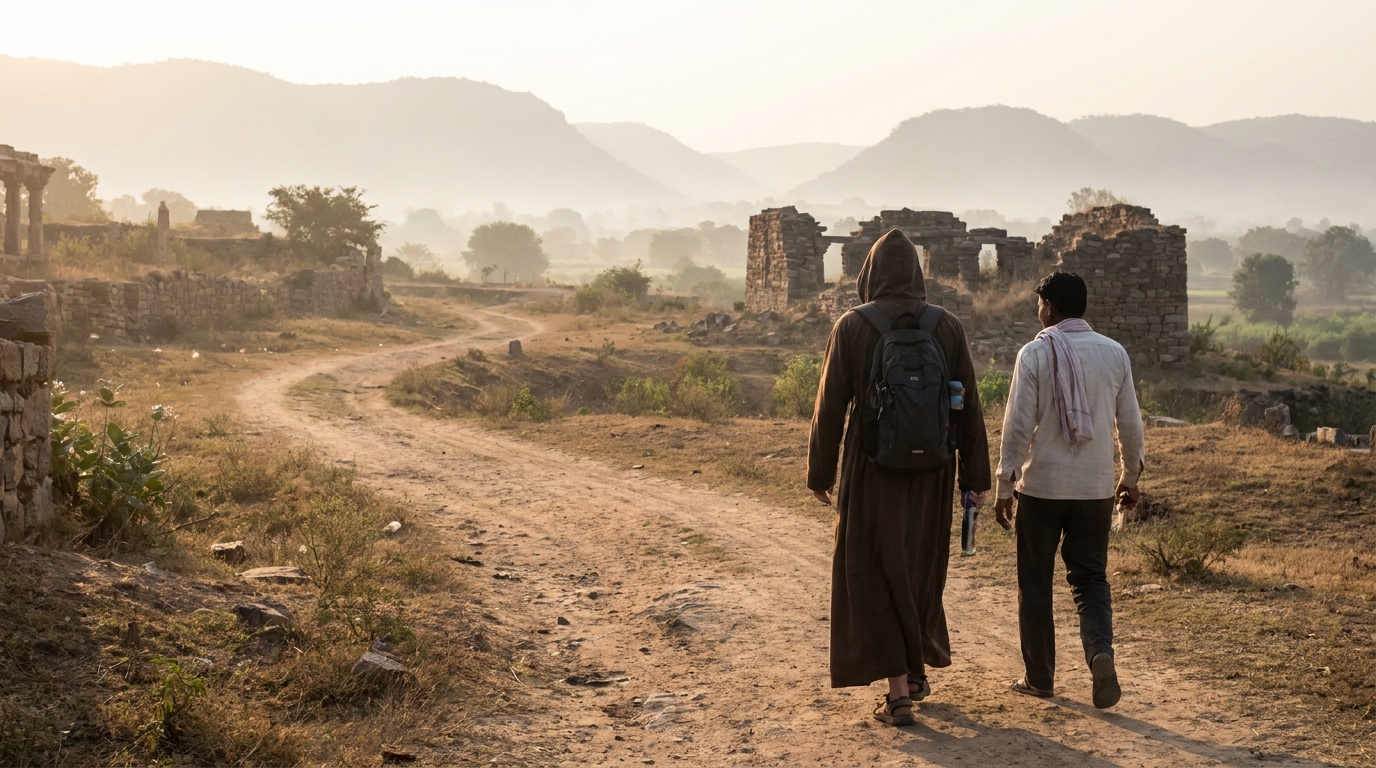
Sri Caitanya’s life was literally a journey. After taking sannyasa (the renounced order of life) at age 24, He traveled extensively throughout India for six years, covering thousands of miles — mostly on foot.
South India Pilgrimage
During His travels through South India, Sri Caitanya visited holy places and transformed countless lives. He didn’t just visit temples — He ignited the hearts of everyone He met. From simple farmers to great scholars, people experienced a spiritual awakening in His presence.
One of the most touching accounts is His meeting with Ramananda Raya on the banks of the Godavari River. Their conversation, recorded in the Caitanya Caritamrita, is one of the deepest explorations of divine love ever documented. They discussed the progressive stages of devotion, from following religious duties all the way to the most intimate, selfless love for God.
Vrindavan: The Land of Krishna’s Pastimes
Sri Caitanya also journeyed to Vrindavan, the sacred land associated with Lord Krishna’s childhood pastimes. When He arrived, His ecstatic love overflowed. He saw every tree, every river, every dust particle as saturated with Krishna’s presence.
This teaches us something profoundly practical: the spiritual journey isn’t just about reaching a destination. It’s about learning to see the sacred everywhere — in nature, in other people, in the ordinary moments of our lives.
Jagannath Puri: The Home of Divine Longing
Sri Caitanya spent the last 18 years of His life in Jagannath Puri, on the eastern coast of India. Here, in the presence of Lord Jagannath (a beloved form of Krishna), He dove deep into the ocean of divine love and separation.
The Caitanya Caritamrita (Antya 20.12) records His heart-wrenching prayer:
> “O Govinda! Feeling Your separation, I am considering a moment to be like twelve years or more. Tears are flowing from my eyes like torrents of rain, and I am feeling all vacant in the world in Your absence.”
This is from His Siksastakam, verse 7 — and it reveals the deepest dimension of Bhakti: love in separation. It might sound sorrowful, but the Bhakti tradition teaches that this longing is actually the highest expression of spiritual connection. When your heart aches for God, it means your heart is truly alive.
Sure, here is the sentence with the clickable link:
Check out our website for more articles: more articles.
Practical Lessons from Sri Caitanya’s Life for Today
You might be wondering, “This is beautiful, but how does a 16th-century saint’s journey apply to my life right now?”
Great question. Let’s explore some deeply practical takeaways.
Humility Is Strength, Not Weakness
Sri Caitanya taught in His Siksastakam (verse 3):
> “One should chant the holy name of the Lord in a humble state of mind, thinking oneself lower than the straw in the street; one should be more tolerant than a tree, devoid of all sense of false prestige, and should be ready to offer all respect to others. In such a state of mind one can chant the holy name of the Lord constantly.”
In a world that constantly tells us to promote ourselves, this is revolutionary. Humility doesn’t mean thinking poorly of yourself. It means being so secure in God’s love that you don’t need to prove anything to anyone.
Service Is the Language of Love
Sri Caitanya served others with extraordinary compassion. He fed the hungry. He comforted the brokenhearted. He honored every living being as a part of God’s family.
Seva (selfless service) is one of the most tangible ways to practice Bhakti Yoga every single day. Cook a meal for someone. Listen with your full presence. Offer your skills, your time, your kindness — without expecting anything in return.
Community Amplifies Devotion
Sri Caitanya rarely practiced alone. He surrounded Himself with devoted friends and companions. He showed us that spiritual life flourishes in community — in sanga, or sacred association.
You don’t have to walk this path by yourself. Find your people. Chant together. Study together. Serve together. Share your struggles and your joys. This is what The Bhakti House is all about.
Everyone Is Welcome at God’s Table
Perhaps the most radical aspect of Sri Caitanya’s mission was His inclusivity. In a society rigidly divided by caste and social status, He embraced everyone. He declared that the chanting of God’s names is not restricted by birth, gender, social position, or any external qualification.
If you’ve ever felt “not spiritual enough,” “not good enough,” or “not the right kind of person” for a spiritual path — Sri Caitanya’s life is your answer. You are welcome. You are wanted. You are loved.
Beginning Your Own Spiritual Adventure
The journey with Sri Caitanya doesn’t require a plane ticket or a packed suitcase. It begins exactly where you are, right now, in this very moment.
Here are some simple, heartfelt ways to start:
Start Chanting
Try chanting the Maha Mantra for just a few minutes each day. You can chant softly to yourself (japa) or sing along with a recording (kirtan). There’s no wrong way to begin. Just let your heart reach out.
Read the Stories
Pick up the Caitanya Caritamrita by Srila Krishnadasa Kaviraja Goswami, with the translations and commentary by His Divine Grace A.C. Bhaktivedanta Swami Prabhupada. These stories are not ordinary literature — they are windows into the spiritual world. You can access them freely at vedabase.io.
Pray with Sincerity
You don’t need perfect words. Just talk to God. Tell Him what’s on your heart. Ask for guidance. Express your gratitude. Even if your prayer feels clumsy or uncertain, sincerity is the only qualification that matters.
Find Community
Connect with others who share this path. Whether at The Bhakti House, at a local temple, or in an online community, sacred association nourishes the seed of devotion in your heart.
Your Invitation to Journey Forward
Dear friend, the spiritual adventure that Sri Caitanya Mahaprabhu offers is not reserved for the elite, the perfect, or the already-enlightened. It’s for the seekers. The questioners. The ones who feel that tug in their hearts that says, “There must be something more.”
There is.
And it begins with one sincere step. One moment of chanting. One honest prayer. One act of kindness offered to another soul.
Sri Caitanya’s life shows us that the path of Bhakti — the path of love — is the most joyful, the most inclusive, and the most transformative adventure a human being can undertake.
You are welcome here. You are enough. And God is closer than you think.
Take that one step today. We’ll walk with you.
With love and devotion,
The Bhakti House �DiamondSuit
FAQs
1. Who was Caitanya and why is he known for his travels?
Caitanya Mahaprabhu was a 16th-century Indian saint and proponent of the Gaudiya Vaishnavism tradition. He is known for his extensive travels throughout India to spread the teachings of bhakti (devotional) yoga.
2. Where did Caitanya travel during his lifetime?
Caitanya traveled extensively throughout India, visiting various holy sites and engaging in philosophical debates with scholars. Some of the places he visited include Puri, Vrindavan, Varanasi, and South India.
3. What was the purpose of Caitanya’s travels?
Caitanya’s travels were primarily aimed at spreading the practice of bhakti yoga and the chanting of the Hare Krishna mantra. He also sought to unite different sects and communities through the common thread of devotion to Lord Krishna.
4. How did Caitanya’s travels impact the spread of Gaudiya Vaishnavism?
Caitanya’s travels played a significant role in popularizing the Gaudiya Vaishnavism tradition. His teachings and personal example inspired many followers to continue spreading the message of bhakti yoga, leading to the establishment of numerous temples and communities dedicated to the practice.
5. What is the significance of Caitanya’s travels in the history of Indian spirituality?
Caitanya’s travels are considered a pivotal moment in the history of Indian spirituality, as they helped revitalize the practice of bhakti yoga and fostered a sense of unity among different religious traditions. His influence continues to be felt in the modern-day practice of Gaudiya Vaishnavism.

