

In every spiritual tradition, there are shining examples who show us what love looks like when it becomes action. In the path of Bhakti Yoga—the yoga of devotion—one of the most beloved and powerful examples is Lord Hanuman.
Hanuman is honored as the great servant of Lord Rama, the Divine appearing as the ideal king, protector, and embodiment of righteousness. Hanuman’s life is a living scripture of courage, humility, strength, prayer, and selfless service. He does not serve for recognition. He does not serve for reward. He serves because his heart belongs to God.
For seekers of every background, Hanuman offers a practical and deeply comforting message: spiritual life is not about becoming proud, distant, or perfect in an external way. It is about learning to love. It is about offering our gifts, our energy, our words, and our time in service to the Divine and to all beings.
Bhakti Yoga means “the yoga of loving devotion.” The Sanskrit word bhakti comes from a root meaning “to share,” “to belong,” or “to love with devotion.” In simple terms, Bhakti Yoga is the path of developing a personal, loving relationship with God.
Hanuman is one of the clearest examples of Bhakti Yoga because every part of his being is dedicated to Lord Rama. His strength is not for himself. His intelligence is not for self-display. His words are not used to impress others. His body, mind, and heart are offered in loving service.
Love That Becomes Action
Many people think devotion is only a feeling. But Hanuman teaches us that true devotion becomes action.
He chants Rama’s name. He remembers Rama. He serves Rama’s mission. He comforts the distressed. He protects the innocent. He carries messages of hope. He uses his extraordinary abilities to help others.
This is practical Bhakti Yoga. We may not leap across oceans like Hanuman, but we can still serve with the same spirit. We can speak kindly. We can help someone who is struggling. We can pray before beginning our work. We can chant God’s names while cooking, driving, cleaning, or walking. We can dedicate our daily responsibilities as an offering.
A Path for Everyone
One of the beautiful truths of Bhakti Yoga is that it welcomes all people. You do not need to be born in a particular place, speak a certain language, or have years of study behind you. You can begin with sincerity.
Hanuman’s example is not distant or unreachable. It is an invitation. Whatever strength you have, offer it. Whatever knowledge you have, use it for good. Whatever love you have, let it grow through service.
The Sacred Story of Hanuman
Hanuman appears prominently in the Ramayana, the ancient Sanskrit epic traditionally attributed to the sage Valmiki. The Ramayana tells the story of Lord Rama, His wife Sita, His brother Lakshmana, and the journey to rescue Sita from the demon-king Ravana.
Hanuman enters the story as a minister of Sugriva, the exiled monkey king. When Hanuman first meets Rama and Lakshmana, he approaches them with humility, wisdom, and sweetness. Rama immediately recognizes Hanuman’s pure heart.
The Meeting of Rama and Hanuman
In the Ramayana, Hanuman’s first meeting with Rama is deeply meaningful. He does not come with arrogance. He comes as a servant, speaking gently and intelligently.
Rama is pleased by Hanuman’s words and character. This moment shows us something important: devotion is not blind emotion. Hanuman is both deeply loving and deeply wise. His speech is thoughtful. His manners are respectful. His heart is surrendered.
For us, this means spiritual growth includes how we speak, how we listen, and how we carry ourselves. A devotee is not measured only by rituals, but by humility, compassion, and integrity.
Hanuman’s Mission to Find Sita
One of Hanuman’s most famous acts of service is his leap across the ocean to find Sita. Sita had been taken to Lanka by Ravana, and Rama’s followers were searching for her.
At first, Hanuman does not fully remember his own strength. The elder Jambavan reminds him of his power and encourages him to rise. Then Hanuman expands his form, chants the name of Rama, and leaps across the ocean.
This is one of the most beloved scenes in Bhakti literature because it speaks to all of us. Sometimes we forget our spiritual strength. Sometimes fear, doubt, or grief makes us feel small. But when we remember God, when we hear encouragement from saintly voices, and when we serve a purpose higher than ourselves, hidden strength awakens.
Hanuman in Lanka
When Hanuman reaches Lanka, he searches carefully and respectfully. He finally finds Sita in the Ashoka grove, surrounded by sorrow and guarded by Ravana’s forces.
Hanuman does not rush thoughtlessly. He waits for the right moment. He speaks the name of Rama. He gives Sita Rama’s ring as proof that he is truly Rama’s messenger.
Here we see another aspect of selfless service: sensitivity. Hanuman is powerful, but he is also gentle. He knows that Sita is suffering. He offers her hope, not pressure. He brings reassurance, not noise. This is real service—understanding what the other person needs and offering it with love.
Hanuman as the Epitome of Selfless Service

Selfless service is called seva in Sanskrit. Seva means service offered with devotion, without selfish expectation. It is not just volunteer work, although it may include that. Seva is an inner mood: “Let this action be pleasing to God. Let this help someone. Let me not seek praise.”
Hanuman is the embodiment of seva. His life answers the question: What does it mean to serve with a pure heart?
He Serves Without Ego
Hanuman accomplishes impossible tasks. He leaps across the ocean. He burns Lanka after being captured. He carries the mountain of healing herbs to save Lakshmana. He stands fearless before powerful enemies.
Yet he never says, “Look what I have done.” He always sees himself as Rama’s servant.
In the Ramcharitmanas, the devotional retelling of the Ramayana by Tulsidas, Hanuman is praised as the one whose heart is filled with Rama, Sita, and Lakshmana. His greatness is not only in his strength, but in his total surrender.
Ego says, “I am the doer.” Bhakti says, “I am blessed to be an instrument.”
This does not mean we deny our gifts. Hanuman uses his gifts fully. But he does not claim ownership over them. He offers them.
He Serves With Joy
Hanuman’s service is not heavy or resentful. It is joyful because it is rooted in love.
When service becomes only obligation, we may become tired, bitter, or proud. But when service is connected to devotion, the heart is nourished. We begin to feel that even small acts can become sacred.
Washing dishes can be seva. Caring for children can be seva. Earning honestly can be seva. Listening to a friend can be seva. Chanting and praying for others can be seva. Helping in a spiritual community can be seva.
The difference is consciousness. Hanuman teaches us to bring God into the center of every action.
He Serves the Servants of God
Hanuman does not only serve Rama directly. He also serves Sita, Lakshmana, Sugriva, Angada, Vibhishana, and all those connected to Rama’s mission.
This is an important lesson for Bhakti Yoga. Love for God naturally extends to love for God’s children. If we say we love God but neglect people, animals, and the world around us, our devotion remains incomplete.
Hanuman’s compassion is active. He protects, encourages, guides, and uplifts. He reminds us that spiritual life is not escape from the world, but a deeper way of serving within it.
Please visit our website for more information on our articles: articles.
The Qualities That Make Hanuman Great
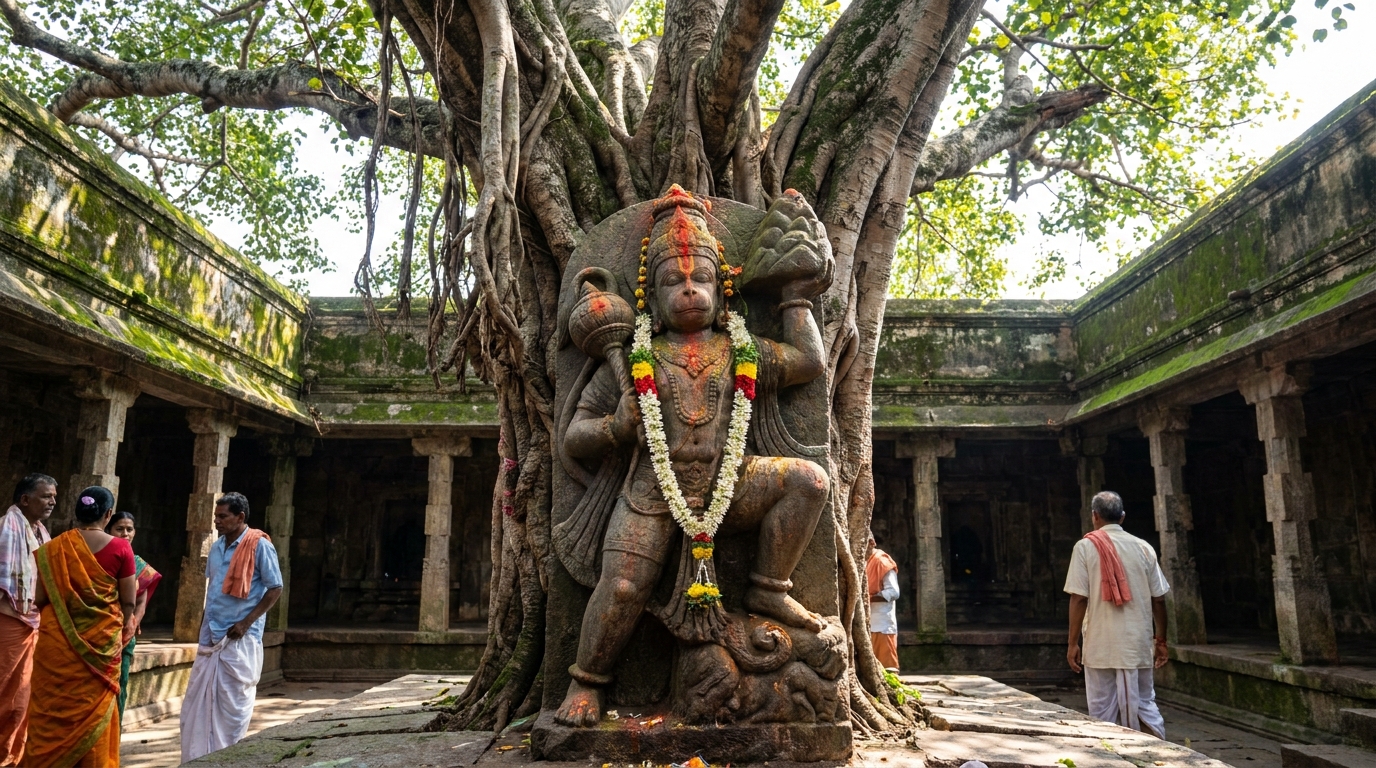
Hanuman is often worshiped as a symbol of strength, courage, and protection. But his greatest qualities are not merely physical. They are spiritual qualities that any sincere person can cultivate.
Humility
Hanuman’s humility is one of his most beautiful qualities. Though he is mighty, he bows. Though he is wise, he listens. Though he performs miracles, he remains a servant.
Humility in Bhakti Yoga does not mean thinking we are worthless. It means remembering that everything we have is a gift. Our talents, breath, intelligence, relationships, and opportunities are sacred trusts. We use them well, but we do not become proud.
In the Bhagavad Gita, Lord Krishna teaches that humility is one of the qualities of true knowledge. Hanuman shows this teaching through his life.
Courage
Hanuman’s courage comes from devotion. He is fearless because he is not centered on himself. His question is not, “Will I be safe?” His question is, “How can I serve Rama?”
This kind of courage is needed in daily life. It takes courage to forgive. It takes courage to be honest. It takes courage to keep faith during hardship. It takes courage to chant when the mind is restless. It takes courage to serve when no one notices.
Hanuman reminds us that courage grows when we remember we are not alone.
Faithfulness
Hanuman’s loyalty to Rama is unwavering. Through danger, uncertainty, and struggle, he stays fixed in devotion.
In spiritual life, faithfulness is very precious. Many of us begin with enthusiasm, but life brings tests. We may become distracted or discouraged. Hanuman shows us how to keep returning to the heart of devotion: remembering God, chanting God’s names, serving with sincerity, and staying connected to saintly association.
Wisdom
Hanuman is sometimes portrayed only as a strong warrior, but the scriptures also show him as deeply wise. His speech is refined. His decisions are thoughtful. He knows when to be gentle and when to be bold.
Bhakti is not separate from wisdom. True devotion helps us see clearly. We begin to ask, “What action will please God? What will bring healing? What will reduce suffering? What will help love grow?”
Hanuman’s wisdom is practical, compassionate, and surrendered.
Hanuman and the Power of the Holy Name
One of the most accessible practices in Bhakti Yoga is chanting. Chanting means repeating sacred names of God with attention and devotion. In Sanskrit, this is often called nama-sankirtana—the congregational chanting of the holy names—or japa, quiet personal repetition on beads.
Hanuman is forever connected with the name of Rama. His strength comes from remembering and chanting Rama’s name.
Why Chanting Matters
The holy name is not considered an ordinary sound in Bhakti tradition. The name of God is understood to carry divine presence. When we chant sincerely, the heart becomes cleansed, softened, and strengthened.
For someone new to chanting, this can be very simple. You might begin with:
“Rama”
“Sita Rama”
“Jai Hanuman”
“Hare Krishna Hare Krishna, Krishna Krishna Hare Hare / Hare Rama Hare Rama, Rama Rama Hare Hare”
There is no need to force emotion. Just chant with sincerity. Let the sound enter the heart. Over time, chanting becomes a shelter.
Hanuman Chalisa as Devotional Prayer
Many devotees honor Hanuman by reciting the Hanuman Chalisa, a forty-verse prayer composed by Tulsidas. The word chalisa means “forty.” This prayer praises Hanuman’s qualities and asks for strength, protection, wisdom, and devotion.
For people of all backgrounds, the Hanuman Chalisa can be approached as a heartfelt prayer. Even if one does not understand every word at first, the mood is powerful: “May I become strong in service. May my mind be purified. May I remember Rama. May I be protected from fear and negativity.”
Prayer is not about performance. It is the honest offering of the heart.
Lessons from Hanuman for Daily Spiritual Life
Hanuman’s life is sacred, but it is also practical. He shows us how to live devotion in ordinary moments.
Begin the Day With Remembrance
Before stepping into responsibilities, we can take a moment to remember God. This may be a prayer, a mantra, a verse, or simply a sincere thought:
“Dear Lord, please guide me today. Let my words and actions be useful. Let me serve with love.”
This small practice can change the atmosphere of the whole day.
Offer Your Work
In the Bhagavad Gita, Krishna teaches that we can offer our work to the Divine. This is called karma-yoga when action is offered without selfish attachment, and it becomes deeply connected with Bhakti when the offering is made with love.
Hanuman does not separate service from spirituality. His work is worship. In the same way, our daily work can become sacred when we offer it.
A teacher can teach as service. A parent can care as service. A doctor can heal as service. An artist can create as service. A businessperson can act honestly and generously as service. A student can study as service. A retiree can pray, guide, and encourage as service.
Serve Someone Without Needing Credit
One Hanuman-like practice is to serve quietly. Do something kind without announcing it. Help someone without expecting praise. Give in a way that protects the dignity of the receiver.
This softens the ego and brings joy to the heart.
Use Strength to Protect, Not Dominate
Hanuman is strong, but his strength is never cruel. He uses power to protect dharma—truth, righteousness, and sacred order. He stands against injustice, but he remains a servant of God.
In our lives, strength may look like influence, knowledge, money, physical ability, emotional stability, or social position. Hanuman asks us: How will you use your strength? Will it serve ego, or will it serve love?
Keep Good Company
Hanuman’s devotion is nourished through association with Rama, Sita, Lakshmana, and other devotees. In Bhakti Yoga, spiritual community is called satsang. Sat means truth, and sang means association. Satsang means keeping company with those who inspire truth, devotion, and goodness.
We all need encouragement. We all need reminders. Just as Jambavan reminded Hanuman of his strength, spiritual friends can remind us of who we truly are.
Hanuman’s Service to Sita: Compassion in Action
A deeply moving part of Hanuman’s story is his meeting with Sita in Lanka. Sita represents devotion, purity, and the soul’s longing for union with the Divine. She is in sorrow, separated from Rama, surrounded by darkness.
Hanuman comes not as a conqueror first, but as a messenger of hope.
The Gift of Hope
When Hanuman gives Sita Rama’s ring, it is more than a sign. It is hope made visible. It says, “You are not forgotten. Help is coming. Rama knows your pain.”
Many people today feel forgotten, lonely, or spiritually distant. To serve like Hanuman means to become a carrier of hope. Sometimes the greatest service is to remind someone: “You are loved. God has not abandoned you. Your life has meaning.”
Listening Before Acting
Hanuman could have tried to carry Sita away immediately, but Sita chose to wait for Rama to come. Hanuman respected her heart and her dignity.
This is a profound lesson. Service is not controlling others “for their own good.” True service listens. It honors the person. It seeks to understand before acting.
In families, friendships, communities, and spiritual spaces, Hanuman’s example can guide us to serve with patience and respect.
Hanuman and Inner Obstacles
The stories of Hanuman are not only outer adventures. They also symbolize the inner journey of the soul.
Crossing the Ocean of Doubt
Hanuman’s leap across the ocean can represent crossing the ocean of doubt, fear, and forgetfulness. The soul longs to reconnect with God, but the mind may feel overwhelmed.
What helps Hanuman leap? Remembrance of Rama. Encouragement from devotees. Faith in his mission.
We can also cross our inner oceans through chanting, prayer, scripture, service, and spiritual friendship.
Burning the Lanka of Ego
When Hanuman’s tail is set on fire in Lanka, he uses that very fire to burn the city’s pride and arrogance. Spiritually, this can remind us that even painful experiences can become part of purification when offered to God.
The “Lanka” within us may be pride, greed, envy, resentment, or forgetfulness. Hanuman’s fire is the fire of devotion. Bhakti does not destroy the soul; it burns what covers the soul.
Carrying the Mountain of Healing
When Lakshmana is wounded in battle, Hanuman is sent to bring a healing herb from the Himalayas. Unable to identify the exact herb, he carries the entire mountain.
This story is both heroic and tender. Hanuman does not give up because the task is difficult. He finds a way.
In our lives, we may not always know the perfect solution. But we can still bring the “mountain” of our sincerity. We can show up. We can pray. We can offer support. We can keep serving.
What Hanuman Teaches Modern Seekers
Many people today are searching for spirituality that is real, grounded, and compassionate. Hanuman speaks directly to this need.
Devotion Is Not Weakness
In a world that often celebrates self-promotion, Hanuman shows that surrender is not weakness. Devotion gives strength. Humility gives clarity. Service gives purpose.
Hanuman is gentle with the suffering and fierce against injustice. This balance is deeply needed today.
Spiritual Growth Happens Through Service
We may want spiritual experiences, peace, or insight. These are beautiful, but Hanuman reminds us that growth often comes through service. When we serve, we confront our impatience, pride, and selfishness. We learn to love beyond convenience.
Service is a mirror. It shows us where we need healing. It also reveals the joy of living for something greater than ourselves.
God Can Use Every Gift
Some people feel they are not spiritual enough. Others feel they have made too many mistakes. Some feel they have nothing special to offer.
Hanuman’s life tells us: offer what you have. God can use your voice, your hands, your mind, your time, your cooking, your listening, your creativity, your strength, your tears, and your prayers.
In Bhakti Yoga, sincerity is more important than outer qualification.
Practicing Hanuman-Like Devotion at Home
You do not need a temple room or elaborate setup to begin honoring Hanuman’s mood of service. A simple, sincere practice is enough.
Create a Small Sacred Pause
Set aside a few minutes each day. Light a candle if you like. Place a picture of Hanuman, Rama, Sita, or any form of God that awakens devotion in your heart. Sit quietly and breathe.
Then pray:
“Dear Lord, please help me serve with humility, courage, and love. May I remember You in all I do.”
Chant With Attention
Choose a simple mantra or name of God. Repeat it daily. If you feel connected to Hanuman, you may chant:
“Jai Hanuman”
“Jai Shri Ram”
“Sita Ram”
The word jai means “victory” or “glory.” So “Jai Hanuman” means “Glory to Hanuman,” and “Jai Shri Ram” means “Glory to Lord Rama.”
Chant softly, sing, or repeat inwardly. The heart responds to regular, loving practice.
Read a Little Scripture
Reading even a small passage from the Ramayana, Ramcharitmanas, Bhagavad Gita, or other Bhakti scriptures can nourish devotion. The purpose is not to collect information, but to receive guidance.
Ask yourself:
“What quality is being shown here?”
“How can I practice this today?”
“How does this bring me closer to God?”
Do One Act of Seva
Each day, choose one act of selfless service. It may be very small. Send a kind message. Clean a shared space. Feed someone. Donate. Volunteer. Pray for a person in pain. Help without needing to be seen.
Offer it inwardly:
“May this be for You.”
This simple intention transforms ordinary action into Bhakti.
Hanuman’s Eternal Message
Hanuman remains beloved because he shows the beauty of a heart fully given to God. He is strong, but humble. Fearless, but gentle. Wise, but simple. Active, but surrendered.
He does not ask us to imitate his miracles. He invites us to embody his mood.
To remember Hanuman is to remember that devotion is practical. Love can be lived. Prayer can become service. Chanting can become courage. Humility can become strength. Faith can carry us across oceans.
The path of Bhakti Yoga is not reserved for a few. It is open to every sincere heart. Whether you are new to spiritual life or have been practicing for many years, Hanuman’s example can guide you deeper into loving service.
May we learn to serve without pride. May we chant with sincerity. May we protect and encourage one another. May we remember God in times of joy and difficulty. And may the spirit of Hanuman awaken within us—the spirit of selfless love, fearless devotion, and joyful surrender.
Everyone is welcome on this path. Wherever you are, whatever your background, you can take one sincere step toward God today: chant one holy name, offer one prayer, read one sacred verse, or serve one person with love.
FAQs
What is the story of Hanuman and the Ideal of Service?
The story of Hanuman and the Ideal of Service comes from the Hindu epic, the Ramayana. Hanuman is a central character in the epic and is known for his unwavering devotion and service to Lord Rama.
What is the ideal of service represented by Hanuman?
Hanuman represents the ideal of selfless service, devotion, and loyalty. He is a symbol of dedication, humility, and sacrifice, and is revered for his unwavering commitment to serving Lord Rama.
How does Hanuman’s story inspire people?
Hanuman’s story inspires people to cultivate qualities such as selflessness, devotion, and loyalty in their own lives. His example encourages individuals to serve others with dedication and humility, without expecting anything in return.
What lessons can be learned from Hanuman’s devotion and service?
Hanuman’s devotion and service teach valuable lessons about the power of selfless action, the importance of loyalty and dedication, and the impact of serving others with humility and love.
How is Hanuman’s story relevant in today’s world?
Hanuman’s story remains relevant in today’s world as it serves as a timeless reminder of the significance of selfless service, devotion, and loyalty. His example continues to inspire individuals to serve others with dedication and humility, fostering a sense of unity and compassion in society.

