

Awakening Devotion in Everyday Life
Spiritual growth does not always begin with a dramatic revelation. Often, it begins quietly.
A longing appears in the heart. A question rises within us: “Is there more to life than work, worry, pleasure, pain, and passing success?” We may feel grateful, but still incomplete. We may be surrounded by people, yet inwardly lonely. We may have beliefs, but still desire a living connection with God.
In the Bhakti tradition, this longing is sacred. It is not a weakness. It is the soul remembering its source.
Bhakti Yoga is the path of awakening devotion—loving connection with the Divine through chanting, prayer, service, remembrance, and sincere spiritual practice. The Sanskrit word bhakti means loving devotion, and yoga means union or connection. So Bhakti Yoga is the path of reconnecting with God through love.
This path is open to everyone. You do not need to be born into a particular culture, have perfect knowledge, or live in a monastery. You may be a parent, student, professional, artist, caregiver, seeker, or someone just beginning to explore spirituality. Bhakti begins wherever you are.
In the Bhagavad-gita, one of the most beloved scriptures of Bhakti Yoga, Lord Krishna says, “Whatever you do, whatever you eat, whatever you offer or give away, and whatever austerities you perform—do that as an offering to Me” (Bhagavad-gita 9.27). This simple teaching brings devotion into daily life. Our ordinary actions can become sacred when offered with love.
Awakening devotion is not about escaping the world. It is about learning to see God’s presence in the world, in others, and within our own hearts. It is a complete path of spiritual growth, grounded in humility, joy, discipline, compassion, and love.
Understanding Bhakti Yoga as a Path of Love
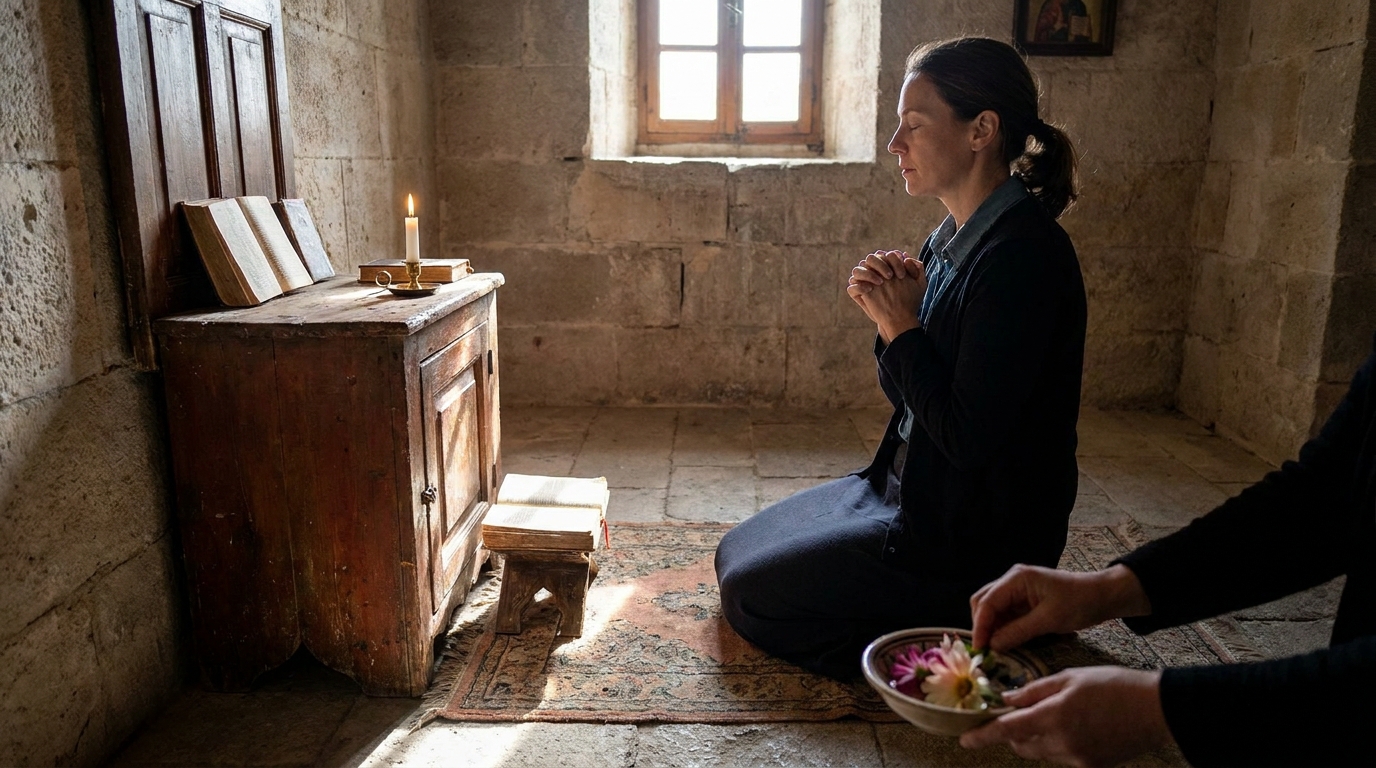
Bhakti Yoga is sometimes described as the heart of all spiritual practice because it centers on relationship. We are not merely trying to understand God as an idea. We are learning to love and be loved by the Supreme Person.
In Sanskrit, God is often called Bhagavan, meaning “the one who possesses all divine qualities in full”—beauty, wisdom, strength, compassion, fame, wealth, and renunciation. In Bhakti, God is not distant or impersonal. God is deeply personal, approachable, and loving.
Devotion Is Natural to the Soul
The Bhakti scriptures teach that love is our original nature. We are all seeking love because the soul is made for loving relationship. Yet in this world, love can become mixed with fear, expectation, disappointment, or attachment. Bhakti gently purifies the heart so love can become selfless, steady, and spiritually satisfying.
The Srimad-Bhagavatam, a sacred text treasured in the Bhakti tradition, describes the highest spiritual practice as devotion that is unmotivated and uninterrupted. In other words, real devotion is not done only for material gain, recognition, or comfort. It is love offered for the joy of serving God.
This may sound lofty, but it begins very simply. We can start by saying, “Dear Lord, I do not know how to love You fully, but I want to learn.”
That prayer is powerful.
Bhakti Welcomes the Whole Person
Some paths emphasize knowledge. Some emphasize meditation. Some emphasize discipline or ritual. Bhakti includes all of these, but places love at the center.
The mind is engaged through sacred wisdom. The voice is engaged through chanting. The hands are engaged through service. The heart is engaged through prayer. The body is engaged through worship, cooking, cleaning, walking, bowing, or caring for others.
Bhakti does not ask us to reject our humanity. It invites us to spiritualize it.
Our emotions, when offered to God, become part of the path. Our struggles can deepen our surrender. Our joys can become gratitude. Our talents can become service. Even our wounds can become places where divine compassion enters.
The Foundations of Spiritual Growth

Spiritual growth is not measured only by how much we know, how long we meditate, or how many religious practices we perform. In Bhakti Yoga, growth is seen in the softening of the heart.
Are we becoming more humble? More compassionate? More honest? More grateful? More willing to serve? More aware of God?
These are signs that devotion is awakening.
Faith as a Living Seed
In Sanskrit, faith is called shraddha. It does not mean blind belief. It means a tender trust that spiritual life has meaning and that God is lovingly guiding us.
Faith may begin very small, like a seed. If we water it through practice, association, and sincere inquiry, it grows. If neglected, it may remain dormant. The Bhakti path helps us protect and nourish this seed of devotion.
You may not feel strong faith every day. That is normal. Spiritual life moves through seasons. Some days we feel inspired; other days we feel dry or distracted. The important thing is to continue with sincerity.
A small daily practice done with honesty is often more transformative than occasional intensity.
Humility Opens the Heart
Humility is essential in Bhakti Yoga. It does not mean thinking we are worthless. It means recognizing that we are dependent on divine grace.
We did not create the air we breathe, the sun that warms us, the earth that holds us, or the love that sustains us. Everything is a gift. Humility helps us receive life as sacred.
The great saint Sri Chaitanya Mahaprabhu, who spread the chanting of God’s names widely in India, taught that one should chant with humility, tolerance, and respect for others. This mood is foundational for real spiritual growth.
When we become humble, we stop trying to control everything. We become more available to God’s guidance.
Surrender as Loving Trust
Another important Sanskrit word is sharanagati, meaning surrender. In Bhakti, surrender is not defeat. It is loving trust.
To surrender means to bring our life before God and say, “Please guide me. I want to live in a way that pleases You. Help me let go of what keeps me far from You.”
This surrender unfolds gradually. We may begin by surrendering a worry, a habit, a decision, or a desire. Over time, we learn to offer our whole life.
The Bhagavad-gita ends with Krishna’s loving invitation: “Abandon all varieties of separate duties and simply surrender unto Me. I shall deliver you from all reactions. Do not fear” (Bhagavad-gita 18.66). This is not a call to irresponsibility. It is a call to deep trust in divine love.
Discover a wide range of insightful articles that delve into various spiritual topics. These articles provide guidance and inspiration for your personal growth journey. Stay updated with the latest articles to enhance your understanding of spiritual practices.
Chanting the Holy Names
One of the most accessible and powerful practices in Bhakti Yoga is chanting the holy names of God. This practice is called nama-sankirtana when done together in community, and japa when done softly or personally, often on prayer beads.
The Sanskrit word nama means name. In Bhakti, God’s names are considered spiritually powerful because they carry God’s presence. When we chant with sincerity, we are not merely repeating sound. We are calling out to the Divine.
Why Chanting Transforms the Heart
The mind is constantly filled with sounds—memories, worries, plans, judgments, songs, conversations, and endless inner noise. Chanting gives the mind a sacred sound to rest upon.
The Hare Krishna maha-mantra is one of the most well-known mantras in the Bhakti tradition:
Hare Krishna, Hare Krishna, Krishna Krishna, Hare Hare
Hare Rama, Hare Rama, Rama Rama, Hare Hare
Hare is a call to the divine energy of the Lord, especially the compassionate feminine aspect of God. Krishna means “the all-attractive one.” Rama means “the source of joy” or “the one who gives spiritual pleasure.” Together, this mantra is a prayer: “O Lord, O divine energy of the Lord, please engage me in Your loving service.”
You do not need to fully understand Sanskrit to benefit from chanting. Like sunlight, spiritual sound works even when we are still learning how it works. But as understanding deepens, chanting becomes more personal and heartfelt.
Beginning a Simple Chanting Practice
If you are new to chanting, begin gently.
Choose a quiet time of day, perhaps morning or evening. Sit comfortably. Take a few deep breaths. Offer a simple prayer: “Dear God, please help me chant with sincerity.” Then repeat the mantra slowly, listening carefully to each word.
You may chant for five minutes, ten minutes, or one round on beads if you have them. The goal is not performance. The goal is presence.
When the mind wanders, do not become discouraged. Bring it back kindly. Every return is part of the practice.
Over time, chanting can become an anchor. It can calm anxiety, purify thoughts, awaken gratitude, and help us feel connected to God throughout the day.
Chanting in Community
Chanting with others is called kirtan. In kirtan, sacred mantras are sung call-and-response style, often with instruments like harmonium, drum, and kartals, or hand cymbals.
Kirtan is joyful, healing, and welcoming. You do not need a trained voice. You do not need to know the melodies. You can simply listen, clap, sing softly, or let the sound wash over your heart.
Many people experience kirtan as a spiritual homecoming. The atmosphere of shared devotion reminds us that we are not alone on the path.
Prayer, Meditation, and Inner Relationship with God
Prayer is the language of the heart. It may be formal or spontaneous, silent or spoken, joyful or tearful. In Bhakti Yoga, prayer is not only asking God for things. It is building relationship.
We can pray in gratitude, confusion, longing, repentance, love, or surrender. God is not offended by our honesty. A sincere prayer, even if imperfect, is precious.
Making Prayer Personal
Many people wonder, “How should I pray?” The answer is simple: begin where you are.
You might say:
“Dear Lord, please guide me.”
“Please help me remember You today.”
“Please give me strength to act with kindness.”
“Please help me serve.”
“Please purify my heart.”
“Thank You for this life and for every opportunity to grow.”
Prayer becomes deeper when we stop trying to sound spiritual and start being real. The Lord already knows our heart. Prayer helps us become honest in His presence.
Remembering God During the Day
In Sanskrit, remembrance of God is called smaranam. It is one of the classic practices of Bhakti described in the Srimad-Bhagavatam. Remembrance means bringing God into our awareness again and again.
We can remember God while walking, cooking, driving, working, caring for children, or facing difficulty. A brief pause can become sacred.
Before eating, we can offer gratitude. Before beginning work, we can ask to serve with integrity. When meeting someone, we can remember that they are a soul, a beloved child of God. When facing stress, we can breathe and repeat a holy name.
These small moments gradually reshape consciousness.
Meditation in Bhakti Yoga
Meditation in Bhakti is not emptying the heart of all relationship. It is filling the heart with divine relationship.
We may meditate on the sound of the holy name, the form of the Lord, a verse from scripture, or the qualities of God—kindness, beauty, mercy, playfulness, protection, and love.
The Bhagavad-gita teaches that the mind can be both friend and enemy. When trained through spiritual practice, the mind becomes a friend. Bhakti meditation gives the mind a loving focus and gives the heart a safe place to rest.
Sacred Wisdom for Practical Living
Bhakti Yoga is deeply devotional, but it is not anti-intellectual. Sacred study is an important part of spiritual growth. Scripture gives direction, protection, and inspiration.
In Sanskrit, sacred wisdom is often called shastra. Shastra helps us understand who we are, who God is, why we suffer, and how to live with purpose.
The Bhagavad-gita as a Guide for the Soul
The Bhagavad-gita is a conversation between Lord Krishna and Arjuna, a warrior facing a painful moral crisis. Arjuna is confused, overwhelmed, and unsure what to do. Krishna does not shame him. He teaches him with compassion.
This setting is meaningful. Spiritual wisdom is not only for peaceful moments. It is for the battlefield of life—when we face grief, duty, fear, conflict, and uncertainty.
Krishna teaches that we are not the temporary body but the eternal soul, called atman. The body changes from childhood to youth to old age, but the self remains. Understanding this helps us live with deeper dignity and less fear.
Krishna also teaches karma-yoga, the practice of offering our work to God without selfish attachment to the results. When combined with devotion, our work becomes service.
The Srimad-Bhagavatam and the Beauty of Devotion
The Srimad-Bhagavatam expands the heart through stories, prayers, teachings, and descriptions of God’s loving relationships with His devotees. It shows that devotion is not dry duty. It is full of beauty, emotion, courage, friendship, surrender, and joy.
The Bhagavatam teaches that hearing about God is itself a purifying practice. When we hear sacred stories with faith, our heart becomes cleansed of envy, fear, and material obsession.
This does not happen by force. It happens like a sunrise. Gradually, light enters.
The Narada Bhakti Sutra and Pure Love
The Narada Bhakti Sutra is a beautiful text that describes devotion as the highest form of love. It teaches that bhakti is immortal, satisfying, and beyond selfish desire.
One of its core messages is that pure devotion brings complete fulfillment because it connects the soul with its eternal beloved, God.
For practical seekers, this means we can ask ourselves: “Is my spiritual practice helping me love more? Am I becoming more generous, patient, and God-centered?”
If so, we are moving in the right direction.
Service as the Expression of Devotion
Love naturally wants to serve. In Bhakti Yoga, service is called seva. Seva means offering our time, energy, skills, and heart for the pleasure of God and the benefit of others.
Service is not just volunteering, though it may include that. It is a sacred attitude. We can serve through cooking, teaching, cleaning, listening, encouraging, giving, singing, organizing, caring, or simply being present with compassion.
Serving God Through Others
Bhakti helps us see every living being as part of God’s family. This vision changes how we treat people.
We may not agree with everyone. We may need healthy boundaries. But we can still honor the soul within each person.
Serving others does not mean becoming exhausted or losing ourselves. True seva is rooted in spiritual connection. We serve not to prove our worth, but because love overflows.
A kind word can be seva. Preparing a meal can be seva. Forgiving someone can be seva. Supporting a spiritual community can be seva. Caring for the earth and animals can also be seva when done in a mood of reverence.
Offering Food with Love
One of the most beloved practices in Bhakti Yoga is offering food to God before eating. Food offered with love becomes prasadam, meaning “mercy” or “grace.”
The process can be simple. Prepare vegetarian food with cleanliness and gratitude. Place a portion before a picture or sacred space and say a prayer: “Dear Lord, please accept this offering made with love.” After a few moments, the food is honored as blessed.
This practice transforms eating into communion. It reminds us that nourishment is a gift and that our body is meant to be used in service.
In the Bhagavad-gita 9.26, Krishna says, “If one offers Me with love and devotion a leaf, a flower, fruit, or water, I will accept it.” The emphasis is not luxury. The emphasis is love.
Serving in Community
Spiritual community, or sangha, is vital. We grow more steadily when we walk with others who encourage devotion.
A Bhakti community may gather for chanting, classes, meals, festivals, prayer, and service. In such spaces, we learn not only from teachings but from people’s examples—their humility, perseverance, kindness, and faith.
Community also reveals our growth areas. Relationships may challenge our ego, impatience, or expectations. But these challenges can become opportunities for purification when approached with honesty and forgiveness.
Overcoming Obstacles on the Path
Every spiritual seeker faces obstacles. This does not mean we are failing. It means we are human.
The path of devotion is merciful because it gives us tools to keep going even when we feel weak.
Dealing with Doubt
Doubt can be uncomfortable, but it is not always an enemy. Honest questions can deepen faith when we bring them into thoughtful study, prayer, and conversation with sincere practitioners.
The Bhagavad-gita encourages inquiry. Krishna does not demand that Arjuna suppress his confusion. He invites him to listen, reflect, and then choose.
If you have doubts, bring them with humility. Read scripture. Ask trusted teachers. Pray for clarity. Continue your practice gently. Often, understanding comes through living the teachings, not only analyzing them.
Facing Distraction and Inconsistency
Modern life is full of distraction. Our attention is pulled in many directions. It can be difficult to maintain regular spiritual practice.
Start small. Choose one daily commitment you can keep. It may be chanting one round, reading one verse, offering one prayer, or taking a few moments of gratitude before bed.
Consistency grows through kindness, not self-hatred. If you miss a day, begin again the next day. Bhakti is not about perfectionism. It is about returning.
Healing from Spiritual Wounds
Some people come to devotion carrying pain from religion, family, community, or past experiences. If this is you, please know that God’s love is gentle.
Authentic Bhakti never requires manipulation, shame, or fear-based control. Real spiritual growth honors the dignity of the soul. It encourages humility, but not humiliation. It encourages surrender, but not abuse. It encourages discipline, but not hardness of heart.
Take your time. Seek healthy community. Pray honestly. Let devotion become a place of healing.
Creating a Daily Bhakti Practice
A daily practice helps devotion become steady. It does not need to be complicated. The best practice is one that is sincere, sustainable, and gradually deepening.
A Simple Morning Practice
Morning is a powerful time for spiritual life because the mind is often clearer. Even 20 minutes can change the direction of the day.
You might begin with:
- Lighting a candle or sitting in a clean, quiet space
- Offering a short prayer of gratitude
- Chanting the holy names for 5 to 15 minutes
- Reading a verse from the Bhagavad-gita or another Bhakti text
- Setting an intention to serve with kindness
This simple rhythm awakens the heart before worldly demands take over.
A Devotional Practice for Busy People
If your life is full, do not feel discouraged. Bhakti can enter small spaces.
Chant while walking. Listen to kirtan while commuting. Keep a sacred verse on your phone. Offer your meals. Pause before meetings and pray, “May I be of service.” Remember God before sleep.
The goal is to weave devotion into life, not to wait for a perfect life before beginning devotion.
Evening Reflection and Gratitude
At night, take a few moments to review the day with God.
You might ask:
“Where did I remember You today?”
“Where did I forget?”
“Whom did I serve?”
“Where can I grow?”
“What am I grateful for?”
Then offer the day—successes, mistakes, joys, and regrets—into divine care. This practice brings peace and helps us wake up with renewed purpose.
The Fruits of Awakening Devotion
As devotion grows, life begins to change from within. The outer circumstances may not become perfect, but the heart becomes more connected, resilient, and peaceful.
A Softer Heart
One fruit of Bhakti is tenderness. We become less interested in harsh judgment and more interested in compassion. We begin to see others not as obstacles to our happiness, but as souls on their own journey.
This does not make us passive. Bhakti gives strength. But it softens the way we hold that strength.
Freedom from Self-Centered Living
Material life often trains us to ask, “What can I get?” Bhakti teaches us to ask, “How can I love? How can I serve? How can I remember God?”
This shift brings freedom. We are no longer trapped in endless comparison, competition, and consumption. We begin to taste joy in giving.
A Living Relationship with God
The deepest fruit of Bhakti is relationship with God. Over time, God becomes not only a concept but a beloved presence.
We may feel guided in decisions, comforted in sorrow, corrected in conscience, and embraced in prayer. We begin to sense that we are never truly alone.
The holy names become dear. Scripture becomes alive. Service becomes meaningful. Community becomes family. The heart begins to awaken.
Taking Your Next Sincere Step
Awakening devotion is a journey of grace. It is not rushed. It is not forced. It grows through sincere steps taken again and again.
You do not need to have everything figured out. You do not need to be perfect before approaching God. In Bhakti Yoga, the sincere desire to turn toward the Divine is already beautiful.
Begin with one step.
Chant one mantra. Offer one prayer. Read one verse. Serve one person. Prepare one meal with love. Attend one kirtan. Ask one honest question. Spend one quiet moment remembering that you are a soul, deeply loved by God.
The path of Bhakti is practical, joyful, and open to all. Wherever you come from, whatever your background, whatever your story, you are welcome.
May your heart be encouraged. May your devotion awaken gently and steadily. May you discover that God is nearer than you imagined, waiting lovingly for your one sincere step.
FAQs
What is the main focus of the article “Awakening Devotion: A Complete Guide”?
The article primarily focuses on exploring the concept of devotion, its significance in various spiritual practices, and how individuals can cultivate and deepen their sense of devotion in their daily lives.
Who can benefit from reading this guide?
This guide is beneficial for anyone interested in enhancing their spiritual journey, including beginners seeking to understand devotion, as well as seasoned practitioners looking for new insights and methods to deepen their practice.
What are some practical tips provided in the article for awakening devotion?
The article offers several practical tips, such as establishing a daily practice, incorporating meditation and prayer, engaging in community service, and reflecting on personal values and beliefs to foster a deeper connection to one’s spiritual path.
Does the article discuss any specific spiritual traditions related to devotion?
Yes, the article discusses various spiritual traditions, including but not limited to Hinduism, Buddhism, Christianity, and Sufism, highlighting how each tradition approaches the concept of devotion and offers unique practices to cultivate it.
Is there a section on overcoming challenges in developing devotion?
Yes, the article includes a section that addresses common challenges individuals may face in developing devotion, such as distractions, doubts, and lack of motivation, along with strategies to overcome these obstacles and maintain a consistent practice.

