
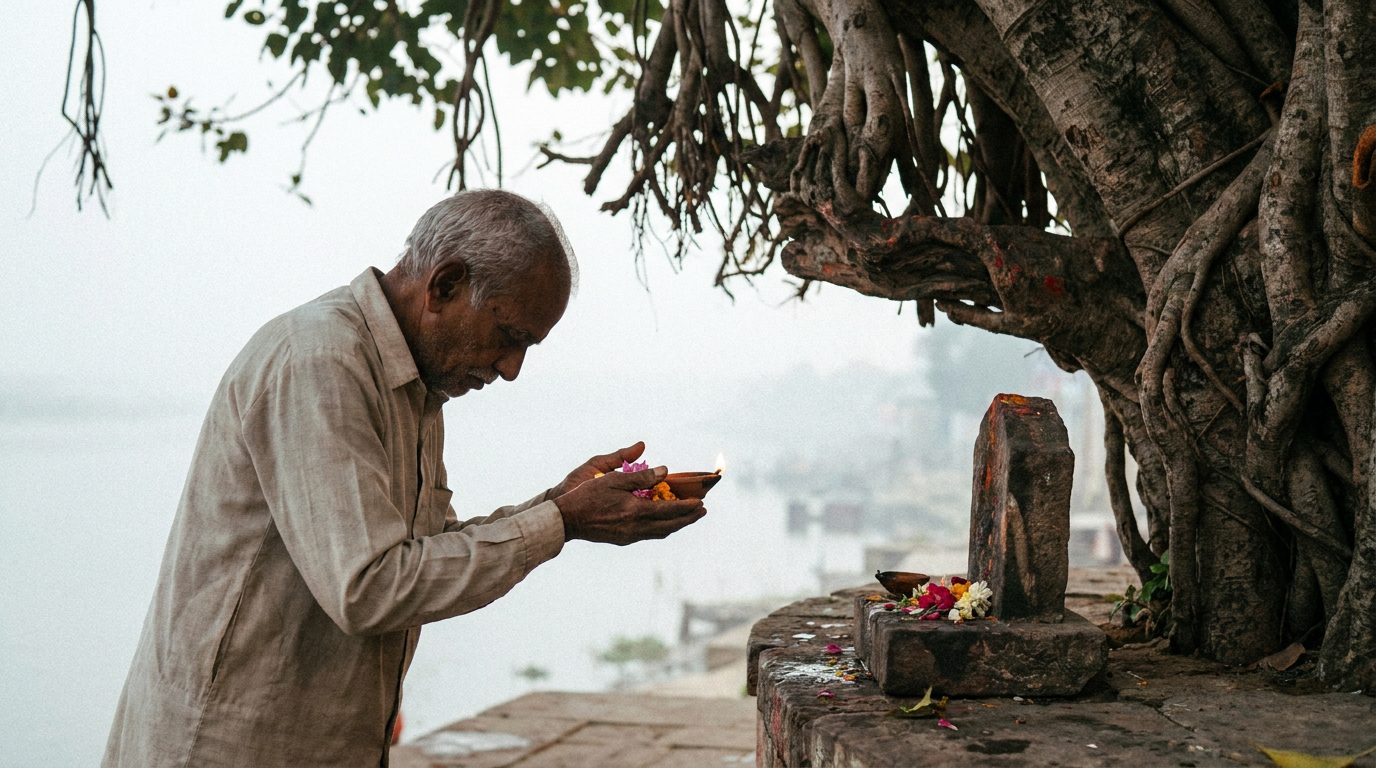
In the path of Bhakti Yoga, the heart is gently invited to move from “I am the controller” toward “I am lovingly held by God.” This journey is not forced, artificial, or reserved for a select few. It is a living, practical path open to every sincere soul—regardless of background, culture, age, education, or previous spiritual experience.
One of the most beautiful expressions of this path is Atma-nivedanam, often translated as complete self-surrender. In Sanskrit, atma means “self” or “soul,” and nivedanam means “offering” or “dedication.” Together, Atma-nivedanam means offering one’s whole self—body, mind, heart, words, actions, hopes, fears, and future—to the loving care of the Supreme Lord.
This is not a passive resignation or loss of individuality. In Bhakti, surrender is not defeat. It is the awakening of love. It is the soul remembering, “I belong to God, and I am safe in divine hands.”
Atma-nivedanam is the devotional practice of offering one’s entire being to God. It is considered one of the nine limbs of Bhakti, described in the Śrīmad-Bhāgavatam, a sacred Bhakti scripture that beautifully presents the lives, prayers, and realizations of great devotees.
The nine practices of Bhakti include hearing about God, chanting His names, remembering Him, serving His feet, worshiping Him, offering prayers, serving as His servant, becoming His friend, and finally, Atma-nivedanam—complete self-surrender.
A Simple Meaning of Self-Surrender
Self-surrender means to lovingly say, “My Lord, I am Yours.”
It means we stop trying to carry the entire weight of life alone. We still act, choose, work, care, and serve—but we do so with a changed heart. We begin to see ourselves as caretakers of God’s gifts rather than owners of everything.
Our body becomes an instrument for service.
Our speech becomes a way to bless and uplift.
Our mind becomes a place to remember the Divine.
Our home becomes a sacred space.
Our talents become offerings.
Our difficulties become invitations to deepen faith.
Surrender Is Love, Not Fear
Sometimes people hear the word “surrender” and feel hesitation. It may sound like giving up power, freedom, or dignity. But in Bhakti Yoga, surrender is rooted in love, trust, and relationship.
It is like a child resting in the arms of a loving parent. The child is not diminished by trust. The child is protected by it.
Atma-nivedanam is not about becoming weak. It is about becoming spiritually honest. It is the humble recognition that the soul finds its deepest joy not in separation from God, but in loving connection with God.
The Scriptural Foundation of Atma-nivedanam
Bhakti scriptures repeatedly teach that surrender is the heart of spiritual life. Not as a demand, but as a loving invitation from the Divine.
The Bhagavad-gītā’s Call to Surrender
In the Bhagavad-gītā, Lord Krishna speaks to Arjuna, a warrior facing confusion, grief, and moral struggle. Near the end of the Gītā, Krishna gives one of the most cherished teachings:
“Abandon all varieties of dharma and simply surrender unto Me. I shall deliver you from all sinful reactions. Do not fear.”
— Bhagavad-gītā 18.66
This verse can feel profound and even overwhelming. What does it mean practically?
It does not mean we abandon responsibility, compassion, or ethical living. Rather, Krishna is asking Arjuna—and all of us—to place our ultimate trust in God. Beneath all duties, identities, and social roles, there is one eternal truth: the soul belongs to the Supreme.
“Do not fear” is essential. Krishna does not invite surrender with threat, but with reassurance. He says, in effect, “Come to Me. I will protect you. You are not alone.”
The Example of Bali Mahārāja
A powerful example of Atma-nivedanam is found in the life of Bali Mahārāja, described in the Śrīmad-Bhāgavatam. Bali was a great king who was tested by the Lord in the form of Vāmanadeva, a divine dwarf-brāhmaṇa.
Vāmanadeva asked Bali for three steps of land. Bali agreed. Then the Lord expanded His form and covered the entire universe with two steps. There was nowhere left for the third. Understanding that everything he owned already belonged to God, Bali offered his own head for the Lord’s final step.
This is Atma-nivedanam.
Bali did not merely offer wealth, land, or words. He offered himself. His surrender was not transactional. It was total, honest, and courageous.
The Prayers of the Devotees
Many great Bhakti saints have prayed in the mood of surrender. Their prayers often express deep humility:
“O Lord, I am Yours. Please engage me in Your service.”
This mood is central to Bhakti. We are not trying to become God. We are trying to love God. We are not trying to control the Divine. We are trying to be lovingly guided by the Divine.
Why Self-Surrender Matters in Spiritual Life

Atma-nivedanam is not merely a lofty spiritual concept. It is deeply practical. Our suffering often increases when we believe we must control everything—people, outcomes, timing, success, reputation, and even our own inner healing.
Self-surrender softens this burden. It teaches us to act sincerely while offering the results to God.
Surrender Frees the Heart from Anxiety
Much of human anxiety comes from attachment to outcomes. We want life to unfold according to our plan. When it does not, we feel shaken.
Bhakti does not tell us to stop caring. It teaches us to care deeply, but with trust. We do our part with sincerity, and we place the result in God’s hands.
This is a daily practice. Before a meeting, we can pray. Before a difficult conversation, we can chant. Before making a decision, we can ask for guidance. After doing our best, we can release the result.
This does not remove every challenge, but it changes how we carry them.
Surrender Heals the Illusion of Isolation
The ego often whispers, “You are alone. You must prove yourself. You must protect yourself at all costs.”
Atma-nivedanam brings another message: “You belong to God. You are accompanied. You are seen.”
This does not mean life will always be easy. But it means our deepest identity is secure. We are not simply a body, a job title, a social role, or a collection of achievements and wounds. We are eternal souls, loved by the Supreme.
Surrender Turns Ordinary Life into Worship
When we offer ourselves to God, ordinary activities can become sacred.
Cooking becomes an offering.
Work becomes service.
Parenting becomes worship.
Friendship becomes a way to honor the Divine in others.
Rest becomes gratitude.
Even struggle becomes prayer.
This is the beauty of Bhakti Yoga. Spiritual life is not limited to a temple, church, mosque, monastery, yoga studio, or quiet meditation space. Wherever we are, we can begin offering our heart.
Check out our latest articles at https://thebhaktihouse.org/blog.
The Difference Between Healthy Surrender and Passive Resignation

It is important to understand that Atma-nivedanam is not the same as passivity, avoidance, or tolerating harm. True surrender awakens wisdom, courage, and loving action.
Surrender Does Not Mean Doing Nothing
In the Bhagavad-gītā, Krishna did not tell Arjuna to walk away from life. He guided Arjuna to act with devotion, clarity, and surrender. Arjuna still had to make choices. He still had to stand up. He still had to fulfill his duty.
Similarly, surrender does not mean we stop working, planning, healing, or serving. It means we stop imagining that we are the ultimate controller.
We act, but without arrogance.
We plan, but without obsession.
We serve, but without needing applause.
We love, but without trying to possess.
Surrender Does Not Mean Accepting Abuse
A devotional heart is humble, but humility does not mean allowing oneself or others to be mistreated. Every living being is a child of God. To protect oneself and others from harm can also be an act of devotion.
If someone is in an unsafe relationship or harmful environment, surrender may mean praying for strength, seeking help, setting boundaries, and taking wise action.
God’s love does not ask us to erase our dignity. It helps us remember it.
Surrender Includes Responsibility
Atma-nivedanam means, “My life is Yours, Lord. Please guide me to use it well.”
This mood naturally leads to responsibility. We become more mindful of our words, choices, habits, and relationships. We ask, “Is this pleasing to God? Is this helpful for my soul? Is this kind? Is this honest? Is this service?”
Surrender is not an escape from life. It is a sacred way to live life.
The Six Moods of Surrender in Bhakti
Bhakti teachers often describe surrender through six practical principles. These are not rigid rules. They are gentle guideposts for cultivating a surrendered heart.
Accept What Supports Devotion
The first principle is to accept what helps us remember and love God.
This may include chanting sacred names, reading scripture, spending time with sincere spiritual people, offering food with gratitude, attending devotional gatherings, and creating a peaceful sacred space at home.
For one person, this may begin with five minutes of prayer in the morning. For another, it may include daily mantra meditation. For another, it may be serving meals, singing kirtan, or studying the Bhagavad-gītā.
The point is not comparison. The point is sincerity.
Avoid What Weakens Devotion
The second principle is to gently reduce what pulls the heart away from love, clarity, and remembrance.
This does not mean becoming harsh or judgmental toward ourselves. Spiritual growth takes time. We may notice certain habits, media, conversations, environments, or patterns that increase envy, anger, greed, or distraction.
With humility, we can pray, “Lord, please help me release what keeps me far from You.”
Renunciation in Bhakti is not dry denial. It is making room for deeper joy.
Trust That God Protects
The third principle is faith in divine protection.
This does not always mean protection from every difficulty. Sometimes God protects us through lessons, delays, closed doors, uncomfortable truths, and unexpected changes.
A surrendered heart gradually learns to say, “Even if I do not understand, I trust that You are with me.”
This trust matures over time. It is nourished by chanting, prayer, scripture, and the company of devotees.
Accept God as Maintainer
The fourth principle is to recognize that God is the ultimate maintainer.
We may earn, cook, plan, and work hard, but the life-force itself is a gift. The sun, rain, earth, breath, intelligence, and opportunity are not fully in our control. Seeing this brings gratitude.
A surrendered person does not become careless. Rather, they work sincerely while remembering, “Everything comes by divine grace.”
Offer Oneself Fully
The fifth principle is the essence of Atma-nivedanam: offering oneself to God.
This can be expressed in a simple prayer:
“My Lord, whatever I have and whatever I am, I offer to You. Please guide me. Please use my life in Your service.”
We may not feel fully surrendered at first. That is okay. Even the desire to surrender is sacred. We can offer our lack of surrender too: “Lord, I want to trust You, but I am afraid. Please help me.”
This honesty is beautiful.
Cultivate Humility
The sixth principle is humility.
Humility does not mean thinking we are worthless. It means seeing clearly: “I am not the center of the universe. I am a beloved servant of God.”
In Bhakti, the word dāsa means “servant.” To be a servant of God is not a low identity; it is a joyful, eternal identity. Service is the natural expression of love.
Humility makes the heart soft. And a soft heart can receive grace.
How to Practice Atma-nivedanam in Daily Life
Complete self-surrender may sound like the highest stage of devotion, and in many ways it is. But we can begin practicing it today in small, sincere ways.
Begin the Day with an Offering
Before looking at your phone or rushing into tasks, pause for a moment.
You might pray:
“Dear Lord, thank You for this day. Please guide my thoughts, words, and actions. May I serve You and Your children with love.”
This simple beginning can change the tone of the whole day. It reminds us that life is not merely a race of responsibilities. It is an opportunity to love.
Chant the Holy Names
Chanting is one of the most accessible and powerful practices in Bhakti Yoga. The Sanskrit word mantra means a sacred sound that helps free the mind. In Bhakti, we chant names of God because God’s names carry divine presence.
A beloved mantra in the Bhakti tradition is the Mahā-mantra, meaning “great mantra”:
Hare Krishna Hare Krishna
Krishna Krishna Hare Hare
Hare Rama Hare Rama
Rama Rama Hare Hare
You do not need to be perfect to chant. You do not need to have everything figured out. You can chant softly, sincerely, and regularly.
Chanting is a way of saying, “Lord, please let me remember You.”
Offer Food with Gratitude
In Bhakti, food can become prasāda, which means “mercy” or “grace.” When we prepare food with love and offer it to God before eating, the meal becomes spiritually uplifting.
A simple offering prayer might be:
“Dear Lord, this food is Yours. Please accept it with my love and gratitude.”
Then, when we eat, we receive not just nutrition but grace. This daily act trains the heart in surrender: “Nothing is mine alone. Everything is a gift.”
Serve Others as Service to God
Atma-nivedanam naturally expresses itself as service. If we say, “I offer myself to God,” then we also begin to ask, “How can I care for God’s creation?”
Service may be grand or simple. Listening patiently. Feeding someone. Volunteering. Encouraging a friend. Cleaning a sacred space. Supporting a spiritual community. Sharing wisdom kindly. Caring for family without resentment.
In Bhakti, service offered with love purifies the heart.
Offer Your Work
Many people wonder how to live spiritually while working in the world. The Bhagavad-gītā gives a clear answer: offer your work to God.
Before beginning a task, inwardly say, “May this be an offering.” During the task, try to act with integrity. After the task, offer the result.
This practice transforms work from ego-centered striving into devotional action.
Pray Through Difficulty
Surrender becomes especially meaningful in times of uncertainty. When we are hurt, afraid, or confused, we may not be able to offer polished prayers. That is okay.
Simple prayers are often the most sincere:
“Please help me.”
“Please guide me.”
“Please stay with me.”
“Please teach me how to love.”
“Please carry what I cannot carry.”
God hears the heart, not just the words.
Common Obstacles to Self-Surrender
Everyone faces inner resistance on the path of surrender. This does not mean we are failing. It means we are human, and growth is unfolding.
Fear of Losing Control
Many of us cling to control because we are afraid. We may think, “If I surrender, what will happen to my dreams? My relationships? My security?”
Bhakti teaches that surrender does not destroy what is truly good for us. It purifies our desires and aligns us with a deeper purpose.
We may still have dreams, but we offer them. We may still make plans, but we hold them gently. We may still love people, but we remember they belong to God too.
Doubt in God’s Love
Some people struggle to surrender because they are unsure whether God is truly loving. Perhaps they have experienced pain, religious judgment, or disappointment.
Bhakti invites us to rediscover God not as a distant critic, but as the most intimate well-wisher of the soul. Krishna in the Bhagavad-gītā says He is the friend of all living beings. This friendship is not sentimental; it is eternal.
If trust feels difficult, begin with honesty. Pray, “If You are there, please help me know You.” Such a prayer is a powerful beginning.
Attachment to Identity
We often identify with roles: parent, professional, artist, student, leader, caregiver, seeker. These identities can be meaningful, but they are not the whole self.
Atma-nivedanam does not erase these roles. It places them in a sacred context. We begin to live them as offerings rather than sources of ego.
The deepest identity is not something we have to manufacture. It is already within us: eternal soul, beloved of God.
Spiritual Perfectionism
Some seekers feel, “I am not surrendered enough. My mind wanders. I still struggle. Maybe I am not qualified.”
But Bhakti is not about presenting a perfect image. It is about offering a sincere heart.
Even if we can offer only one small part of ourselves today, that offering matters. A little chanting, a little prayer, a little service, a little humility—these are seeds of surrender.
God can grow a forest from one sincere seed.
Atma-nivedanam and the Heart of Bhakti Yoga
Bhakti Yoga is the path of devotion, the path of loving relationship with God. Atma-nivedanam is one of its deepest fruits because love naturally wants to give itself.
When we truly love, we do not only give objects. We give attention, time, trust, care, and presence. In the highest sense, we give ourselves.
Love Is the Essence
Bhakti is not merely philosophy, ritual, or discipline—though all of these can support it. The essence is love.
The soul longs to love and be loved perfectly. In this world, love is often mixed with fear, expectation, insecurity, or loss. But divine love is the soul’s eternal home.
Atma-nivedanam is the movement toward that home.
Surrender Deepens Relationship
In any loving relationship, trust deepens intimacy. The more we trust God, the more naturally we speak to Him, remember Him, depend on Him, and serve Him.
This relationship becomes personal. God is not just an abstract energy or distant idea. In Bhakti, the Supreme is understood as a loving person, full of beauty, wisdom, compassion, and sweetness.
We may approach God by many names. Krishna, Rama, Vishnu, Narayana, Radha, Govinda, and many others are cherished names in the Bhakti tradition. The sincere calling of the heart is what matters most.
The Role of Grace
Self-surrender is both our practice and God’s gift. We make effort, but grace carries us beyond our limited strength.
Just as a small child may reach up, and the parent lifts them, the devotee reaches through prayer, chanting, and service—and God responds with mercy.
Our part is sincerity. God’s part is grace.
Practical Signs of Growing Surrender
How do we know if Atma-nivedanam is gradually awakening in our heart? It may not appear as a dramatic event. Often, surrender grows quietly.
More Peace Amid Uncertainty
We may still face challenges, but we feel less alone. We remember to pray sooner. We recover from disappointments with more faith. We feel held, even when life is unresolved.
More Gratitude
A surrendered heart notices gifts everywhere: breath, food, friendship, scripture, sunlight, opportunities to serve, and even lessons hidden in hardship.
Gratitude is one of the fragrances of surrender.
Less Need for Recognition
When service becomes an offering to God, we become less dependent on praise. Appreciation is still sweet, but it is not the foundation of our worth.
We begin to feel joy simply in serving.
More Compassion for Others
As we surrender, we see others more gently. We understand that everyone is struggling, learning, longing, and being guided in different ways.
This vision helps us become kinder.
A Stronger Desire to Remember God
Perhaps the most important sign is a growing desire to remember God—not only in formal practice, but throughout the day.
We may find ourselves chanting while walking, praying while cooking, or silently offering gratitude in the middle of work. This is Bhakti becoming natural.
A Gentle Atma-nivedanam Practice
If you would like to begin practicing self-surrender, here is a simple devotional exercise. You can do it in the morning, evening, or whenever your heart feels ready.
Step 1: Sit Quietly
Find a peaceful place. Sit comfortably. Take a few slow breaths. Let the body soften.
You do not need to create a perfect meditation environment. Just come as you are.
Step 2: Remember God’s Presence
Bring to mind the Divine in whatever form feels sacred to you. You may remember Krishna, Rama, Radha, Vishnu, or simply the loving presence of God in your heart.
Say inwardly, “You are here. I am not alone.”
Step 3: Offer What You Are Carrying
Name what is in your heart.
“My Lord, I offer You my worries.”
“I offer You my plans.”
“I offer You my family.”
“I offer You my work.”
“I offer You my confusion.”
“I offer You my desire to love You.”
Be honest and simple.
Step 4: Chant or Pray
Chant the Mahā-mantra or another sacred name of God. Even a few minutes can be powerful when done sincerely.
Let the sound carry your heart.
Step 5: Ask to Serve
End with a prayer:
“Please guide me today. Please let me serve You in some small way.”
Then look for one opportunity to act with love.
Living the Prayer: “I Am Yours”
Atma-nivedanam is not completed in one moment and then forgotten. It is lived again and again. In joy, we offer gratitude. In pain, we offer tears. In confusion, we offer questions. In success, we offer the results. In failure, we offer our humility.
The path of surrender is tender. Some days we may feel full of faith. Other days we may feel distracted or doubtful. Still, every sincere step counts.
Bhakti Yoga welcomes the whole person. We do not have to hide our humanity from God. We can bring everything to the altar of love.
The Courage to Trust
To surrender is courageous because it asks us to trust beyond what we can see. It asks us to loosen the grip of ego and open the hands of the heart.
But what do we find when we open those hands?
We find that God was already holding us.
The Joy of Belonging
Atma-nivedanam leads to the joy of belonging. Not belonging to a label or institution alone, but belonging to the Supreme Beloved.
This belonging is the soul’s shelter. It is not dependent on external success. It cannot be taken away by time. It is eternal.
One Step Is Enough to Begin
If complete self-surrender feels far away, do not be discouraged. Begin with one sincere step.
Chant one round.
Offer one meal.
Say one prayer.
Read one verse.
Forgive one person.
Serve one soul.
Ask God for help once today.
In Bhakti, sincerity is more important than display. The Lord sees the smallest offering made with love.
Everyone Is Welcome on the Path of Surrender
Atma-nivedanam is a sacred invitation to come closer to God with our whole heart. It is the journey from fear to trust, from control to offering, from isolation to relationship, from ego-centered living to love-centered living.
You do not need to be born into a particular tradition to begin. You do not need to know Sanskrit. You do not need to be perfect, pure, or advanced. Bhakti begins wherever you are.
Come with your questions. Come with your hopes. Come with your doubts. Come with your longing. The path of Bhakti Yoga is wide enough for every sincere soul.
May we each find the courage to say, in our own simple way, “My Lord, I am Yours.” And may that prayer guide us into chanting, prayer, service, spiritual growth, and deeper love.
Everyone is welcome to take one sincere step toward God today.
FAQs
What is Atma-nivedanam?
Atma-nivedanam is a concept in Hindu philosophy that refers to the complete surrender of the self to a higher power or divine entity. It is a practice of offering oneself entirely to the will of God.
What are the key principles of Atma-nivedanam?
The key principles of Atma-nivedanam include self-surrender, devotion, humility, and acceptance of the divine will. Practitioners strive to let go of their ego and desires, and instead, align themselves with the greater purpose of the universe.
How is Atma-nivedanam practiced?
Atma-nivedanam is practiced through various spiritual disciplines such as prayer, meditation, self-reflection, and acts of service. It involves cultivating a deep sense of surrender and trust in the divine, and letting go of attachment to the outcomes of one’s actions.
What are the benefits of practicing Atma-nivedanam?
Practicing Atma-nivedanam is believed to bring inner peace, contentment, and a sense of purpose. It can help individuals overcome feelings of anxiety, fear, and insecurity by fostering a deep connection with the divine and a sense of being part of something greater than oneself.
Are there any specific rituals or ceremonies associated with Atma-nivedanam?
While Atma-nivedanam is primarily a personal and internal practice, some individuals may choose to express their surrender through rituals or ceremonies such as offering prayers, performing acts of charity, or participating in religious gatherings. However, these external expressions are not mandatory for the practice of Atma-nivedanam.

