
Understanding the Heart Behind Bhakti Yoga
Bhakti Yoga is often described as the yoga of love and devotion. The Sanskrit word bhakti comes from a root that suggests loving participation, service, and heartfelt connection. In simple terms, Bhakti Yoga is the path of offering our mind, emotions, words, actions, and relationships to God.
For some people, God may be known as Krishna, Rama, Vishnu, Radha, Shiva, the Divine Mother, Allah, Christ, or simply the Supreme, the Source, or the Beloved. At The Bhakti House, we welcome seekers from all backgrounds. Bhakti Yoga does not begin with a demand that we become perfect. It begins with a sincere heart.
The psychology of Bhakti Yoga is deeply practical. It recognizes that human beings are emotional, relational, and meaning-seeking. We are shaped by what we love, what we remember, what we repeat, and what we serve. Bhakti practices gently redirect the heart toward a sacred center.
In the Bhagavad-gita, one of the most treasured scriptures of the Bhakti tradition, Krishna says:
“Always think of Me, become My devotee, worship Me, and offer your homage unto Me.”
— Bhagavad-gita 18.65
This is not merely a religious command. It is also a profound psychological invitation. What we think about regularly shapes our inner world. What we worship—consciously or unconsciously—shapes our values. What we serve shapes our identity.
Bhakti Yoga helps us become aware of these inner patterns and lovingly reorient them toward divine connection, compassion, humility, and joy.
The Psychology of Devotion: Why Love Transforms the Mind
Modern psychology often speaks about attachment, identity, emotional regulation, and meaning. Bhakti Yoga has addressed these same human needs for thousands of years, though in a devotional language.
The human heart longs to love and be loved. When that longing is not guided spiritually, it may become scattered through endless desires, anxieties, comparisons, or attachments. Bhakti does not reject the heart’s need for love. Instead, it honors that longing and offers it a sacred direction.
Devotion Gives the Mind a Loving Focus
The mind is naturally restless. In Sanskrit, the word manas refers to the mind as it thinks, feels, doubts, and moves from one object to another. Many of us experience this every day: we begin with one thought, then quickly move into worry, memory, planning, distraction, and self-judgment.
Bhakti Yoga gives the mind a loving focus. Through chanting, prayer, study, and service, the mind learns to return to God again and again.
This returning is important. Bhakti is not about never becoming distracted. It is about gently coming back.
When a person chants the names of God, such as the Hare Krishna mantra, the mind receives a sacred sound to rest upon:
Hare Krishna, Hare Krishna, Krishna Krishna, Hare Hare
Hare Rama, Hare Rama, Rama Rama, Hare Hare
“Hare” calls upon the divine energy of love, “Krishna” means the all-attractive Lord, and “Rama” refers to the reservoir of spiritual joy. Even if someone is new to Sanskrit, they can approach the mantra simply as a prayer: “O Divine Beloved, please engage me in loving service.”
This kind of repetition can calm the nervous system, soften emotional tension, and create a sense of inner companionship. The practitioner begins to feel, “I am not alone. I am held. I can return to love.”
Devotion Reorders Our Inner Attachments
Psychologically, attachment means the bonds we form with people, habits, outcomes, identities, and possessions. Some attachments are healthy, while others become sources of suffering when we depend on them for our entire sense of worth.
Bhakti Yoga does not teach cold detachment or emotional emptiness. It teaches spiritual attachment—loving connection with God as the center of life. As this attachment grows, other relationships can become healthier because we no longer demand that limited beings fulfill infinite needs.
In the Srimad Bhagavatam, a central scripture of Bhakti Yoga, devotion is described as a process that cleanses the heart. This cleansing is not a harsh rejection of our humanity. It is more like clearing a window so sunlight can come through.
When love for God awakens, our relationships can become less possessive and more generous. We learn to see others not as objects for our enjoyment, but as sacred souls worthy of respect.
Chanting as Sacred Sound and Mental Repatterning

Chanting is one of the most accessible devotional practices in Bhakti Yoga. It may be done alone or in community, quietly or musically. The Sanskrit word kirtan means congregational chanting, often with instruments and call-and-response singing. The word japa refers to personal mantra meditation, usually repeated softly on prayer beads.
From a psychological perspective, chanting works on several levels at once. It engages the voice, breath, hearing, attention, memory, and emotion. It gives the mind a meaningful pattern to follow and the heart a prayerful place to open.
The Mind Follows Repetition
Much of our inner life is built through repetition. We repeat worries, fears, judgments, desires, and personal stories. Over time, these repetitions can become mental grooves.
Mantra offers a new groove.
When we chant sacred names, we are not simply repeating sounds. We are repeatedly turning toward the Divine. This steady practice can gradually replace anxious rumination with prayerful remembrance.
In Bhakti, this remembrance is called smaranam, meaning remembering God. It is one of the nine classic practices of devotion described in the Srimad Bhagavatam. Remembering God does not mean we stop functioning in the world. Rather, we bring divine awareness into daily life.
We may remember God while cooking, walking, working, driving, caring for children, or sitting quietly before sleep. The psychology is simple and beautiful: what we remember becomes more present to us.
Chanting Helps the Heart Express What Words Cannot
Many people carry emotions that are difficult to explain. Grief, longing, gratitude, guilt, loneliness, hope—these can live deep within us. Chanting gives the heart a safe and sacred way to express itself.
In kirtan, a person may sing softly, cry, smile, listen, or simply sit in stillness. No performance is required. The point is not musical perfection. The point is sincerity.
This is important for spiritual psychology. Healing often begins when the heart feels safe enough to be honest. Bhakti practices create a loving container where our emotions can be offered, not suppressed.
A person may come to chanting feeling heavy and leave feeling lighter—not because every life problem has disappeared, but because the burden has been shared with God.
Sacred Sound Builds Community
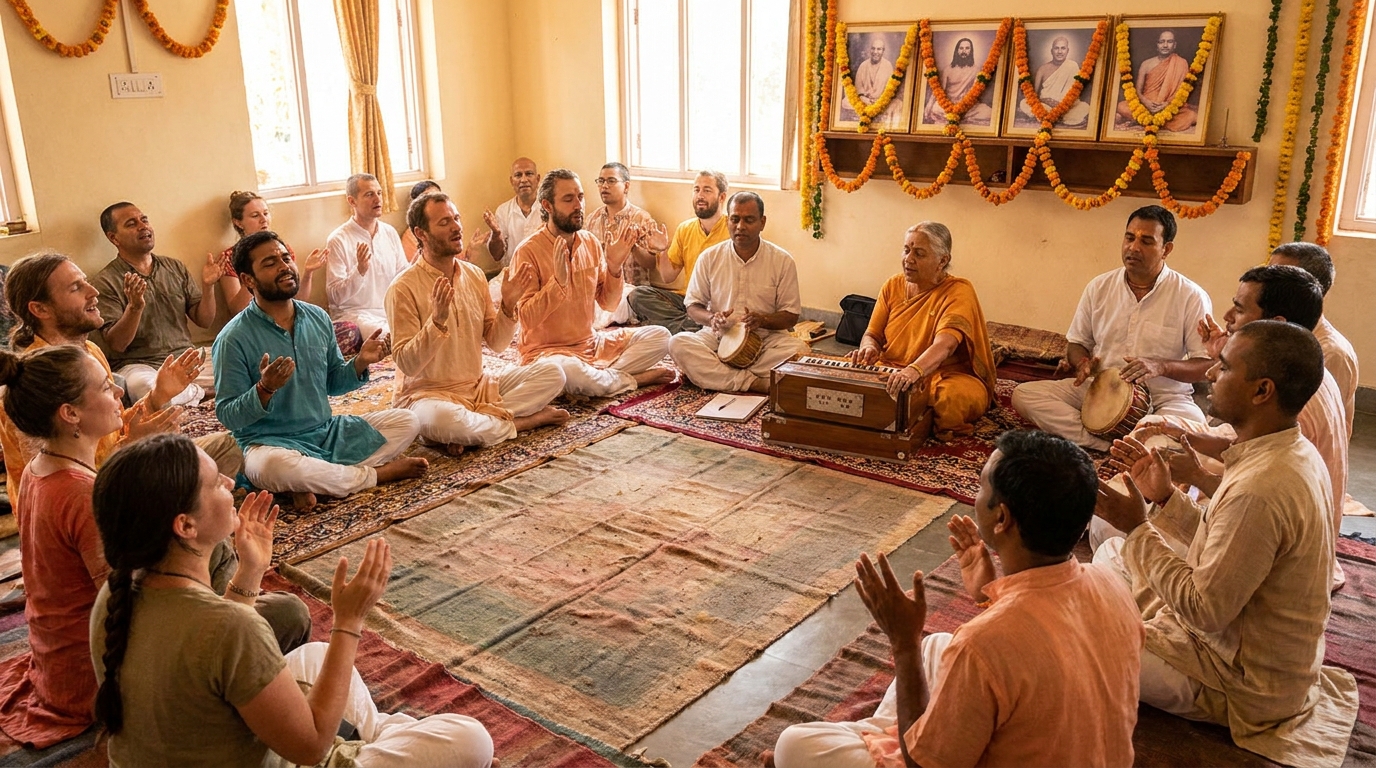
Kirtan also meets a deep human need for belonging. Many people today feel spiritually lonely, even when surrounded by activity. Singing together reminds us that we are not isolated minds trying to survive alone. We are souls walking a path together.
In a Bhakti community, people of different ages, cultures, and backgrounds may sit together and chant the same divine names. This shared practice softens divisions. It invites humility. It teaches us to listen, respond, harmonize, and support one another.
In this way, chanting is not only a personal meditation. It is a community practice of healing and unity.
Discover a wide range of insightful articles that delve into various spiritual topics. These articles provide guidance and inspiration for your personal growth journey. Stay updated with the latest articles to enhance your understanding of spiritual practices.
Prayer, Surrender, and Emotional Honesty
Prayer is the language of relationship with God. In Bhakti Yoga, prayer does not need to be formal or complicated. It can be spoken in Sanskrit, English, silence, tears, song, or simple thoughts of the heart.
The Sanskrit word sharanagati means surrender. For some, surrender may sound frightening, as if it means losing freedom or becoming passive. In Bhakti, surrender means lovingly trusting the Divine and offering our life to a higher wisdom. It is not weakness. It is the courage to stop pretending we are fully in control.
Prayer Creates a Secure Spiritual Attachment
Many people carry wounds around love, trust, and safety. Some have been disappointed by caregivers, communities, or religious institutions. Bhakti Yoga acknowledges that trust takes time. We do not have to force ourselves into artificial faith.
Prayer can begin honestly:
“God, I do not know how to trust You yet.”
“Please help me take one step.”
“I am confused, but I want to be guided.”
“Thank You for what I cannot yet understand.”
“Please let my heart become softer.”
This kind of prayer builds relationship. Over time, the practitioner may begin to feel that God is not distant or abstract, but personally present as the well-wisher of the soul.
In the Bhagavad-gita 9.22, Krishna says that for those who remember Him with devotion, He carries what they lack and preserves what they have. Practically, this verse can be understood as reassurance: sincere spiritual effort is never ignored. We are supported more deeply than we can see.
Surrender Reduces the Burden of Control
Anxiety often grows from the belief that everything depends on us. We try to control outcomes, people, timing, success, reputation, and even the spiritual journey itself. Bhakti gently teaches another way.
We still act responsibly. We still make choices, work hard, care for our families, and honor our duties. But inwardly, we practice offering the results to God.
This principle is called karma-yoga when action is performed without selfish attachment to results. In Bhakti Yoga, our work becomes an offering of love.
A simple daily prayer may be:
“Dear Lord, please let this action be pleasing to You. Please guide the result. Please purify my intention.”
Psychologically, this reduces pressure and increases resilience. We learn to do our best without making our worth depend on the outcome.
Honest Prayer Softens Shame
Shame says, “I am too broken to approach God.” Bhakti says, “Come as you are.”
The lives of saints in the Bhakti tradition often show this tenderness. Great devotees pray with humility, admitting their struggles and asking for mercy. Their humility is not self-hatred. It is truthfulness before divine love.
When we bring our real condition to God, shame begins to loosen. We do not need to hide behind spiritual appearances. The path of devotion is not for those who have no problems. It is for those who are willing to offer their problems into the fire of love.
Service as a Path of Healing and Identity
Service is central to Bhakti Yoga. The Sanskrit word seva means loving service. It is action performed for the pleasure of God and the welfare of others.
In a world that often teaches us to ask, “What can I get?” Bhakti invites us to ask, “How may I serve?” This shift is psychologically powerful. It moves us from self-centered anxiety toward meaningful contribution.
Service Gives Life Sacred Meaning
Many people suffer not only from stress, but from meaninglessness. We may be busy, yet inwardly wonder, “What is all this for?” Bhakti Yoga teaches that every part of life can become meaningful when offered in devotion.
Cooking can become sacred when food is prepared with love and offered to God. This sanctified food is called prasadam, meaning mercy or grace. Cleaning a temple, helping a neighbor, caring for a child, singing in kirtan, sharing wisdom, donating time, listening to someone’s pain—all of these can become seva when done with a devotional heart.
The psychology of seva is simple: we grow through loving action. Our identity shifts from “I am the enjoyer” to “I am a servant of love.”
This identity is not degrading. In Bhakti, to be a servant of God is the soul’s joy. It means we are connected, purposeful, and held within a divine relationship.
Service Reduces Self-Absorption
When the mind is trapped in self-focus, suffering often intensifies. We replay our worries, compare ourselves with others, and become preoccupied with how we are perceived.
Service opens the window. It helps us see that others also struggle, hope, love, and need kindness. Compassion becomes active.
This does not mean neglecting our own well-being. Healthy seva is not burnout. It is not people-pleasing. True devotional service is guided by wisdom, humility, and balance. We serve as an offering, not as a way to prove our worth.
When service is rooted in remembrance of God, it nourishes rather than drains. We become instruments, not isolated heroes.
Offering Our Talents Purifies the Ego
Everyone has gifts. Some can sing, cook, organize, teach, write, garden, comfort, build, lead, or pray deeply. Bhakti Yoga encourages us to offer these gifts.
The ego may say, “These abilities make me superior,” or “I am not good enough to offer anything.” Bhakti gives another perspective: “Whatever I have is a gift from God, and I can offer it back with gratitude.”
This attitude purifies both pride and insecurity. We do not need to inflate ourselves, and we do not need to disappear. We simply offer.
Devotional Practices and Spiritual Growth
Bhakti Yoga is both tender and transformative. It comforts the heart, but it also changes us. Over time, devotional practices shape our character, desires, relationships, and inner values.
The Bhagavad-gita describes spiritual growth as a movement from restless desire toward steady wisdom, from selfishness toward compassion, from forgetfulness toward remembrance. Bhakti makes this growth natural by centering it in love.
The Nine Practices of Bhakti
The Srimad Bhagavatam describes nine main practices of devotion:
- Shravanam — hearing about God
- Kirtanam — chanting or glorifying God
- Smaranam — remembering God
- Pada-sevanam — serving the Lord’s feet, or serving with humility
- Archanam — worship, often through sacred images or offerings
- Vandanam — offering prayers
- Dasyam — serving as a devoted servant
- Sakhyam — relating to God as a friend
- Atma-nivedanam — offering one’s whole self
These practices are not meant to overwhelm us. They are invitations. One person may begin with chanting. Another may begin with reading scripture. Another may begin by offering food, praying before work, or serving in community.
The psychology of these practices is cumulative. Each small act strengthens a devotional identity. Each sincere effort tells the heart, “This is who I am becoming.”
Growth Happens Through Relationship, Not Force
Many self-improvement paths rely heavily on willpower. Bhakti Yoga honors discipline, but it does not depend on willpower alone. It depends on relationship.
When love grows, change becomes more natural. A person may gradually lose interest in habits that once felt irresistible. Not because they are being harshly repressed, but because the heart is tasting something higher.
In the Bhagavad-gita 2.59, Krishna explains that lower desires fall away when one experiences a higher taste. This “higher taste” is central to the psychology of Bhakti Yoga. Spiritual joy is not merely an idea. It is something the heart can experience through sincere practice.
When we taste peace in chanting, warmth in prayer, meaning in service, and wisdom in scripture, the mind begins to trust the path.
Devotion Helps Integrate the Whole Person
Some spiritual paths can seem to favor the intellect over the emotions, or discipline over tenderness. Bhakti Yoga welcomes the whole person.
The mind is engaged through philosophy.
The heart is engaged through love.
The body is engaged through service.
The voice is engaged through chanting.
The ears are engaged through hearing sacred sound.
The hands are engaged through offerings.
The community is engaged through shared devotion.
This integration is psychologically healthy. We are not asked to split ourselves into spiritual and non-spiritual parts. Instead, every part of life can be harmonized in divine remembrance.
The Role of Scripture in Healing the Mind
Authentic Bhakti scriptures are not only ancient texts. They are living guides for the heart. When approached with humility, they help us see ourselves, our struggles, and our purpose more clearly.
Scripture gives language to the soul. It reminds us that we are more than our thoughts, emotions, body, history, or social identity. In Sanskrit, the word atma means the self or soul—the eternal spiritual being within.
The Bhagavad-gita and the Inner Battlefield
The Bhagavad-gita takes place on a battlefield, where Arjuna, a great warrior, is overwhelmed by grief, confusion, and moral crisis. This setting is psychologically meaningful. Many of us also stand on inner battlefields.
We may struggle between duty and emotion, faith and fear, clarity and confusion. Arjuna does not pretend to be strong. He admits his weakness and asks Krishna for guidance.
This is a powerful model of spiritual healing. Arjuna’s transformation begins when he becomes teachable.
He says, “I am Your disciple. Please instruct me.”
— Bhagavad-gita 2.7
In our own lives, this may mean pausing and praying, “I do not know the way forward. Please guide me.” Such humility opens the heart to wisdom.
The Srimad Bhagavatam and the Cleansing of the Heart
The Srimad Bhagavatam explains that hearing and chanting about God cleanses the heart of unwanted things. These unwanted things may include envy, greed, anger, pride, lust, and illusion. In modern psychological language, we might also speak of unhealthy patterns, compulsions, distorted self-images, and emotional wounds.
Bhakti does not promise instant perfection. It offers purification through steady practice and divine grace.
This is encouraging. We do not have to purify ourselves before approaching God. We approach God, and purification begins.
The Saints Show the Psychology of Love
The great Bhakti saints—such as Mirabai, Chaitanya Mahaprabhu, Tukaram, Andal, Narottama Dasa Thakura, and many others—show us that devotion is alive, emotional, poetic, and deeply human.
Their songs often express longing, humility, joy, repentance, and complete dependence on God. They teach us that spiritual maturity does not make the heart dry. It makes the heart more tender.
Their example helps modern seekers understand that tears in prayer are not weakness, longing for God is not escapism, and humility is not low self-esteem. These can be signs of a heart awakening to divine love.
Bringing Bhakti Psychology Into Daily Life
The psychology of Bhakti Yoga becomes most meaningful when it enters ordinary life. We do not need to live in a monastery or temple to practice devotion. We can begin where we are.
Bhakti is practical. It can fit into a morning routine, a family kitchen, a stressful commute, a workplace challenge, or a quiet moment before sleep.
Begin the Day With Remembrance
A simple morning practice can shape the entire day. Before checking the phone, we can pause and offer a prayer:
“Dear God, thank You for this day. Please guide my thoughts, words, and actions. Let me be of service.”
Even one minute of sincere remembrance can create a devotional direction. Over time, this small practice trains the mind to begin from gratitude rather than anxiety.
Chant With Realistic Commitment
If you are new to chanting, begin gently. You might chant one round on japa beads, sing one kirtan recording, or repeat a mantra for five minutes.
The goal is not to impress anyone. The goal is relationship.
If the mind wanders, do not be discouraged. Wandering is expected. Each return to the mantra is an act of devotion. Each return strengthens attention, humility, and love.
Offer Food With Gratitude
Preparing and offering food is a beautiful Bhakti practice. Before eating, you can pause and say:
“Dear Lord, thank You for this food. Please accept this offering and bless my heart with gratitude.”
In traditional Bhakti, food is offered to Krishna with prayers and then received as prasadam, divine mercy. Even a simple fruit, cup of water, or home-cooked meal can become sacred when offered with love.
Krishna says in the Bhagavad-gita 9.26:
“If one offers Me with love and devotion a leaf, a flower, fruit, or water, I will accept it.”
This verse reveals the heart of Bhakti. God is not asking for luxury. God is asking for love.
Transform Work Into Service
Before beginning work, silently offer your efforts:
“May this work be useful. May I act with integrity. May the results be in Your hands.”
This simple shift can transform ordinary duties into karma-yoga and Bhakti. Work becomes less about ego and more about contribution.
Even difficult tasks can become meaningful when offered sincerely.
Practice Devotional Reflection at Night
At the end of the day, take a few moments to reflect:
Where did I remember God today?
Where did I forget?
How did I serve?
Where do I need forgiveness or guidance?
What can I offer in gratitude?
This is not meant for self-condemnation. It is a gentle spiritual inventory. We learn, we offer, and we rest in mercy.
Common Misunderstandings About Bhakti Yoga
Because Bhakti Yoga is heart-centered, it can sometimes be misunderstood. Some may think devotion is sentimental, irrational, or only for people born into a particular tradition. In truth, Bhakti is both deeply emotional and deeply philosophical. It is universal, yet beautifully expressed through specific sacred practices.
Bhakti Is Not Blind Faith
Authentic Bhakti encourages inquiry. In the Bhagavad-gita, Arjuna asks questions. Krishna answers with reason, compassion, and spiritual insight.
Faith in Bhakti is not the rejection of intelligence. It is the softening of the heart so intelligence can be guided by divine wisdom. We are encouraged to hear, reflect, ask, practice, and realize.
Bhakti Is Not Escaping the World
Devotion does not mean avoiding responsibility. Krishna taught Arjuna on a battlefield, not in a cave far away from duty. Bhakti asks us to bring spiritual consciousness into our responsibilities.
We care for family, serve society, work honestly, and face challenges—but with remembrance of God.
This makes Bhakti especially practical for householders, students, professionals, parents, elders, and anyone living in the modern world.
Bhakti Is Not Only for One Culture
Bhakti Yoga has roots in the sacred traditions of India, and it is important to honor those roots with respect. At the same time, love of God is not limited by nationality, race, language, gender, or background.
Anyone can chant. Anyone can pray. Anyone can serve. Anyone can begin.
The heart’s longing for divine love is universal.
The Inner Fruits of Devotional Practice
As Bhakti Yoga matures, certain inner fruits may begin to appear. They may come gradually, quietly, and imperfectly. We may still struggle, but we notice changes.
We may become more patient.
More grateful.
More honest.
More compassionate.
Less controlled by comparison.
More willing to forgive.
More able to seek guidance.
More attracted to sacred sound and spiritual company.
These fruits are gifts of grace, cultivated through practice.
Peace Through Divine Connection
Peace in Bhakti does not mean life becomes free of difficulty. It means we develop a deeper shelter. The heart begins to understand, “Whatever comes, I can turn toward God.”
This inner shelter is one of the great psychological blessings of Bhakti Yoga. The nervous system learns safety through sacred remembrance. The mind learns direction through mantra. The heart learns trust through prayer.
Joy Through Loving Service
Bhakti joy is not always loud or dramatic. Sometimes it is quiet contentment. Sometimes it is tears in kirtan. Sometimes it is the satisfaction of serving without needing recognition.
This joy comes from alignment. We feel most whole when we live according to the soul’s nature, and Bhakti teaches that the soul’s nature is to love and serve God.
Humility Through Grace
Humility is one of the most beautiful outcomes of devotional life. It does not mean thinking, “I am worthless.” It means recognizing, “Everything I have is a gift, and I am dependent on grace.”
Such humility brings relief. We no longer need to pretend to be the center of the universe. We can become small in the most freeing way—small enough to be held by the Infinite.
A Gentle Invitation to Begin
The psychology of Bhakti Yoga reveals something very hopeful: the heart can be trained in love. The mind can be purified through sacred sound. Emotions can be offered in prayer. Identity can be healed through service. Life can become meaningful when centered on God.
You do not have to begin with perfect faith. You do not have to know Sanskrit. You do not have to have a spiritual background. You do not have to be free from doubt, pain, or struggle.
Begin with one sincere step.
Chant one mantra. Offer one prayer. Read one verse from the Bhagavad-gita. Serve one person with kindness. Offer one meal with gratitude. Sit in one kirtan and simply listen.
Bhakti Yoga is a path of love, and love grows through relationship. God sees the sincerity behind even the smallest offering.
At The Bhakti House, everyone is welcome. Wherever you come from, whatever your story may be, you are invited to take one humble, heartfelt step toward God today.
FAQs
What is Bhakti Yoga?
Bhakti Yoga is a spiritual practice within Hinduism that emphasizes devotion and love towards a personal deity. It involves various forms of worship, prayer, and rituals aimed at cultivating a deep emotional connection with the divine. This path is often characterized by surrender, humility, and the expression of love through various devotional practices.
How does Bhakti Yoga relate to psychology?
Bhakti Yoga can be understood through psychological principles as it fosters emotional well-being, reduces stress, and enhances feelings of connectedness. The practice encourages individuals to express their emotions and cultivate positive feelings such as love, compassion, and gratitude, which can lead to improved mental health and resilience.
What are the psychological benefits of practicing Bhakti Yoga?
Practicing Bhakti Yoga can lead to several psychological benefits, including increased emotional stability, reduced anxiety and depression, and enhanced overall life satisfaction. The focus on devotion and community can also foster a sense of belonging and purpose, which are crucial for mental well-being.
Can Bhakti Yoga be practiced by anyone?
Yes, Bhakti Yoga is accessible to everyone, regardless of their religious background or beliefs. The core principles of devotion and love can resonate with individuals from various walks of life, making it a universal practice that promotes inner peace and connection with others.
What role does community play in Bhakti Yoga?
Community plays a significant role in Bhakti Yoga as it often involves group worship, singing, and communal rituals. This collective practice fosters a sense of belonging and support among practitioners, enhancing the emotional and spiritual experience. Engaging with a community can also provide encouragement and motivation on one’s spiritual journey.

