

For many people entering a Bhakti Yoga community for the first time, one of the most tender sights is a small green plant being cared for with deep love. She may be placed on a simple altar, decorated with flowers, offered water, or honored with songs and prayers. This sacred plant is Tulasī, also known as Tulasī Devī or holy basil.
In the Bhakti tradition, Tulasī is not seen as an ordinary plant. She is honored as a beloved servant of God, especially dear to Śrī Krishna and Lord Vishnu. Her presence reminds us that devotion can be simple, living, fragrant, and close to the heart.
Whether you are new to Bhakti Yoga, grew up in a Hindu family, or are simply curious about spiritual traditions, learning about Tulasī can open a gentle doorway into the path of loving service.
In Bhakti Yoga, the heart of spiritual life is relationship. Bhakti means loving devotion, and Yoga means connection. So Bhakti Yoga is the path of reconnecting with God through love.
Tulasī is worshiped because she is deeply connected with that loving relationship. The scriptures describe her as very dear to Krishna, the Supreme Person, and to Lord Vishnu, the all-pervading form of God worshiped in many devotional traditions.
The meaning of Tulasī Devī
The word Tulasī is often translated as “the incomparable one.” Devī means “goddess” or “divine lady.” When devotees say Tulasī Devī, they are acknowledging that Tulasī is not merely a useful herb. She is a sacred personality who serves God with pure love.
This may be new for some readers. In Bhakti, the world is not viewed as dead matter. Everything belongs to God, and everything can be connected to God. Some beings and objects are especially sacred because they help awaken devotion. Tulasī is one of the most beloved examples.
Tulasī and Krishna’s heart
In temples and homes, devotees often offer Tulasī leaves to Krishna. This offering is simple, yet it carries deep meaning. A single Tulasī leaf offered with sincerity is considered spiritually powerful because Krishna accepts love more than luxury.
The Bhagavad-gītā, one of the most important Bhakti scriptures, says:
“Whoever offers Me with devotion a leaf, a flower, fruit, or water, I accept that loving offering from the pure-hearted soul.”
Bhagavad-gītā 9.26
In this verse, Krishna does not ask for wealth, status, or complicated rituals. He asks for devotion. A leaf, a flower, fruit, or water becomes sacred when offered with love. In many Bhakti traditions, the “leaf” most lovingly offered is a Tulasī leaf.
Worship as loving honor, not superstition
When devotees worship Tulasī, they are not worshiping a plant as a separate god. Rather, they are honoring Tulasī as a pure devotee of the Lord. Just as someone may honor a great saint because that saint brings them closer to God, devotees honor Tulasī because she helps them remember, serve, and love Krishna.
This is a beautiful principle in Bhakti: we honor what helps us love God.
Tulasī Represents Pure Devotional Service
Tulasī is worshiped because she embodies sevā, which means service offered with love. In Bhakti, service is not a burden. It is the natural expression of the soul.
To water Tulasī, circumambulate her, sing to her, or offer her leaves to Krishna is a way of practicing humility and care. Through small acts, the heart becomes softer.
What is sevā?
Sevā is a Sanskrit word meaning devotional service. It is service done not for ego, recognition, or reward, but for the pleasure of God and the benefit of others.
In daily life, sevā may look like cooking a meal for others, cleaning a sacred space, caring for children, helping someone in pain, chanting God’s names, or tending a Tulasī plant.
Tulasī teaches us that spiritual growth does not always begin with dramatic experiences. Sometimes it begins by showing up each day with water, attention, and gratitude.
Tulasī invites us into consistency
A plant needs regular care. She cannot be loved only in theory. She needs water, light, protection, and tenderness.
In this way, Tulasī gently trains the devotee. Bhakti Yoga is also nourished through regular practice. A little chanting, a little prayer, a little service, a little study—done daily—can transform a life over time.
The worship of Tulasī reminds us that love becomes real through care.
Humility in approaching the sacred
Many Tulasī prayers express humility. Devotees ask her for the blessing of devotion to Krishna. They do not approach her demanding material success or power. They come as learners.
This humble mood is central to Bhakti. We do not conquer God through knowledge or ritual. We receive divine love through sincerity, grace, and service.
Tulasī Is Honored in Bhakti Scriptures
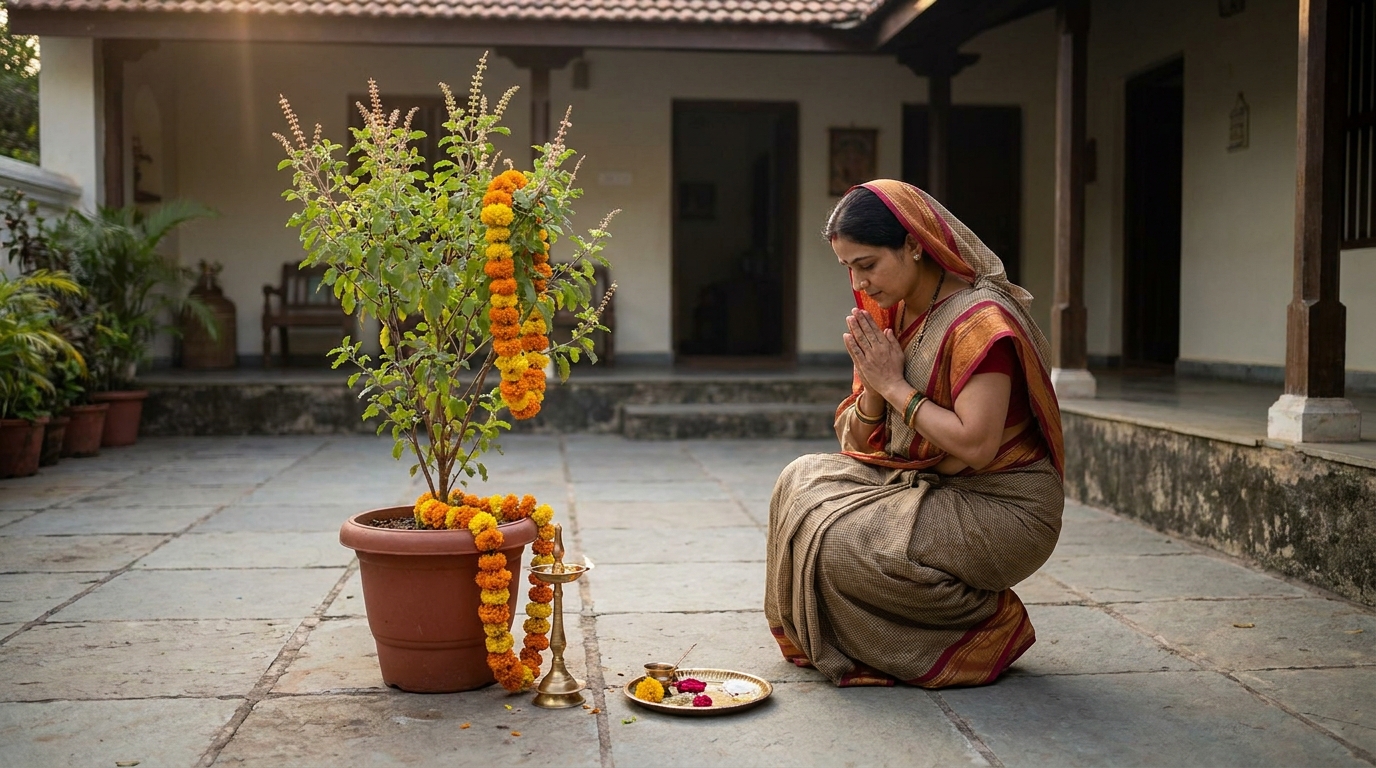
The worship of Tulasī is not simply a cultural habit. It is deeply rooted in sacred texts and devotional practice passed down through generations.
Different scriptures and traditions describe Tulasī’s glories in poetic and devotional ways. While the language may sometimes feel grand to modern readers, the heart of the teaching is simple: Tulasī is beloved by God, and honoring her awakens devotion.
Bhagavad-gītā and the spirit of simple offering
As mentioned earlier, Bhagavad-gītā 9.26 teaches that Krishna accepts even a simple offering when it is made with devotion. This verse is often connected with Tulasī because devotees offer her leaves with food, flowers, or water.
The practical lesson is encouraging: you do not need to be rich, perfect, or socially important to begin spiritual life. You can begin with one leaf, one prayer, one sincere moment.
This is the mercy of Bhakti Yoga. God is accessible through love.
Padma Purāṇa and Tulasī’s glories
The Padma Purāṇa, one of the traditional Purāṇic texts, praises Tulasī as extremely dear to Lord Vishnu. It describes the spiritual benefit of seeing, touching, watering, offering, and caring for Tulasī with devotion.
For a modern reader, this is not meant to encourage mechanical religion. The point is not that a person can casually perform an external act while keeping a hard heart. The deeper teaching is that when our body, words, and mind are engaged in honoring the sacred, our consciousness becomes purified.
Spiritual life is embodied. We learn through doing.
Śrīmad-Bhāgavatam and the fragrance of devotion
The Śrīmad-Bhāgavatam, a central scripture in Krishna Bhakti, describes the beauty of the Lord and the devotion of His servants in rich spiritual imagery. Tulasī is often connected with the Lord’s lotus feet, garlands, and worship.
The “lotus feet” of God is a devotional phrase meaning the shelter, grace, and loving presence of the Divine. When Tulasī is offered at Krishna’s feet, it symbolizes that devotion rests in surrender.
To surrender in Bhakti does not mean losing yourself in a negative way. It means giving the heart to divine love and allowing that love to guide, heal, and uplift us.
Check out our latest posts at https://thebhaktihouse.org/blog.
Tulasī Worship Helps Us Practice Bhakti Yoga at Home
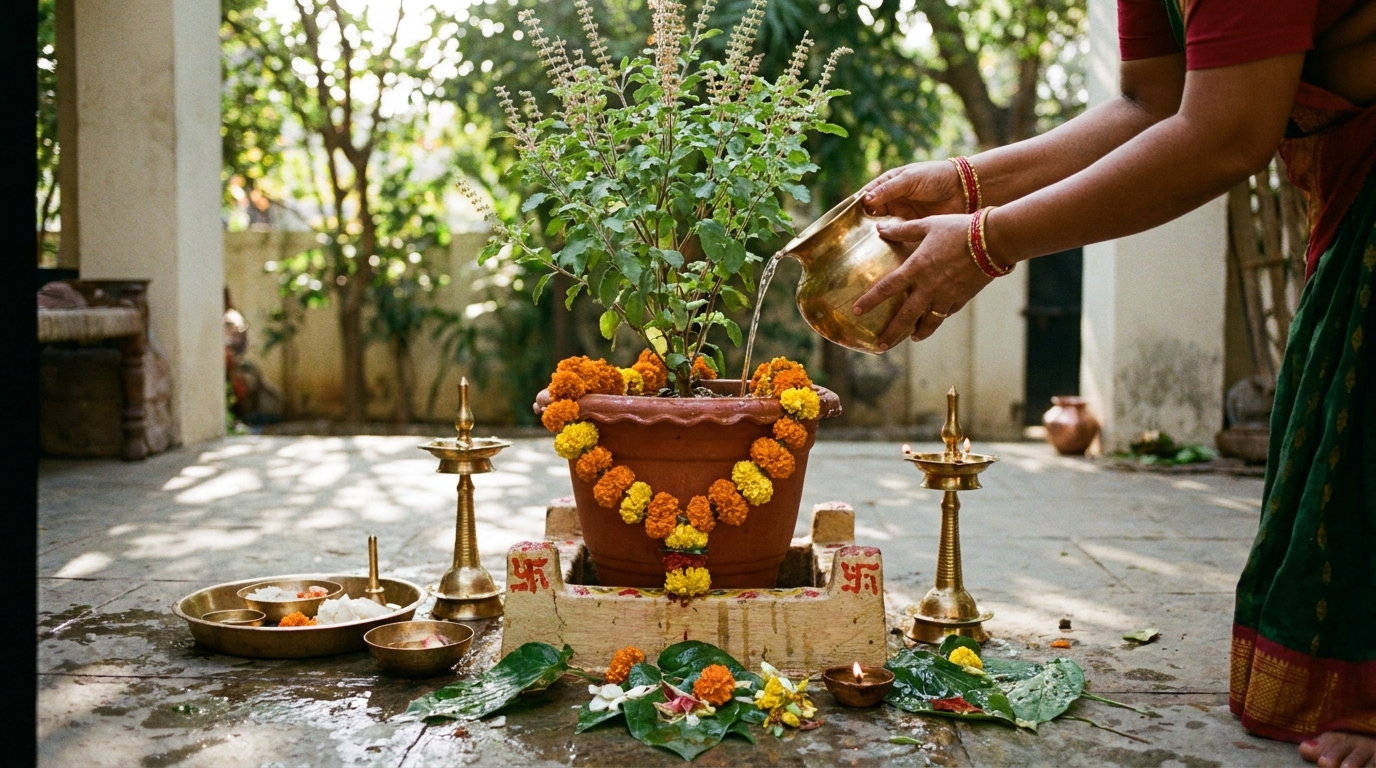
One of the most beautiful things about Tulasī worship is that it brings sacred life into the home. Not everyone can visit a temple every day. Not everyone has time for long rituals. But many people can create a small space for prayer, chanting, and loving attention.
Tulasī makes the home feel like a place of remembrance.
Creating a simple sacred space
A home altar does not need to be elaborate. It may include a picture of Krishna, Rama, Vishnu, or another form of God worshiped in your tradition. It may include scripture, a candle or lamp, flowers, and a clean place for prayer.
If you have Tulasī at home, she should be kept respectfully in a clean and bright place, with appropriate sunlight and care. Devotees often avoid placing her in unclean areas or treating her casually.
This is not about fear. It is about honoring a sacred relationship.
Offering water and prayers
Many devotees water Tulasī daily, depending on the season and the plant’s needs. While watering, they may chant prayers or simply speak from the heart:
“Dear Tulasī Devī, please help me grow in devotion. Please bless my home with remembrance of God. Please guide me toward loving service.”
Simple prayers are welcome. Bhakti is not limited to experts. If your prayer is sincere, it has spiritual value.
Circumambulating Tulasī
In many Bhakti communities, devotees walk around Tulasī in a clockwise direction. This is called parikramā, which means going around something sacred as an act of honor.
The practice reminds us to place God and devotion at the center. Instead of asking the sacred to revolve around our desires, we gently train ourselves to revolve our lives around divine love.
Even walking around Tulasī a few times with prayerful attention can become a moment of grounding and gratitude.
Offering Tulasī leaves
In many Krishna and Vishnu traditions, food offerings to the Lord include a Tulasī leaf. This is because Tulasī is especially dear to Krishna.
Devotees are careful not to pluck Tulasī leaves casually. Traditionally, leaves are picked only when needed for worship, with clean hands, prayer, and respect. Many devotees avoid picking leaves at night or on certain sacred days, according to their tradition.
If you are new, it is helpful to learn from experienced practitioners before beginning this practice. The main mood is reverence.
Tulasī Connects Chanting, Prayer, and the Holy Name
Tulasī is closely connected with chanting, especially the chanting of God’s names. In Bhakti Yoga, the divine name is not considered ordinary sound. It is a living spiritual presence.
One of the most well-known mantras in the Krishna Bhakti tradition is the Hare Krishna mahā-mantra:
Hare Krishna, Hare Krishna, Krishna Krishna, Hare Hare
Hare Rama, Hare Rama, Rama Rama, Hare Hare
Mahā-mantra means “great mantra.” A mantra is a sacred sound that helps focus and purify the mind. This mantra is a prayer asking to be engaged in loving service to God.
Tulasī beads and japa meditation
Many devotees chant on japa beads made from Tulasī wood. Japa means quiet, repeated chanting or prayerful recitation. A strand usually has 108 beads, and the practitioner chants one mantra on each bead.
Tulasī beads are considered sacred because they assist the devotee in remembering Krishna. When a person holds them, they are reminded: “Let my speech become prayer. Let my mind return to God. Let my life become service.”
For beginners, chanting even one round, or a few minutes daily, can be a powerful spiritual practice.
Wearing Tulasī neck beads
Some devotees wear Tulasī neck beads, known as kaṇṭhī-mālā. Kaṇṭha means throat or neck, and mālā means garland or beads.
Wearing Tulasī beads is a sign of devotion and a reminder of spiritual identity. It is also a way of saying, “I belong to God.” However, it should be done with sincerity and respect, not as fashion or spiritual decoration.
If someone is interested in wearing Tulasī beads, it is good to ask guidance from a trusted teacher or devotional community.
Chanting as a practice for everyone
You do not have to be born into a particular culture to chant God’s names. Bhakti Yoga welcomes sincere seekers from all backgrounds.
Chanting can be done softly, loudly, alone, or with others. It can be sung with instruments in kīrtan, which means congregational chanting, or practiced quietly in meditation.
Tulasī supports this chanting life by reminding us that devotion is alive, personal, and nourished by daily care.
Tulasī Teaches Us Reverence for Nature
In a world facing ecological crisis, Tulasī worship offers a needed spiritual lesson: nature is not merely a resource. Creation is sacred because it belongs to God.
Bhakti does not see the earth as separate from spiritual life. The soil, water, air, sunlight, animals, plants, and human beings are all part of God’s energy. When we care for Tulasī, we learn to care more deeply for the natural world.
Sacred ecology begins with relationship
Modern life often trains us to consume quickly and discard easily. Tulasī invites the opposite mood. She asks us to slow down, observe, water, protect, and give thanks.
This small relationship can expand. If one plant is sacred, perhaps all life deserves more respect. If Tulasī is dear to Krishna, then the world Krishna created should not be exploited carelessly.
Spiritual practice becomes practical when it changes how we live.
Caring for Tulasī with sensitivity
Tulasī is sacred, but she is also botanically delicate in many climates. She may need warmth, sunlight, good drainage, and protection from cold. Caring for her properly is part of worship.
Devotees should avoid using harmful chemicals on her. They should also avoid neglecting her and then feeling guilty. If you are learning, be patient. Ask for help. Study how to care for holy basil in your region.
Love includes learning what the beloved needs.
Beyond ritual: a heart of gratitude
The goal is not simply to perform a ritual around Tulasī and then live selfishly. True Tulasī worship should make us more grateful, gentle, and responsible.
When we bow to Tulasī, we are also bowing to the sacredness of life. We are remembering that everything can be offered back to God.
Tulasī Worship Is a Path of Mercy and Spiritual Growth
Tulasī is sometimes described as a merciful guide for the soul. Devotees pray to her for entrance into the service of Krishna. This does not mean she replaces God. Rather, she helps bring the devotee closer to God, just as a compassionate teacher helps a student approach wisdom.
In Bhakti, grace is essential. We grow not only by effort, but by receiving mercy.
Mercy means spiritual help
The Sanskrit word kṛpā means mercy or grace. It is the loving help that comes from God and God’s devotees.
When devotees ask Tulasī for mercy, they are asking for help to become sincere. They are asking for help to overcome distraction, pride, selfishness, and forgetfulness.
This is very practical. Most of us know we need help. We may want to love God, but our minds wander. We may want to serve, but our ego resists. We may want to be peaceful, but old habits return.
Tulasī worship gives us a daily way to ask for grace.
Spiritual growth through small acts
Many people imagine spiritual advancement as something dramatic or mystical. Bhakti often grows through small, faithful acts:
Watering Tulasī.
Chanting one mantra.
Offering one meal.
Reading one verse.
Serving one person.
Apologizing with humility.
Choosing kindness.
Remembering God before sleep.
These small acts may seem simple, but they shape the heart. Over time, they become a life of devotion.
Tulasī and the softening of the heart
The heart can become dry from stress, disappointment, and self-protection. Tulasī worship is gentle medicine. Her presence invites tenderness.
To stand before Tulasī and pray honestly is to let the soul breathe. We do not need to pretend. We can come with our questions, grief, gratitude, and longing.
Bhakti Yoga teaches that God is not far away from the sincere heart.
Common Questions About Tulasī in Bhakti Tradition
Many newcomers have thoughtful questions about Tulasī worship. Honest questions are welcome. Bhakti is not meant to be blind sentiment. It is a living path of love, wisdom, and practice.
Is Tulasī the same as ordinary basil?
Tulasī is commonly known as holy basil, and it is related to basil plants used in cooking. However, in the Bhakti tradition, Tulasī is honored as sacred and is not treated like an ordinary kitchen herb.
There are different varieties of Tulasī, including Rama Tulasī and Krishna Tulasī. Devotees may care for either with reverence.
While Tulasī also has a history in Ayurveda, the traditional Indian system of natural health, devotees primarily honor her for her spiritual role in service to Krishna and Vishnu.
Can anyone worship Tulasī?
Yes. Anyone may honor Tulasī with sincerity and respect. You do not need to belong to a certain ethnicity, nationality, or social background.
If you are new, you can begin simply: offer a respectful bow, say a prayer, chant God’s names, or help care for a Tulasī plant under guidance.
Bhakti Yoga is people-first. The door is open to the sincere heart.
What if I cannot keep a Tulasī plant?
Not everyone can care for Tulasī at home. Some climates are difficult. Some living situations do not allow plants. Some people travel often.
If you cannot keep Tulasī, you can still honor her. You may visit a temple or Bhakti community where Tulasī is worshiped. You may offer prayers mentally. You may chant on Tulasī beads if appropriate. You may learn about her glories and cultivate the qualities she represents: devotion, service, humility, and love.
God sees the intention.
Is Tulasī worship required for Bhakti Yoga?
Tulasī worship is deeply cherished in many Bhakti traditions, especially those centered on Krishna and Vishnu. However, the essence of Bhakti Yoga is sincere devotion to God.
Tulasī helps nourish that devotion. She is not a barrier or burden. She is a blessing. If someone is just beginning, they can approach gradually and respectfully.
Spiritual life grows best when it is rooted in sincerity rather than pressure.
How to Begin Honoring Tulasī Today
If your heart feels drawn to Tulasī, you can begin in a simple and respectful way. Bhakti Yoga does not ask us to imitate advanced practitioners. It invites us to take one sincere step.
Begin with prayer
You might pray:
“Dear Tulasī Devī, please bless me with devotion. Please help me remember God. Please teach me to serve with humility and love.”
This simple prayer can be offered in your own words. The mood matters more than poetic language.
Chant near Tulasī
If you have access to a Tulasī plant, you can sit nearby and chant. You may chant the Hare Krishna mahā-mantra, another name of God meaningful to you, or a simple prayer from your heart.
Chanting near Tulasī can help the mind become peaceful and focused. Her presence encourages sacred attention.
Serve with care
If you help care for Tulasī, do so gently. Water her properly. Keep her space clean. Protect her from harsh conditions. Learn from those who have experience.
Service becomes worship when it is done with love.
Offer your life gradually
The deepest meaning of Tulasī worship is not only offering leaves to Krishna, but offering the heart.
We may begin by offering a leaf, then a prayer, then a habit, then a fear, then our time, then our relationships, then our whole life.
This is Bhakti Yoga: the gradual awakening of love for God through chanting, prayer, service, scripture, community, and grace.
Tulasī’s Message for the Modern Heart
Tulasī stands quietly, but her message is profound.
She teaches that love is practical.
She teaches that the sacred can live in the home.
She teaches that small acts matter.
She teaches that nature is holy.
She teaches that devotion is personal.
She teaches that God accepts a simple offering when it is given with love.
In a busy and often lonely world, Tulasī invites us back into relationship—with God, with creation, with others, and with our own soul.
You may come from any background. You may have many questions. You may feel spiritually confident, or you may feel uncertain and far away. Still, Bhakti welcomes you.
Come gently. Come honestly. Offer one prayer. Chant one name of God. Serve one living being. Water one sacred plant. Read one verse. Take one sincere step.
Tulasī Devī is worshiped because she helps us remember the heart of Bhakti: love offered to God with humility, gratitude, and devotion.
Everyone is welcome to begin. Everyone is welcome to grow. Everyone is welcome to take one sincere step toward God.
FAQs
What is Tulasī in the Bhakti tradition?
Tulasī, also known as holy basil, is a sacred plant in the Bhakti tradition of Hinduism. It is considered to be an incarnation of the goddess Lakshmi and is revered for its spiritual and medicinal properties.
How is Tulasī worshiped in the Bhakti tradition?
Tulasī is worshiped daily by offering water, flowers, and incense. Devotees also perform a ritual known as Tulasī Vivāha, where the plant is ceremonially married to the god Vishnu or his avatar Krishna.
What is the significance of Tulasī in the Bhakti tradition?
Tulasī is believed to purify the mind, body, and soul of the worshiper. It is also considered to be a symbol of devotion and is said to bring good fortune to those who worship it with sincerity.
Are there specific rules for caring for Tulasī in the Bhakti tradition?
Devotees are expected to care for Tulasī with great reverence. This includes watering the plant daily, keeping it in a clean and sacred space, and avoiding any impure activities around it.
What are the benefits of worshiping Tulasī in the Bhakti tradition?
Worshiping Tulasī is believed to bestow spiritual blessings, protect the worshiper from negative influences, and bring about overall well-being and prosperity. Additionally, the leaves of the Tulasī plant are used in various religious rituals and medicinal preparations.

