
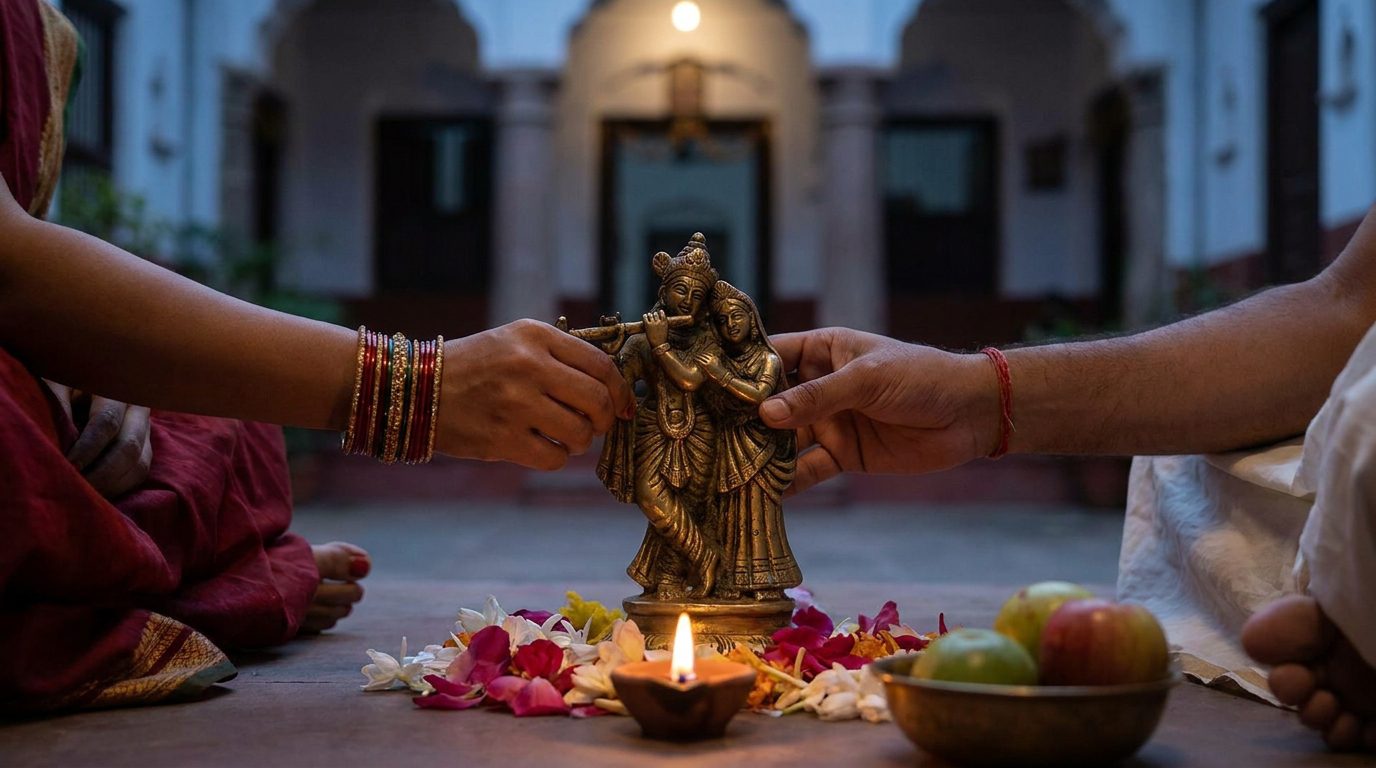
In the path of Bhakti Yoga, we are invited to love God not only as the Supreme Creator, but also as our dearest friend, protector, beloved, and eternal shelter. Bhakti means devotion, or loving service to the Divine. It is a practical spiritual path that includes chanting God’s names, prayer, hearing sacred wisdom, serving others, and gradually softening the heart.
Among the many beautiful teachings of Bhakti, one of the most sacred and often misunderstood is Mādhurya-rasa.
The Sanskrit word mādhurya means “sweetness,” and rasa means “spiritual relationship,” “mood,” or “taste.” So Mādhurya-rasa refers to the sweetest, most intimate loving relationship with Krishna, the Supreme Person, in the mood of divine love.
Because this subject is so deep and tender, it must be approached with humility, purity, guidance, and patience. Just as we would not casually walk into someone’s private family altar or enter a sacred temple without reverence, we should not approach Mādhurya-rasa as a topic for curiosity, fantasy, or argument.
It is not ordinary romance. It is not mythology. It is not a license for material desire. It is the highest expression of pure love for God, completely free from selfishness.
In the Bhakti tradition, especially as taught by Sri Chaitanya Mahaprabhu and the great Vaishnava teachers, Mādhurya-rasa is honored as the most confidential treasure of the spiritual world. But to honor something properly, we must also understand what it is not.
What Is Mādhurya-rasa?
A Spiritual Relationship Beyond Material Desire
Mādhurya-rasa is the mood of divine love in which the soul relates to Krishna as the beloved. This love is perfectly pure. It is not based on bodily attraction, possession, ego, or emotional neediness.
In our world, romantic love is often mixed with fear, expectation, insecurity, and self-centered desire. Even when sincere, it is usually conditioned by the body and mind. But Mādhurya-rasa is completely spiritual. It exists in the eternal realm of Krishna, where every gesture, word, song, and glance is an offering of love.
The Srimad Bhagavatam, one of the most important scriptures in Bhakti Yoga, describes Krishna’s loving exchanges with the gopis, the cowherd maidens of Vrindavan. The gopis are not ordinary women, and their love is not worldly romance. They represent the highest expression of selfless devotion.
Their only desire is Krishna’s happiness.
This is the key to understanding Mādhurya-rasa: it is not about what the devotee can receive from Krishna, but how the devotee can completely offer the heart for Krishna’s pleasure.
The Meaning of Rasa in Bhakti
In Bhakti theology, rasa refers to the unique loving relationship between the soul and God. Different souls may love Krishna in different spiritual moods.
Some love Him in śānta-rasa, a peaceful mood of reverence. Some love Him in dāsya-rasa, the mood of service. Others love Him in sakhya-rasa, friendship. Some love Him in vātsalya-rasa, parental affection. And some love Him in mādhurya-rasa, the mood of divine beloved love.
All of these relationships are sacred. No one should think that one devotee is “less” because their heart is drawn to service, friendship, or reverence. In Bhakti, love is measured not by external category, but by sincerity, purity, and surrender.
Why It Is Considered Confidential
Mādhurya-rasa is considered confidential because it reveals Krishna’s most intimate exchanges with His dearest devotees. These teachings are not hidden because they are shameful. They are protected because they are sacred.
A jewel is kept carefully, not because it is useless, but because it is precious.
Similarly, the inner moods of Vrindavan are not meant to be handled carelessly. When approached prematurely or through the lens of material desire, the truth becomes distorted. But when approached through humility, chanting, service, and guidance, these teachings can awaken deep gratitude and longing for pure devotion.
Common Misconception: Mādhurya-rasa Is Ordinary Romance

The Mistake of Projecting Human Desire onto God
One of the most common misconceptions is thinking that Krishna’s loving pastimes with the gopis are similar to worldly romance. This misunderstanding comes from projecting human experience onto divine reality.
In the material world, we often think love means, “How does this person make me feel?” or “What can I get from this relationship?” But spiritual love asks, “How may I serve? How may I please God? How may I give myself in devotion?”
The gopis of Vrindavan do not approach Krishna with selfish desire. Their love is so pure that they are willing to sacrifice their own reputation, comfort, and even spiritual liberation if it will bring Krishna joy.
This is difficult for us to fully understand because our hearts are still healing. We may love sincerely, but our love is usually mixed with ego. That is why we do not imitate the gopis. We honor them, pray for their mercy, and purify our hearts through sincere practice.
Lust and Love Are Opposites
Bhakti scriptures make a clear distinction between kāma, selfish desire, and prema, pure love.
Kāma means desire for one’s own enjoyment. Prema means desire for Krishna’s happiness.
Externally, a person may use the word “love,” but the inner intention makes all the difference. If I want to enjoy another for myself, that is not pure love. If I want to serve another for their genuine good, that begins to reflect love.
The love of the gopis is the highest prema. It is not lust spiritualized. It is love completely beyond lust.
Sri Chaitanya Mahaprabhu, who is revered as Krishna appearing in the mood of His own devotee, came to share this highest love. Yet His own life was marked by humility, renunciation, chanting, compassion, and deep longing for Krishna—not indulgence or cheap imitation.
Sacred Poetry Requires Sacred Hearing
Many Bhakti scriptures use beautiful poetic language to describe Krishna’s pastimes. Without proper understanding, readers may interpret these descriptions materially.
This is why the tradition emphasizes hearing from authentic teachers, called gurus, and from sincere devotees who live the teachings. The Bhagavad-gita teaches that spiritual knowledge is received through humility, inquiry, and service. We do not simply analyze divine love from a distance; we prepare the heart to receive it.
When we hear sacred topics with reverence, they purify us. When we hear them with a restless or exploitative mind, we may misunderstand and even become spiritually confused.
Check out our latest articles at https://thebhaktihouse.org/blog.
Common Misconception: Everyone Should Immediately Meditate on Mādhurya-rasa

Bhakti Is a Gradual Path of Purification
Another misconception is that a new practitioner should immediately meditate on the most intimate pastimes of Krishna and the gopis. While the heart may feel drawn to these beautiful teachings, Bhakti Yoga encourages gradual, grounded spiritual growth.
We begin with śraddhā, faith. Faith does not mean blind belief. It means a sincere openness: “Perhaps there is a deeper truth. Perhaps love of God is possible for me.”
From faith, we seek association with devotees, begin spiritual practice, and gradually allow the heart to become purified. This process is described in the Bhakti tradition as a natural unfolding, not a forced performance.
Just as a child first learns to stand, then walk, then run, a devotee grows step by step.
The Foundation Is Hearing and Chanting
The most essential practice in Bhakti Yoga is hearing and chanting the holy names of God. In many Bhakti communities, this includes chanting the Hare Krishna maha-mantra:
Hare Krishna, Hare Krishna, Krishna Krishna, Hare Hare
Hare Rama, Hare Rama, Rama Rama, Hare Hare
This mantra is a prayer. “Hare” calls upon the divine energy of the Lord, often understood as Srimati Radharani, the feminine embodiment of devotion. “Krishna” means the all-attractive Lord. “Rama” means the source of spiritual joy.
In simple words, the mantra means: “O Lord, O Divine Mother, please engage me in Your loving service.”
Through chanting, the heart becomes cleansed. We begin to experience that spiritual life is not only philosophy, but relationship. The holy name brings us closer to Krishna in a safe, natural, and deeply transformative way.
We Do Not Need to Pretend
Sometimes sincere seekers feel pressure to claim an advanced spiritual mood. They may think, “If Mādhurya-rasa is the highest, I should identify with it immediately.”
But Bhakti is not about pretending. Krishna is attracted to honesty.
If we are struggling, we can pray from that place. If our mind is distracted, we can chant anyway. If our heart feels dry, we can still offer one small act of service. This sincerity is more pleasing to Krishna than dramatic displays of imagined realization.
In spiritual life, humility protects us.
Common Misconception: Mādhurya-rasa Is Separate from Service
Love Means Service
A major misunderstanding is thinking that Mādhurya-rasa is only about emotion, sweetness, or inner meditation, disconnected from practical service. But in Bhakti, love is always expressed through seva, or service.
Seva means loving service offered for the pleasure of God and the benefit of others. It may look simple: cooking with devotion, cleaning a temple, caring for guests, chanting with attention, helping someone feel welcome, sharing wisdom kindly, or offering one’s daily work to God.
In the highest spiritual reality, even the most intimate love is filled with service. The gopis are not seeking to enjoy Krishna; they are absorbed in serving Him. Their songs, ornaments, movements, and emotions are all offerings.
If we want to approach their mood, we begin by serving in our present life.
Daily Life Can Become Devotional
Bhakti Yoga does not ask us to abandon our humanity. It invites us to spiritualize our humanity.
We can offer our food before eating. We can begin the day with prayer. We can chant while walking, cooking, or driving. We can speak more gently. We can forgive more quickly. We can serve our family, community, and world as part of our devotion to Krishna.
Mādhurya-rasa may be the highest flower of divine love, but the roots are everyday sincerity.
If we neglect basic kindness, honesty, and service, then speaking about advanced spiritual moods becomes hollow. But if we cultivate devotion in small, steady ways, the heart becomes a garden where real love can grow.
Service Protects the Heart from Sentimentality
Sentiment can be sweet, but without service and discipline it may not last. Real Bhakti matures through practice.
The Sanskrit word sādhana means spiritual practice. Sādhana-bhakti includes chanting, hearing scripture, worship, prayer, service, remembering Krishna, and living in a way that supports spiritual growth.
Through sādhana, our emotions become purified. We learn to distinguish between temporary excitement and deep devotion. We learn patience. We learn surrender. We learn how to love beyond our moods.
Common Misconception: The Gopis Are Ordinary Historical Figures
The Gopis Are Perfect Devotees
The gopis of Vrindavan are sometimes misunderstood as ordinary village girls. In the Bhakti tradition, they are honored as the highest perfected devotees of Krishna. Their love is beyond the limitations of material identity.
Among them, Srimati Radharani is worshiped as the supreme devotee, the fullest embodiment of pure love for Krishna. She is not separate from Krishna in the ordinary sense; She is His divine pleasure potency, His own loving energy.
For newcomers, this may sound mystical, but the simple meaning is beautiful: God is not alone. The Divine includes both the lover and the beloved, the source of love and the perfect expression of love. Radha and Krishna together reveal the fullness of spiritual relationship.
Their Apparent Social Transgression Has Spiritual Meaning
Some readers struggle with the descriptions of the gopis leaving their homes to meet Krishna in the night. Without guidance, this can appear morally confusing.
The Bhakti teachers explain that these pastimes are not instructions for worldly behavior. They reveal the soul’s willingness to leave behind all ego-based attachments for the call of God.
When Krishna plays His flute, it symbolizes the divine call entering the heart. The gopis respond immediately because their love is total. They are not motivated by rebellion or pleasure-seeking. They are moved by pure devotion.
For us, the practical lesson is not to imitate their external actions. The lesson is to hear Krishna’s call in our own life and respond with sincerity.
What attachments keep us from prayer? What distractions keep us from chanting? What fears keep us from serving? In this way, the gopis’ example becomes deeply practical.
The Rasa-lila Is Not Entertainment
The rasa-lila, Krishna’s sacred dance with the gopis, is one of the most profound sections of the Srimad Bhagavatam. It should not be treated as entertainment, sensual art, or casual storytelling.
The Bhagavatam itself explains that one who faithfully hears these pastimes from the proper source can become purified of lust and awaken devotion. This is a powerful promise—but the words “faithfully” and “proper source” matter.
We approach the rasa-lila not as consumers, but as servants. We listen with prayer: “May my heart be purified. May I understand even one drop of this love. May I stop using others for myself and learn to love as service.”
Common Misconception: Mādhurya-rasa Is Only for a Certain Culture or Background
Bhakti Welcomes Everyone
Bhakti Yoga is not limited by nationality, ethnicity, gender, age, social status, or religious background. The soul is eternal, and every soul has a relationship with God.
Some may come from Hindu families. Others may come from Christian, Muslim, Jewish, Buddhist, Indigenous, secular, or interfaith backgrounds. Some may be lifelong seekers; others may be unsure what they believe.
Everyone is welcome to begin with sincerity.
The holy name of God is not owned by one community. Love of God is the birthright of every living being. Bhakti invites us to come as we are and grow from there.
Sanskrit Terms Are Doorways, Not Barriers
Sanskrit words like bhakti, rasa, seva, prema, and Krishna may feel unfamiliar at first. But they are not meant to exclude anyone. They are sacred doorways into refined spiritual understanding.
Bhakti means devotion.
Seva means service.
Prema means pure love.
Rasa means spiritual relationship or taste.
Krishna means the all-attractive Supreme Person.
When we learn these words slowly and respectfully, they can enrich our spiritual life. But no one should feel they must become a scholar before they can chant, pray, or serve.
A sincere heart is more important than perfect pronunciation.
The Universal Longing for Divine Love
At the center of Mādhurya-rasa is a universal truth: the soul longs for complete love.
We may search for it in relationships, achievements, possessions, approval, or experiences. But nothing temporary can fully satisfy the eternal heart. Bhakti teaches that our deepest longing is ultimately for Krishna, the source of all beauty, sweetness, and love.
This does not make human relationships meaningless. Rather, it helps us honor them properly. When we place God in the center, our relationships can become more compassionate, less possessive, and more sacred.
How to Approach Mādhurya-rasa in a Healthy Way
Begin with the Holy Name
The safest and most powerful way to approach Krishna is through His names. Chanting does not require wealth, status, or intellectual qualification. It only asks for sincerity.
You can chant softly on beads, sing in a group, or repeat the names in your heart. If your mind wanders, gently return. If your heart feels closed, keep chanting. The holy name is patient and merciful.
In Bhakti, Krishna is fully present in His name. So when we chant, we are not merely making sound. We are entering relationship.
Study Scripture with Guidance
Sacred texts are like maps of the spiritual journey. The Bhagavad-gita gives foundational wisdom: who we are, what the soul is, how to act with devotion, and how to surrender to God. The Srimad Bhagavatam deepens our understanding of Krishna’s nature and His loving relationships with devotees.
For those drawn to the teachings of Sri Chaitanya Mahaprabhu, texts like Chaitanya Charitamrita and the writings of the Goswamis of Vrindavan offer profound insight. But these should be approached with guidance, patience, and humility.
Reading scripture is not just about gathering information. It is about transformation.
Before reading, we can pray: “Please help me understand what is useful for my growth. Please protect me from pride and misunderstanding.”
Seek Humble Association
Association is powerful. When we spend time with sincere devotees, our own devotion awakens. Their faith strengthens our faith. Their service inspires our service. Their humility teaches us how to walk the path.
Authentic spiritual association does not encourage imitation, pride, or spiritual competition. It brings us back to chanting, service, compassion, and surrender.
If a community or teacher makes advanced topics seem cheap, uses sacred teachings to justify exploitation, or discourages honest questions, we should be careful. True Bhakti is loving, accountable, scripturally grounded, and humble.
Let Character Grow Alongside Devotion
A healthy approach to Mādhurya-rasa includes the cultivation of good character. Truthfulness, compassion, self-control, forgiveness, gratitude, and respect are not separate from devotion. They are expressions of a heart becoming purified.
If someone speaks constantly about intimate divine love but treats others harshly, something is unbalanced.
Krishna is pleased not only by our songs, but by how we care for His children.
The Role of Sri Chaitanya Mahaprabhu
The Gift of Divine Love
Sri Chaitanya Mahaprabhu appeared in Bengal in the 15th century and spread the chanting of Krishna’s holy names. He taught that in this age, the most accessible path to spiritual awakening is nāma-saṅkīrtana, the congregational chanting of God’s names.
He revealed the highest love of Radha and Krishna, yet He shared it through the simplest practice: chanting.
This is deeply merciful. Rather than demanding that we become qualified by our own strength, He gave a process that purifies us as we practice.
We chant, and the heart changes.
Humility as the Gateway
Sri Chaitanya gave a famous instruction:
“One should chant the holy name of the Lord in a humble state of mind, thinking oneself lower than a blade of grass, more tolerant than a tree, ready to offer respect to all, and not expecting respect for oneself.”
This teaching is not meant to make us feel worthless. It is meant to free us from ego. A humble heart can receive grace. A proud heart cannot hold the sweetness of Bhakti.
Mādhurya-rasa is not accessed through entitlement. It is approached through humble chanting, heartfelt prayer, and sincere service.
The Mood of Longing
Sri Chaitanya’s life shows that the highest devotion is filled with longing for Krishna. Spiritual longing is not despair. It is the soul awakening to its need for God.
Sometimes we may feel separation from the Divine. We may feel distant, distracted, or unworthy. In Bhakti, even that feeling can become prayer:
“Krishna, I have forgotten You, but I want to remember. Please help me. Please draw me closer.”
This honest longing is very precious.
Practical Reflections for Modern Seekers
Do Not Rush the Inner Life
Modern culture often pushes us to consume spiritual experiences quickly. We may want the highest teachings, the deepest meditations, and the sweetest emotions immediately.
But love cannot be rushed.
A real relationship grows through attention, trust, and consistency. Our relationship with Krishna is no different. We show up. We chant. We listen. We serve. We fall and rise again. Slowly, the heart becomes softened.
Mādhurya-rasa is not a concept to possess. It is a sacred reality that may be revealed by grace.
Let Sacred Teachings Heal, Not Inflame
If hearing about Krishna’s intimate pastimes increases humility, purity, compassion, and longing for service, that is a good sign. If it increases agitation, fantasy, pride, or disregard for moral responsibility, then we may need to step back and strengthen our foundation.
There is no shame in focusing on the basics. In fact, the basics are not basic in a shallow sense. Chanting, prayer, service, and hearing are eternally powerful.
The holy name contains everything.
Keep Krishna in the Center
The purpose of learning about Mādhurya-rasa is not to become fascinated with spiritual identity or advanced emotion. The purpose is to love Krishna more purely.
We can ask ourselves:
Am I becoming kinder?
Am I chanting more sincerely?
Am I serving without needing recognition?
Am I becoming less selfish in relationships?
Am I remembering Krishna in daily life?
These simple questions keep us grounded.
The Beauty of Proper Understanding
Reverence Opens the Door to Sweetness
When we clear away misconceptions, Mādhurya-rasa becomes even more beautiful. We see it not as ordinary romance, but as the highest possible self-giving love. We see the gopis not as objects of curiosity, but as our worshipable teachers. We see Krishna not as a mythic lover, but as the all-attractive Lord who draws every soul home through love.
Reverence does not reduce sweetness. It protects it.
Just as a sacred flame must be guarded from harsh wind, our understanding of divine love must be protected by humility and proper practice.
The Path Is Both High and Near
Mādhurya-rasa is exalted beyond our present realization, yet Bhakti itself is very near. Krishna is close through His name. He is close when we offer food with love. He is close when we bow our head in prayer. He is close when we serve someone with compassion. He is close when we admit, “I do not fully understand, but I want to love You.”
This is the wonder of Bhakti: the highest truth becomes accessible through the simplest sincere act.
Every Step Matters
No sincere effort is wasted. The Bhagavad-gita teaches that even a little progress on the spiritual path protects one from great fear. Every mantra chanted, every prayer whispered, every act of service offered, every moment of honest reflection plants a seed in the heart.
That seed is called bhakti-latā-bīja, the seed of the creeper of devotion. With hearing, chanting, and service, it grows. Gradually, it reaches beyond the coverings of the material world and seeks shelter at Krishna’s lotus feet.
This growth is not forced. It is nourished.
A Humble Invitation to Walk Forward
Mādhurya-rasa is a sacred jewel of the Bhakti tradition. It is the highest sweetness of divine love, revealed through the pure devotion of Srimati Radharani and the gopis of Vrindavan. But to approach it properly, we must gently release misconceptions.
It is not ordinary romance.
It is not material desire.
It is not something to imitate.
It is not separate from service.
It is not reserved for one culture or background.
It is the purest form of love for Krishna, approached through humility, chanting, prayer, guidance, and sincere devotion.
Wherever you are on your spiritual journey, you are welcome. You do not need to have everything figured out. You do not need to be advanced. You do not need to pretend.
You can begin with one sincere step.
Chant one mantra. Offer one prayer. Read one verse. Serve one person. Sit quietly and say, “Krishna, please guide me. Please teach me how to love.”
The path of Bhakti is a path of love, and love grows through sincerity. May we approach these sacred teachings with clean hands, humble hearts, and a deep desire to serve. May the sweetness of Krishna’s love gradually awaken within us all.
Everyone is welcome to take one sincere step toward God today.
FAQs
What is Mādhurya-rasa?
Mādhurya-rasa is a concept in Hindu philosophy and aesthetics that refers to the sentiment of sweetness or beauty. It is one of the nine rasas or aesthetic flavors that are central to Indian classical arts, including music, dance, and literature.
What are some common misconceptions about Mādhurya-rasa?
One common misconception about Mādhurya-rasa is that it is solely related to romantic love. In reality, Mādhurya-rasa encompasses a broader sense of sweetness and beauty that can be experienced in various relationships and interactions.
Is Mādhurya-rasa limited to romantic relationships?
No, Mādhurya-rasa can be experienced in a variety of relationships, including those between friends, family members, and even in one’s relationship with the divine. It is not limited to romantic love, although that is one aspect of its expression.
How is Mādhurya-rasa depicted in Indian classical arts?
In Indian classical arts, Mādhurya-rasa is depicted through various forms of expression, including music, dance, poetry, and visual arts. Artists use specific techniques and emotions to evoke the sentiment of sweetness and beauty in their performances and creations.
What is the significance of understanding Mādhurya-rasa?
Understanding Mādhurya-rasa is significant because it allows individuals to appreciate and experience the beauty and sweetness in various aspects of life. It also enriches the understanding and interpretation of Indian classical arts and literature.

