
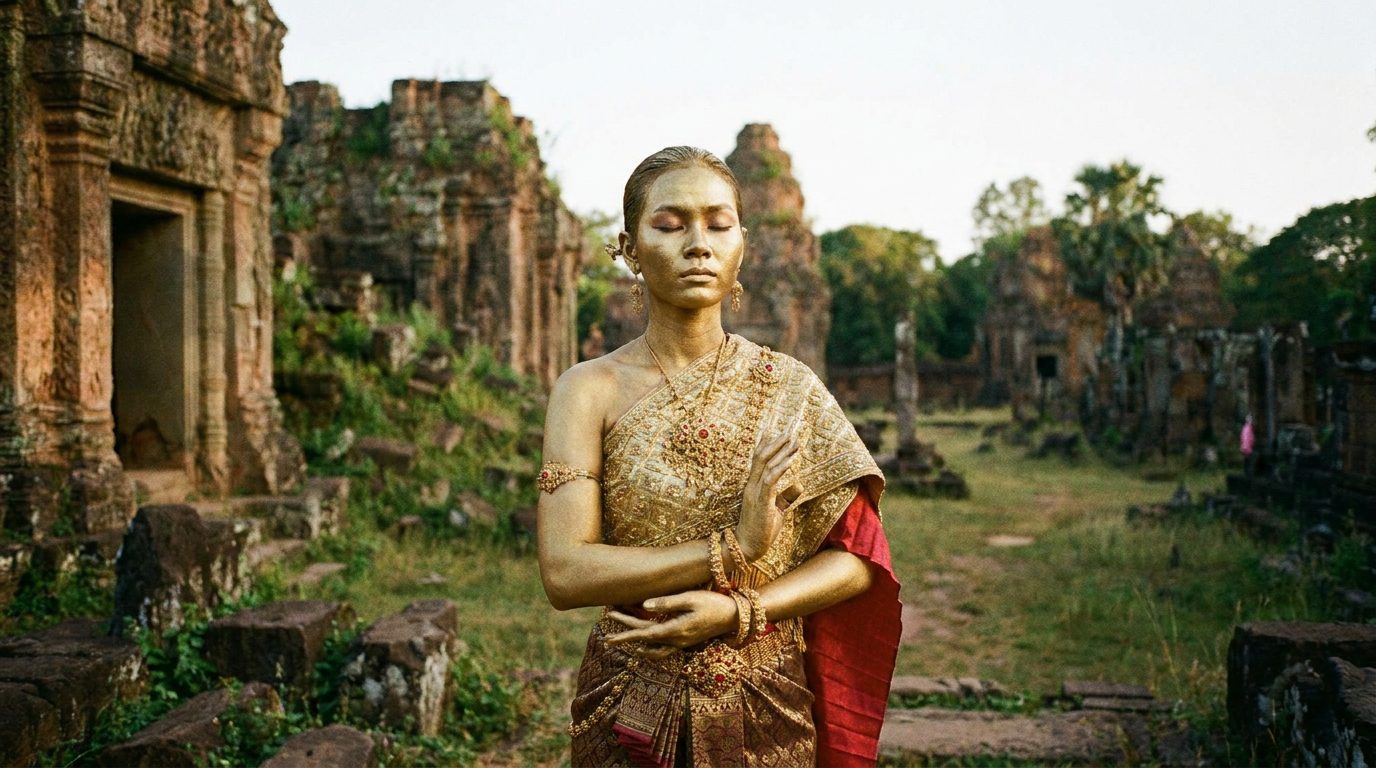
There is a story so beautiful, so full of mercy, that it has been transforming hearts for over five hundred years. It is the story of a golden-complexioned saint who danced through the streets of India, tears streaming down His face, chanting the holy names of God and inviting every single soul — regardless of caste, creed, or background — to taste the sweetest love the universe has ever known.
His name is Sri Chaitanya Mahaprabhu, and in the Bhakti tradition, He is celebrated as the Golden Avatar — God Himself appearing in the most approachable, most compassionate form imaginable.
Whether you are brand new to Bhakti Yoga or have been walking this path for years, the story of this Golden Avatar has something deeply personal and profoundly encouraging for you. Let’s explore it together with open hearts.
In the Bhakti tradition, an avatar (pronounced AH-vuh-tar) simply means a “descent” — God coming down into this world to be close to us, to help us, and to re-establish the path of love. Throughout sacred history, God has appeared in many forms: as Rama, as Krishna, as Narasimha, and in so many other beautiful manifestations.
Sri Chaitanya Mahaprabhu appeared in 1486 in Mayapur, a small town in West Bengal, India. He is called the “Golden Avatar” because of His radiant golden complexion, which shone like molten gold. But there is a much deeper reason for that golden color, and it holds the key to understanding His extraordinary mission.
The Hidden Identity
What makes Sri Chaitanya Mahaprabhu especially fascinating is that He came in a hidden way. Unlike previous avatars who openly displayed divine power — lifting mountains, defeating demons, or ruling kingdoms — Lord Chaitanya came as a devotee. He came to show us, by His own example, how to love God.
The Srimad Bhagavatam (11.5.32) offers a beautiful verse that devotees treasure as a reference to this hidden avatar:
> “In the age of Kali, intelligent persons perform congregational chanting to worship the incarnation of Godhead who constantly sings the names of Krishna. Although His complexion is not blackish, He is Krishna Himself. He is accompanied by His associates, servants, weapons, and confidential companions.”
This verse is remarkable because it describes someone who is Krishna but does not appear in Krishna’s familiar dark-blue complexion. Instead, He comes with a golden hue, and His “weapon” is not a discus or a bow — it is the holy name itself.
Why Gold? The Beautiful Secret
Here is one of the most tender truths in all of Bhakti theology: Sri Chaitanya Mahaprabhu’s golden complexion comes from the fact that Krishna Himself has taken on the mood and radiance of His greatest devotee, Srimati Radharani.
Radharani, whose complexion is golden, represents the very pinnacle of divine love. Krishna, wanting to understand the depth of Her love for Him — wanting to taste what it feels like to be a devotee — wrapped Himself in Her golden devotion and appeared as Lord Chaitanya.
So when we see the Golden Avatar, we are seeing something extraordinarily intimate: God experiencing His own sweetness through the heart of His most beloved devotee.
The Mission Of Boundless Mercy
Every avatar comes with a mission. Lord Chaitanya’s mission was breathtakingly simple and infinitely generous: to freely distribute pure love of God (prema) to everyone, without restriction.
In previous ages, spiritual paths often required great austerities, elaborate rituals, or lifetimes of study. But Sri Chaitanya Mahaprabhu opened the floodgates of mercy. He taught that in this current age — called Kali Yuga, an age of confusion and difficulty — the most powerful and accessible spiritual practice is the congregational chanting of God’s holy names.
The Gift Of The Holy Name
The primary practice Lord Chaitanya gave to the world is sankirtana — the joyful, communal chanting of the Hare Krishna maha-mantra:
**Hare Krishna, Hare Krishna, Krishna Krishna, Hare Hare
Hare Rama, Hare Rama, Rama Rama, Hare Hare**
Maha-mantra simply means “the great prayer” or “the great chant for deliverance.” Hare (HAH-ray) calls upon God’s divine energy of love. Krishna means “the all-attractive one.” Rama means “the source of all joy.”
When we chant these names — whether softly on our own or joyfully together — we are not just repeating syllables. We are calling out to the Divine with sincerity, and the Divine responds. As the Chaitanya Charitamrita (Antya 20.12) records Lord Chaitanya’s own teaching:
> “O my Lord, Your holy name alone can render all benediction to living beings, and thus You have hundreds and millions of names, like Krishna and Govinda. In these transcendental names You have invested all Your transcendental energies. There are not even hard and fast rules for chanting these names.”
Isn’t that beautiful? No hard and fast rules. You don’t have to be perfect. You don’t have to know Sanskrit. You just have to be sincere. God has made Himself available in His name for everyone.
Love Without Borders
One of the most radical aspects of Lord Chaitanya’s mission was its complete inclusivity. In a time and place where spiritual knowledge was often restricted by social hierarchies, Lord Chaitanya embraced everyone. He dined with people considered untouchable by society. He sent His followers to share the holy names with people of all religions and backgrounds. He declared that the chanting of God’s names transcends all material designations.
The Chaitanya Charitamrita (Adi 9.29) beautifully captures this mood of unconditional generosity:
> “Not considering who asked for it and who did not, nor who was fit and who unfit to receive it, Chaitanya Mahaprabhu distributed the fruit of devotional service.”
This is the heart of the Golden Avatar’s mission — love given freely, without qualification. You are welcome. You have always been welcome.
The Teachings That Transform Lives

Sri Chaitanya Mahaprabhu left behind a treasury of teachings that continue to guide spiritual seekers today. Although He wrote very little Himself, His conversations, prayers, and instructions were carefully preserved by His close associates and later compiled into sacred texts.
The Eight Verses Of Instruction
The only written composition directly attributed to Lord Chaitanya is the Siksastakam — eight extraordinary verses that contain the complete essence of Bhakti Yoga. Each verse takes the practitioner deeper into the ocean of divine love.
The very first verse (Siksastakam 1) begins with a celebration of chanting:
> “Glory to the Sri Krishna sankirtana, which cleanses the heart of all the dust accumulated for years and extinguishes the fire of conditional life, of repeated birth and death. This sankirtana movement is the prime benediction for humanity at large because it spreads the rays of the benediction moon.”
In practical terms, this means that when we chant, we are gently cleaning the mirror of our heart. All the layers of fear, confusion, selfishness, and pain that have accumulated over so many lifetimes begin to dissolve. What is revealed underneath is our true nature — joyful, loving, and eternally connected to God.
Humility As The Foundation
Lord Chaitanya also taught that genuine spiritual growth is rooted in humility — not the kind that makes you feel small or worthless, but the kind that makes you feel deeply grateful and genuinely caring toward others.
In the third verse of the Siksastakam, He says:
> “One should chant the holy name of the Lord in a humble state of mind, thinking oneself lower than the straw in the street; one should be more tolerant than a tree, devoid of all sense of false prestige, and should be ready to offer all respect to others. In such a state of mind one can chant the holy name of the Lord constantly.”
This is not about self-rejection. It is about being so full of love that there is no room left for ego. When we practice this kind of gentle humility, chanting becomes effortless and the heart opens wide.
Check out our website for more articles: more articles.
How The Golden Avatar Inspires Bhakti Yoga Today
The influence of Sri Chaitanya Mahaprabhu’s movement is alive and vibrant today. When you see people chanting joyfully in a park, when you visit a Bhakti center and are greeted with warm smiles and a delicious vegetarian feast, when you hear the maha-mantra being sung at a kirtan gathering — you are experiencing the ripple effects of this Golden Avatar’s mercy.
Kirtan: The Heart Of The Practice
Kirtan (KEER-tan) means “to praise” or “to glorify,” and it is the practice of singing God’s names together. It doesn’t matter if you can sing beautifully or if you can barely carry a tune. In kirtan, every voice is welcome because it is not a performance — it is a prayer.
The beauty of kirtan is that it engages your whole being. Your voice chants, your body moves, your mind focuses, and your heart opens. Many people describe their first kirtan experience as unexpectedly emotional — tears come, joy arises, and something deep inside feels like it has come home.
Service And Community
Lord Chaitanya didn’t only teach chanting. He taught that love for God naturally overflows into love for all living beings. This is why Bhakti communities emphasize seva (selfless service) — cooking for others, caring for those in need, sharing spiritual wisdom, and building communities where everyone feels like family.
Service is not a burden in Bhakti — it is an expression of love. When your heart is full, giving becomes the most natural thing in the world.
Why This Revelation Matters For You
You might be reading this and wondering, “This is beautiful, but what does it have to do with my life right now?”
Everything.
The Golden Avatar’s message is ultimately about your relationship with God — a relationship that is already real, already alive, just waiting to be rediscovered. You don’t have to earn it. You don’t have to become someone different. You just have to take one sincere step.
Starting Where You Are
Maybe that step is sitting quietly for five minutes and chanting the Hare Krishna maha-mantra, just to see how it feels.
Maybe it is attending a kirtan gathering and letting yourself be surrounded by the sound of devotion.
Maybe it is offering a simple prayer from the heart: “Dear God, I want to know You. Please help me.”
Whatever form it takes, that one sincere step is enough. The Golden Avatar’s entire mission was built on the understanding that God runs toward us the moment we turn toward Him.
As the Bhagavad Gita (9.22) lovingly assures us:
> “But those who always worship Me with exclusive devotion, meditating on My transcendental form — to them I carry what they lack, and I preserve what they have.”
God is not distant. God is not indifferent. God is actively carrying what you need to take the next step.
An Open Invitation
At The Bhakti House, we believe with all our hearts that the mercy of Sri Chaitanya Mahaprabhu — the Golden Avatar — is meant for you. It doesn’t matter where you come from, what you’ve done, what you believe, or how much you know. The door of divine love is open, and you are warmly, genuinely, completely welcome.
Take one sincere step today. Chant one round of the holy name. Offer one heartfelt prayer. Read one verse from sacred scripture and let it sit in your heart.
The Golden Avatar came so that no one would be left behind. That includes you.
We would love to walk this path alongside you. 💛
FAQs
What is The Golden Avatar?
The Golden Avatar is a concept in Hindu mythology that refers to the tenth and final avatar of the god Vishnu, who is believed to appear at the end of the Kali Yuga (the current age of darkness and decay) to restore righteousness and order to the world.
What are the characteristics of The Golden Avatar?
The Golden Avatar is said to possess divine qualities and powers, and is often depicted as a figure of immense wisdom, compassion, and strength. The avatar is believed to bring about a new era of peace and prosperity.
What are some popular beliefs and stories associated with The Golden Avatar?
One of the most well-known beliefs is that The Golden Avatar will appear riding a white horse, wielding a flaming sword, and leading the forces of good in a final battle against the forces of evil. There are also various stories and prophecies about the avatar’s arrival and the events that will precede it.
How is The Golden Avatar celebrated or honored in Hindu culture?
The concept of The Golden Avatar is celebrated in various ways, including through religious rituals, prayers, and festivals. Many Hindus also honor the avatar through acts of charity, kindness, and devotion to Vishnu.
What is the significance of The Golden Avatar in Hinduism?
The Golden Avatar holds great significance in Hinduism as a symbol of hope and renewal. The avatar’s arrival is believed to mark the end of a dark and tumultuous period, and the beginning of a new age of righteousness and spiritual enlightenment.

