
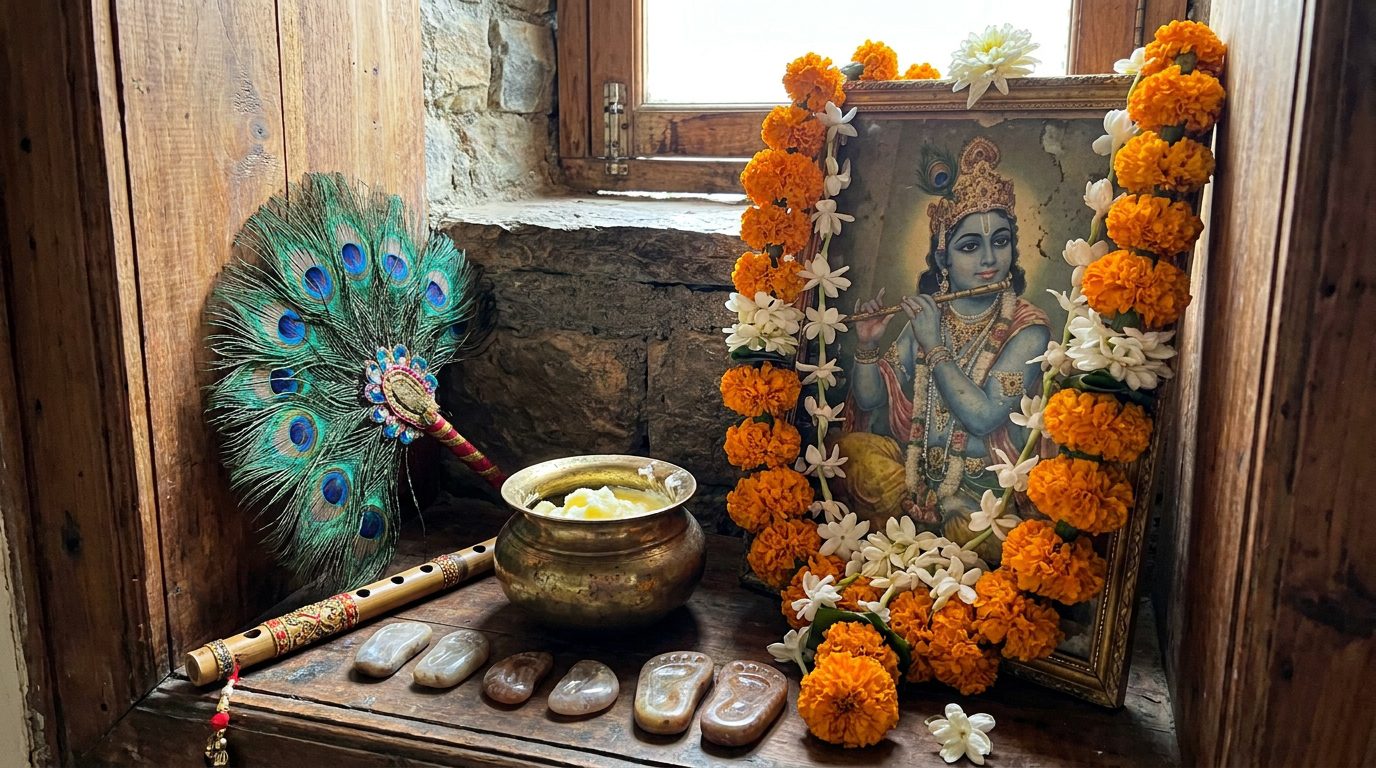
Have you ever looked at a beautiful painting of Lord Krishna and wondered about all the items He holds, the ornaments He wears, or the colors that surround Him? You’re not alone. For thousands of years, devotees and curious seekers alike have been drawn to the deeply meaningful symbols associated with Krishna — each one carrying a powerful spiritual message that speaks directly to the heart.
At The Bhakti House, we believe that understanding these sacred symbols isn’t just an intellectual exercise. It’s an invitation to deepen your relationship with the Divine. Whether you’re brand new to Bhakti Yoga or you’ve been chanting for years, exploring Krishna’s symbols can open up fresh layers of love, wonder, and spiritual insight in your daily practice.
So let’s walk through these beautiful symbols together, one by one, and discover what they reveal about the nature of God and our own spiritual journey.
Perhaps no symbol is more closely associated with Krishna than His beloved flute, known in Sanskrit as the venu or murali. If you’ve ever seen an image of Krishna, chances are He’s standing in His graceful three-bend pose, holding a flute to His lips. But this isn’t just a musical instrument. It represents something profoundly spiritual.
Why the Flute Matters to Every Seeker
The flute is hollow. It has no ego, no agenda, no resistance. It simply allows Krishna’s breath to flow through it, and what emerges is the most enchanting music in all of creation. This is a beautiful metaphor for the surrendered soul. When we empty ourselves of false pride and selfish desires, we become instruments through which divine love can flow freely into the world.
In the Śrīmad-Bhāgavatam (10.21.7), the gopīs (the cowherd women of Vrindavan who are considered the highest devotees) describe the effect of Krishna’s flute song:
> “O gopīs, what auspicious activities must the flute have performed to enjoy the nectar of Kṛṣṇa’s lips independently and leave only a taste for us gopīs, for whom that nectar is actually meant!”
The gopīs are so captivated by the sound of the flute that everything else loses its significance. This teaches us that the call of divine love is the most powerful force in existence. It can reach anyone, anywhere, at any time — no matter your background, your past, or your current circumstances.
A Practical Reflection
When you chant the Hare Krishna maha-mantra — Hare Krishna, Hare Krishna, Krishna Krishna, Hare Hare / Hare Rama, Hare Rama, Rama Rama, Hare Hare — you are responding to that same flute call. You are answering God’s invitation to come home. Try chanting with the intention of becoming like the flute: hollow, willing, and open to whatever the Lord wants to express through your life.
The Peacock Feather: Beauty, Grace, and Humility
Resting gently in Krishna’s dark, curling hair is a single peacock feather. This is not merely decorative — it tells a story about the relationship between God and His creation.
The Story Behind the Feather
According to beloved devotional traditions, the peacocks of Vrindavan were so overwhelmed by the beauty of Krishna’s flute playing that they began to dance in ecstasy. Afterward, the lead peacock offered his finest feather at Krishna’s feet as a gesture of love and gratitude. Krishna, being the most loving and reciprocal person, placed that feather in His own crown.
Think about this for a moment. The Supreme Lord of all creation chose to wear the humble offering of a peacock. This reveals something extraordinary about Krishna’s nature — He treasures even the simplest offering when it is given with genuine love.
What This Means for Us
In the Bhagavad-gītā (9.26), Krishna Himself confirms this principle:
> “If one offers Me with love and devotion a leaf, a flower, a fruit, or water, I will accept it.”
You don’t need to be wealthy, highly educated, or spiritually advanced to approach Krishna. A sincere heart is the only qualification. The peacock feather in Krishna’s hair is a constant reminder that God cherishes your love above all else — and that He will honor your offering by holding it close.
The Sudarshana Chakra: Divine Protection and Justice
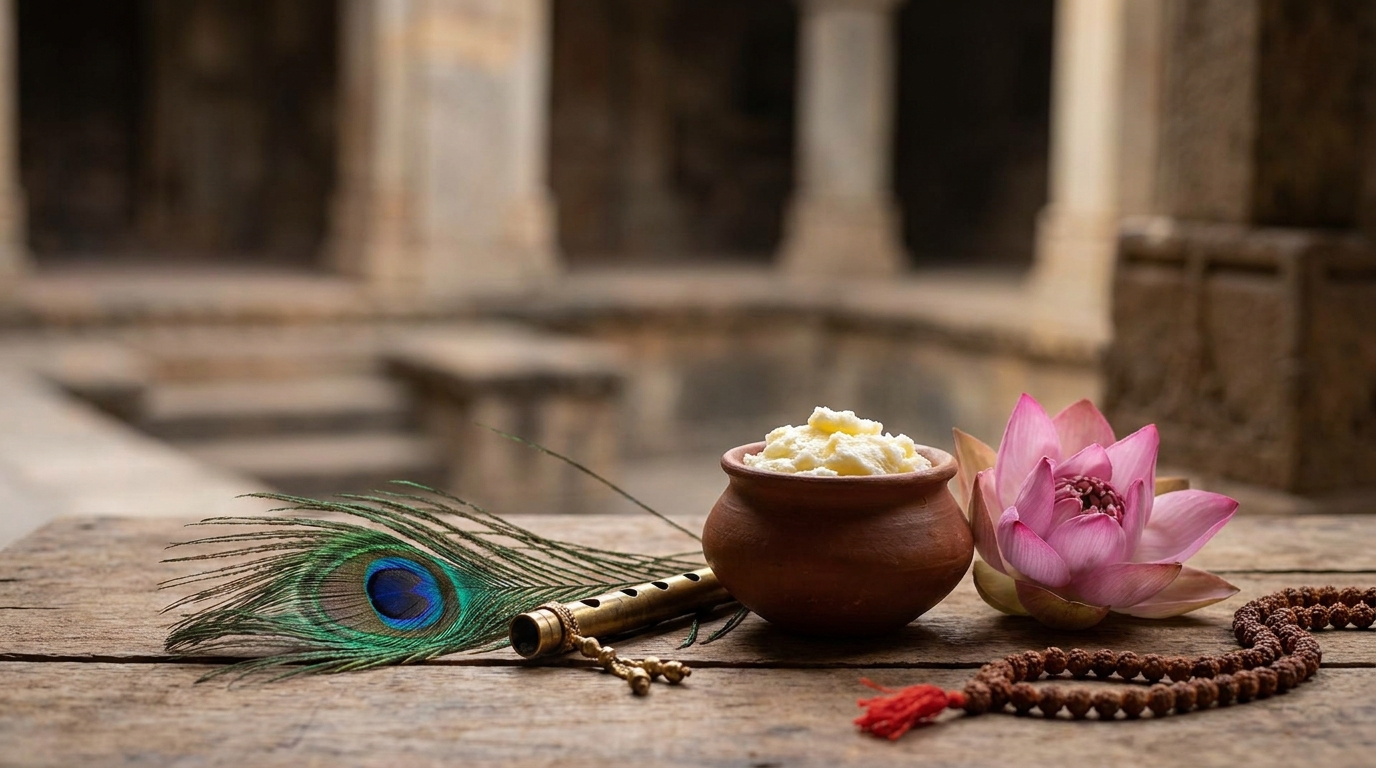
Krishna is often depicted with a disc-like weapon called the Sudarshana Chakra (the word sudarshana means “auspicious vision” in Sanskrit). This powerful disc spins on His finger and represents His commitment to protecting those who take shelter of Him.
More Than a Weapon
While the Sudarshana Chakra certainly symbolizes divine power, its deeper meaning is about protection and the restoration of balance. In a world where injustice and suffering exist, devotees find tremendous comfort knowing that the Lord is never passive. He actively intervenes to shelter His beloved children.
In the Bhagavad-gītā (4.8), Krishna declares:
> “To deliver the pious and to annihilate the miscreants, as well as to reestablish the principles of religion, I Myself appear, millennium after millennium.”
This is not about vengeance. It’s about love in action. Just as a caring parent protects their child from danger, Krishna uses His divine power to create the conditions where love, devotion, and spiritual growth can flourish.
Finding Shelter in Daily Life
For practitioners of Bhakti Yoga, this symbol is deeply reassuring. When life feels chaotic, when challenges seem overwhelming, remembering the Sudarshana Chakra can be a source of real comfort. Through prayer, chanting, and sincere devotion, we place ourselves under Krishna’s protective care. We don’t have to fight every battle alone.
Check out our website for more articles: more articles.
The Lotus Flower: Purity in the Midst of the World
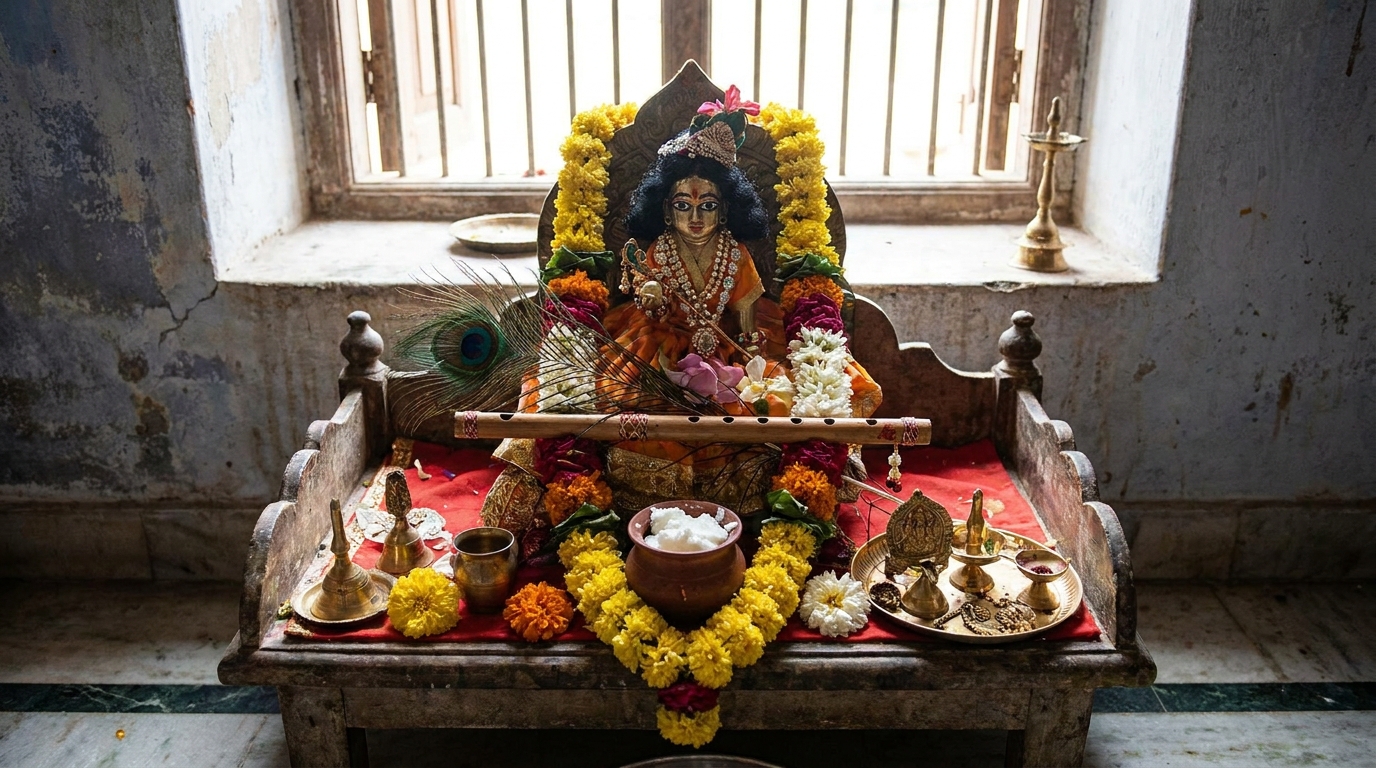
The lotus appears again and again in connection with Krishna. His eyes are compared to lotus petals. His feet are called “lotus feet.” He often holds a lotus in His hand. Understanding why this flower is so significant can transform how you see your own spiritual life.
Why the Lotus Is So Special
A lotus grows in muddy water, yet its petals remain completely clean and untouched by the muck below. This is a perfect image for spiritual life in the material world. You don’t have to leave your job, your family, or your daily responsibilities to grow spiritually. Like the lotus, you can remain in the world while keeping your heart anchored in devotion.
Krishna’s Lotus Feet
The concept of taking shelter of Krishna’s “lotus feet” (known as padapadma or charana-kamala in Sanskrit) is central to Bhakti Yoga. It represents humility, surrender, and the sweetness of approaching God with reverence and love.
In the Śrīmad-Bhāgavatam (1.2.6), we find this foundational verse about the goal of all spiritual practice:
> “The supreme occupation [dharma] for all humanity is that by which men can attain to loving devotional service unto the transcendent Lord. Such devotional service must be unmotivated and uninterrupted to completely satisfy the self.”
Taking shelter of Krishna’s lotus feet means making devotional service — chanting, praying, serving others, offering your daily activities to God — the foundation of your life. It doesn’t require perfection. It requires sincerity.
The Yellow Garments: Radiance, Warmth, and Spiritual Joy
Krishna is almost always depicted wearing beautiful yellow or golden garments, known as pitambara in Sanskrit. This bright, warm color isn’t accidental — it carries deep spiritual significance.
What the Color Yellow Represents
Yellow is associated with knowledge, warmth, and auspiciousness in Vedic culture. When Krishna wears golden garments, it symbolizes His nature as the source of all knowledge and the embodiment of spiritual joy. His appearance is meant to attract the heart, to draw us toward something infinitely beautiful and infinitely good.
Krishna’s Beauty as a Spiritual Practice
In Bhakti Yoga, meditating on Krishna’s beautiful form is actually a recognized spiritual practice. It’s not superficial — it’s deeply transformative. When we contemplate the Lord’s beauty, our hearts naturally soften, our attachments to temporary things begin to loosen, and our desire to connect with God grows stronger.
The great devotee Brahma prays in the Brahma-saṁhitā (5.30):
> “I worship Govinda, the primeval Lord, who is adept in playing on His flute, with blooming eyes like lotus petals, with head bedecked with peacock’s feather, with the figure of beauty tinged with the hue of blue clouds, and His unique loveliness charming millions of Cupids.”
Reading or hearing descriptions like this is itself a devotional act. It purifies the heart and awakens dormant love for God.
The Kaustubha Gem and Vaijayanti Garland: The Lord Who Carries His Devotees
Two additional symbols associated with Krishna deserve special attention: the Kaustubha gem that rests on His chest and the Vaijayanti garland that hangs around His neck.
The Kaustubha Gem
This brilliant jewel represents the pure, conscious soul. The fact that Krishna wears it over His heart tells us something deeply moving — the Lord carries every soul close to His heart. You are never forgotten. You are never insignificant. In Krishna’s eyes, every living being is a precious jewel.
The Vaijayanti Garland
This garland is made of five kinds of fragrant flowers, representing the five elements of material creation and the five senses. By wearing this garland, Krishna shows that all of creation is an offering to Him, and that every element of our existence can be spiritualized when connected to devotion.
Bringing These Symbols Into Your Daily Practice
Understanding Krishna’s symbols is wonderful, but the real magic happens when you let them transform your daily life. Here are a few simple, practical ways to do that:
Chant with awareness. When you chant the holy names, remember the flute. Let yourself become an instrument of divine love.
Offer something simple. Remember the peacock feather. Even a glass of water offered with love is received by Krishna with joy.
Trust in divine protection. When anxiety arises, remember the Sudarshana Chakra. You are not alone in your struggles.
Stay rooted in devotion. Like the lotus, you can live in this busy, imperfect world and still grow spiritually every single day.
Meditate on beauty. Spend a few moments each day contemplating Krishna’s form, His symbols, and His loving nature. Let this beauty soften your heart and draw you closer to Him.
You Are Welcome Here
Whatever brought you to this article — curiosity, a longing for something deeper, a friend’s recommendation, or the quiet pull of your own soul — we’re grateful you’re here. Bhakti Yoga is not about being perfect. It’s about being sincere. It’s about taking one small, honest step toward God and trusting that He will take ten steps toward you.
Krishna’s symbols remind us that the Lord is endlessly beautiful, endlessly loving, and endlessly accessible. He holds a flute to call you home. He wears a peacock feather to show you that your simplest offering matters. He carries the Sudarshana Chakra to protect you. He stands on a lotus to show you that purity is possible right where you are.
You don’t have to have all the answers. You don’t have to change everything overnight. Just take one sincere step. Chant one round of the holy names. Offer one prayer from the heart. Read one verse of sacred scripture. That one step is enough to begin a journey that will transform your life from the inside out.
Everyone is welcome on this path. Everyone is welcome at The Bhakti House. And most importantly, everyone is welcome in Krishna’s heart — because you have always been there.
FAQs
What are some of the symbols associated with Krishna?
Some of the symbols associated with Krishna include the peacock feather, the flute, the lotus flower, the cow, and the Sudarshana Chakra.
What is the significance of the peacock feather in relation to Krishna?
The peacock feather is often seen adorning Krishna’s head and is symbolic of his divine beauty and grace. It is also associated with his playful and mischievous nature.
Why is the flute considered a symbol of Krishna?
The flute is a symbol of Krishna’s ability to attract and enchant others. It is also representative of the divine music and melody that emanates from Krishna’s presence.
What does the lotus flower symbolize in relation to Krishna?
The lotus flower is a symbol of purity, enlightenment, and divine beauty. It is often associated with Krishna’s transcendental and spiritual nature.
What is the significance of the cow and the Sudarshana Chakra as symbols of Krishna?
The cow is a symbol of Krishna’s nurturing and protective nature, while the Sudarshana Chakra represents his divine power and ability to protect his devotees from harm.

