
There is a moment in every spiritual seeker’s life when the heart whispers, “There must be something more.” More than routine. More than ritual. More love, more meaning, more connection to the Divine. If you have ever felt that quiet longing, you are already standing at the doorway that Śrī Caitanya Mahāprabhu opened wide for the entire world over five hundred years ago.
At The Bhakti House, we believe that Caitanya’s teachings are not locked away in ancient history. They are alive, breathing, and deeply relevant to anyone — regardless of background, culture, or experience — who wants to taste the sweetness of a life centered on love for God. Let us walk through these transformative teachings together, one gentle step at a time.
Śrī Caitanya Mahāprabhu (1486–1534) appeared in Navadvīpa, a town in West Bengal, India. To His devotees, He is understood as the Supreme Lord Himself appearing in the mood of a devotee — specifically, in the mood of Śrīmatī Rādhārāṇī, the embodiment of the highest love for Kṛṣṇa.
But even if you are new to these names and ideas, the essence is beautifully simple: Caitanya came to show us what it looks like when a human being loves God with every fiber of their being. He did not merely teach devotion — He lived it, wept it, sang it, and danced it through the streets.
A Scholar Who Became an Ocean of Love
Before He began His mission of spreading the holy names, Caitanya was known as Nimāi Paṇḍita, a brilliant young scholar. He mastered logic, grammar, and scripture at an astonishingly young age. Yet He chose to set aside intellectual prestige in favor of something far greater: complete surrender to the sweetness of God’s holy names. This transformation reminds us that knowledge is beautiful, but love is the ultimate destination.
The Golden Avatāra
Caitanya is often called the “Golden Avatāra” because of His radiant golden complexion. The Śrīmad-Bhāgavatam offers a glimpse into this divine appearance:
> “In the Age of Kali, intelligent persons perform congregational chanting to worship the incarnation of Godhead who constantly sings the names of Kṛṣṇa. Although His complexion is not blackish, He is Kṛṣṇa Himself. He is accompanied by His associates, servants, weapons, and confidential companions.” — Śrīmad-Bhāgavatam 11.5.32 (vedabase.io)
This verse reveals that Caitanya’s mission was foretold in scripture — and that His “weapon” for this age is not a sword or a bow, but the congregational chanting of God’s holy names.
The Heart of Caitanya’s Mission: The Holy Name
If there is one thread that runs through every aspect of Caitanya’s teachings, it is the supreme importance of chanting God’s names. In the Vedic tradition, the current age we live in is called Kali-yuga — an era marked by quarrel, confusion, and spiritual forgetfulness. Caitanya taught that in this challenging time, the most accessible and powerful spiritual practice is the chanting of the mahā-mantra:
Hare Kṛṣṇa, Hare Kṛṣṇa, Kṛṣṇa Kṛṣṇa, Hare Hare / Hare Rāma, Hare Rāma, Rāma Rāma, Hare Hare
This is not a magic formula. It is a prayer of the heart — a calling out to the Divine with sincerity and love. “Hare” is an address to God’s divine energy. “Kṛṣṇa” means the all-attractive Supreme Person. “Rāma” means the source of all spiritual joy. When we chant, we are simply saying, “O Lord, O Divine Energy, please engage me in Your loving service.”
Caitanya’s Eight Verses: The Śikṣāṣṭaka
Though Caitanya was a prolific speaker and inspired volumes of devotional philosophy through His close followers, He personally left behind only eight verses, known as the Śikṣāṣṭaka. These eight prayers are considered the complete essence of His teachings. The very first verse establishes the glory of chanting:
> “Glory to the Śrī Kṛṣṇa saṅkīrtana, which cleanses the heart of all the dust accumulated for years and extinguishes the fire of conditional life, of repeated birth and death. This saṅkīrtana movement is the prime benediction for humanity at large because it spreads the rays of the benediction moon. It is the life of all transcendental knowledge. It increases the ocean of transcendental bliss, and it enables us to fully taste the nectar for which we are always anxious.” — Śikṣāṣṭaka 1, Śrī Caitanya Mahāprabhu (vedabase.io, Caitanya-caritāmṛta, Antya 20.12)
Read that again slowly. Caitanya is saying that chanting cleanses the heart, ends the cycle of suffering, spreads blessings to everyone, and awakens the deepest joy we have been longing for all along. That is an extraordinary promise — and countless devotees across centuries have experienced its truth firsthand.
Humility: The Foundation for Chanting
Caitanya did not teach chanting as a mechanical exercise. In His third verse of the Śikṣāṣṭaka, He reveals the inner disposition that makes chanting truly transformative:
> “One should chant the holy name of the Lord in a humble state of mind, thinking oneself lower than the straw in the street; one should be more tolerant than a tree, devoid of all sense of false prestige, and should be ready to offer all respect to others. In such a state of mind one can chant the holy name of the Lord constantly.” — Śikṣāṣṭaka 3 (vedabase.io, Caitanya-caritāmṛta, Antya 20.21)
This teaching is profoundly practical. It tells us that spiritual growth is not about becoming important or impressive. It is about becoming soft, open, and genuinely respectful toward every living being. When the heart is humble, the holy name enters deeply and does its beautiful work.
Love of God: The Ultimate Goal
Many spiritual traditions speak of liberation — freedom from suffering, escape from the cycle of birth and death. Caitanya acknowledged liberation but taught something even higher: prema, or pure love of God.
In the Bhakti tradition as illuminated by Caitanya, liberation is not the final destination. It is more like a rest stop along the highway. The real destination is an eternal, joyful, loving relationship with the Supreme Person, Kṛṣṇa.
Beyond Fear, Beyond Duty
What makes Caitanya’s teaching so refreshing is that it moves devotion beyond fear and obligation. We do not chant to avoid punishment. We do not serve God out of dry duty. We do these things because love naturally expresses itself in connection, in service, in song.
Caitanya’s own life demonstrated this. He would chant and dance in such ecstasy that tears would stream down His face. He would sometimes fall to the ground, overwhelmed by feelings of divine separation and longing. His example shows that the spiritual path is not emotionless or sterile — it is the most deeply felt experience a human being can have.
Rādhā’s Love as the Highest Standard
Caitanya taught that the love of Śrīmatī Rādhārāṇī for Kṛṣṇa represents the highest possible expression of devotion. Rādhā’s love is selfless, all-consuming, and entirely focused on Kṛṣṇa’s happiness. Caitanya came in Her mood to taste and distribute that extraordinary love. For us, this means that Bhakti Yoga is ultimately about learning to love God not for what we can get, but simply because He is supremely lovable.
Check out our website for more articles: more articles.
Caitanya’s Practical Path: How to Live These Teachings Daily
One of the most beautiful aspects of Caitanya’s movement is its accessibility. You do not need to be a scholar. You do not need to renounce the world. You do not need to be born into any particular family or tradition. Caitanya’s path meets you exactly where you are.
Chanting: Your Daily Anchor
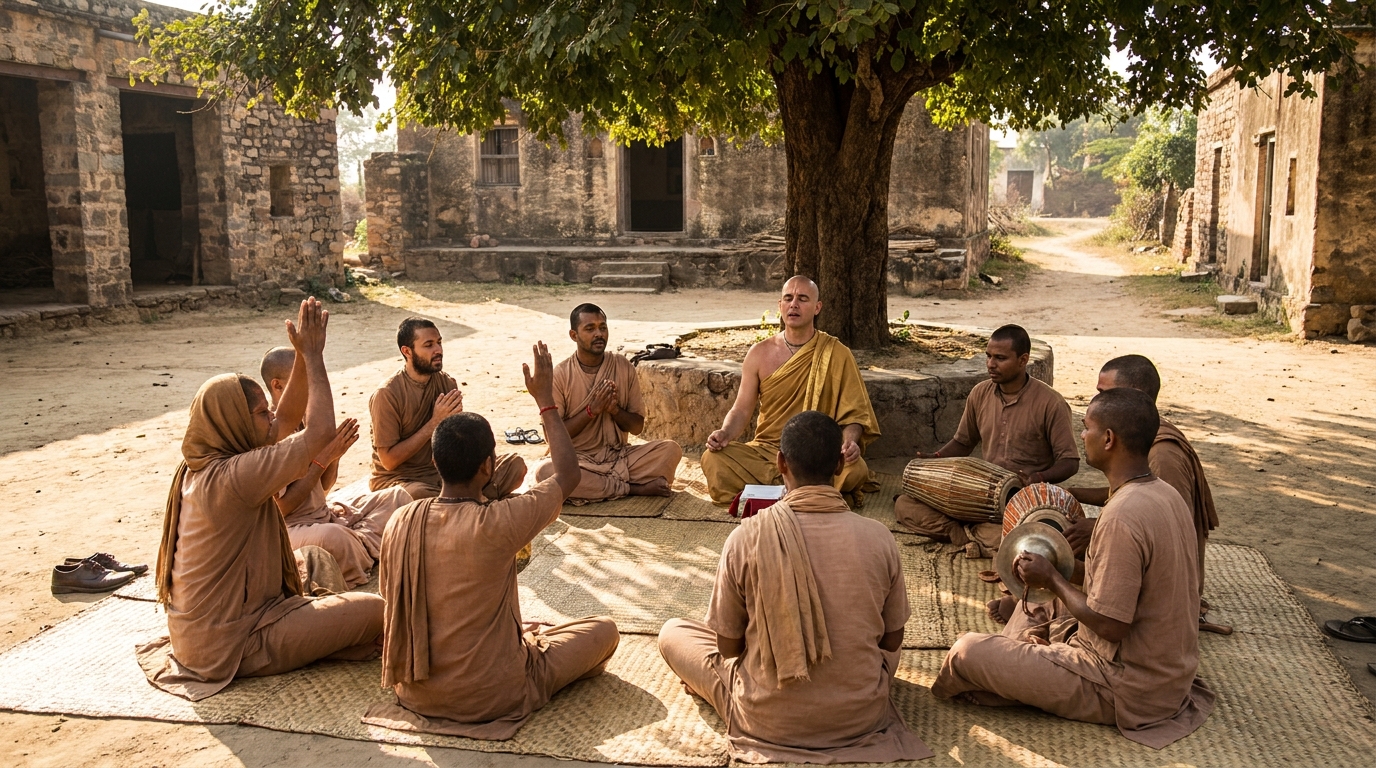
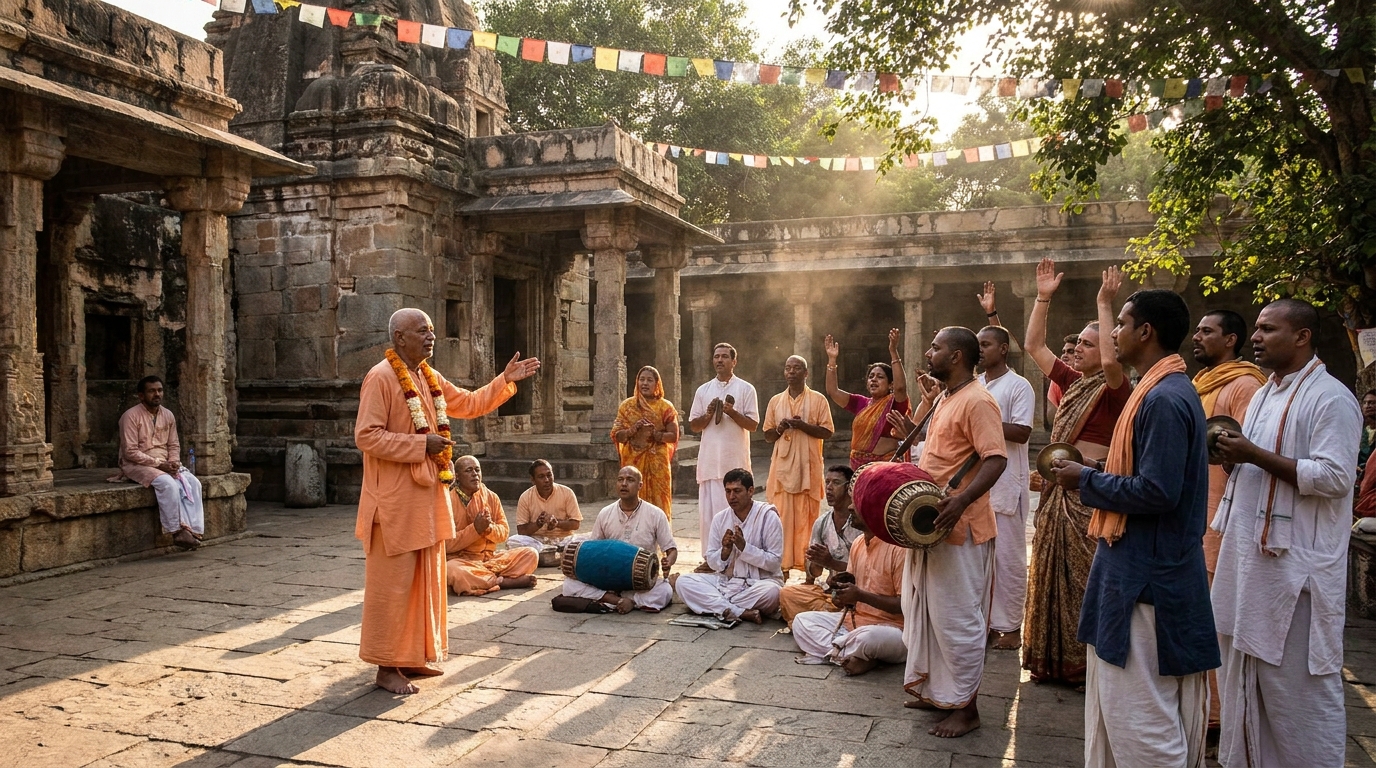
The simplest and most powerful daily practice is chanting the Hare Kṛṣṇa mahā-mantra. You can chant softly on meditation beads (called japa), or you can sing aloud with others in congregational chanting (called kīrtana). Even five or ten minutes of sincere chanting each day can begin to transform your inner landscape.
Hearing and Reading: Nourishing the Heart
Caitanya emphasized hearing about Kṛṣṇa’s names, qualities, pastimes, and teachings. Reading sacred texts like the Bhagavad-gītā, the Śrīmad-Bhāgavatam, and the Caitanya-caritāmṛta — even a few verses at a time — waters the seed of devotion planted in the heart. As Caitanya-caritāmṛta explains:
> “Pure love for Kṛṣṇa is eternally established in the hearts of the living entities. It is not something to be gained from another source. When the heart is purified by hearing and chanting, this love naturally awakens.” — Caitanya-caritāmṛta, Madhya 22.107 (vedabase.io)
This is deeply encouraging. Love for God is not something we have to manufacture. It is already within us. Our practice simply clears away the dust so it can shine through.
Service: Love in Action
Caitanya’s path is not passive. Devotion expresses itself through service — cooking a meal with love and offering it to God, helping others, sharing what we have learned, caring for the natural world, or simply being kind. Bhakti is love in action. Every act of genuine service, no matter how small, draws us closer to the Divine.
Community: Walking Together
Caitanya placed great importance on sādhu-saṅga — the association of sincere spiritual seekers. We are not meant to walk this path alone. Gathering with others to chant, share meals, discuss scripture, and support one another creates a spiritual atmosphere that lifts everyone. This is one of the core values at The Bhakti House: community as a vehicle for spiritual growth.
Caitanya’s Legacy: A Movement That Changed the World
The impact of Caitanya’s teachings did not end with His physical presence. His closest associates — the Six Gosvāmīs of Vṛndāvana, including Rūpa Gosvāmī and Sanātana Gosvāmī — systematically compiled His teachings into vast and luminous theological works. Kṛṣṇadāsa Kavirāja Gosvāmī composed the Caitanya-caritāmṛta, one of the most beloved devotional texts in the world, which chronicles Caitanya’s life and teachings in extraordinary depth.
A Global Invitation
In the twentieth century, His Divine Grace A.C. Bhaktivedanta Swami Prabhupāda carried Caitanya’s teachings across the ocean to the Western world, founding the International Society for Krishna Consciousness (ISKCON) in 1966. Through his tireless efforts, millions of people from every continent encountered the holy name and the path of Bhakti Yoga. Today, Caitanya’s movement continues to grow, touching hearts in every corner of the globe.
Relevance for Today
In a world often overwhelmed by anxiety, division, and materialism, Caitanya’s message is like cool water for a parched soul. He teaches that real happiness is not found in accumulation or achievement, but in connection — connection to God, connection to each other, and connection to our own deepest nature as loving spiritual beings.
You Are Welcome Here
Perhaps you have been chanting for years, or perhaps you have never heard the mahā-mantra before reading this article. Perhaps you come from a Hindu background, a Christian background, no religious background at all, or something entirely different. It truly does not matter.
Caitanya’s love is not exclusive. His arms are wide open. His invitation is for everyone.
Śrī Caitanya Mahāprabhu demonstrated that one sincere step toward God is met with a thousand steps of grace flowing back toward you. You do not have to be perfect. You do not have to have it all figured out. You simply have to be willing to open your heart, even just a little.
So wherever you are today, we warmly invite you to take that one sincere step. Chant one round of the mahā-mantra. Read one verse of sacred scripture. Offer one prayer from the deepest part of your heart. Sit with one community of loving seekers.
God is not far away. He is as close as His holy name on your lips and His love already planted in your heart.
Welcome home.
Hare Kṛṣṇa.
FAQs
What are the main teachings of Caitanya?
Caitanya’s teachings revolve around the practice of bhakti yoga, which emphasizes devotion and love for the divine. He taught that by chanting the Hare Krishna mantra and engaging in devotional activities, one can attain spiritual liberation and experience a deep connection with the divine.
What is the significance of Caitanya’s teachings?
Caitanya’s teachings are significant because they emphasize the accessibility of spiritual realization through the practice of bhakti yoga. He emphasized the importance of chanting the holy names of God and engaging in devotional service as a means to attain spiritual enlightenment.
How did Caitanya’s teachings influence Hinduism?
Caitanya’s teachings had a profound impact on Hinduism, particularly in the development of the Gaudiya Vaishnavism tradition. His emphasis on the chanting of the Hare Krishna mantra and the practice of devotional service has influenced the devotional practices of many Hindus.
What is the historical context of Caitanya’s teachings?
Caitanya Mahaprabhu, the founder of the Gaudiya Vaishnavism tradition, lived in India during the 16th century. He was a prominent figure in the Bhakti movement, which sought to emphasize the path of devotion and love for the divine as a means to attain spiritual liberation.
How are Caitanya’s teachings practiced today?
Caitanya’s teachings are practiced today through the chanting of the Hare Krishna mantra, engaging in devotional activities such as kirtan (congregational chanting), and studying the philosophical teachings of Gaudiya Vaishnavism. His teachings continue to inspire and guide the spiritual practices of many devotees around the world.

