
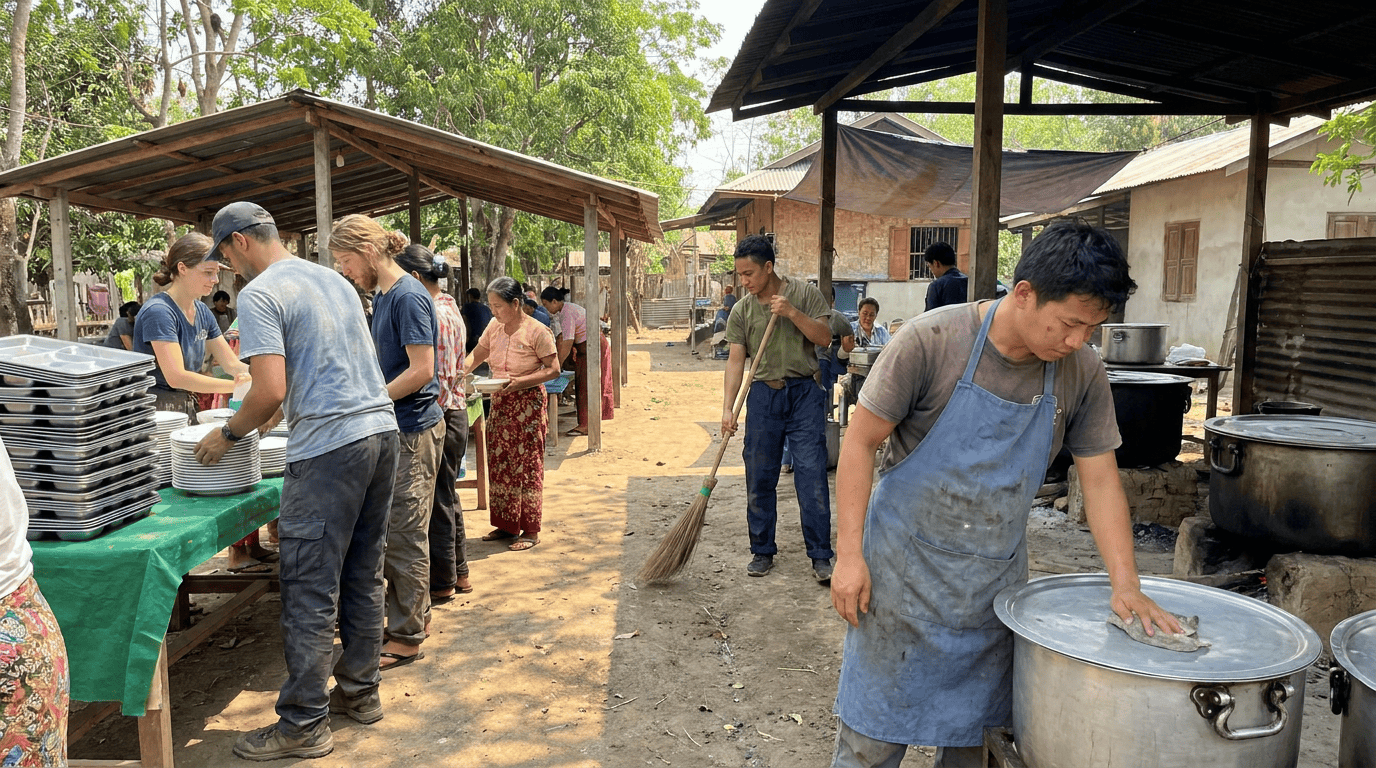
Seva is a beautiful Sanskrit word that means “selfless service.” It comes from the heart of Bhakti Yoga, the path of devotion, where every action can become an offering of love to God.
In simple terms, seva means serving with a spirit of humility, gratitude, and devotion—without demanding recognition, reward, or control over the results. It is service done not only to help others, but also to purify the heart and deepen our relationship with the Divine.
In the Bhakti tradition, God is understood as the Supreme Person, the source of all love, beauty, compassion, and life. Different spiritual traditions may call Him by different names—Krishna, Rama, Vishnu, Govinda, Allah, Yahweh, the Divine, the Beloved, or simply God. The heart of seva is not limited by background, culture, or religious label. It is the universal movement of love expressed through action.
Seva teaches us that spirituality is not only something we practice while sitting in meditation or chanting in a temple. Spirituality can live in the way we cook, clean, listen, encourage, give, forgive, and care for the world around us.
Through seva, ordinary life becomes sacred.
Seva as Service to God and All Living Beings
Bhakti scriptures explain that every living being is connected to God. In the Bhagavad-gita, Krishna says:
“I am seated in everyone’s heart.”
—Bhagavad-gita 15.15
This means that when we serve others with compassion and humility, we are not merely doing something “nice.” We are honoring the presence of God within them.
A simple act—offering food, helping a friend, caring for a child, cleaning a spiritual space, planting a tree, supporting someone who is struggling—can become seva when it is done with devotion.
The outer action may be small, but the inner intention makes it sacred.
Seva Is Not Slavery or Self-Neglect
Sometimes people misunderstand service. They may think seva means losing boundaries, becoming exhausted, or letting others take advantage of them. But true seva is not self-harm. It is not people-pleasing. It is not serving from fear, guilt, or pressure.
Seva is love in action, guided by wisdom.
A healthy spiritual life includes rest, prayer, nourishment, honest communication, and balance. When we serve from a centered heart, we are more able to give sincerely and sustainably.
Seva is not about proving our worth. It is about remembering that our worth already comes from being a beloved soul, part of God.
The Spiritual Meaning of Seva in Bhakti Yoga
Bhakti Yoga is the yoga of love and devotion. The word “bhakti” means loving devotion, and “yoga” means union or connection. So Bhakti Yoga is the path of reconnecting with God through love.
Seva is one of the most practical expressions of Bhakti Yoga. It takes devotion out of theory and brings it into daily life.
We may chant holy names, offer prayers, read sacred texts, and meditate. These practices soften the heart. Then seva allows that softened heart to move into the world.
Seva Purifies the Heart
In Bhakti, the heart is often compared to a mirror. Over time, the mirror becomes covered by dust—selfishness, pride, envy, fear, anger, and forgetfulness of God. Spiritual practices clean that mirror.
Chanting, prayer, scripture, and seva all help remove the dust from the heart.
When we serve selflessly, we begin to see our own attachments. We may notice a desire to be praised. We may feel irritated when no one thanks us. We may compare our service to someone else’s. These moments are not failures. They are invitations to grow.
Seva gently reveals what is inside us, so we can offer it to God.
Instead of thinking, “I am such a spiritual person because I serve,” we can pray, “Dear Lord, please help me serve with a cleaner heart.”
That humble prayer is powerful.
Seva Awakens Love
Love grows when it is expressed. If we keep love locked inside as an idea, it may remain weak. But when we act with love—again and again—the heart becomes trained in devotion.
In the Bhagavad-gita, Krishna teaches:
“Whatever you do, whatever you eat, whatever you offer or give away, and whatever austerities you perform—do that as an offering to Me.”
—Bhagavad-gita 9.27
This verse is a foundational teaching for seva. Krishna is saying that life itself can become an offering. We do not have to wait until we are perfect. We can begin with what we already do.
Cooking can become an offering. Work can become an offering. Parenting can become an offering. Caring for the elderly, studying, cleaning, singing, gardening, writing, building, organizing, and listening can all become offerings.
The key is consciousness: “Dear God, may this be for You. May this serve Your children. May this help me remember You.”
Seva Connects Us to Community
Bhakti is deeply personal, but it is not isolated. Spiritual growth is supported by sangha, which means spiritual community or association.
Serving with others helps us learn cooperation, patience, forgiveness, and humility. In community seva, we may not always get our preferred role. We may need to listen more, adjust more, or appreciate others more.
This is part of the training.
A temple, ashram, kirtan gathering, home group, food distribution project, or devotional community becomes a place where seva transforms hearts—not only through the tasks, but through the relationships formed in service.
Different Types of Seva
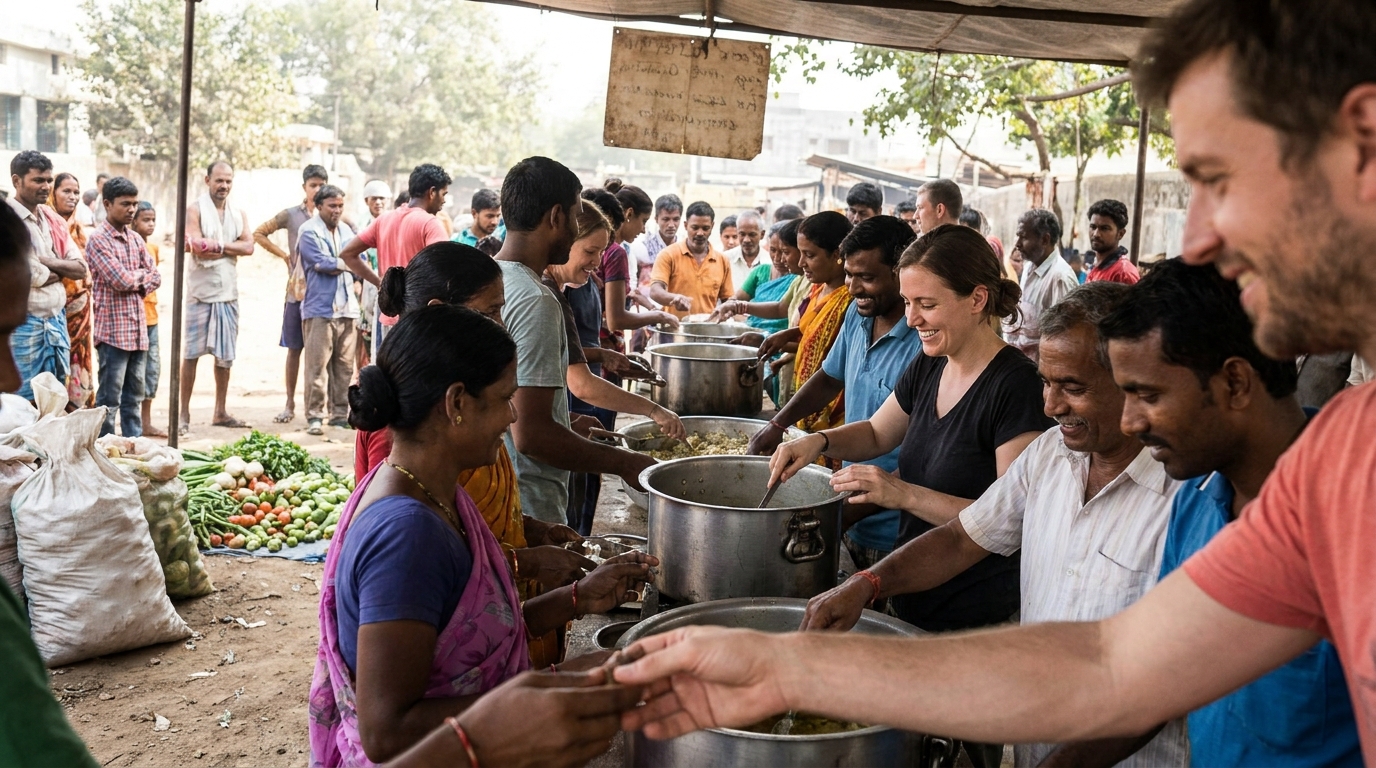
Seva can take many forms. There is no single personality type required. You do not need to be loud, wealthy, strong, scholarly, or “advanced.” Everyone has something to offer.
In Bhakti Yoga, the sincerity of the offering matters more than the size of the offering.
Physical Seva
Physical seva involves using the body to serve. This might include:
- Cleaning a temple, meditation space, or community center
- Cooking sacred vegetarian meals
- Serving prasadam, food offered to God
- Setting up chairs or instruments for kirtan
- Gardening or caring for sacred spaces
- Helping with festivals or gatherings
- Driving someone to a program
- Repairing, organizing, decorating, or building
The body is a gift. When used in service, it becomes spiritualized.
Even sweeping the floor can become a prayer: “May this space welcome others into peace. May those who enter feel closer to God.”
Emotional Seva
Emotional seva is the service of the heart. It includes presence, kindness, patience, and compassion.
Sometimes the greatest service is listening without judgment. Many people carry silent burdens. A gentle word, a calm presence, or a sincere question—“How are you really doing?”—can be deeply healing.
Emotional seva may include:
- Encouraging someone who feels discouraged
- Visiting someone who is lonely
- Offering forgiveness
- Being patient with someone’s growth
- Celebrating another person’s success
- Holding space during grief
- Speaking truth with kindness
In Bhakti, every soul is on a journey. Emotional seva helps others feel seen, valued, and spiritually supported.
Intellectual Seva
Intellectual seva uses the mind, skills, and knowledge in service. This might include teaching, writing, organizing, translating, designing, accounting, planning, mentoring, or studying scripture and sharing it in an accessible way.
For example, someone may serve by creating a website for a spiritual community. Another may help manage finances ethically. Another may study the Bhagavad-gita and lead a discussion for newcomers.
The mind can be restless when used only for self-centered aims. But when offered to God, the mind becomes an instrument of clarity and compassion.
Devotional Seva
Devotional seva directly supports worship and spiritual practice. It may include:
- Leading or supporting kirtan, devotional chanting
- Offering flowers, incense, lamps, or food to the Lord
- Caring for sacred images or Deities
- Reading scripture aloud
- Preparing an altar
- Making garlands
- Supporting festivals and holy days
- Helping others learn to chant or pray
In Bhakti Yoga, devotional practices are not rituals without meaning. They are loving exchanges. Just as we may cook for someone we love, decorate a home for a guest, or sing for a beloved friend, devotional seva is the soul’s expression of love for God.
Social and Compassionate Seva
Bhakti is not disconnected from the needs of the world. Compassionate seva may include feeding people, caring for animals, supporting the sick, helping the poor, protecting the environment, or offering spiritual friendship to those in distress.
Many Bhakti communities distribute prasadam—sanctified food offered to God—as a form of mercy and nourishment. Food offered with devotion carries not only physical nourishment but spiritual blessing.
Compassionate seva reminds us that love of God naturally expands into care for God’s creation.
Sure, here is the sentence with the clickable link:
I love to visit The Bhakti House for spiritual inspiration.
How to Practice Seva in Daily Life

Seva is not only for monks, priests, teachers, or full-time volunteers. It is for everyone. A parent can practice seva. A student can practice seva. A business owner, artist, nurse, driver, engineer, retiree, or child can practice seva.
The question is not, “Do I have a perfect spiritual life?” The question is, “Can I offer this moment with love?”
Begin With Intention
Before beginning any task, pause for a few seconds. Offer a simple prayer.
You might say:
“Dear God, please let this action be pleasing to You.”
“May this service help someone.”
“Please purify my heart through this work.”
“Let me serve without pride.”
“May I remember You while I do this.”
This small inner shift changes the quality of the action.
The same task can feel heavy when done for ego, but sacred when done as an offering.
Offer Your Work
Many people spend much of life working. Bhakti Yoga teaches that work does not have to be separate from spiritual life.
If your work is honest and does not harm others, you can offer it to God. You can pray before starting your day. You can treat coworkers with respect. You can use your earnings responsibly. You can avoid greed and remember that your talents are gifts.
Krishna explains in the Bhagavad-gita that we have a right to perform our duties, but we are not the ultimate controllers of the results:
“You have a right to perform your prescribed duty, but you are not entitled to the fruits of action.”
—Bhagavad-gita 2.47
This does not mean we become careless. It means we act sincerely, but release the ego’s demand to control everything.
Seva teaches us to do our best and offer the results.
Serve at Home
Home is one of the most powerful places to practice seva. Sometimes we imagine spiritual service as something public or impressive. But quietly caring for those closest to us may be one of the deepest forms of purification.
You can practice seva at home by:
- Cooking with love and offering the food to God before eating
- Keeping the home clean as a sacred space
- Speaking gently to family members
- Caring for children as souls entrusted to you
- Supporting a partner without resentment
- Honoring elders
- Creating time for prayer, chanting, or scripture
- Resolving conflict with humility
A home where God is remembered becomes an ashram in spirit, even if it is simple.
Serve Through Chanting
Chanting is central to Bhakti Yoga. The Sanskrit word kirtan means devotional singing, especially singing the names of God. Japa means personal meditation on sacred mantras, often repeated on beads.
The maha-mantra, or “great mantra,” is one of the most cherished chants in the Bhakti tradition:
Hare Krishna Hare Krishna
Krishna Krishna Hare Hare
Hare Rama Hare Rama
Rama Rama Hare Hare
“Hare” calls upon the Divine energy of God. “Krishna” means the all-attractive Lord. “Rama” means the source of spiritual joy.
Chanting is both prayer and seva. When we chant, we serve the holy name by giving our attention, voice, and heart. When we chant with others, we help create an atmosphere where many hearts can remember God.
Even if you are new, you can begin softly. Listen. Repeat. Let the sound carry you.
Serve Food With Love
In Bhakti, food is sacred. When vegetarian food is prepared with love and offered to God, it becomes prasadam, which means mercy or grace.
Offering food can be simple. You can place a portion before a picture or sacred symbol of God and pray:
“Dear Lord, thank You for this food. Please accept this offering made with love.”
After a few moments, the food can be shared as prasadam.
Serving prasadam is a powerful form of seva because everyone needs nourishment. When food is prepared without violence, offered with devotion, and shared generously, it becomes a bridge of love.
The Inner Attitude of Seva
The heart behind seva matters deeply. Two people may do the same action outwardly, but the inner consciousness may be very different.
One may serve for praise. Another may serve with gratitude. One may serve while judging others. Another may serve while praying for humility.
Bhakti does not ask us to pretend we are pure. It invites us to become honest and keep offering ourselves.
Humility
Humility is not thinking badly of ourselves. It is seeing ourselves truthfully—as dependent on God’s grace.
A humble person does not think, “I am useless.” A humble person thinks, “Whatever ability I have is a gift, and I want to use it well.”
Seva naturally cultivates humility because we learn that we are part of something greater than ourselves. We are not the center. We are servants of love.
In the Sri Chaitanya tradition, a beloved verse teaches:
“One should chant the holy name of the Lord in a humble state of mind, thinking oneself lower than a blade of grass, more tolerant than a tree, free from false pride, and ready to offer respect to all.”
—Sri Shikshashtakam, Verse 3
This mood is the soul of seva.
Gratitude
Seva becomes joyful when we see it as a privilege, not a burden.
Instead of thinking, “Why do I have to do this?” we can practice thinking, “How blessed I am to have a chance to serve.”
Of course, we may not always feel grateful. The mind may complain. The body may feel tired. That is human. But through prayer and practice, gratitude can grow.
We may begin to see that every opportunity to serve is a doorway into God’s presence.
Detachment From Recognition
One of the hardest lessons in seva is serving without needing to be seen.
The ego wants credit. It wants appreciation. It wants others to notice how much we are doing. When appreciation comes, we can receive it gracefully. But if appreciation does not come, our service can still be meaningful.
God sees the heart.
In the Bhagavad-gita, Krishna promises that sincere spiritual effort is never lost:
“In this endeavor there is no loss or diminution, and a little advancement on this path can protect one from the greatest fear.”
—Bhagavad-gita 2.40
Even one small act of genuine service has eternal value.
Patience With Others
Serving in community can bring joy, but it can also bring friction. People have different temperaments, expectations, wounds, and ways of doing things.
Seva teaches us to be patient. It helps us practice seeing beyond surface behavior and remembering the soul within each person.
This does not mean ignoring harmful behavior. Healthy boundaries and honest communication are also service. But whenever possible, we can choose compassion over harsh judgment.
A devotional community becomes strong not because everyone is perfect, but because people keep choosing forgiveness, humility, and shared purpose.
Common Challenges in Seva
Every sincere practitioner faces challenges. Seva is beautiful, but it is also purifying. It brings our inner patterns to the surface.
This is not a reason to stop. It is a reason to go deeper.
Burnout
Burnout can happen when we serve beyond our capacity, forget our personal spiritual practices, or feel responsible for everything.
Signs of burnout may include resentment, exhaustion, irritability, loss of joy, or feeling spiritually dry.
The remedy is not always to quit all service, but to rebalance. Return to prayer. Rest. Speak honestly with a guide or community leader. Simplify. Remember that God is the ultimate maintainer.
You are a servant, not the Supreme Controller.
Healthy seva flows from connection with God, not from constant pressure.
Pride
Pride can enter quietly. We may start thinking, “I do more than others,” or “This project depends on me,” or “My service is more important.”
When pride appears, we can gently return to prayer:
“Dear Lord, please protect me from false pride. Let me remember that everything belongs to You.”
Serving alongside others helps us appreciate the many different gifts within the community. The person cleaning quietly may be doing service just as sacred as the person leading publicly.
In Bhakti, no sincere service is small.
Comparison
Comparison steals joy. We may compare our service, knowledge, devotion, voice, cooking, leadership, or spiritual progress with others.
But each soul has a unique relationship with God. Seva is not a competition. It is an offering.
A flower does not need to become a candle. A drum does not need to become a flute. Each has its place in the offering.
Ask instead: “What is mine to offer today?”
Attachment to Results
We may serve sincerely, but the outcome may not be what we hoped. The event may be small. The person may not change. The project may struggle. The community may not respond as expected.
This is where the teaching of offering results becomes practical.
Our duty is sincerity. The results belong to God.
Sometimes the visible result is small, but the invisible result is deep. A single kind word may stay in someone’s heart for years. A meal served with love may awaken faith. A clean floor may welcome a seeker who desperately needs peace.
We do not always know what God is doing through our service.
Seva and the Scriptures
Authentic Bhakti scriptures repeatedly glorify devotional service. They teach that love for God is not passive. Love naturally wants to serve.
Bhagavad-gita: Action as Offering
The Bhagavad-gita is one of the most important texts of Bhakti Yoga. It is a conversation between Krishna and Arjuna on a battlefield, where Arjuna is confused about his duty.
Krishna does not tell Arjuna to abandon life and run away. He teaches him how to act with spiritual consciousness.
This is central to seva. We do not have to reject the world to love God. We learn to act in the world as an offering.
Krishna says:
“Always think of Me, become My devotee, worship Me, and offer your homage unto Me. Thus you will come to Me without fail.”
—Bhagavad-gita 18.65
Seva supports this instruction. Through service, we remember God, express devotion, and offer our life back to Him.
Srimad-Bhagavatam: Hearing, Chanting, and Serving
The Srimad-Bhagavatam is a treasured Bhakti scripture filled with stories, prayers, philosophy, and teachings about devotion.
It explains that hearing about God, chanting His names, remembering Him, and serving Him purify the heart. These practices are not separate from seva; they nourish seva and give it spiritual depth.
One famous teaching lists nine processes of devotional service:
Hearing, chanting, remembering, serving the Lord’s feet, worshiping, praying, becoming a servant, becoming a friend, and surrendering everything.
These are different ways the soul reconnects with God. Seva appears throughout them, because devotion is relational. We hear to remember. We chant to call out. We pray to open the heart. We serve to express love.
Chaitanya Mahaprabhu: Compassion Through the Holy Name
Sri Chaitanya Mahaprabhu, a great saint and teacher in the Bhakti tradition, shared the chanting of God’s names widely. He taught that the holy name is available to everyone, regardless of birth, education, wealth, or social position.
His life shows that the highest spiritual love expresses itself as compassion. He welcomed people, uplifted them, and invited them into chanting, service, and devotion.
Following in that mood, seva is not exclusive. It is not only for the “qualified.” It is a path that qualifies us as we walk it.
Everyone can chant. Everyone can pray. Everyone can serve.
How to Begin Your Seva Journey
If you are new to seva, begin simply. Do not worry about doing something grand. A small, sincere offering made regularly can transform your life.
Start With One Daily Offering
Choose one action each day and consciously offer it to God.
It might be:
- Lighting a candle and saying a prayer
- Chanting one round or one mantra
- Cooking one meal with devotion
- Sending one encouraging message
- Cleaning one area with gratitude
- Offering your workday before it begins
- Helping one person without expecting anything back
Consistency matters more than size.
A single drop of water, offered daily, can nourish a seed.
Join a Spiritual Community
If possible, find a Bhakti community where you can chant, learn, serve, and grow with others. This may be a temple, a kirtan group, a satsang, an online class, or a home gathering.
Satsang means “association with truth” or “spiritual company.” Good association strengthens our faith and helps us stay inspired.
When you visit a community, you might ask:
“How can I help?”
“Is there a simple service I can do?”
“Can I assist with cleaning, cooking, setup, or welcoming guests?”
Often, the simplest services are the most transformative.
Learn From a Guide
In Bhakti Yoga, guidance is important. A teacher, mentor, or experienced devotee can help us understand how to serve in a balanced and meaningful way.
A true guide does not exploit service. They help us grow closer to God. They encourage humility, scripture, chanting, integrity, and compassion.
If you are seeking guidance, pray sincerely. God knows the heart and can send support in the right time.
Make Your Talents Sacred
Ask yourself:
“What gifts has God given me?”
“What do people naturally come to me for?”
“What skills can I offer?”
“What breaks my heart in the world?”
“What brings me joy when I serve?”
Your seva may be connected to music, food, teaching, technology, healing, writing, hospitality, gardening, caring for children, supporting elders, organizing events, or simply being a steady and kind presence.
Bhakti does not erase your uniqueness. It spiritualizes it.
Seva as a Lifelong Path of Love
Seva is not a project we complete. It is a way of living. As our devotion deepens, our understanding of service also matures.
At first, we may serve because it feels good. Then we may serve because we know it is right. Later, we may serve because love gives us no other choice.
The highest seva is not forced. It flows naturally from a heart awakened by love of God.
From Duty to Devotion
Duty is not a bad beginning. Sometimes we serve because we made a commitment, because help is needed, or because our teacher or community asked.
Over time, duty can become devotion.
When the heart becomes purified, service is no longer merely an obligation. It becomes a joyful expression of relationship.
Just as a mother may rise in the night to care for her child, not because it is convenient but because love moves her, the devotee serves God and others because love becomes the center of life.
Seeing All Life as Sacred
As seva deepens, the line between “spiritual life” and “regular life” begins to soften.
We may start to see that every interaction is an opportunity to serve. Every difficulty is an opportunity to remember. Every gift is an opportunity to offer gratitude.
We begin to ask less, “What can I get?” and more, “How can I love?”
This shift is the heart of Bhakti Yoga.
The Joy of Being a Servant
Modern culture often teaches us to seek power, attention, and personal success above all else. Bhakti offers a different vision: the joy of loving service.
To be a servant of God is not low. It is the soul’s natural dignity.
In Bhakti, service is not a loss of freedom. It is freedom from the lonely prison of ego. When we serve with love, we remember who we are: not isolated consumers, but eternal souls connected to the Supreme Beloved and to all living beings.
Practical Seva Ideas for Every Season of Life
No matter your stage of life, there is a way to serve.
If You Are Busy
If your schedule is full, choose small offerings:
- Chant while commuting
- Offer your meals
- Give kind attention to one person daily
- Donate regularly to a devotional or compassionate cause
- Keep a small altar clean
- Pray for others before sleeping
Do not underestimate small, steady devotion.
If You Are Struggling
If you are going through grief, illness, depression, or hardship, your seva may look very gentle.
You might serve by:
- Whispering one prayer
- Listening to sacred chanting
- Offering your pain to God
- Being honest with a trusted devotee
- Accepting help with gratitude
- Continuing to live with faith one day at a time
Receiving care can also be spiritual. Sometimes allowing others to serve is part of our humility.
You are not less loved by God when you are weak.
If You Have Resources
If you have financial, professional, or social resources, you can use them in sacred ways.
You might support:
- Prasadam distribution
- Temples and spiritual communities
- Bhakti education
- Kirtan events
- Scripture publication
- Care for devotees and spiritual teachers
- Compassionate service projects
Wealth becomes purified when used in service. Influence becomes sacred when used to uplift.
If You Are New to Bhakti
If you are just beginning, you are welcome. You do not need to know all the Sanskrit words, melodies, rituals, or philosophy.
Start with sincerity.
Come to kirtan. Chant what you can. Ask questions. Help wash a dish. Share a meal. Read a little Bhagavad-gita. Say a simple prayer.
God is not impressed by performance. God is touched by the heart.
A Simple Seva Meditation
You can practice this short meditation before any service:
Sit or stand quietly. Take a few gentle breaths.
Bring your attention to your heart.
Pray in your own words:
“Dear Lord, source of all love, thank You for giving me this chance to serve. Please guide my thoughts, words, and actions. May I serve without pride, without selfishness, and without expectation. May this offering bring peace to others and draw my heart closer to You.”
Then begin your task.
If your mind wanders, gently return to remembrance.
This is seva.
Everyone Is Welcome to Serve
Seva is one of the most accessible and powerful practices in Bhakti Yoga. It does not require wealth, status, scholarship, or perfection. It asks for sincerity.
A small act done with love can open the heart. A simple prayer can change the direction of a day. One moment of chanting can reconnect us with God. One humble service can soften years of pride.
Whether you are deeply rooted in a spiritual tradition, exploring Bhakti for the first time, returning after a long distance, or simply longing for a more loving way to live, seva is open to you.
Bring what you have. Bring your questions. Bring your imperfect heart. Bring your willingness.
God can use all of it.
At The Bhakti House, the invitation is simple and warm: come as you are, and take one sincere step toward God. Chant one holy name. Offer one prayer. Serve one person. Share one meal. Open your heart just a little.
Everyone is welcome on the path of love.
FAQs
What is Seva?
Seva is a Sanskrit word that means “selfless service” or “volunteer work.” It is the act of giving back to the community without expecting anything in return.
What are the benefits of practicing Seva?
Practicing Seva can lead to a sense of fulfillment, increased empathy, and a deeper connection to the community. It can also help reduce stress and improve mental well-being.
How can one get involved in Seva?
There are many ways to get involved in Seva, including volunteering at local organizations, participating in community service projects, or donating time and resources to those in need.
What are some examples of Seva activities?
Examples of Seva activities include serving meals at a homeless shelter, tutoring children in underserved communities, participating in environmental clean-up efforts, and providing support to elderly or disabled individuals.
Is Seva a part of any specific religious or cultural tradition?
Seva is a concept that is present in many religious and cultural traditions, including Hinduism, Sikhism, Buddhism, and Jainism. However, the practice of Seva is not limited to any specific faith and is embraced by people of all backgrounds.

