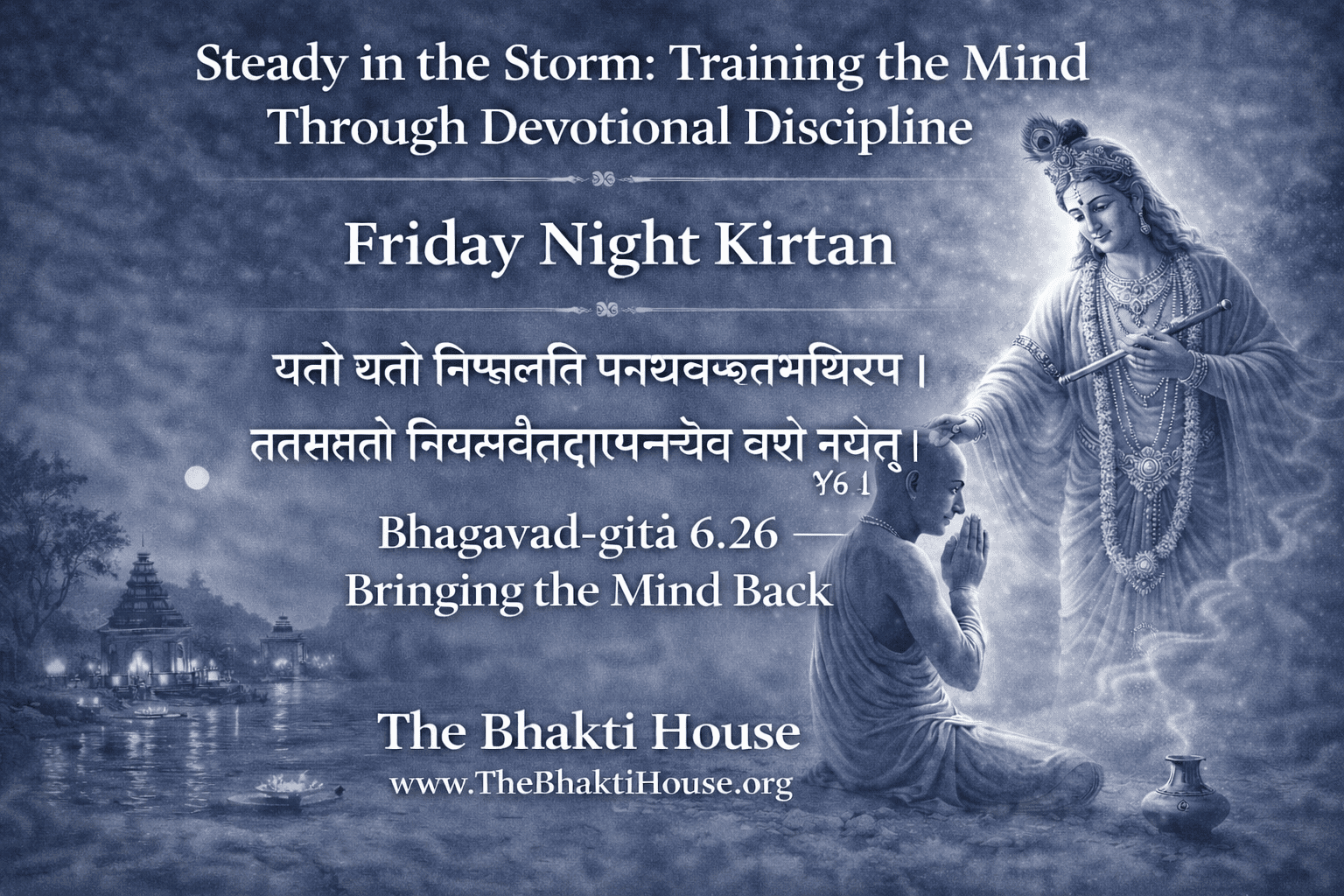
Friday Night Kirtan
March 20, 2026 — The Bhakti House, Jackson, Michigan
We now enter a crucial stage in spiritual life.
Longing has awakened.
Identity has been clarified.
But realization must become stable.
Spiritual life is not sustained by inspiration alone.
It requires discipline.
Tonight’s Friday Night Kirtan focuses on one of the greatest challenges in devotional life:
The restless mind.
Even after understanding that we are eternal servants of Kṛṣṇa, the mind wanders. It resists surrender. It clings to distraction.
The Bhagavad-gītā addresses this directly.
Bhagavad-gītā 6.26 — Bringing the Mind Back
Devanāgarī
यतो यतो निश्चरति
मनश्चञ्चलमस्थिरम् ।
ततस्ततो नियम्यैतद्
आत्मन्येव वशं नयेत् ॥
Roman Transliteration
yato yato niścarati
manaś cañcalam asthiram
tatas tato niyamyaitad
ātmany eva vaśaṁ nayet
Translation (Vedabase.io)
“From wherever the mind wanders due to its flickering and unsteady nature, one must certainly withdraw it and bring it back under the control of the Self.”
Theological Reflection
This verse is profoundly compassionate.
Kṛṣṇa does not condemn the restless mind.
He acknowledges it.
“Wherever the mind wanders…”
Not if.
Wherever.
The mind is described as:
• Cañcalam — flickering
• Asthiram — unsteady
Even advanced practitioners experience distraction.
The difference between beginner and mature devotee is not the absence of distraction.
It is the willingness to return.
Again.
And again.
And again.
Spiritual discipline is not rigid suppression.
It is patient redirection.
The Practice of Returning
Notice the instruction:
“Tatas tato niyamyaitad — from wherever it wanders, bring it back.”
No self-hatred.
No dramatic guilt.
No discouragement.
Simply return.
This is the heart of sādhana.
You chant.
The mind wanders.
You bring it back.
You hear again.
You continue.
Each return strengthens spiritual muscle.
Why Discipline Matters in Bhakti
Many mistake devotion for pure emotion.
But love without steadiness becomes unstable.
If chanting only happens when we “feel inspired,” it will eventually stop.
Regulation protects inspiration.
The tradition calls this niyama-sevā — regulated service.
Fixed times.
Fixed practices.
Fixed commitments.
Not because Kṛṣṇa needs them.
Because we do.
Supporting Verse: Śrīmad-Bhāgavatam 1.2.18
To understand how discipline purifies gradually, we turn to Śrīmad-Bhāgavatam.
Devanāgarī
नष्टप्रायेष्वभद्रेषु
नित्यं भागवतसेवया ।
भगवत्युत्तमश्लोके
भक्तिर्भवति नैष्ठिकी ॥
Roman Transliteration
naṣṭa-prāyeṣv abhadreṣu
nityaṁ bhāgavata-sevayā
bhagavaty uttama-śloke
bhaktir bhavati naiṣṭhikī
Translation (Vedabase.io)
“By regular attendance in classes on the Bhāgavatam and by rendering of service to the pure devotee, all that is troublesome to the heart is almost completely destroyed, and loving service unto the Personality of Godhead, who is praised with transcendental songs, is established as an irrevocable fact.”
Theological Reflection
The verse describes gradual purification.
“Naṣṭa-prāyeṣu abhadreṣu” — when the impurities are almost destroyed.
Notice: almost.
Purification is progressive.
“Nityaṁ bhāgavata-sevayā” — by regular service to the Bhāgavatam and the devotee.
Regular.
Daily.
Steady.
From that steadiness arises:
“Bhaktir bhavati naiṣṭhikī” — firm devotion.
Naiṣṭhikī means unwavering.
This is the goal of Weekend 3.
From awakening → identity → steadiness.
The Modern Challenge
In 2026, distraction is constant.
Phones vibrate.
Notifications flash.
Attention fragments.
Spiritual life competes with endless stimulation.
Which makes discipline even more essential.
Without structure, consciousness drifts.
With structure, consciousness strengthens.
The Bhakti House exists to create rhythm:
Friday — Congregational Kīrtan
Saturday — Reflection
Sunday — Scriptural grounding
Weekly rhythm becomes inner rhythm.
Friday Night Kirtan: Discipline in Sound
Tonight’s kīrtan reflects this theme.
We will:
• Begin slow and attentive
• Sustain one melody longer than comfortable
• Resist the urge to constantly change tempo
• Focus on attentive repetition
The goal is not novelty.
The goal is absorption.
Discipline transforms repetition into depth.
The Difference Between Force and Training
Spiritual discipline is not self-violence.
It is training.
Consider physical training.
At first, the body resists exercise.
Over time, it strengthens.
Similarly, the mind resists focus.
Over time, it softens.
We are not fighting the mind.
We are educating it.
Teaching it to rest in Kṛṣṇa.
Practical Application for The Bhakti House
This week’s discipline commitment:
- Fixed chanting time daily
- Minimum number of rounds maintained
- Phone outside the room during japa
- Attend all three weekend gatherings
Small consistency produces large transformation.
Do not underestimate daily repetition.
Reflection Questions
- Do I depend on inspiration more than discipline?
- When the mind wanders, do I become discouraged?
- What is my biggest distraction?
- What concrete regulation can I strengthen this week?
Assignment
For the next seven days:
When chanting, each time the mind wanders, gently say:
“Come back.”
No frustration.
No drama.
Just return.
Count how many times you return.
Each return is success.
Weekend 3 in March 2026 Has Begun
Spiritual life matures in stages.
Weekend 1: Desire awakened.
Weekend 2: Identity clarified.
Weekend 3: Practice stabilized.
Tomorrow’s Rest & Retreat will deepen this further:
From Discipline to Taste — How Steady Practice Awakens Spiritual Joy
Because discipline is not the end.
It is the doorway to sweetness.