

There is a kind of joy that does not depend on perfect circumstances.
It can rise in a crowded city street, in a quiet bedroom, in a temple room filled with music, or in the heart of someone who feels tired, unsure, or far from God. In the Bhakti tradition, this joy is awakened through Harinama—the sacred chanting of the names of God.
The word Harinama comes from two Sanskrit words: Hari, a name for God meaning “the One who removes suffering and carries away the heart,” and nama, meaning “name.” So Harinama means “the holy name of God,” especially when sung or chanted with devotion.
In Bhakti Yoga, the yoga of love and devotion, chanting is not only a spiritual practice. It is a way of opening the heart. It is prayer with melody. It is meditation with feeling. It is a simple, powerful way to remember God and share spiritual happiness with others.
Many people encounter Harinama through the maha-mantra, the “great mantra”:
**Hare Krishna Hare Krishna
Krishna Krishna Hare Hare
Hare Rama Hare Rama
Rama Rama Hare Hare**
This mantra is a loving call to the Divine. Krishna means “the all-attractive One.” Rama means “the source of joy.” Hare calls upon God’s divine energy, especially the energy of grace and devotion. In simple terms, the mantra is a prayer: “O Lord, O divine energy of the Lord, please engage me in loving service.”
Harinama is not limited by background, nationality, language, social position, or level of spiritual experience. Anyone can chant. Anyone can listen. Anyone can receive the blessing of sacred sound.
And this is why Harinama spreads joy.
What Is Harinama?
Sacred Sound as Spiritual Connection
In many spiritual traditions, sound is understood to be powerful. Words can heal or harm. Music can soften the heart. Prayer can bring comfort in difficult times.
In Bhakti Yoga, sacred sound is considered especially potent because the name of God is not separate from God. This may be a new idea for some readers, but it is a central teaching of the Bhakti scriptures. When we chant with sincerity, we are not merely repeating syllables. We are entering the presence of the Divine through sound.
The Padma Purana, an ancient Bhakti scripture, teaches that the holy name of Krishna is spiritually complete and full of divine energy. This means that even if we do not fully understand the theology, the sound itself can purify the heart and awaken devotion.
Just as the sun can warm us whether or not we understand its scientific nature, the holy name can bless us even if we are just beginning.
Chanting as Meditation for the Heart
Many people think of meditation as silence, stillness, and emptying the mind. That can be helpful. But Bhakti Yoga offers another form of meditation: filling the mind and heart with sacred remembrance.
Chanting gives the restless mind something holy to rest upon. Instead of fighting every thought, we gently return to the sound:
Hare Krishna Hare Krishna
Krishna Krishna Hare Hare
Hare Rama Hare Rama
Rama Rama Hare Hare
This repetition is not meant to be mechanical. It is like calling out to a dear friend, again and again, with trust. Sometimes the chanting feels joyful. Sometimes it feels dry. Sometimes the mind wanders. That is all part of the journey.
The practice is simple: hear the sound, return to the sound, offer the heart.
A Practice for Everyone
One of the most beautiful qualities of Harinama is its accessibility. You do not need wealth, advanced education, physical flexibility, or a perfect life. You do not need to be born into a particular culture. You do not need to have all your beliefs figured out.
You can begin wherever you are.
You can chant softly at home. You can sing in a group. You can listen while walking. You can repeat the mantra on prayer beads. You can whisper the holy name in a moment of anxiety or gratitude.
Harinama meets us in real life.
The Scriptural Roots of Harinama
The Bhagavad-gita and Remembering God
The Bhagavad-gita, one of the most beloved sacred texts of India, is a conversation between Lord Krishna and His friend Arjuna. Arjuna is confused, overwhelmed, and uncertain about his duty. Krishna guides him toward spiritual wisdom, devotion, and loving surrender.
In the Gita, Krishna says:
“Always think of Me, become My devotee, worship Me, and offer your homage unto Me.”
(Bhagavad-gita 18.65)
This instruction is deeply practical. Krishna is not asking for devotion only in a temple or only during a formal ritual. He is inviting us into a life of remembrance.
Chanting the holy names is one of the easiest and most direct ways to remember God. When we chant, we bring the mind back to Krishna. We remind the heart that we are not alone. We reconnect with the One who loves us eternally.
The Srimad-Bhagavatam and the Age of Chanting
The Srimad-Bhagavatam, another essential Bhakti scripture, describes chanting as the recommended spiritual practice for this age. It says:
“In this age of quarrel and confusion, there is one great blessing: simply by chanting the names of Krishna, one can become free from material bondage and attain the supreme goal.”
(Srimad-Bhagavatam 12.3.51, paraphrased)
This verse is both honest and hopeful. It acknowledges that our times can be difficult. People are often distracted, anxious, divided, and spiritually hungry. Yet the scripture says there is a great blessing available: the chanting of God’s names.
This is not a small thing. It means that divine grace is close. It means spiritual life is not reserved for the few. It means that in the middle of modern pressure, we can still find a sacred doorway.
Sri Chaitanya Mahaprabhu and the Gift of Kirtan
About 500 years ago, Sri Chaitanya Mahaprabhu, a great saint and incarnation of divine love in the Bhakti tradition, spread the chanting of the holy names throughout India. He especially emphasized kirtan, the joyful singing of God’s names in community.
Sri Chaitanya taught that chanting cleanses the mirror of the heart. This image is very tender. The heart, in its natural state, is pure and loving. But over time, it becomes covered by fear, pride, pain, envy, and forgetfulness. Harinama gently wipes away these coverings.
The more we chant sincerely, the more we begin to see ourselves and others with spiritual clarity.
Check out our latest posts at https://thebhaktihouse.org/blog.
How Harinama Spreads Joy
Joy Through Connection With God
The deepest joy of Harinama comes from reconnection.
In Bhakti Yoga, the soul is understood as an eternal part of God, naturally meant for loving relationship with Him. When we forget this relationship, we may search for happiness in many places—success, approval, pleasure, control, distraction. Some of these things may bring temporary satisfaction, but they cannot fully nourish the soul.
The holy name speaks directly to the soul.
When we chant, we are calling out to Krishna, the all-attractive Lord, and Rama, the source of spiritual joy. We are saying, “Please let me remember You. Please let me serve You. Please bring me closer.”
This prayerful calling awakens a joy that is not dependent on external achievement. It is the joy of belonging.
Joy Through Community
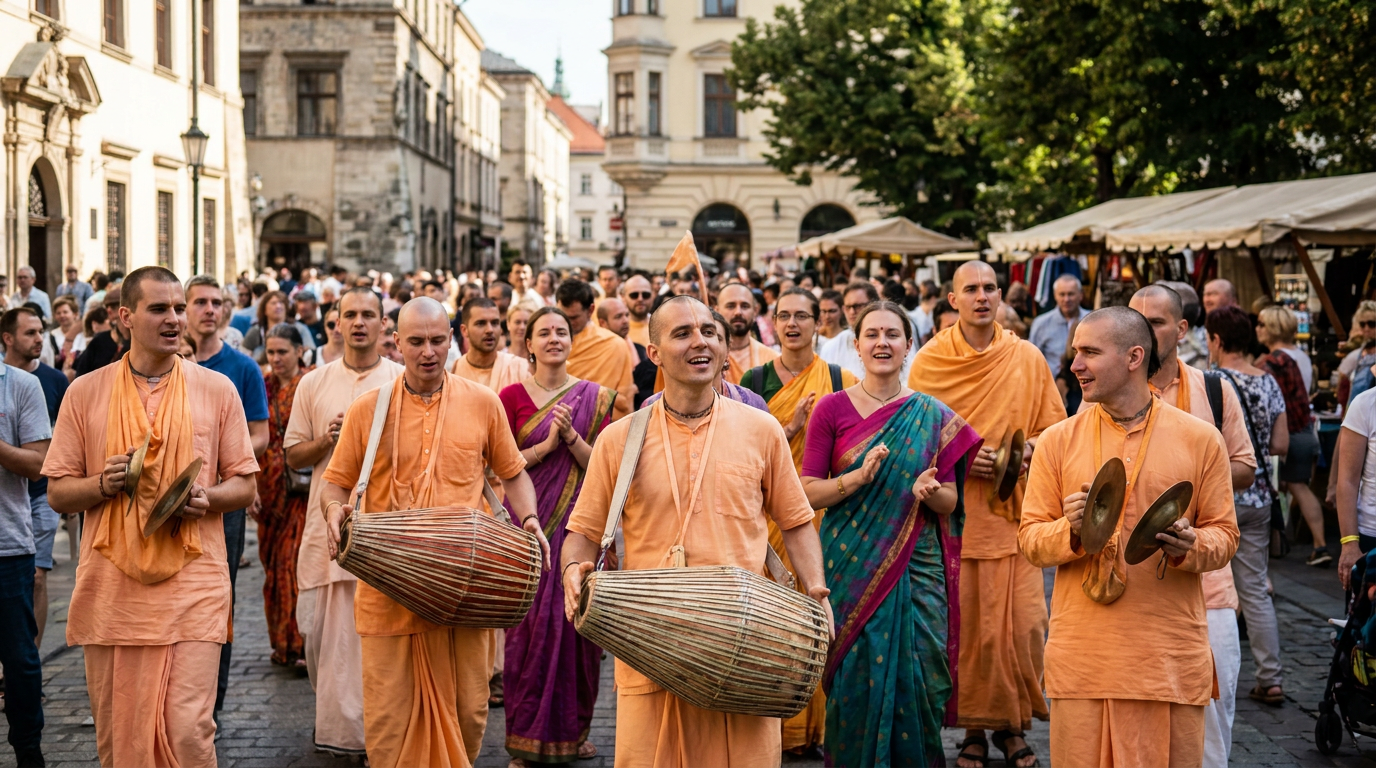
Harinama often becomes especially powerful in sankirtan, which means “congregational chanting” or “chanting together.” When people gather to sing the names of God, something beautiful happens.
Voices blend. Differences soften. The mood becomes shared. Some people clap. Some play instruments. Some close their eyes. Some simply listen. Everyone participates in their own way.
In a world where so many people feel isolated, kirtan creates spiritual community. It reminds us that we are not separate beings struggling alone. We are souls journeying together toward love.
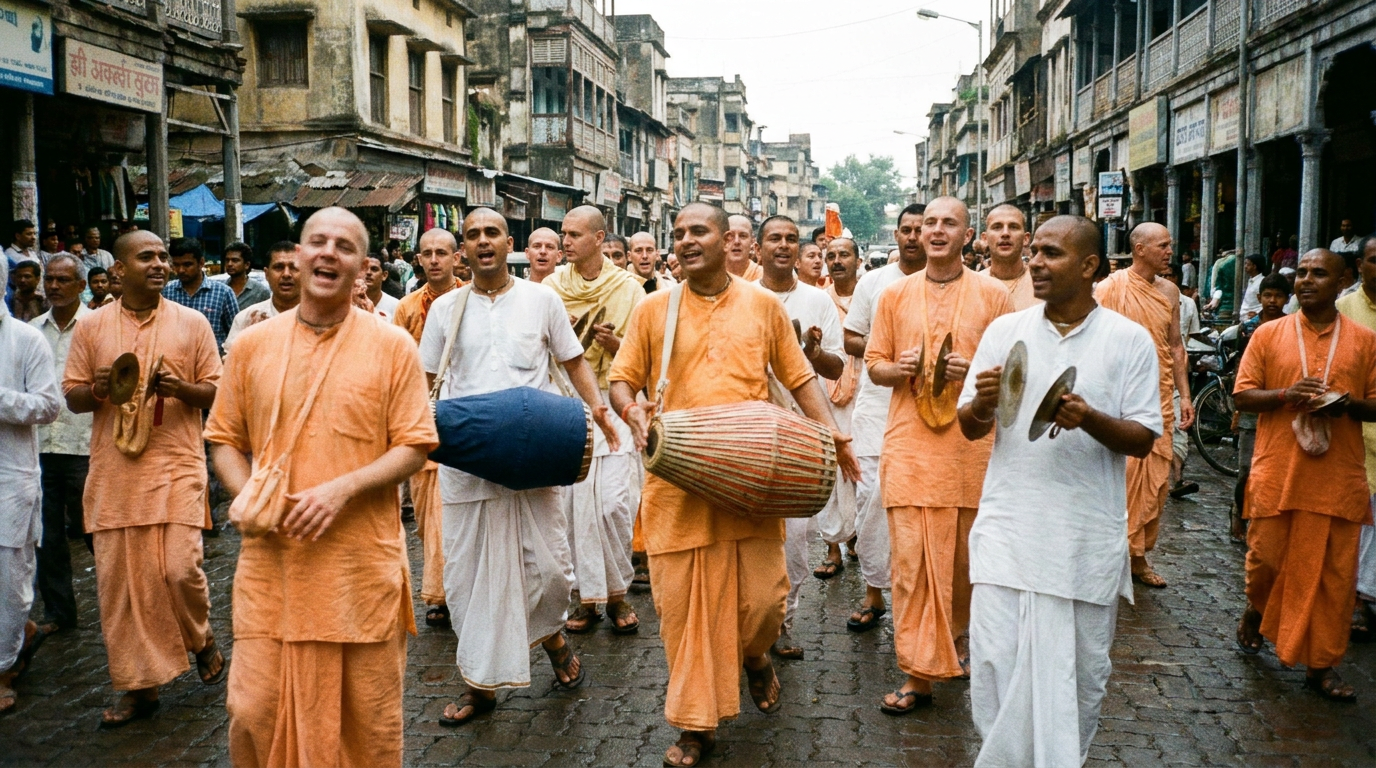
This is one reason public Harinama—chanting in streets, parks, festivals, and public spaces—can be so uplifting. People may pass by without expecting anything spiritual. Then they hear the drums, the cymbals, the singing. A smile appears. A child begins to dance. Someone pauses. Someone receives a mantra card. Someone remembers God for the first time in years.
Joy spreads naturally when it is shared.
Joy Through Simplicity
Many spiritual paths can feel complicated at first. There may be philosophy to study, habits to change, and disciplines to cultivate. These are valuable. But Harinama begins with something very simple: sound.
Chant and hear.
That simplicity is merciful. Even when life feels heavy, we can chant. Even when our mind feels unsteady, we can chant. Even when we feel unqualified, we can chant.
The holy name does not demand that we become perfect before approaching God. Rather, the holy name helps purify and transform us as we approach.
This is very comforting. We come as we are, but we do not remain as we are. Through sincere chanting, the heart gradually becomes softer, cleaner, and more loving.
The Practical Power of Chanting
Chanting Reduces Anxiety and Restlessness
Many people who begin chanting notice that it helps calm the mind. This does not mean all problems disappear instantly. Bhakti Yoga is not an escape from life. It is a way of bringing God into life.
When we chant, our attention shifts from endless mental noise to sacred sound. The breath becomes steadier. The heart feels held. The nervous system can relax. Most importantly, we remember that we are in the care of the Divine.
A simple practice might be to chant the maha-mantra for five minutes in the morning before looking at your phone. Sit comfortably. Speak the mantra clearly. Listen to each word. If your mind wanders, gently return. No harshness. No guilt. Just return.
This small act can shape the whole day.
Chanting Softens the Heart
The Bhakti scriptures often describe the heart as needing purification. This does not mean we are bad or hopeless. It means that our original loving nature is covered.
Chanting helps uncover compassion, humility, patience, and gratitude. Over time, we may notice subtle changes. We may become less reactive. We may feel more inspired to serve. We may forgive more easily. We may become more honest with ourselves.
This is spiritual growth—not merely having mystical experiences, but becoming more loving in practical life.
Real chanting bears fruit in character.
Chanting Gives Strength in Difficulty
Everyone faces seasons of pain: illness, loss, disappointment, loneliness, uncertainty. In those moments, Harinama can become a lifeline.
Sometimes prayer with many words feels impossible. But the holy name is enough.
Hare Krishna.
Hare Rama.
O Lord, please be with me.
The name carries the prayer for us when we do not know what to say. It gives strength not because it denies suffering, but because it brings divine presence into the suffering.
Many devotees have found that chanting does not always remove the storm immediately, but it gives shelter within the storm.
Harinama as Service to Others
Sharing Sacred Sound With Compassion
To spread Harinama is not to pressure people. It is not to judge or argue. It is not to claim superiority.
True Harinama is shared with humility and compassion. We offer sacred sound as a gift, trusting that each person has their own relationship with God and their own timing.
At The Bhakti House, the mood is welcoming: come as you are. Listen. Chant if you like. Ask questions. Take prasadam, sacred vegetarian food offered to God. Meet kind people. Explore at your own pace.
When Harinama is shared in this spirit, it becomes a service to the world.
Public Kirtan as a Blessing
Public chanting has a long tradition in Bhakti Yoga. Sri Chaitanya Mahaprabhu and His followers brought kirtan into the streets so that everyone could hear the holy name—not only those who entered temples or studied scriptures.
This is a radical act of spiritual generosity.
The holy name goes where people are. It enters marketplaces, sidewalks, parks, campuses, and neighborhoods. It does not wait behind closed doors. It moves outward with love.
Some people may not understand it. Some may simply enjoy the music. Some may feel curious. Some may feel deeply touched. All are blessed by hearing sacred sound.
In Bhakti teachings, even unconscious contact with the holy name is spiritually beneficial. A person may hear the mantra once and carry that seed in the heart for years.
Serving Through Music, Food, and Friendship
Harinama often opens the door to other forms of devotional service, called seva. Seva means “service offered with love.” In Bhakti Yoga, service is not just volunteer work; it is a way of expressing love for God and care for His children.
After kirtan, people may gather for spiritual discussion, prayer, or prasadam. They may help cook, clean, set up chairs, play instruments, welcome guests, or simply offer a kind smile.
These simple acts matter.
A joyful spiritual community is built through many small offerings. Someone chants. Someone listens. Someone serves food. Someone comforts a newcomer. Someone asks a sincere question. Together, these offerings create a space where hearts can heal.
How to Begin Your Own Harinama Practice
Start With Listening
If chanting feels unfamiliar, begin by listening. Put on a gentle kirtan recording. Sit quietly or play it while cooking, driving, or walking. Let the sound enter your heart without pressure.
Listening is powerful. In Sanskrit, this is called sravanam, or “hearing.” Hearing about and hearing the names of God is one of the main practices of Bhakti Yoga.
You do not need to force an experience. Just receive.
Chant a Little Each Day
A steady practice grows through small, sincere steps. You might begin with one round of the maha-mantra on japa beads, or simply chant for five to ten minutes daily.
Japa means personal, soft chanting, often done on a strand of 108 beads. Each bead helps you keep attention as you repeat the mantra. But if you do not have beads, that is okay. You can chant with your voice, your breath, and your intention.
Try this simple approach:
Sit in a peaceful place.
Take a few slow breaths.
Offer a short prayer: “Dear Lord, please help me chant with sincerity.”
Chant the maha-mantra clearly.
Listen to each word.
End with gratitude.
Consistency is more important than performance. A small daily offering can become a deep well of strength.
Join Kirtan With Others
While personal chanting is beautiful, group kirtan brings a special kind of nourishment. The energy of shared devotion can carry us when our own focus is weak.
If there is a Bhakti center, temple, yoga studio, or kirtan gathering near you, consider attending. You do not have to know the words perfectly. You do not have to sing well. You can sit, listen, clap, hum, or simply be present.
Kirtan is not a concert in the ordinary sense. It is participatory prayer. The goal is not performance, but offering.
Bring the Holy Name Into Daily Life
Harinama is not only for formal practice. You can remember God throughout the day.
Chant while washing dishes.
Chant while walking.
Chant before a difficult conversation.
Chant before eating.
Chant when you feel grateful.
Chant when you feel afraid.
This is how Bhakti Yoga becomes practical. It enters ordinary moments and makes them sacred.
Over time, the holy name becomes a companion. Not just something we do, but someone we turn toward.
The Inner Attitude of Harinama
Humility Opens the Heart
Sri Chaitanya Mahaprabhu gave a famous teaching about the mood needed for constant chanting:
“One should chant the holy name of the Lord in a humble state of mind, considering oneself lower than a blade of grass, more tolerant than a tree, free from pride, and ready to offer respect to others.”
This is a high teaching, and most of us may feel far from it. But it gives us a direction.
Humility does not mean hating ourselves. It means being honest, open, and free from the need to dominate. It means recognizing that we are dependent on grace. It means making space for God in the heart.
When we chant with humility, the holy name enters more deeply.
Sincerity Is More Important Than Perfection
Many beginners worry: “Am I chanting correctly? Is my pronunciation perfect? Is my mind too distracted? Am I qualified?”
These are understandable questions. But Bhakti Yoga assures us that sincerity is the heart of the practice.
Yes, we can learn proper pronunciation. Yes, we can improve our focus. Yes, we can study the meaning of the mantra. But God sees the intention behind the sound.
A child calling a parent may not speak perfectly, but the parent understands the love. In the same way, Krishna hears the sincere heart.
Do not wait to become perfect before chanting. Chanting is part of how the heart becomes purified.
Gratitude Deepens the Practice
Gratitude turns chanting from routine into relationship.
Before chanting, we can remember: “I have been given another chance to connect with God.” After chanting, we can offer thanks: “Thank You for allowing me to speak Your names.”
This simple gratitude protects us from taking the holy name casually. It reminds us that Harinama is a gift, not an achievement.
The more grateful we become, the more joy we can receive and share.
Harinama and Spiritual Growth
From Sound to Service
As chanting purifies the heart, it naturally awakens the desire to serve. This is one of the signs that Harinama is working within us.
We may begin by chanting for our own peace. That is natural. But gradually, our prayer expands. We start to care more deeply about others. We want to bring comfort, nourishment, wisdom, and kindness into the world.
This is the beauty of Bhakti Yoga. It does not end in private peace. It flowers into loving service.
The holy name connects us with Krishna, and Krishna’s love moves through us toward others.
From Restlessness to Remembrance
Modern life pulls the mind in many directions. Notifications, responsibilities, worries, desires, and comparisons can scatter our attention. Harinama gathers the heart back into remembrance.
In Sanskrit, remembrance of God is called smaranam. It is not forced or fearful. It is loving awareness: “God is here. God is kind. God is my shelter.”
The more we chant, the more this remembrance may appear naturally. A line of the mantra arises while walking. A name of Krishna comes during stress. A moment of gratitude appears before sleep.
This is spiritual progress. The heart is learning where to turn.
From Isolation to Belonging
Many people carry a quiet loneliness, even when surrounded by others. Bhakti Yoga teaches that our deepest belonging is in relationship with God and with all living beings as part of God’s family.
Harinama awakens that belonging.
When we chant, we are joining a river of devotion that has flowed for generations. Saints, seekers, families, monks, musicians, children, elders, and ordinary people in every kind of life have taken shelter in the holy name.
We are not alone in our longing. We are not alone in our struggles. We are not alone in our hope.
The holy name brings us home.
Spreading Joy in a World That Needs Healing
A Gentle Revolution of Love
The world does not need more noise, pride, or division. It needs healing sound. It needs humble hearts. It needs people willing to live with compassion and spiritual purpose.
Harinama is a gentle revolution. It changes the atmosphere without violence. It invites without forcing. It uplifts without excluding.
When devotees chant in public, when families chant at home, when friends gather for kirtan, when one person whispers the holy name with tears, joy is spreading.
Not always loudly. Not always visibly. But truly.
Every Voice Matters
You may think, “My chanting is small. My voice is not beautiful. My devotion is weak.”
But in Bhakti, every sincere offering has value.
A single lamp can brighten a dark room. A single kind word can encourage a tired heart. A single sincere mantra can begin a lifelong journey back to God.
Your voice matters—not because it is polished, but because it can be offered.
The holy name does not require us to be impressive. It invites us to be sincere.
Sharing Without Fear
Sometimes people hesitate to share spiritual practices because they do not want to offend others or appear pushy. This sensitivity is good. Bhakti should always be shared respectfully.
We can share Harinama naturally:
Invite a friend to kirtan.
Play sacred music in your home.
Offer prasadam with love.
Speak about how chanting has helped you.
Give someone space to explore without pressure.
Answer questions honestly and humbly.
The goal is not to win an argument. The goal is to offer a blessing.
When Harinama is shared with kindness, it can touch hearts in ways we may never fully know.
A Simple Invitation to Chant
Harinama is both ancient and fresh. It has been sung by saints for centuries, yet it can meet us today in the middle of our very real lives.
It is a path of love.
It is a prayer we can sing.
It is meditation for the heart.
It is service to the world.
It is joy that grows when shared.
Whether you are new to Bhakti Yoga or have been chanting for many years, the invitation remains beautifully simple: take shelter in the holy name. Begin again. Listen again. Offer your heart again.
You do not need to have everything figured out. You do not need to feel spiritually advanced. You do not need to come from any particular background. God’s names are open to all.
At The Bhakti House, everyone is welcome—seekers, skeptics, longtime practitioners, families, students, artists, elders, and anyone longing for deeper meaning. Come chant, pray, serve, learn, ask, rest, and grow.
Take one sincere step toward God today. Chant one mantra. Offer one prayer. Share one kindness. The path of Bhakti begins with love, and every heartfelt step is received.
FAQs
What is Harinama?
Harinama refers to the practice of chanting the holy names of God, particularly in the form of kirtan, a call-and-response style of singing.
What is the significance of Harinama?
Harinama is considered a powerful spiritual practice in many traditions, believed to bring about inner peace, spiritual purification, and a closer connection to the divine.
What are the origins of Harinama?
The practice of Harinama has its roots in ancient Vedic scriptures and has been passed down through various spiritual lineages in India and beyond.
How is Harinama practiced?
Harinama is typically practiced through group chanting, often accompanied by musical instruments and rhythmic clapping. It is often performed in public spaces as a way to share the spiritual benefits with others.
What are the benefits of practicing Harinama?
Practitioners believe that regular chanting of the holy names can lead to a deeper sense of spiritual fulfillment, increased mindfulness, and a sense of connection to the divine.

