
In every age, people look for a way to return to what is sacred.
We may call it peace, meaning, healing, God, truth, or love. We may come from different traditions, cultures, and life stories. Some of us grew up with prayer. Some of us are just beginning to wonder if there is something more. Some of us feel close to the Divine, and some of us feel distant, distracted, or even spiritually tired.
Bhakti Yoga offers a beautiful and practical doorway back to the heart.
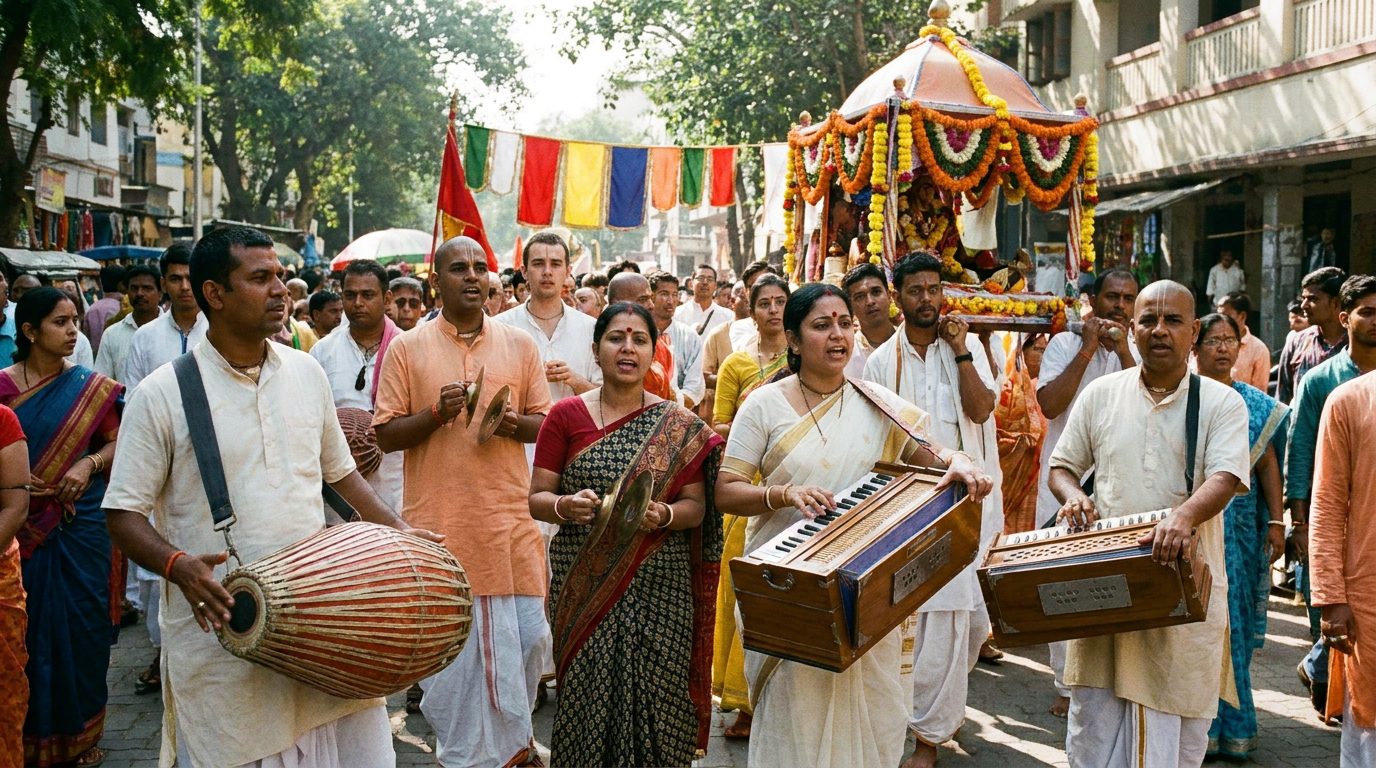
At the center of this path is Nama Sankirtana—the joyful chanting of the holy names of God. “Nama” means “name,” and “Sankirtana” means “collective singing or glorification.” In simple words, Nama Sankirtana is the practice of coming together to chant sacred names with love, humility, and devotion.
It is not only music. It is not only meditation. It is not only a religious ritual. Nama Sankirtana is a living prayer. It is a way to remember God, cleanse the heart, awaken love, and revive spirituality in daily life.
Nama Sankirtana is the devotional practice of chanting the names of the Divine, often in a group, with music, rhythm, and heartfelt intention.
In the Bhakti tradition, the holy name is understood to be spiritually powerful because God and God’s name are not separate. When we chant sincerely, we are not merely making sound. We are reaching toward the Divine Presence through sacred vibration.
For many practitioners, Nama Sankirtana includes chanting mantras such as:
**Hare Krishna Hare Krishna
Krishna Krishna Hare Hare
Hare Rama Hare Rama
Rama Rama Hare Hare**
This is known as the Maha Mantra, meaning “the great mantra.” A mantra is a sacred sound or prayer that helps focus the mind and awaken spiritual consciousness. “Hare” addresses the divine energy of the Lord, “Krishna” means the all-attractive Supreme Person, and “Rama” means the source of spiritual joy.
A simple meaning of the Maha Mantra is:
“O Lord, O Divine Energy of the Lord, please engage me in loving service.”
This prayer is humble. It does not demand wealth, fame, or power. It asks for reconnection. It asks to love and serve.
The Meaning of “Nama”
“Nama” means name. In Bhakti Yoga, the names of God are cherished as direct invitations into relationship with the Divine.
Just as hearing the name of someone we love can awaken memory, affection, and longing, chanting the holy names can awaken remembrance of God. The name becomes a bridge between the restless heart and the eternal source of love.
Different traditions use different names for God. In Bhakti, names such as Krishna, Rama, Govinda, Gopala, Narayana, and Hari are lovingly chanted. Each name reveals a quality of the Divine—beauty, compassion, protection, joy, and all-attractiveness.
The Meaning of “Sankirtana”
“Sankirtana” means congregational chanting or collective glorification.
“Kirtana” refers to singing or speaking about God’s names, qualities, and pastimes. The prefix “san” suggests completeness, togetherness, and shared participation. So Sankirtana is not a performance for a few talented people. It is a spiritual gathering where everyone can participate.
Some may sing loudly. Some may softly repeat. Some may simply listen with an open heart. All are included.
This is one reason Nama Sankirtana is so powerful. It brings people together beyond social labels. In the shared space of sacred sound, we remember that we are all souls, all children of God, all longing for love.
A Practice for the Heart, Not Just the Voice
One does not need a trained singing voice to chant. Bhakti is not measured by musical ability.
The heart is the real instrument.
A person may chant with perfect melody but no sincerity, and the practice remains external. Another may chant softly, with tears, confusion, longing, or simple honesty, and that chanting becomes deeply sacred.
Nama Sankirtana welcomes our real selves. We do not have to pretend to be pure before we begin. We begin, and the practice gradually purifies us.
Why Nama Sankirtana Revives Spirituality
Many people today feel spiritually dry, even when life appears full on the outside. We may have constant access to information, entertainment, and social connection, yet still feel lonely or restless within.
Nama Sankirtana revives spirituality because it brings the mind, body, voice, and heart into remembrance of God.
It is simple enough for a child and deep enough for a lifelong saint.
It Awakens Remembrance of God
In the Bhagavad-gita, Lord Krishna says:
“Always think of Me, become My devotee, worship Me, and offer your homage unto Me.”
—Bhagavad-gita 18.65
This instruction may seem difficult in ordinary life. How can we always think of God while working, caring for family, studying, driving, cooking, or facing stress?
Chanting helps.
The holy name gives the mind something sacred to hold. Instead of being pulled endlessly by worry, comparison, fear, or desire, the mind is gently invited to rest in divine remembrance.
Even a few minutes of chanting can change the direction of the day. It brings God from the background of life into the center.
It Cleanses the Heart
A famous verse from the Sri Chaitanya Charitamrita describes the power of Sankirtana:
“Glory to the Sri Krishna Sankirtana, which cleanses the mirror of the heart.”
This image is very tender and practical. The heart is like a mirror. Its natural function is to reflect spiritual truth and love. But over time, the mirror becomes covered by dust—selfishness, fear, pride, pain, distraction, and forgetfulness.
Nama Sankirtana cleanses that mirror.
Not always instantly. Sometimes gently. Sometimes gradually. Sometimes in ways we do not notice until we look back and realize we are becoming softer, more patient, more prayerful, less reactive, and more grateful.
It Restores Joy
Spiritual life is not meant to be dry or heavy. Bhakti Yoga is the path of loving relationship with God, and love naturally carries joy.
Nama Sankirtana often includes musical instruments such as harmonium, kartals, mridanga drum, guitar, or simple clapping. The rhythm helps the body participate. The melody helps the emotions open. The mantra helps the soul remember.
This joy is not ordinary excitement. It is not dependent on perfect circumstances. It is a deeper spiritual joy that comes from connection.
Even when life is difficult, chanting can help us touch a joy that is not destroyed by difficulty.
It Brings Community and Belonging
Modern life can be isolating. Many people carry their struggles quietly. Nama Sankirtana creates sacred community.
When people gather to chant, they do not need to explain everything. The holy name holds everyone. One person may be celebrating. Another may be grieving. One may be strong in faith. Another may be unsure. Yet all can sit together and chant.
In this way, Sankirtana becomes spiritual shelter.
It reminds us that the journey back to God is personal, but not lonely.
Nama Sankirtana in the Bhakti Scriptures
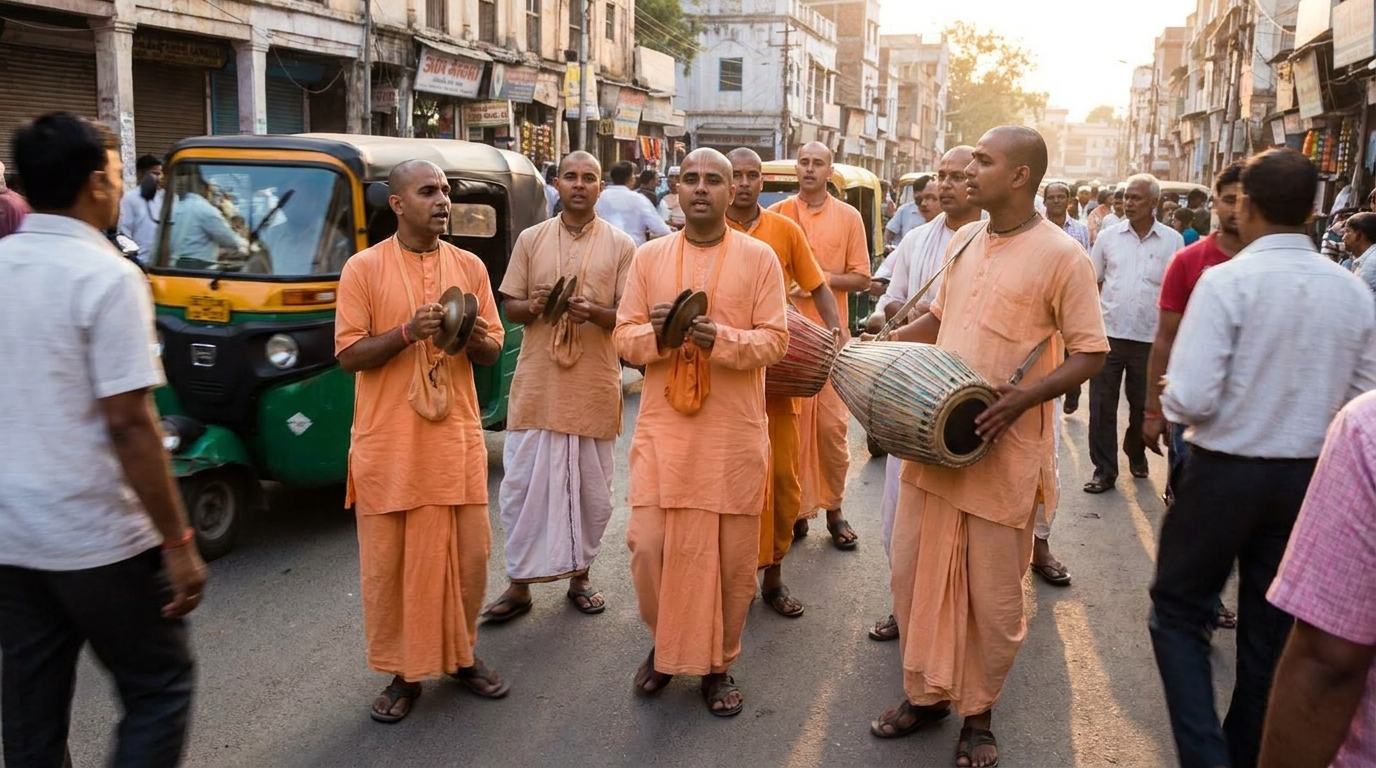
The practice of chanting God’s names is not a recent invention. It is deeply rooted in authentic Bhakti scriptures and has been practiced by saints for generations.
The Bhagavad-gita: Devotion Made Practical
The Bhagavad-gita is a sacred dialogue between Lord Krishna and Arjuna. It teaches many forms of yoga, but its conclusion is loving devotion to God.
Krishna says:
“Whatever you do, whatever you eat, whatever you offer or give away, and whatever austerities you perform—do that as an offering to Me.”
—Bhagavad-gita 9.27
This verse shows the practical heart of Bhakti Yoga. Spirituality is not limited to a temple, church, mosque, synagogue, monastery, or meditation room. Every part of life can become an offering.
Nama Sankirtana helps us live this teaching. By chanting, we remember to offer our actions to God. We begin to cook with gratitude, work with integrity, speak with kindness, and serve others as part of our devotion.
The Srimad Bhagavatam: Hearing and Chanting
The Srimad Bhagavatam, one of the most beloved scriptures in the Bhakti tradition, repeatedly glorifies hearing and chanting about the Lord.
It teaches that hearing and chanting the names, qualities, and activities of God purifies the heart and awakens devotion.
This is important because Bhakti is not only a belief system. It is a practice of sacred hearing and sacred speaking. What we hear shapes our consciousness. What we repeat shapes our inner world.
When we regularly hear and chant the holy names, our consciousness becomes nourished by divine sound.
Sri Chaitanya Mahaprabhu and the Sankirtana Movement
Sri Chaitanya Mahaprabhu, a 15th-century saint and divine teacher, widely spread Nama Sankirtana as the recommended spiritual practice for this age.
He taught that the holy name of Krishna is full of spiritual power and mercy. He did not reserve chanting for scholars, monks, or the socially privileged. He invited everyone.
His movement was marked by humility, compassion, ecstatic chanting, and the sharing of divine love.
A well-known prayer from Sri Chaitanya says:
“One should chant the holy name of the Lord in a humble state of mind, thinking oneself lower than a blade of grass, more tolerant than a tree, free from pride, and ready to offer respect to all.”
This prayer gives us the mood for chanting. Nama Sankirtana is not about ego. It is not about who sings best or who appears most spiritual. It is about becoming humble enough to receive grace.
The Holy Name as Mercy
Bhakti scriptures teach that in this age, spiritual life can be difficult. Our minds are restless. Our lives are busy. Our attention is scattered.
For this reason, the holy name is given as a special mercy.
Chanting does not require wealth. It does not require high education. It does not require a perfect past. It does not require a specific social position.
Anyone can chant.
This is the beauty of Nama Sankirtana. It brings the highest spiritual gift into the most accessible form: sound.
Sure, here is the sentence with the clickable link:
Check out our latest posts on posts.
How to Practice Nama Sankirtana in Daily Life
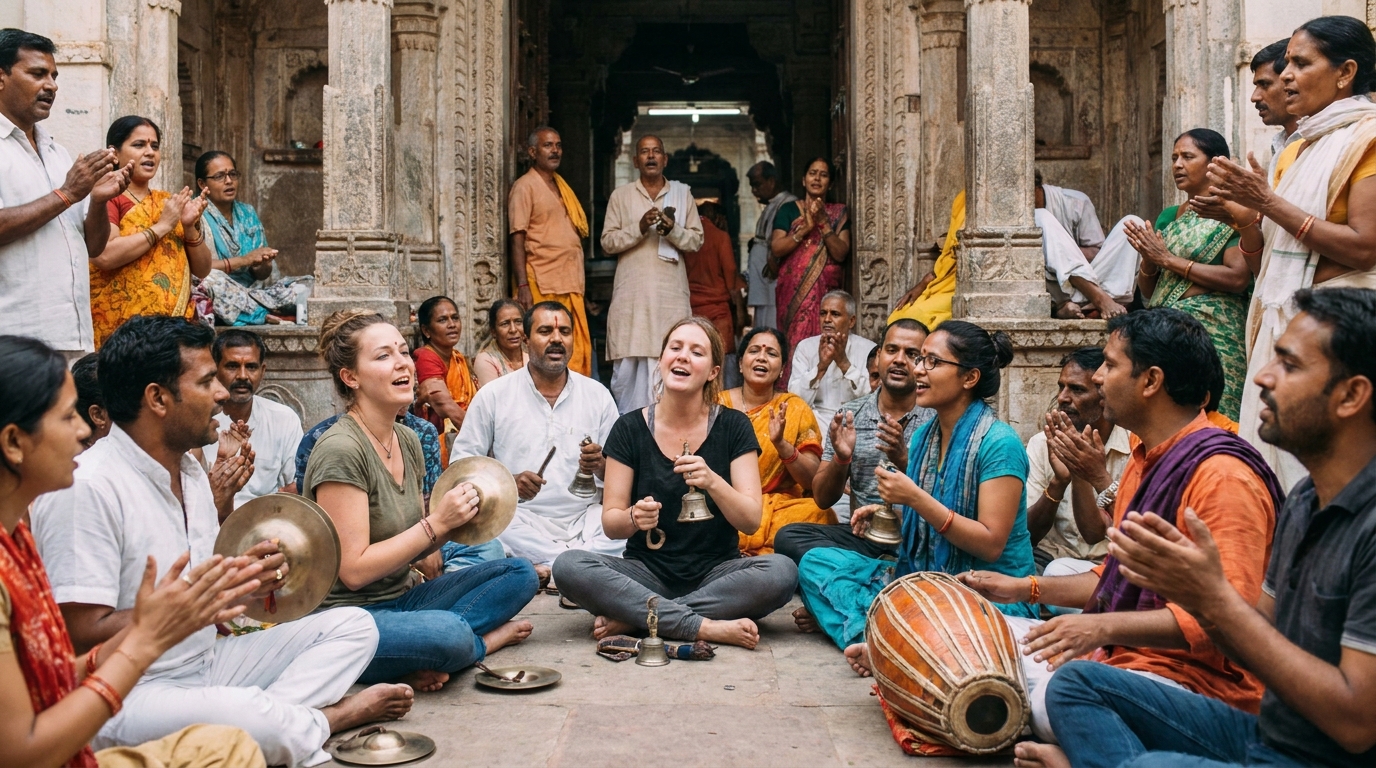
Nama Sankirtana can be practiced in many settings. Some people attend weekly kirtan gatherings. Some chant at home. Some chant while walking. Some begin with only five minutes a day.
The most important thing is sincerity.
Begin with Listening
If you are new to chanting, you can begin simply by listening.
Find a recording of the Maha Mantra or attend a local kirtan gathering. Sit comfortably. Let the sound enter your heart. You do not need to force any experience.
Listening itself is sacred.
In Bhakti Yoga, hearing is a powerful spiritual practice. The ears become a doorway to the soul. As you listen, you may silently pray, “May this sound awaken love in my heart.”
Chant Softly at Home
You can chant at home in a simple way.
Choose a clean, peaceful place if possible. Light a candle or offer a flower if that helps you feel devotional. Sit comfortably. Take a few deep breaths. Then chant the mantra slowly:
Hare Krishna Hare Krishna
Krishna Krishna Hare Hare
Hare Rama Hare Rama
Rama Rama Hare Hare
You can chant aloud, whisper, or sing. You can use beads, known as japa mala, to count repetitions. “Japa” means personal, meditative chanting, and a “mala” is a string of prayer beads.
Even one round, one song, or one sincere repetition can be meaningful.
Join a Kirtan Gathering
Kirtan is a beautiful form of Nama Sankirtana where one person leads and others respond. This is called call-and-response chanting.
You do not need to know the melody in advance. You simply listen and repeat. Over time, the mantra becomes familiar, and the heart begins to open naturally.
A kirtan gathering may include chanting, prayer, spiritual discussion, vegetarian or sanctified food, and community. At The Bhakti House and similar devotional spaces, the mood is meant to be welcoming and sincere. Everyone is invited to come as they are.
Chant While Serving
Bhakti Yoga is not only about inner meditation. It is also about service.
The Sanskrit word seva means loving service offered to God and others. You can chant while cooking, cleaning, gardening, driving, or preparing for your day. This brings sacred remembrance into ordinary activities.
Service becomes more joyful when connected to the holy name. Chanting softens the heart, and service gives that softened heart a practical expression.
Make a Simple Daily Commitment
Spiritual growth often comes through small, steady steps.
You might begin with:
- Five minutes of chanting each morning
- Listening to one kirtan while commuting
- Attending one Nama Sankirtana gathering each week
- Chanting before meals as an offering of gratitude
- Repeating the Maha Mantra when feeling anxious or overwhelmed
The goal is not perfection. The goal is relationship.
Just as we nourish a friendship through regular contact, we nourish our relationship with God through regular remembrance.
The Inner Mood of Chanting
The sound of the holy name is powerful, but the mood we bring matters deeply.
Nama Sankirtana is not mechanical. It is relational. We are calling out to God.
Chant with Humility
Humility does not mean hating ourselves. It means seeing clearly that we are dependent on grace.
When we chant humbly, we do not try to control God. We do not chant to prove ourselves. We chant because we need divine shelter.
A humble prayer might be:
“Dear Lord, I do not know how to love You properly, but I want to begin. Please guide me.”
This kind of prayer is very dear in Bhakti.
Chant with Patience
Sometimes chanting feels joyful and easy. Sometimes the mind wanders. Sometimes the heart feels dry.
This is normal.
Spiritual practice reveals the condition of the heart, and that can be uncomfortable at times. But we do not stop. We continue gently, trusting that the holy name is working even when we cannot feel it.
Just as medicine works gradually, chanting purifies gradually.
Patience is part of devotion.
Chant with Gratitude
Gratitude opens the heart.
Before chanting, you may pause and remember one blessing: breath, food, shelter, friendship, the chance to pray, or simply the opportunity to begin again.
When chanting is mixed with gratitude, it becomes sweeter. We begin to see life not as something we own, but as something sacred entrusted to us.
Chant with Respect for All
True chanting should make us kinder.
If we chant God’s names but become proud, harsh, or dismissive of others, we have missed the heart of the practice. Bhakti teaches that every living being is a soul, beloved by God.
Nama Sankirtana should help us honor all people, including those whose beliefs or backgrounds differ from ours.
The holy name is not a weapon. It is a gift.
Nama Sankirtana and Personal Transformation
The revival of spirituality is not only about attending gatherings or learning philosophy. It is about transformation of the heart.
Nama Sankirtana helps transform the way we see ourselves, others, and the world.
From Anxiety to Shelter
Many of us live with anxiety about the future, regret about the past, or pressure in the present.
Chanting gives the mind a sacred resting place. It does not necessarily remove every difficulty, but it gives us shelter within difficulty.
When we chant, we remember: “I am not alone. God is near. I can take one breath, one prayer, one step.”
This remembrance can be deeply healing.
From Ego to Service
The ego asks, “How can I be seen? How can I be praised? How can I control?”
Bhakti asks, “How can I love? How can I serve? How can I become an instrument of grace?”
Nama Sankirtana gradually shifts our center. We begin to feel joy not only in receiving, but in giving. We become more sensitive to the needs of others. We begin to understand that service is not a burden but a blessing.
From Distraction to Devotion
Our attention is one of our most precious gifts.
Every day, countless voices compete for it. Nama Sankirtana lovingly redirects attention toward God.
This does not mean rejecting the world. Rather, it means seeing the world through spiritual vision. Work, family, art, nature, and relationships can all become connected to devotion when our consciousness is purified.
Chanting helps us remember the sacred within the ordinary.
From Loneliness to Relationship
At the deepest level, Bhakti teaches that the soul longs for relationship with God.
We may try to fill this longing in many ways, but only divine love can fully satisfy the heart. Nama Sankirtana is the soul calling out to its eternal beloved.
Even if we do not fully understand this at first, the practice begins to awaken that relationship.
The holy name carries presence. Through chanting, we gradually feel accompanied, guided, and loved.
Nama Sankirtana in Community Life
A community centered on Nama Sankirtana becomes a place of healing, learning, and shared devotion.
It is not meant to be exclusive or judgmental. It is meant to be a spiritual home where people can grow sincerely.
Welcoming All Backgrounds
People may come to Nama Sankirtana from many paths. Some may identify as Hindu. Some may come from Christian, Muslim, Jewish, Buddhist, Sikh, Indigenous, interfaith, or non-religious backgrounds. Some may not know what they believe.
Bhakti Yoga welcomes sincere inquiry.
Chanting is an invitation, not a demand. No one needs to abandon their dignity, culture, or story to begin. The holy name meets each person personally.
Sharing Sacred Food
Many Bhakti gatherings include prasada, which means food offered to God with love and then shared as mercy.
Prasada reminds us that spirituality is not only in the mind. It enters daily life through cooking, eating, serving, and receiving.
A simple meal offered with devotion can become a spiritual experience. When shared in community, it nourishes both body and soul.
Growing Through Spiritual Friendship
In Sanskrit, spiritual association is called sadhu-sanga. “Sadhu” means a saintly or sincere spiritual person, and “sanga” means association.
We become shaped by the company we keep. When we spend time with people who value chanting, prayer, compassion, and service, our own spiritual life becomes strengthened.
Spiritual friendship does not mean pretending to be perfect together. It means helping one another remember God.
Serving Together
Nama Sankirtana naturally leads to seva, or service.
A chanting community may serve by feeding others, caring for the temple or spiritual center, supporting families, teaching children, visiting the lonely, sharing wisdom, or offering music and prayer to the wider community.
When chanting and service come together, spirituality becomes alive. The heart receives and then gives.
Common Questions About Nama Sankirtana
Many sincere people have questions when they first encounter chanting. Questions are welcome. Bhakti is not afraid of honest inquiry.
Do I Have to Be Hindu to Chant?
No.
While Nama Sankirtana is deeply rooted in the Bhakti tradition of India, the chanting of God’s names is open to everyone. God is not limited by labels. The soul’s longing for divine love is universal.
You can chant respectfully, sincerely, and at your own pace.
What If I Do Not Understand Sanskrit?
Understanding helps, but the holy name is not dependent on intellectual mastery.
Sanskrit is an ancient sacred language, and its sounds carry spiritual depth. Still, even if you are learning the meanings slowly, you can chant with sincerity.
Just as a child calling for a parent may not understand grammar perfectly, the sincerity of the call matters most.
What If My Mind Wanders?
It will. Everyone’s mind wanders.
When you notice your mind has wandered, gently return to the sound. Do not become discouraged. Each return is part of the practice.
Chanting is not about violently silencing the mind. It is about patiently bringing the mind back to God again and again.
What If I Feel Emotional?
It is natural for chanting to touch the heart.
Sometimes people feel peace, joy, sadness, longing, or tears. These experiences may come and go. We do not need to chase them or fear them.
Simply offer whatever arises to God.
Can I Chant Alone?
Yes. Personal chanting is very valuable.
At the same time, group chanting has a special power. When many voices come together, faith is strengthened. If possible, include both personal chanting and community kirtan in your spiritual life.
Reviving Spirituality in the Modern World
The world does not only need more noise. It needs sacred sound.
It does not only need more opinion. It needs prayer.
It does not only need more speed. It needs remembrance.
Nama Sankirtana offers a practical, joyful, and deeply transformative way to revive spirituality in modern life. It can enter a busy home, a college campus, a yoga studio, a temple, a retreat center, a city street, or a quiet room.
Wherever the holy name is chanted sincerely, that place becomes touched by grace.
A Path for Busy People
Many people think spiritual life requires hours of free time. But Bhakti Yoga meets us where we are.
You can chant while walking. You can play kirtan while cooking. You can repeat the Maha Mantra before opening your laptop. You can pause for one minute of prayer before a difficult conversation.
Small moments become sacred when offered with love.
A Path for Healing Hearts
Some people come to chanting after disappointment, grief, addiction, burnout, or loss. Nama Sankirtana does not shame a wounded heart.
It gives the heart a place to rest.
The holy name is compassionate. We can bring our brokenness into the sound and let God begin the work of healing.
A Path for Lifelong Growth
Bhakti is simple, but it is not shallow.
One can chant for a lifetime and continue discovering new depth. The name becomes sweeter as the heart becomes clearer. Prayer becomes more intimate. Service becomes more natural. Scripture becomes more alive.
Nama Sankirtana is not only a beginning practice. It is a lifelong companion on the journey of love.
Taking One Sincere Step
Reviving spirituality does not require a dramatic display. It begins with one sincere step.
One chant.
One prayer.
One act of service.
One moment of humility.
One gathering with devotees.
One offering of the heart.
If you feel drawn to Nama Sankirtana, you are welcome. If you are curious, you are welcome. If you are unsure, you are welcome. If you have been away from spiritual life for a long time, you are welcome. If you are longing for God but do not know how to begin, you are welcome.
Bhakti Yoga is the path of love, and love begins wherever we are.
May the holy names bring peace to your mind, softness to your heart, courage to your steps, and remembrance of the Divine in your daily life.
Everyone is welcome to take one sincere step toward God today.
FAQs
What is Nama sankirtana?
Nama sankirtana is a form of devotional singing and chanting that is practiced in various spiritual traditions, including Hinduism and Buddhism. It involves the repetition of sacred names or mantras, often accompanied by music and dance.
What is the significance of Nama sankirtana?
Nama sankirtana is believed to have the power to purify the mind, uplift the spirit, and bring about a sense of inner peace and harmony. It is also considered a means of connecting with the divine and cultivating a deeper spiritual awareness.
How is Nama sankirtana practiced?
Nama sankirtana is typically practiced in a group setting, with participants coming together to sing and chant the sacred names or mantras. It is often accompanied by musical instruments such as drums, cymbals, and harmonium, and may also involve dancing and clapping.
What are the benefits of Nama sankirtana?
Practitioners of Nama sankirtana believe that it can help to alleviate stress, anxiety, and negative emotions, and promote a sense of well-being and inner joy. It is also seen as a way to cultivate a sense of community and unity among participants.
Is Nama sankirtana associated with any specific religious tradition?
While Nama sankirtana is commonly associated with Hinduism, it is also practiced in other spiritual traditions, including Buddhism and Sikhism. It is considered a universal practice that transcends religious boundaries and is open to people of all faiths.

