
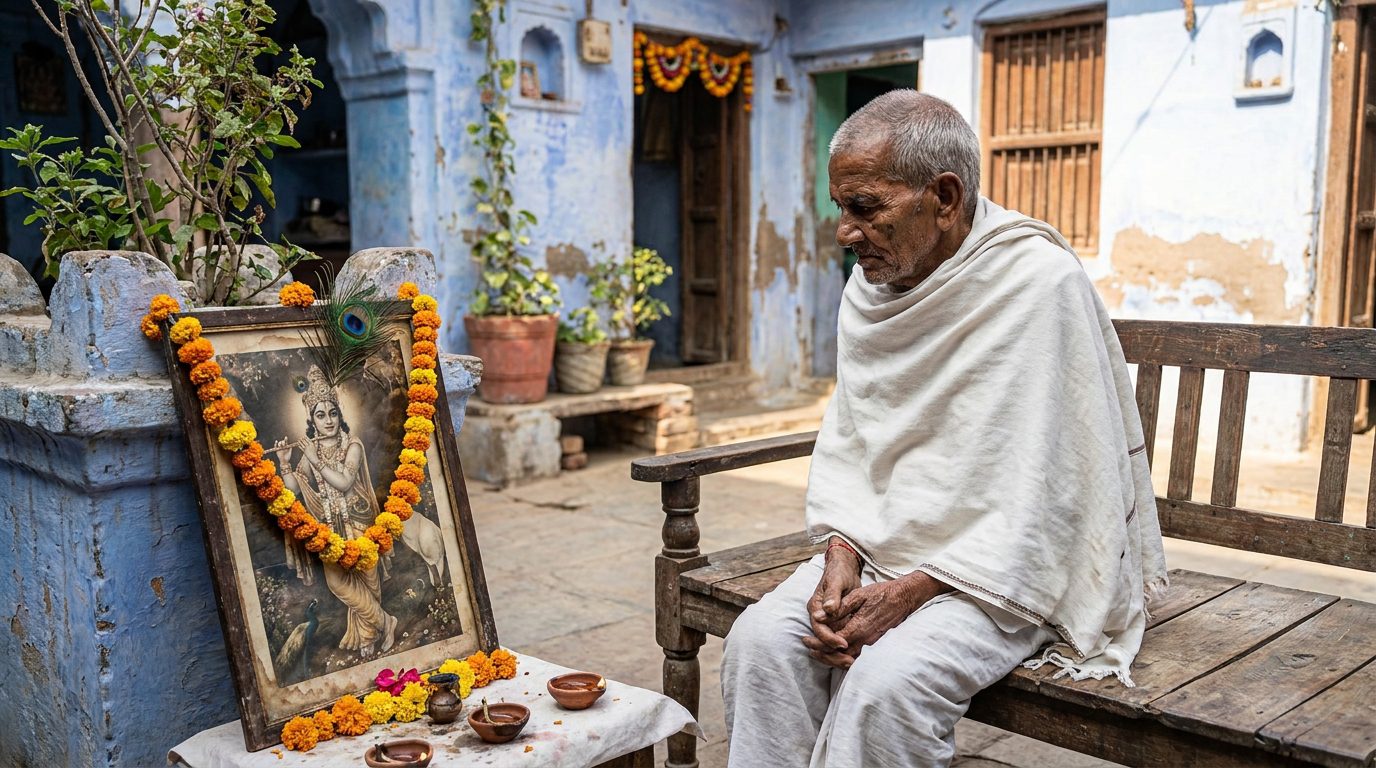
Have you ever felt torn between your daily responsibilities and your longing for something deeper? Maybe you’re rushing through your morning, juggling tasks at work, caring for your family, and by the time evening arrives, you wonder where the day went — and whether you remembered to connect with God even once.
If that sounds familiar, please know you’re not alone. And more importantly, please know that Bhakti Yoga — the path of devotion and love — doesn’t ask you to abandon your life to find God. It asks you to invite God into the life you already have.
At The Bhakti House, we believe that remembering Krishna (God, the Supreme Beloved) isn’t reserved for monks living in temples or saints sitting in meditation for hours. It’s for you — the parent, the student, the worker, the caregiver, the dreamer. It’s for all of us, exactly where we are.
This article explores how we can practically weave devotion into our everyday lives, drawing from the timeless wisdom of the Bhagavad Gita, the Srimad Bhagavatam, and the teachings of great Bhakti saints who walked this path before us.
In the Bhagavad Gita (8.7), Krishna lovingly tells Arjuna:
“Therefore, at all times, remember Me and fight. With your mind and intellect surrendered to Me, you will surely come to Me.”
This is one of the most practical and beautiful instructions in all of spiritual literature. Krishna doesn’t say, “Leave the battlefield.” He doesn’t say, “Stop working.” He says, “Remember Me while you do what you need to do.”
The Sanskrit word here is smaranam — remembrance. It’s one of the nine core practices of Bhakti Yoga, and it’s something every single person can do, no matter how busy life gets.
The Heart Always Has Room
Here’s the beautiful thing about remembrance: it doesn’t require extra time. It requires a shift in attention. Your hands can be typing an email while your heart quietly holds the name of God. Your feet can be walking to the grocery store while your mind gently returns to a prayer or a mantra.
Remembering Krishna is less about adding another item to your to-do list and more about softening the space inside you so that love for God can flow through everything you already do.
What Does “Krishna” Mean?
For those who may be new to this tradition, Krishna is a name for God that means “the All-Attractive One.” In the Bhakti tradition, God is understood as a person — the Supreme Person — who is full of beauty, compassion, playfulness, and infinite love. When we say “remember Krishna,” we’re really saying “remember the One who loves you most.”
And if the name Krishna doesn’t resonate with you personally, that’s completely okay. The principle remains the same: stay connected to God, by whatever name your heart calls out, throughout your day.
The Challenge of Modern Life: Why We Forget
Let’s be honest — modern life is designed to make us forget. Notifications, deadlines, social media, commutes, bills, and the constant buzz of information pull our attention in a hundred different directions.
The ancient texts actually anticipated this. In the Srimad Bhagavatam (1.2.19), it’s explained that the material world has a covering, clouding effect on the soul. Our natural consciousness — which is joyful, loving, and connected to God — gets buried under layers of distraction, stress, and forgetfulness.
This isn’t something to feel guilty about. It’s simply the nature of the world we live in. The Bhakti path is gentle. It doesn’t shame us for forgetting. It lovingly encourages us to remember again. And again. And again.
The Pull of Busyness
Many of us wear busyness like a badge of honor. We feel productive when our calendars are full. But productivity and presence are not the same thing. You can accomplish a hundred tasks in a day and still feel spiritually empty inside.
The Bhakti tradition teaches us that real fulfillment doesn’t come from doing more. It comes from doing with love — and with remembrance of the One who is the source of all love.
The Guilt Trap
Some devotional practitioners fall into a painful cycle: they feel guilty for not chanting enough, not praying enough, not being “spiritual” enough. But guilt is not devotion. Krishna is not keeping score. In the Bhagavad Gita (9.26), He says:
“If someone offers Me a leaf, a flower, a fruit, or water with love and devotion, I accept it.”
God is looking at the love behind our efforts, not the size of them. Even one moment of sincere remembrance is precious to Krishna.
Practical Ways to Remember Krishna Throughout Your Day
So how do we actually do this? How do we keep God close while navigating the real demands of daily life? Here are several simple, practical approaches rooted in Bhakti wisdom.
Morning Intention: Start Before the World Starts
Before you check your phone, before the day’s demands rush in, take even two minutes to connect. You might softly chant the Maha Mantra — Hare Krishna, Hare Krishna, Krishna Krishna, Hare Hare, Hare Rama, Hare Rama, Rama Rama, Hare Hare — even just a few times. Or simply say a prayer in your own words: “Dear Lord, please help me remember You today.”
The Maha Mantra (which means “the great chant for deliverance”) is considered especially powerful in this age. The vibration of God’s holy names has the ability to purify the heart and awaken our natural love.
Even a small morning practice creates a spiritual anchor that holds you steady as the day unfolds.
Chanting During Ordinary Moments
You don’t need a meditation cushion to chant. You can chant while commuting, while washing dishes, while folding laundry, while walking the dog. The beauty of japa (soft, personal chanting, usually done on prayer beads) and kirtan (singing God’s names together) is that they sanctify ordinary moments.
Srila Bhaktivinoda Thakura, a beloved Bhakti saint, wrote songs about remembering Krishna while going about household duties. He saw no contradiction between sweeping a floor and sweeping the heart clean with devotion.
Offering Your Work as Service
One of the most transformative teachings in the Bhagavad Gita is the concept of karma yoga combined with Bhakti — offering the fruits of your work to God. In Chapter 9, Verse 27, Krishna says:
“Whatever you do, whatever you eat, whatever you offer or give away, and whatever austerities you perform — do that as an offering to Me.”
This means your job can become devotion. Your cooking can become devotion. Your parenting can become devotion. When you shift your intention from “I’m doing this for myself” to “I’m doing this as an offering of love,” the entire quality of your work changes. It becomes lighter. More meaningful. More connected.
Seeing Krishna in Others
The Srimad Bhagavatam teaches that the Supreme Lord dwells in the hearts of all living beings as the Paramatma (the Supersoul). When we treat others with kindness, patience, and respect, we’re honoring that divine presence within them.
This is seva — service — in its broadest and most beautiful sense. Every act of genuine kindness is an act of devotion.
Sure, here is the sentence with the clickable link:
Check out our blog for more posts at more posts.
Learning from the Saints Who Balanced Both
Throughout Bhakti history, countless devotees have shown us that it’s possible — and even natural — to be deeply devoted while living active, engaged lives.
Arjuna: The Devoted Warrior
Arjuna, to whom Krishna spoke the Bhagavad Gita, was not a renunciant. He was a warrior, a family man, a leader with enormous responsibilities. Yet Krishna chose him as the recipient of the highest spiritual knowledge. The message is clear: you don’t have to leave the world to find God. You have to find God in the world.
Queen Kunti: Devotion Through Hardship
Queen Kunti, one of the most beloved devotees in the Srimad Bhagavatam, endured tremendous suffering — exile, persecution, and the near-destruction of her family. Yet through it all, she turned to Krishna with such raw honesty and love that her prayers are considered among the most exalted in all of Bhakti literature. She teaches us that devotion isn’t about having a perfect life. It’s about having a sincere heart.
The Gopis of Vrindavan: Love in Every Action
The gopis (the cowherd women of Vrindavan) are described as the highest devotees of Krishna. They were not scholars or ascetics. They were village women who churned butter, carried water, and cared for their families. But every single thing they did was saturated with love for Krishna. Their example shows us that the deepest devotion doesn’t look extraordinary from the outside — it glows from within.
Creating a Sustainable Devotional Rhythm
Balance isn’t about perfection. It’s about rhythm — a gentle, sustainable pattern of returning to God throughout the flow of your life.
Be Honest About Where You Are
Don’t try to imitate someone else’s spiritual practice. Start where you are. If five minutes of chanting in the morning is what you can genuinely offer right now, offer those five minutes with your whole heart. Krishna will honor that sincerity far more than an hour of distracted obligation.
Build Small, Sacred Habits
Consider creating what we might call “devotional touchpoints” throughout your day:
- Morning: A short prayer or a few rounds of chanting
- Mealtime: A moment of gratitude, offering your food to God before eating (prasadam — food offered with love becomes spiritually nourishing)
- Commute: Listening to kirtan or a Bhakti scripture reading
- Evening: A few minutes of reflection, perhaps reading a verse from the Bhagavad Gita
- Before sleep: Offering the day to Krishna, asking for His presence in your dreams
Find Community
Bhakti is not meant to be practiced alone. The word sanga means “association,” and keeping the company of fellow seekers is one of the most powerful supports on the path. Whether it’s joining a local kirtan, attending a satsang (spiritual gathering), or simply sharing a meal with someone who inspires your faith — community nourishes devotion in ways that solitary practice alone cannot.
At The Bhakti House, we cherish this spirit of togetherness. Everyone who walks through the door — or reads these words — is part of this family.
When You Forget, Begin Again with Love
Here’s perhaps the most important thing to remember: you will forget. You will have days where Krishna feels distant, where your mind is consumed by worries, where devotion feels like a distant memory. This is not failure. This is being human.
The Bhakti path is endlessly forgiving. In the Bhagavad Gita (9.30-31), Krishna makes an astonishing promise:
“Even if someone who has committed the most terrible actions worships Me with exclusive devotion, that person is to be considered saintly, for their resolve is rightly placed. Quickly they become righteous and attain lasting peace. Declare it boldly — My devotee never perishes.”
God doesn’t give up on us. Not ever. So we don’t need to give up on ourselves.
Every moment is a fresh invitation to remember. Every breath is a new beginning.
You Are Welcome Here
Whether you’ve been practicing Bhakti for decades or you’re hearing about it for the first time today, please know this: you are welcome. You are enough. And you don’t need to have everything figured out to take one sincere step toward God.
Maybe that step is chanting the Maha Mantra softly tomorrow morning. Maybe it’s offering a quiet “thank you” before your next meal. Maybe it’s simply holding the intention in your heart: I want to remember You.
That’s enough. That’s more than enough. That’s everything.
Krishna is already looking toward you with love. All you have to do is look back.
We’d love to walk this path with you. If this article touched your heart, please reach out, join us for kirtan, or simply stay connected. The door of The Bhakti House is always open — and so is the door of the heart.

