
Understanding Parikrama as a Sacred Journey of the Heart
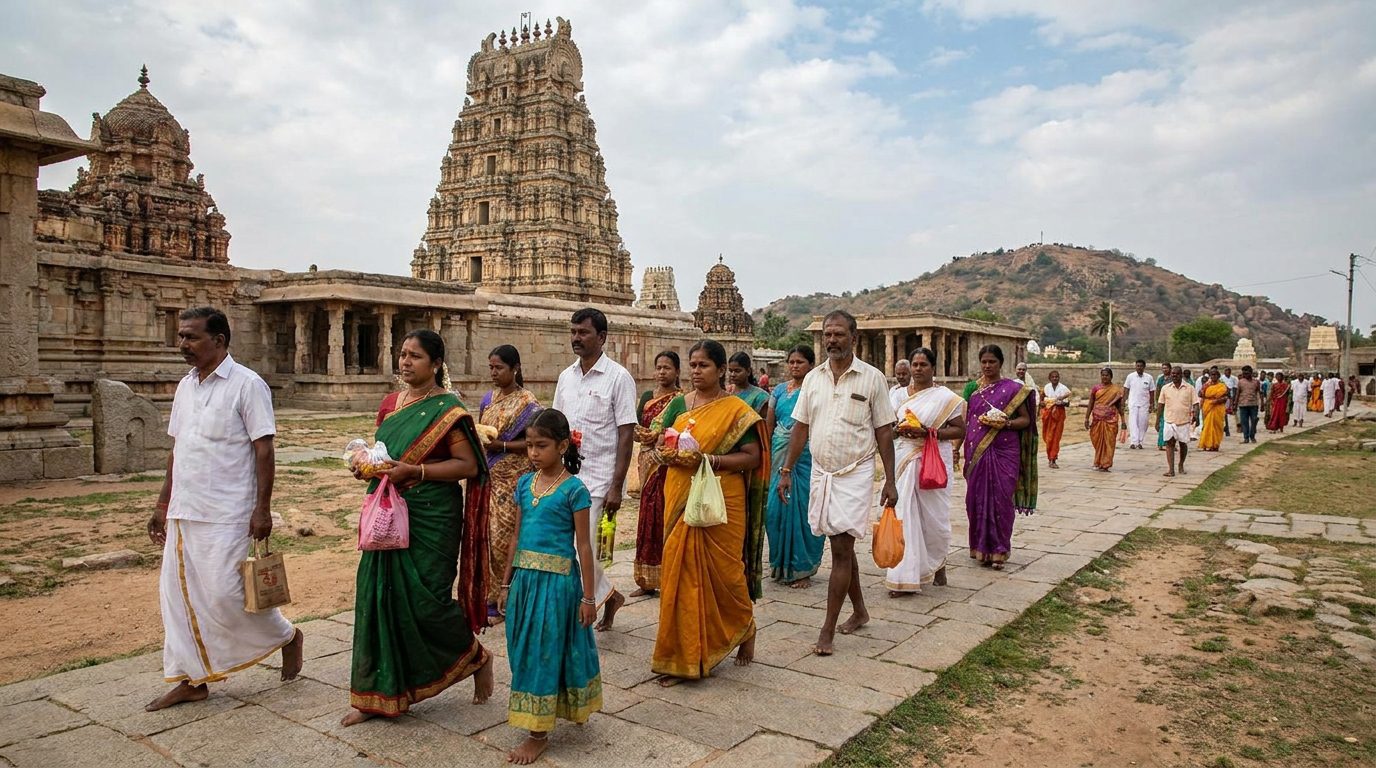
Parikrama is one of the most beloved practices in Hindu spiritual life. The Sanskrit word parikrama means “to go around” or “to circumambulate.” It comes from pari, meaning “around,” and krama, meaning “step.” In simple terms, parikrama is the act of walking around a sacred place, temple, holy mountain, river, deity, or pilgrimage circuit with devotion.
But parikrama is much more than walking in a circle.
For devotees, it is a journey of the heart. Each step becomes a prayer. Each breath becomes an offering. Each turn reminds us that God is the true center of life. Instead of asking the world to revolve around us, parikrama gently teaches us to place the Divine at the center and move with humility, love, and remembrance.
In Bhakti Yoga, the path of loving devotion, parikrama is a practical way to express love for God. Some people chant sacred names while walking. Some pray silently. Some offer gratitude. Some simply walk with an open heart, trusting that sincere effort is seen by the Divine.
People of all backgrounds can appreciate this sacred practice. You do not need to be born into a Hindu family, know Sanskrit, or have advanced spiritual knowledge to begin. Parikrama welcomes the sincere heart. Whether you walk around a temple once, circle a sacred hill, or journey through an ancient pilgrimage route, the inner mood matters most.
The Bhagavad Gita teaches that even a simple offering made with devotion is accepted by the Lord. Krishna says, “If one offers Me with love and devotion a leaf, a flower, fruit, or water, I will accept it” (Bhagavad Gita 9.26). In the same spirit, even a simple step taken with love can become sacred.
Why Devotees Perform Parikrama
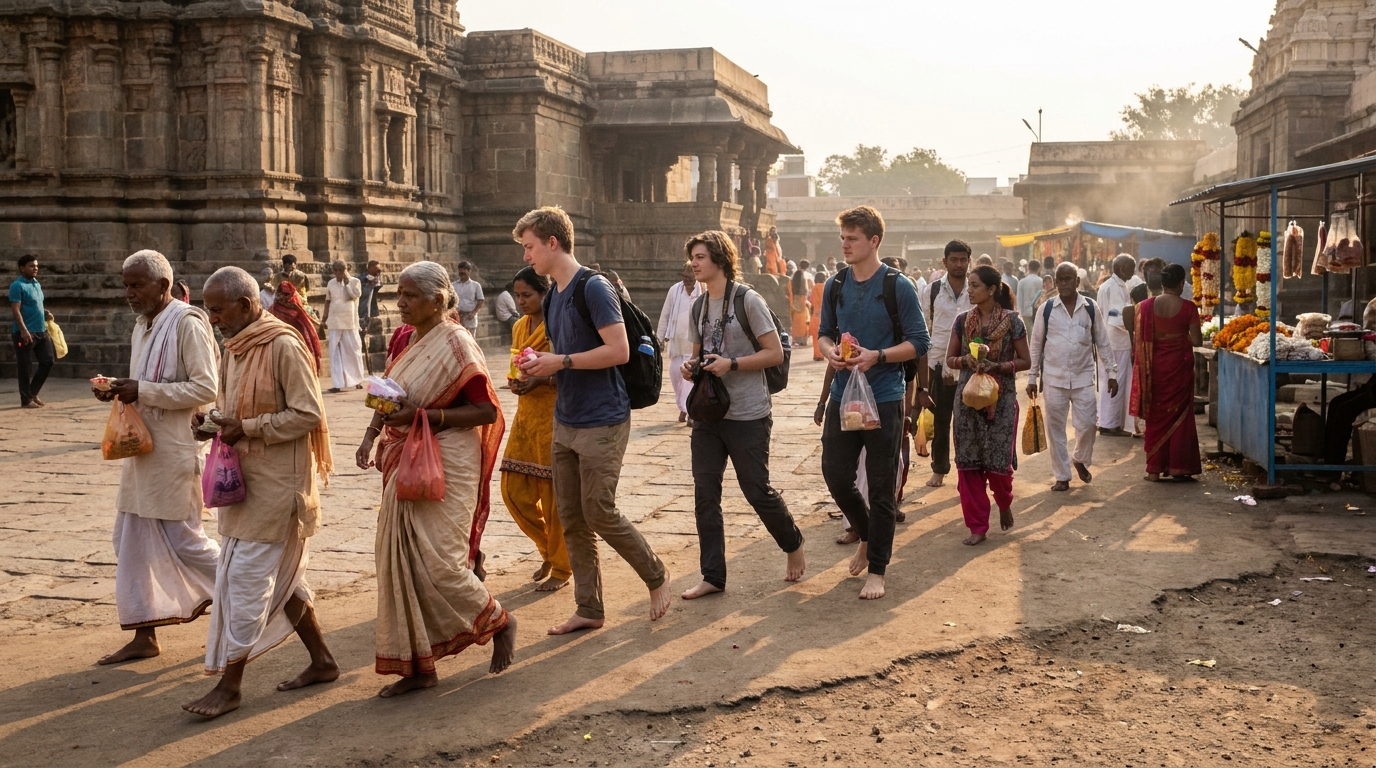
Parikrama has been practiced for thousands of years across India and beyond. It appears in temple traditions, village worship, sacred geography, pilgrimage festivals, and personal devotional life. While the outer form may vary, the inner purpose is deeply consistent: to remember God, purify the heart, and grow in devotion.
Placing God at the Center
When we walk around a sacred object or holy place, we physically express an important spiritual truth: the Divine is the center. In daily life, it is easy to make our worries, ambitions, fears, or opinions the center of everything. Parikrama softly reorients us.
The body moves, but the heart bows.
In a temple, devotees often walk clockwise around the deity, known in Sanskrit as the murti. A murti is not considered an ordinary statue. In Hindu devotion, it is a sacred form through which God receives worship and offers mercy to devotees. Circumambulating the deity is a way of saying, “May my life revolve around You.”
This practice can be very grounding. Even if the mind is distracted, the body participates in prayer. Step by step, the soul remembers.
Purification Through Sacred Movement
Many pilgrims undertake parikrama for purification. This does not mean that a person is bad or unworthy. In Bhakti, purification means clearing away what covers our natural love for God: pride, anger, greed, envy, forgetfulness, and selfishness.
Sacred walking can help soften these coverings. The rhythm of the feet, the chanting of holy names, and the presence of other pilgrims create a spiritual atmosphere. The heart begins to loosen its grip on ordinary stress.
In the Srimad Bhagavatam, one of the great Bhakti scriptures, hearing and chanting about the Lord is described as a powerful purifier of the heart. Parikrama often includes both: pilgrims hear sacred stories connected to the place and chant names of God as they walk. In this way, the journey becomes a moving form of meditation.
Gratitude, Prayer, and Surrender
People also perform parikrama as an offering of gratitude. A family may walk around a temple after a prayer has been answered. A devotee may circle a sacred hill to thank God for protection. Someone else may walk with tears, asking for strength during a difficult season.
Parikrama gives the heart a language beyond words.
Sometimes we do not know how to pray. We may feel tired, confused, or unworthy. Yet we can still take one step. Then another. In Bhakti Yoga, this simple sincerity is precious.
Surrender, called sharanagati in Sanskrit, means taking shelter of God with trust. Parikrama can become a practice of surrender: “I do not control everything. I walk with You. Please guide me.”
How Parikrama Is Practiced
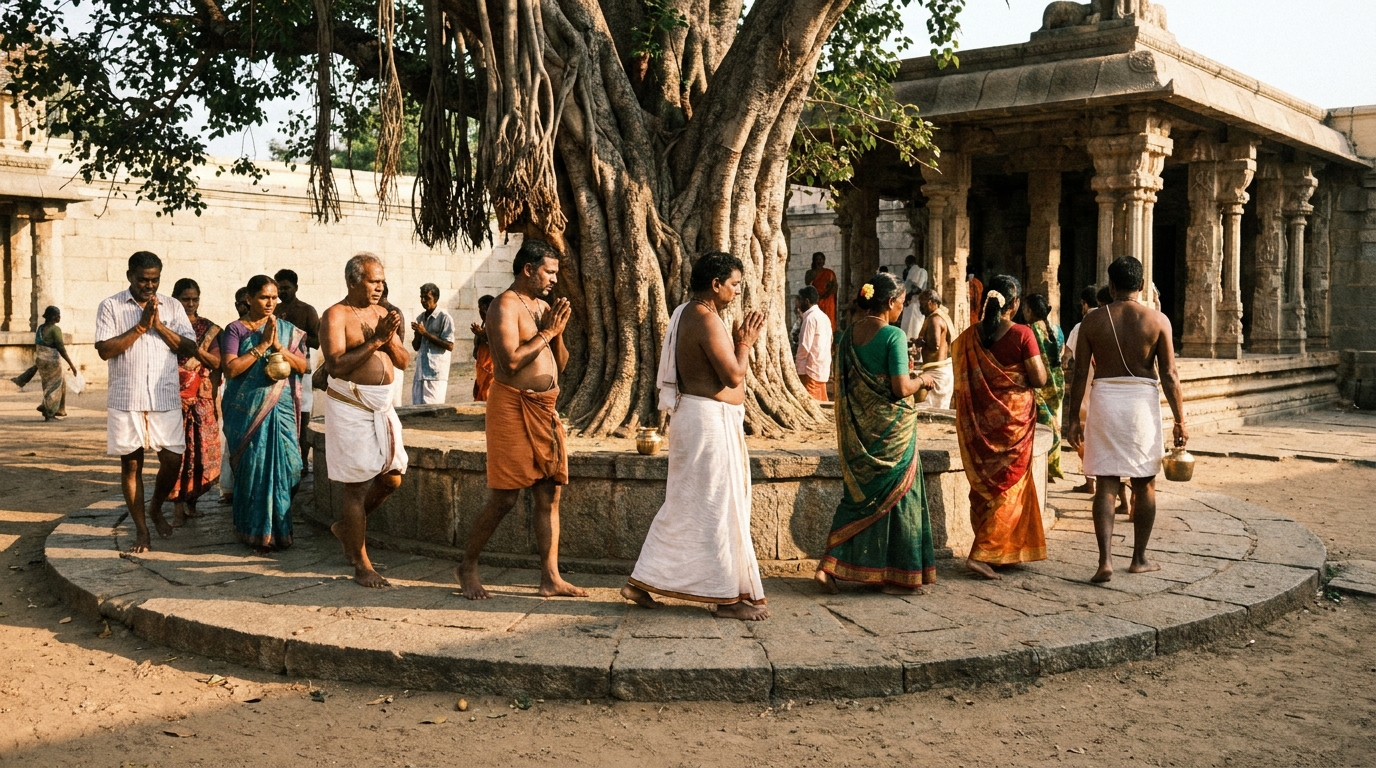
Parikrama can be simple or extensive. It may take five minutes in a small temple or several days around a sacred region. It may be done alone, with family, or in a large group of pilgrims singing together. The essential elements are respect, devotion, and remembrance.
Walking Clockwise With Reverence
In most Hindu traditions, parikrama is performed clockwise. This means the sacred object, deity, temple, mountain, or holy place remains on the right side as one walks. The right side is traditionally associated with honor and auspiciousness.
For example, after taking darshan—seeing and being seen by the deity in a temple—a devotee may walk around the inner or outer shrine one, three, seven, or more times. The number may depend on local custom, personal vow, or family tradition.
It is best to walk calmly, without rushing. Parikrama is not a race. The purpose is not to “complete” the circle as quickly as possible, but to become more aware of the sacred presence.
If you are new, you can simply fold your hands, walk quietly, and offer a prayer such as:
“Dear Lord, please help me remember You. Please guide my life in love and service.”
Chanting During Parikrama
Chanting is one of the most beautiful ways to practice parikrama. In Bhakti Yoga, sacred sound is central. A mantra is a spiritual sound or prayer that helps focus the mind on God.
Many devotees chant the Hare Krishna maha-mantra:
Hare Krishna, Hare Krishna, Krishna Krishna, Hare Hare
Hare Rama, Hare Rama, Rama Rama, Hare Hare
“Maha-mantra” means “great mantra.” This chant calls upon the Divine names of Krishna and Rama, asking to be engaged in loving service. “Hare” addresses the Lord’s divine energy, often understood as the compassionate feminine aspect of God.
Others may chant “Om Namah Shivaya,” a sacred mantra honoring Lord Shiva, or “Sri Ram Jai Ram Jai Jai Ram,” glorifying Lord Rama. Some may sing bhajans, devotional songs. Some may quietly repeat the name of God they know and love.
The heart of chanting is not performance. It is relationship. We chant to remember, to call out, to listen, and to love.
Offering Prayers and Simple Service
Parikrama is often accompanied by offerings. A devotee may offer flowers, lamps, incense, water, or food prepared with devotion. In Sanskrit, devotional offering is connected with seva, meaning service. Seva is one of the most practical expressions of Bhakti Yoga.
During a pilgrimage circuit, seva may include helping elderly pilgrims, sharing water, cleaning a pathway, supporting temple service, feeding others, or simply walking with patience and kindness.
This is important. A person can walk many miles, but if the heart becomes proud or harsh, the deeper purpose is missed. True parikrama teaches humility. The journey around a sacred place should also bring us closer to the sacredness within others.
As Krishna teaches in the Bhagavad Gita 12.13–14, a dear devotee is one who is non-envious, kind, humble, forgiving, steady, and devoted. Parikrama becomes meaningful when these qualities grow in daily life.
I recently discovered a website with insightful articles on mindfulness and meditation. The articles provide practical tips for incorporating spirituality into daily life. If you’re interested in personal growth, these articles are definitely worth a read.
Major Types of Sacred Parikrama
Across Hindu traditions, many forms of parikrama are practiced. Some are centered around temples, some around mountains, some around rivers, and others around entire holy regions. Each has its own mood, history, and spiritual meaning.
Temple Parikrama
Temple parikrama is the most accessible form for many people. After offering respects to the deity, devotees walk around the sanctum or temple building. In some temples, there is a designated pathway called a pradakshina patha. The word pradakshina is closely related to parikrama and also means circumambulation, especially in a clockwise direction.
Temple parikrama may be done daily or on special days. It is common during festivals, after worship ceremonies, or before making a personal prayer.
For beginners, temple parikrama is a gentle place to start. You can walk slowly, observe how others move respectfully, and follow local customs. If unsure, it is always appropriate to ask a temple guide or devotee for help.
Mountain and Hill Parikrama
Sacred mountains and hills hold a special place in Hindu pilgrimage. They are often seen as living forms of divinity or as places where saints, sages, and divine pastimes have occurred.
One well-known example is Govardhan Parikrama in Vrindavan, connected to Lord Krishna. According to the Srimad Bhagavatam, Krishna lifted Govardhan Hill to protect the residents of Vrindavan from devastating rains. Devotees honor Govardhan as beloved to Krishna and often walk the approximately 21-kilometer circuit with chanting and prayer.
Another famous example is Arunachala Girivalam in Tamil Nadu, where devotees walk around Arunachala Hill, sacred to Lord Shiva. Many pilgrims believe the hill itself is a form of Shiva, radiating spiritual grace.
Mountain parikrama can be physically demanding, but it offers a powerful reminder: the spiritual path requires steadiness. The hill does not move. The pilgrim keeps walking.
River Parikrama
Rivers are revered in Hindu tradition as sacred mothers. The Ganga, Yamuna, Narmada, Godavari, Kaveri, and other holy rivers are honored not only as water but as divine sources of purification, nourishment, and grace.
Some river parikramas are extensive. The Narmada Parikrama, for example, is a traditional pilgrimage where devotees walk along one bank of the Narmada River from its source toward the sea and return along the other bank. This can take months or even years, depending on the pace and vow of the pilgrim.
Not everyone can undertake such a long journey, and that is perfectly okay. Even walking prayerfully along a riverbank, offering respect, and avoiding pollution can be a form of devotion. Caring for sacred rivers is also seva. Love for God naturally includes care for God’s creation.
Regional Pilgrimage Circuits
Some parikramas involve entire sacred regions. These circuits connect temples, forests, ghats, ponds, samadhi sites of saints, and places connected with divine activities.
Vrindavan Parikrama is a beloved route around the holy town of Vrindavan, where Krishna’s childhood and youth pastimes are remembered. Pilgrims chant, visit temples, bow at sacred sites, and hear stories of Krishna and Radha, the supreme expression of divine love in many Bhakti traditions.
Vraja Mandala Parikrama is a larger pilgrimage through the broader land of Vraja, traditionally performed over a month, especially during the sacred month of Kartik. Pilgrims visit places such as Mathura, Govardhan, Radha Kund, Nandagram, Barsana, and many forests associated with Krishna’s pastimes.
Other important circuits include Ayodhya Parikrama, connected to Lord Rama; Kashi Panchakroshi Yatra, a sacred route around Varanasi; and various circuits around Jagannath Puri, Dwarka, and other holy places.
Each region carries a unique devotional mood. Yet the essence remains the same: to walk in remembrance and love.
Famous Parikrama Circuits and Their Spiritual Significance
India’s sacred geography is vast and deeply layered. Every holy place has its own stories, songs, saints, and blessings. Here are some of the most cherished parikrama circuits, described with simple context for new readers.
Govardhan Parikrama in Vraja
Govardhan Parikrama is one of the most famous Bhakti pilgrimage circuits. Govardhan Hill is located near Vrindavan in Uttar Pradesh. Devotees especially connected to Krishna worship Govardhan as sacred and deeply merciful.
The story comes from the Srimad Bhagavatam. When the people of Vrindavan prepared a sacrifice for Indra, the god of rain, young Krishna encouraged them to worship Govardhan Hill instead, because the hill provided grass, water, caves, and nourishment for the cows and villagers. Angered, Indra sent heavy storms. Krishna lifted Govardhan Hill like an umbrella and protected everyone for seven days.
For devotees, this pastime reveals Krishna as protector, friend, and beloved Lord. Walking around Govardhan is a way to remember His shelter.
Many pilgrims chant the holy names, offer dandavats—full-body prostrations—or pause at sacred places such as Radha Kund and Kusum Sarovar. Some complete the circuit in a few hours; others take a full day or more. The mood is not hurry, but devotion.
Vrindavan Parikrama and the Path of Sweet Devotion
Vrindavan is cherished as the land of Krishna’s intimate pastimes. The parikrama path around Vrindavan is often walked in the early morning. Pilgrims pass temples, ashrams, trees, cows, monkeys, and sacred sites filled with centuries of prayer.
The atmosphere can be both simple and profound. One may hear bells ringing, devotees singing “Radhe Radhe,” and the sound of japa beads moving through fingers. Japa means personal mantra meditation, often done by softly repeating the holy names on beads.
Vrindavan Parikrama teaches a tender lesson: God is not only majestic and powerful, but also sweet, playful, and close. In Bhakti Yoga, this sweetness is called madhurya, the intimate beauty of the Divine.
Arunachala Girivalam and the Fire of Inner Stillness
Arunachala, in Tiruvannamalai, Tamil Nadu, is one of the most sacred sites for devotees of Lord Shiva. The circumambulation of Arunachala Hill is called Girivalam or Giri Pradakshina. Giri means hill or mountain.
Many pilgrims walk the circuit on full moon nights, though it can be done at other times as well. The path is around 14 kilometers and includes temples and sacred spots along the way.
Arunachala is associated with the element of fire and the light of spiritual knowledge. Saints such as Ramana Maharshi lived there and taught self-inquiry and inner silence. For many seekers, walking around Arunachala becomes a meditation on the presence of God within the heart.
Narmada Parikrama and Devotion to the Sacred River
The Narmada River is honored as one of India’s most sacred rivers. The Narmada Parikrama is among the longest and most demanding pilgrimage vows. Traditionally, pilgrims walk from the river’s source to the ocean along one bank, cross near the sea, and return along the other bank.
This journey requires simplicity, faith, discipline, and surrender. Pilgrims may depend on the kindness of villagers, temples, and the river herself. For many, the Narmada becomes not just a river but a mother and guide.
While few people can complete the full parikrama, the spirit of Narmada devotion can be practiced by honoring water, living simply, and praying for purity of heart.
Kashi Panchakroshi Yatra and the Grace of Shiva
Kashi, also known as Varanasi, is one of the most ancient living sacred cities in the world. It is especially connected with Lord Shiva. The Panchakroshi Yatra is a traditional pilgrimage circuit around Kashi, covering a sacred boundary of the city.
Pilgrims visit temples and sacred points while remembering Shiva’s compassion and the liberating power of Kashi. The word pancha means five, and krosha is an ancient measure of distance, giving the route its name.
Kashi teaches impermanence and grace. Along the Ganga’s ghats, life and death are visible side by side. Parikrama here can awaken deep reflection: What is truly lasting? What should I give my heart to? How can I live with more devotion today?
Preparing for a Parikrama Pilgrimage
A sacred journey benefits from both outer preparation and inner preparation. The body needs care, the mind needs clarity, and the heart needs humility.
Preparing the Body With Care
Before undertaking a longer parikrama, consider your health and walking ability. Some circuits involve uneven paths, heat, crowds, hills, or long distances. Comfortable footwear may be appropriate on certain routes, while some temple or traditional paths may be walked barefoot. Follow local customs while also caring responsibly for your body.
Bring water, simple food if needed, sun protection, and any necessary medicines. If you have medical conditions, speak with a healthcare professional before attempting a demanding pilgrimage. Devotion does not require neglecting the body. The body is a gift and a vehicle for service.
For shorter temple parikrama, physical preparation may be minimal. Still, walk with awareness. Move gently around elderly devotees, children, and others.
Preparing the Mind With Sacred Intention
Before beginning, set an intention. This can be simple:
“I am walking to remember God.”
“I am offering this parikrama for healing and guidance.”
“May my heart become more humble and loving.”
“May all beings be blessed.”
A clear intention helps transform walking into worship. If the mind wanders, gently return to the mantra, prayer, or sacred story connected with the place.
Reading about the pilgrimage site beforehand can also deepen your experience. Learn the stories, saints, and traditions connected to the route. When you know the meaning of a place, each step becomes more alive.
Preparing the Heart With Humility
Pilgrimage can sometimes bring discomfort. There may be dust, noise, delays, crowds, or unexpected challenges. These are not obstacles to devotion; they may become part of the teaching.
Humility means we do not demand that sacred places serve our preferences. Instead, we approach with respect: “I have come to receive, to learn, and to serve.”
It is also wise to avoid judging others. Pilgrims come with different levels of knowledge, culture, and practice. Some may be deeply traditional. Others may be new. Some may sing loudly. Others may walk quietly. The path of Bhakti invites us to see each person as a soul on a journey.
What to Do During Parikrama
During parikrama, every action can become part of devotion. The way we walk, speak, eat, rest, and interact with others all matter.
Chant, Listen, and Remember
Chanting helps keep the mind steady. You may repeat a mantra, sing softly, or listen to devotional songs. If you are with a group, join the kirtan. Kirtan means congregational chanting of God’s names, often with music.
Listening is also powerful. Hear the stories of the sacred place. Listen to the wisdom of saints and guides. Listen to the quiet voice of the heart.
In Bhakti, remembrance is called smaranam. It is one of the nine classic processes of devotion described in the Srimad Bhagavatam: hearing, chanting, remembering, serving, worshiping, praying, becoming a servant, becoming a friend of God, and offering everything. Parikrama can include all of these in a natural way.
Practice Kindness Along the Path
A sacred circuit is not only about reaching holy sites. It is also about how we treat others along the way.
Offer space to those walking faster or slower. Share water if you can. Avoid littering. Speak gently. Thank those who serve pilgrims. Respect local residents, animals, temple priests, and fellow travelers.
If monkeys, cows, dogs, or other animals are present, treat them respectfully and safely. Do not tease or disturb them. In many holy places, animals are part of the sacred environment.
Kindness is not separate from devotion. It is devotion made visible.
Honor Local Customs
Every pilgrimage place has customs. Some areas may require modest clothing, silence, removing shoes, avoiding photography, or not entering certain spaces. These customs may be rooted in centuries of reverence.
If you do not understand a rule, ask respectfully. Avoid arguing in sacred spaces. Even if a custom is unfamiliar, honoring it can be a beautiful act of humility.
For visitors from outside the tradition, this sensitivity is especially important. Hindu pilgrimage sites are living places of worship, not only cultural landmarks. When we enter with respect, we receive more deeply.
The Inner Meaning of Sacred Circles
The circle is a powerful spiritual symbol. It has no sharp beginning or end. It suggests wholeness, continuity, and return. Parikrama uses the circle not as an abstract idea, but as a bodily prayer.
Returning Again and Again to God
Life often pulls us outward. We chase tasks, roles, relationships, goals, and responsibilities. These are not necessarily wrong, but they can make us forget our spiritual center.
Parikrama teaches return.
With every round, we come back to the same sacred point. This repetition is not empty. It mirrors spiritual practice itself. We chant again. We pray again. We serve again. We fall, rise, and return again.
The Bhagavad Gita 18.66 offers a profound invitation from Krishna: “Abandon all varieties of dharma and simply surrender unto Me. I shall deliver you from all sinful reactions. Do not fear.” This verse is often understood in Bhakti as God’s loving call to take shelter. Parikrama embodies that return to shelter, one step at a time.
Moving From Ego to Offering
The ego says, “I am the center.” Bhakti says, “Love is the center. God is the center.”
Parikrama helps shift the heart from self-centeredness to offering. We may begin with personal desires, and that is okay. Many pilgrims come with prayers for health, family, success, peace, or relief from suffering. God is compassionate and hears all prayers.
But as devotion deepens, prayer matures. We begin to ask not only, “Please give me what I want,” but “Please make me an instrument of Your love.”
This is spiritual growth. It does not happen by force. It unfolds through sincere practice, grace, and time.
Seeing the World as Sacred
After walking around a temple or holy hill, we may begin to see the wider world differently. If God is present in the temple, could God also be present in the heart of every living being? If a river can be sacred, can water everywhere be treated with gratitude? If a pilgrimage path deserves cleanliness, can our own neighborhood become a place of service?
Parikrama trains sacred vision.
The Isha Upanishad begins with the teaching that everything in this world is pervaded by the Divine. Bhakti brings this truth into relationship. We do not merely think, “All is sacred.” We live it through care, gratitude, chanting, and service.
Parikrama for Beginners and Modern Seekers
Not everyone can travel to India or walk long distances. Many people have family responsibilities, health limitations, financial constraints, or live far from traditional pilgrimage sites. The beauty of Bhakti Yoga is that devotion is accessible wherever we are.
Begin With a Temple or Home Practice
If there is a Hindu temple near you, you can begin by visiting respectfully and performing a simple parikrama around the shrine if permitted. Watch how devotees do it. Move slowly. Offer a prayer.
If you have a home altar, you may also walk around it if space allows. If not, you can mentally circumambulate by sitting in prayer and imagining your life moving around God as the center.
Even lighting a candle or lamp, chanting a mantra, and offering one sincere bow can carry the mood of parikrama.
Create a Sacred Walking Practice
You can also transform an ordinary walk into a devotional practice. Walk in a park, around a garden, near water, or through your neighborhood while chanting softly or inwardly. Dedicate the walk to God.
This does not replace traditional parikrama, but it can express the same principle: sacred movement with remembrance.
You might choose a simple practice:
- Walk for 10 minutes while repeating a mantra.
- Offer gratitude for five blessings.
- Pray for people who are suffering.
- Pick up litter as an act of seva.
- End by bowing your head and asking for guidance.
Bhakti Yoga meets us where we are. The important thing is sincerity.
Include Family and Community
Parikrama can be a beautiful family practice. Children may enjoy walking around a temple, offering flowers, singing simple chants, or hearing stories of Krishna, Rama, Shiva, Devi, or other divine forms.
Communities can organize group walks with kirtan, scripture readings, and service projects. A local parikrama around a temple or sacred natural space can bring people together in devotion.
For interfaith families or newcomers, keep the language welcoming. Explain that parikrama is a way of honoring the sacred, practicing gratitude, and placing love at the center. No one should feel pressured. Devotion grows best in an atmosphere of kindness.
Common Questions About Parikrama
Many sincere seekers have practical questions before beginning. It is good to ask. Understanding helps us practice with confidence and respect.
Do I Need to Be Hindu to Perform Parikrama?
Parikrama comes from Hindu tradition, and it should be approached with respect for that tradition. But sincere seekers from all backgrounds are often welcome to participate, especially in public temple and pilgrimage settings.
The key is humility. Do not treat the practice as a tourist performance or spiritual souvenir. Approach it as prayer. If you are unsure what is appropriate, ask a local devotee, priest, or guide.
God sees the heart. A sincere step taken with reverence is meaningful.
How Many Times Should I Walk Around?
The number varies. In temples, devotees may perform one, three, seven, eleven, or more rounds. Some traditions have specific numbers for certain deities or vows. Large pilgrimage circuits are usually completed once, though some devotees repeat them regularly.
If you are new, one mindful round is better than many distracted rounds. Begin simply. Let devotion grow naturally.
Should Parikrama Be Done Barefoot?
In many temples and some sacred routes, devotees walk barefoot as a sign of respect. However, longer outdoor parikramas may involve rough roads, heat, or health concerns. Customs differ by place.
Follow local tradition where required, but do not harm your body unnecessarily. If footwear is acceptable on a long route, choose simple and comfortable shoes. If barefoot walking is expected, prepare carefully and walk within your capacity.
What If My Mind Wanders?
The mind wanders for everyone. Do not be discouraged. When you notice distraction, gently return to your prayer or mantra.
Bhakti is not about pretending to be perfect. It is about returning with love. Every return is itself part of the practice.
Can Parikrama Be Offered for Someone Else?
Yes. Many devotees offer parikrama for the well-being of loved ones, ancestors, teachers, communities, or the world. You can begin by saying, “May the benefit of this prayerful walk be offered for…” and name the person or intention.
This can be a beautiful expression of compassion. Still, we remember that God’s wisdom is greater than ours. We offer prayers with trust, not control.
Living the Spirit of Parikrama After the Journey
A pilgrimage does not truly end when the walking stops. The deeper question is: How has this journey changed the way we live?
Carry the Sacred Center Into Daily Life
After parikrama, try to keep God at the center in small ways. Begin the day with prayer. Chant while cooking or driving. Offer your food before eating. Read a verse from scripture. Speak kindly. Serve someone without expecting recognition.
These simple acts continue the circle of devotion.
Bhakti Yoga is practical. It is not limited to temples or pilgrimage sites. It enters the kitchen, workplace, family room, hospital, classroom, and street. Wherever love for God is remembered and expressed, that place becomes sacred.
Let Service Become Your Pilgrimage
Not everyone can walk around Govardhan, Arunachala, Kashi, or the Narmada. But everyone can serve.
Service may mean volunteering at a temple, feeding others, caring for children, supporting spiritual education, helping the lonely, protecting nature, or listening deeply to someone in pain. When done as an offering to God, service becomes Bhakti.
The saints of the Bhakti tradition remind us again and again that love is shown through action. Chanting softens the heart; service expresses that softness.
Keep Chanting as Your Companion
If parikrama is a sacred walk, chanting is a sacred companion for every step of life. The holy names can be repeated anywhere: at home, in a car, on a walk, before sleep, in sorrow, in joy.
The Kali-santarana Upanishad especially praises the chanting of the Hare Krishna maha-mantra as a means of spiritual deliverance in this age. Many Bhakti teachers have emphasized that chanting is both simple and profound. It requires no wealth, no status, no special qualification—only sincerity.
When life feels confusing, chant. When life feels blessed, chant. When you do not know what to do next, chant and take one honest step.
A Gentle Invitation to Begin
Parikrama is a sacred Hindu pilgrimage practice, but at its heart it speaks to a universal longing: the longing to live with God at the center. It reminds us that spirituality is not only something we think about. It is something we walk, breathe, sing, serve, and become.
Whether you are a lifelong devotee, a curious seeker, a visitor from another faith, or someone quietly returning to prayer after many years, you are welcome to approach this path with humility and love.
You do not need to begin with a great vow or a long journey. Begin with one sincere step.
Walk around a temple with reverence. Chant one mantra with attention. Offer one prayer from the heart. Serve one person with kindness. Read one verse of sacred wisdom. Ask God, in your own words, to guide you.
In Bhakti Yoga, no sincere effort is wasted. Every loving step matters. May your life become a beautiful parikrama, gently circling closer and closer to the Divine center, where the soul finds shelter, purpose, and joy.
Everyone is welcome to take one sincere step toward God today.
FAQs
What is Parikrama?
Parikrama is a Hindu religious practice of walking around a sacred place or object, such as a temple, mountain, or lake, as a form of devotion and worship.
How is Parikrama performed?
Parikrama is typically performed by walking in a clockwise direction around the sacred site or object, while chanting prayers or mantras. It is believed to bring spiritual benefits and blessings to the devotee.
What are some famous Parikrama sites in India?
Some famous Parikrama sites in India include the Govardhan Hill in Mathura, the Narmada River Parikrama, the Kailash Parikrama in Tibet, and the Panch Kedar Parikrama in Uttarakhand.
Is Parikrama only practiced in Hinduism?
No, Parikrama is not limited to Hinduism. It is also practiced in other religions such as Buddhism, Jainism, and Sikhism, each with its own significance and rituals.
What are the benefits of performing Parikrama?
Performing Parikrama is believed to purify the mind, body, and soul, as well as bring blessings, good fortune, and spiritual growth to the devotee. It is also seen as a way to express devotion and gratitude towards the divine.

