
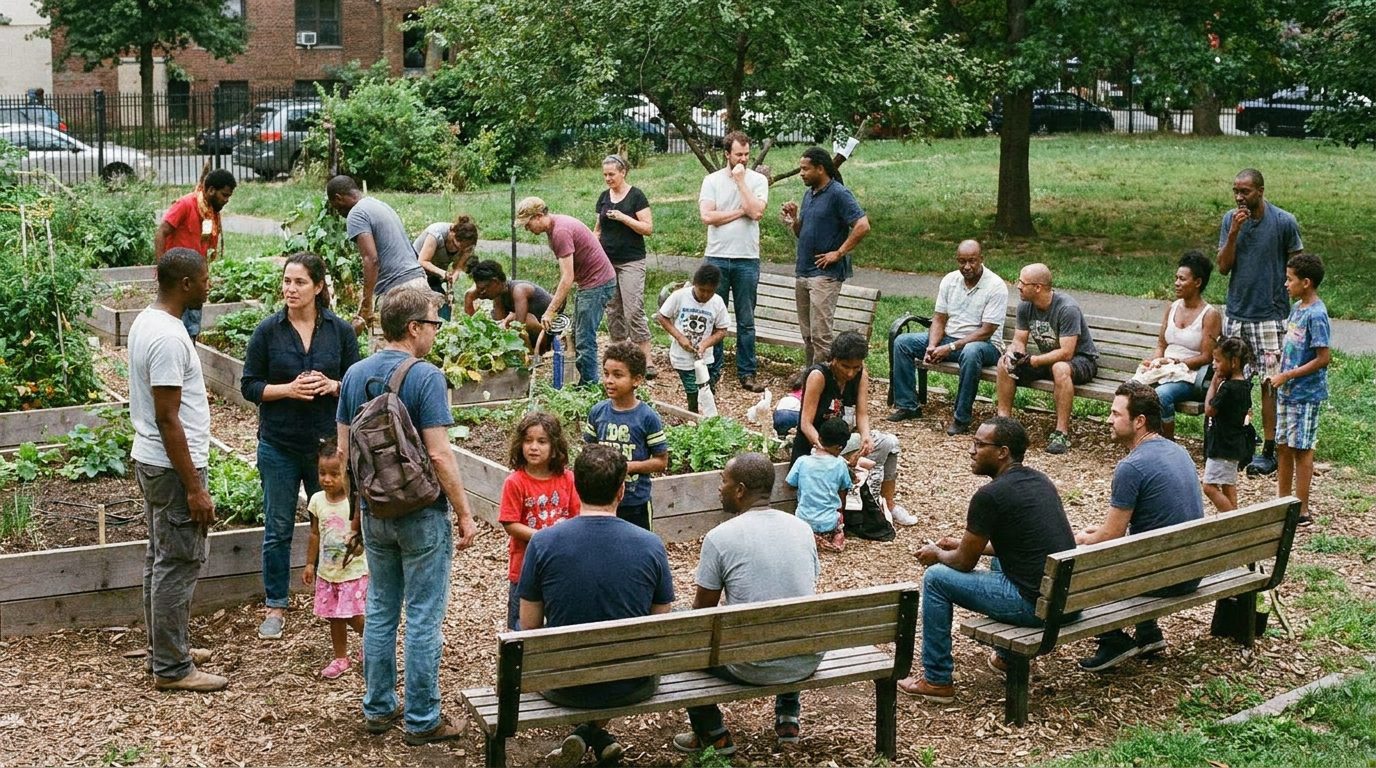
In every spiritual community, there is a beautiful dance between giving and receiving. When we come together as seekers on the path of Bhakti — the yoga of love and devotion — we naturally bring our hopes, our needs, and sometimes our expectations. This is perfectly human. But the deeper we walk together, the more we discover that true community flourishes not when we focus on what we can get, but on what we can offer with an open heart.
At The Bhakti House, we believe every person who walks through our doors, whether physically or virtually, is a cherished part of our family. Whether you come from a lifelong devotional tradition, or you are hearing the word “Bhakti” for the very first time today, you are welcome here. The Bhagavad Gita reminds us, “All of them — as they surrender unto Me — I reward accordingly” (Gita 4.11). God does not turn anyone away, and neither should a community built in God’s name.
This article is for anyone who has ever been part of a spiritual community, wanted to join one, or struggled with the sometimes-tricky balance between what we hope to receive and what we are called to give. Let’s explore this together with honesty, compassion, and practical wisdom rooted in the Bhakti tradition.
More Than a Social Club
Community, or sangha in Sanskrit (meaning the company of fellow seekers), is one of the most treasured gifts on the Bhakti path. It is not simply a social group or a membership organization. In the Bhakti tradition, community is considered so important that the great teacher Rupa Goswami listed sadhu-sanga — the association of devoted, sincere souls — as one of the very first steps in awakening love for God.
When we gather to chant together, to share a meal, to serve side by side, or to study sacred texts, something happens that goes beyond what any of us could achieve alone. Our hearts soften. Our faith deepens. Our rough edges get lovingly smoothed. The Srimad Bhagavatam (3.25.25) explains that through association with devotees, stories of God’s glories are shared, and these stories become joyful to hear. Community is the soil where devotion grows.
Expectations Are Natural — and Worth Examining
It is completely natural to come into a community with expectations. Perhaps you hope for friendship, spiritual guidance, a sense of belonging, support during hard times, or simply a peaceful place to chant and pray. These are all beautiful, legitimate needs.
At the same time, the Bhakti path gently invites us to look at our expectations with honesty. Are we approaching community primarily as consumers — hoping it will meet our needs on our terms? Or are we approaching it as participants — ready to contribute, to stretch, to grow, and sometimes to be uncomfortable in the service of something bigger than ourselves?
This is not about guilt. It is about growth. And recognizing the difference between healthy expectations and self-centered demands is one of the most transformative practices any community member can undertake.
The Benefits of Being Part of a Spiritual Community
Spiritual Nourishment and Growth
One of the greatest benefits of Bhakti community is access to kirtana (congregational chanting of God’s holy names), shared prayer, and the study of scriptures like the Bhagavad Gita and Srimad Bhagavatam. When we chant together — whether it is the Hare Krishna maha-mantra or other sacred names of the Divine — the experience is amplified. There is a sweetness, an energy, a joy that arises in group devotion that is hard to replicate on our own.
Sri Chaitanya Mahaprabhu, the great 15th-century saint who ignited a revolution of devotional love, emphasized sankirtana — the communal chanting of God’s names — as the most powerful spiritual practice for our age. He showed by his own example that when hearts come together in sincere chanting, the presence of the Divine becomes palpable.
Emotional Support and Belonging
Spiritual life is not always easy. There are seasons of doubt, grief, loneliness, and struggle. Being part of a loving community means you do not have to walk through those seasons alone. There are people who will pray for you, sit with you, bring you a meal, or simply listen. This is seva (selfless service) in one of its most personal and profound forms.
Practical Learning and Mentorship
A thriving Bhakti community offers opportunities to learn from those who have walked the path longer. Whether it is understanding how to set up a home altar, learning to cook prasadam (food lovingly offered to God), developing a daily meditation practice, or navigating the challenges of applying spiritual principles in modern life, the wisdom shared within community is invaluable.
Accountability and Encouragement
Let us be honest — maintaining a spiritual practice on our own can be difficult. Life gets busy. Motivation fades. Having a community that gently holds us accountable, that celebrates our progress, and that encourages us when we stumble is an enormous blessing. The path of Bhakti is not meant to be walked in isolation.
The Responsibilities That Come with Community
Showing Up with Sincerity
Responsibility begins with presence — not perfection. You do not have to be an advanced practitioner, a scholar, or someone who has all the answers. But showing up sincerely, whether to a chanting session, a volunteer opportunity, a study group, or simply to offer a kind word to a fellow member, matters enormously. Community is built by the people who choose, again and again, to be present.
Serving Beyond Personal Comfort
Seva, or selfless service, is the heartbeat of Bhakti community. The Bhagavad Gita (3.19) encourages us to perform our duty without attachment to results: “Therefore, without being attached to the fruits of activities, one should act as a matter of duty, for by working without attachment one attains the Supreme.”
In practical terms, this might mean cleaning up after an event, cooking for others, setting up chairs, managing the community’s social media, mentoring a new member, or doing the unglamorous behind-the-scenes work that keeps everything running. Service is not just what we do for the community — it is how we purify our own hearts. Every act of service, done with love and without the need for recognition, brings us closer to God.
Practicing Patience and Humility
No community is perfect, because no community is made up of perfect people. There will be misunderstandings, disagreements, and moments when others do not meet our expectations. The Bhakti path asks us to practice kshama (forgiveness) and vinaya (humility) in these moments.
The great devotee Prahlada Maharaja, even in the face of extreme persecution, maintained his gentle and forgiving nature. While our community challenges may be far less dramatic, the principle is the same: we grow the most when we respond to difficulty with grace rather than grievance.
Communicating Openly and Respectfully
Healthy communities are built on honest, respectful communication. If you have a concern, a need, or a suggestion, bringing it forward with kindness and a desire for mutual understanding is a responsibility we all share. Gossip, passive-aggressiveness, and silent resentment are poisons to any community. Direct, loving communication is the antidote.
Sure, here is the sentence with the clickable link:
You can find more bhakti articles here.
Common Challenges and How to Navigate Them
When Expectations Go Unmet
There will be times when the community does not meet your expectations. Perhaps an event is canceled, a leader makes a decision you disagree with, or you feel overlooked. In these moments, it is helpful to pause and ask yourself: “Am I approaching this situation with the heart of a servant, or with the mindset of a customer?”
This is not to dismiss your feelings — they are valid. But the Bhakti perspective invites us to see challenges as opportunities for deeper surrender and trust in God’s plan. Sometimes what we think we need is not what will help us grow the most.
Avoiding Burnout in Service
On the other end of the spectrum, some community members give so much of themselves that they become exhausted, resentful, or spiritually dry. This is a real danger, and it is important to recognize that sustainable service requires balance. Taking time for your own sadhana (personal spiritual practice), resting when you need to, and asking for help are not signs of weakness — they are signs of wisdom.
The Bhagavad Gita (6.16-17) teaches that yoga is not achieved by those who eat too much or too little, sleep too much or too little. Balance is essential on the spiritual path, and this includes our service within community.
Navigating Different Levels of Commitment
In any community, members will have varying levels of commitment, availability, and capacity. Some people may attend every event; others can only come once a month. Some may volunteer hours each week; others may only be able to contribute financially or through prayer. A mature community recognizes that every contribution matters and avoids creating hierarchies based on who does the most.
Welcoming Newcomers While Honoring Long-Term Members
A truly devotional community keeps its doors wide open while also nurturing the deep roots of its long-standing members. Newcomers should feel immediately welcomed and embraced, without being overwhelmed. Long-term members should feel appreciated and not taken for granted. Striking this balance requires intentionality, kindness, and regular reflection from community leadership and members alike.
Building a Culture of Gratitude and Generosity
Gratitude as a Daily Practice
One of the most powerful things any community member can do is cultivate gratitude. Be thankful for the person who organized the chanting session. Express appreciation to the person who cooked the offering. Acknowledge the leaders who spend countless hours behind the scenes. A community where gratitude flows freely is a community where people feel seen, valued, and inspired to keep giving.
In the Bhakti tradition, gratitude ultimately flows toward God, the source of all blessings. When we recognize that every good thing in our lives — including our spiritual community — is a gift from the Divine, our hearts naturally overflow with thankfulness.
Generosity Without Conditions
True generosity in community means giving without keeping score. It means serving without expecting anything in return. It means offering your time, your talent, your resources, and your love simply because it is the right thing to do, because it pleases God, and because it is what love looks like in action.
The Srimad Bhagavatam is full of stories of devotees who gave everything — their wealth, their comfort, even their lives — out of pure love for God and His devotees. While we may not be called to such dramatic sacrifices, we can embody that same spirit in the small, daily acts of generosity that make community life beautiful.
Creating Realistic and Loving Community Agreements
The Value of Clear Communication from Leadership
Healthy communities benefit from clear, transparent communication about what members can expect and what is expected of them. This is not about creating rigid rules but about establishing a shared understanding that fosters trust. When people know what the community offers, how decisions are made, and how to get involved, they feel empowered rather than confused.
Mutual Respect as a Non-Negotiable Foundation
Regardless of background, experience level, or personal opinion, every member of a Bhakti community deserves to be treated with dignity and respect. This means honoring boundaries, listening to diverse perspectives, and creating a safe space where people can be vulnerable and authentic. The Bhakti path celebrates the unique relationship each individual has with God, and a healthy community reflects that celebration.
Regular Reflection and Honest Feedback
Communities that thrive are those that are willing to honestly assess themselves. Are we living up to our values? Are people feeling welcome and supported? Are we growing closer to God together? Regularly inviting feedback — and actually listening to it — is a sign of spiritual maturity and genuine care.
An Invitation to Walk This Path Together
If you have read this far, something in your heart is calling you toward deeper community, deeper devotion, and deeper love. That calling is not an accident. The Bhakti tradition teaches that the desire for God, however faint, is itself a sign of God’s grace already at work in your life.
You do not need to have everything figured out. You do not need to know all the Sanskrit terms or have years of chanting experience. You do not need to be perfect, polished, or free of doubt. You just need to take one sincere step.
Come as you are. Bring your expectations, your questions, your gifts, and your willingness to grow. Be patient with yourself and with others. Offer what you can. Receive what is given with gratitude. And trust that the path of love, walked together in community, will take you exactly where you need to go.
As Sri Chaitanya Mahaprabhu so beautifully prayed: “O Lord, I do not desire wealth, followers, beautiful companions, or even liberation. All I ask is for unmotivated, uninterrupted devotion to You, life after life.” (Siksastakam, Verse 4)
That is the heart of Bhakti. That is the heart of community. And that is the heart we hope to share with every single person who finds their way to The Bhakti House.
You are welcome here. Always.
Take one sincere step toward God today — whether it is chanting a single round of the holy names, offering a prayer from the heart, performing a small act of service, or simply sitting quietly and opening your heart to the Divine. Whatever that step looks like for you, it is enough. And it is beautiful.
We would love to walk with you.

