
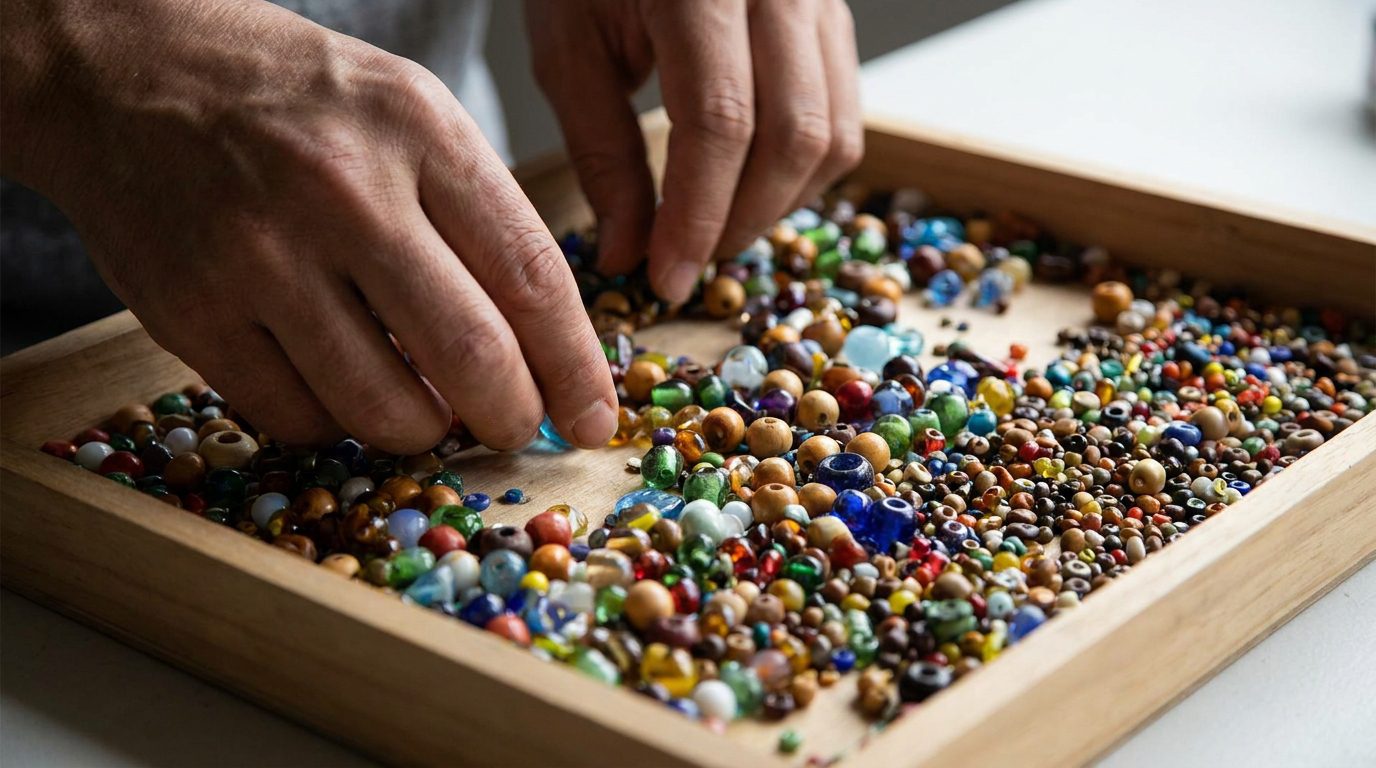
There is something wonderfully human about counting.
A child counts fingers. A shopkeeper counts coins. A student counts steps in a math problem. A devotee counts the holy names on beads. In every case, counting helps the mind become steady, attentive, and clear.
“Mastering Math: The Power of Counting Beads” may sound like a classroom topic, but it also opens a doorway into the heart. Counting beads can support practical math skills, mindful concentration, and spiritual growth. In the Bhakti Yoga tradition, beads are often used for chanting, prayer, and remembrance of God. This simple practice can become a gentle teacher—helping us count, focus, breathe, listen, and love.
Whether you are a parent, student, teacher, spiritual seeker, or simply someone curious about meditation, counting beads can be a beautiful bridge between the head and the heart.
Counting beads is one of the oldest learning tools in the world. Across cultures, people have used beads, stones, knots, shells, and seeds to keep track of numbers, prayers, and intentions.
In Bhakti Yoga, a strand of prayer beads is often called a mala. The Sanskrit word mala means “garland.” A mala is usually used for japa, which means the soft repetition of a sacred name or mantra. A mantra is a sacred sound or prayer that helps focus the mind and awaken the heart.
For example, many practitioners chant the maha-mantra, which means “great mantra”:
Hare Krishna Hare Krishna
Krishna Krishna Hare Hare
Hare Rama Hare Rama
Rama Rama Hare Hare
These names of God are understood in the Bhakti tradition as a direct way to remember and connect with the Divine. “Krishna” means the all-attractive Lord, and “Rama” means the source of spiritual joy. “Hare” is a loving call to the Lord’s divine energy.
But even before someone understands all the philosophy, the practice itself is very accessible: hold a bead, chant or pray, move to the next bead, and continue with attention.
Why Beads Help the Mind Learn
The mind can be restless. It jumps from thought to thought, task to task, worry to worry. Beads give the hands something gentle to do, while giving the mind a clear path to follow.
Each bead becomes one moment of attention.
For math learning, this is powerful. Counting beads turns numbers into something physical and visible. A child can touch “one,” move to “two,” and feel the order of numbers. An older student can use beads to explore grouping, skip counting, multiplication, division, fractions, and patterns.
For spiritual practice, this is equally powerful. Each bead becomes a small offering. Each count becomes a prayer. Each round becomes a journey.
The Beauty of Repetition
Repetition is essential in both math and spiritual life.
In math, we repeat facts and patterns until they become natural. We practice counting by twos, fives, and tens. We repeat multiplication tables. We solve problems again and again until the method becomes clear.
In Bhakti Yoga, we repeat the names of God not because God needs repetition, but because our hearts need remembrance. The Bhagavad-gita, one of the most beloved scriptures of India, encourages steady practice. In Bhagavad-gita 8.7, Krishna teaches that we can remember Him while performing our duties. This means spiritual life is not separate from daily life. It can be woven into ordinary actions—walking, working, studying, serving, and even counting.
How Counting Beads Builds Math Skills
Counting beads can make math feel less abstract and more friendly. Many people struggle with math because numbers can seem distant or intimidating. Beads bring numbers into the hands.
When students can touch and move beads, they can see math happening. This builds confidence.
One-to-One Correspondence
One of the first math skills a child learns is called one-to-one correspondence. This simply means understanding that each object counted matches one number word.
For example:
One bead = “one”
Second bead = “two”
Third bead = “three”
This seems simple, but it is a foundation for all later math. Without this skill, numbers remain memorized sounds rather than meaningful quantities.
Counting beads helps children slow down. They touch one bead at a time. They say one number at a time. They learn that numbers are ordered and connected to real things.
Skip Counting and Multiplication
Beads are excellent for skip counting.
A student can count by twos: 2, 4, 6, 8, 10.
Or by fives: 5, 10, 15, 20, 25.
Or by tens: 10, 20, 30, 40, 50.
This prepares the mind for multiplication. Multiplication is repeated addition. When students group beads into equal sets, they begin to see multiplication as something practical.
For example:
3 groups of 4 beads = 12 beads
5 groups of 6 beads = 30 beads
10 groups of 10 beads = 100 beads
Instead of merely memorizing “5 times 6 equals 30,” the student can see and touch the truth of it.
Division and Sharing
Beads can also teach division in a gentle way.
If there are 20 beads and 4 friends, how many beads does each friend receive?
The student can physically distribute the beads: one for you, one for you, one for you, one for you—again and again—until all are shared. Each person gets 5 beads.
This teaches division as fair sharing. It also quietly teaches kindness. Math becomes not only calculation, but cooperation.
Patterns, Sequences, and Early Algebra
A strand of beads can be arranged by color, size, or shape. This helps students recognize patterns.
Red, blue, red, blue.
Small, small, large, small, small, large.
One, two, four, eight, sixteen.
Patterns are the beginning of algebraic thinking. When children ask, “What comes next?” they are learning to recognize structure.
In a devotional setting, we might also gently notice that creation itself is filled with patterns—the seasons, the moon, the rhythm of breath, the heartbeat, the rising and setting of the sun. Math can help us appreciate the order and intelligence within God’s creation.
The Spiritual Power of Counting Beads
In Bhakti Yoga, counting beads is not only an educational method. It is a sacred practice.
A devotee may use a mala of 108 beads. The number 108 is honored in many spiritual traditions of India. While there are different explanations for its significance, what matters most in practice is sincerity. The beads help us complete a set number of prayers or mantras with care.
What Is Japa?
Japa means repeating a sacred name or mantra, often softly or silently. In Bhakti Yoga, japa is a personal form of prayer. It is a way to spend time with God.
A person may sit quietly, hold the beads, and chant one mantra on each bead. When one round is completed, they may continue or pause for reflection.
Japa is not mechanical counting. The counting supports attention, but the heart of the practice is loving remembrance.
The great Bhakti scripture Srimad-Bhagavatam teaches the importance of hearing and chanting about the Lord. In Srimad-Bhagavatam 1.2.17, it is described that hearing sacred sound cleanses the heart. Practically, this means that when we regularly make time for divine sound, our inner life becomes clearer. We may become more patient, more grateful, more peaceful, and more willing to serve.
The Beads as a Path of Prayer
Each bead can become a step toward God.
Some days our chanting feels focused and joyful. Other days the mind wanders. This is normal. Bhakti Yoga is not about pretending to be advanced. It is about coming sincerely, again and again.
A humble practitioner might pray:
“Dear Lord, please help me remember You.”
“Please guide my mind.”
“Please let me serve with love.”
“Please make my heart soft.”
The beads help us return. When the mind wanders, we gently notice and come back to the next bead, the next mantra, the next prayer.
Counting Without Losing the Heart
There is a gentle warning here. Counting can help us, but it should not make us proud.
In spiritual life, numbers can be useful. A person may chant a certain number of rounds daily. They may keep a vow. They may track their practice. This can be very supportive.
But Bhakti is not about spiritual accounting. God is not impressed by our numbers if our heart is absent. The purpose of counting is to help us remember, not to make us feel superior.
The Bhagavad-gita 9.26 offers a beautiful teaching. Krishna says that if someone offers Him a leaf, a flower, fruit, or water with devotion, He accepts it. The key is devotion—loving intention.
So whether we chant one bead, one round, or many rounds, we can ask: “Am I offering this with love?”
Check out our latest posts at https://thebhaktihouse.org/blog.
Counting Beads as Meditation for Students
Students today carry many pressures. Exams, grades, screens, social expectations, and busy schedules can make the mind feel scattered. Counting beads can be a grounding practice for students of all ages.
It can be used in a spiritual way, a mindfulness way, or as part of math learning. For those who are open to prayer, it becomes especially meaningful.
Focus Before Studying
Before beginning math homework, a student can take one minute with beads.
They may count 10 beads slowly while breathing deeply. Or they may say a short prayer on each bead:
“Please help me learn.”
“Please help me be patient.”
“Please help me do my best.”
This simple pause can reduce anxiety and prepare the mind to concentrate.
In Bhakti Yoga, study itself can become an offering. A student may think, “Let me use my intelligence in a good way. Let me learn so I can serve others.” This transforms education from pressure into purpose.
Reducing Math Anxiety
Many people say, “I’m just not a math person.” Often, this belief comes from fear, shame, or past difficulty.
Counting beads can help soften that fear. Beads are approachable. They do not judge. They invite slow practice.
A student who feels overwhelmed by numbers can begin with something simple:
Count 12 beads.
Make 3 groups of 4.
Make 4 groups of 3.
Notice that both equal 12.
This small discovery can build confidence. Math becomes something to explore, not something to fear.
Learning Patience Through Practice
Math mastery does not usually happen all at once. Spiritual growth also takes time.
Both require patience.
When a student makes a mistake, beads can help them slow down and begin again. When a chanter loses focus, beads help them return. This is a precious life lesson: mistakes are not the end. Wandering is not failure. We can begin again.
In the Bhakti tradition, this quality is connected to humility. Humility does not mean thinking we are worthless. It means being honest, teachable, and dependent on grace.
Practical Ways to Use Counting Beads for Math
Counting beads can be used at home, in classrooms, in homeschool settings, Sunday schools, temple programs, and personal study spaces. The practice can be simple and creative.
You do not need expensive materials. A string of beads, loose beads, buttons, beans, or small stones can work.
Counting from 1 to 108
A traditional japa mala often has 108 beads. This number gives many opportunities for math practice.
Students can count from 1 to 108.
They can count backward from 108 to 1.
They can identify even and odd numbers.
They can find multiples of 2, 3, 4, 6, 9, and 12.
They can divide 108 into equal groups.
For example:
108 ÷ 2 = 54
108 ÷ 3 = 36
108 ÷ 4 = 27
108 ÷ 6 = 18
108 ÷ 9 = 12
108 ÷ 12 = 9
This makes the mala a living math tool.
Building Multiplication Tables
To practice multiplication, students can move beads in groups.
For the 6 times table, count 6 beads at a time:
6, 12, 18, 24, 30, 36.
For the 9 times table:
9, 18, 27, 36, 45, 54.
Students can use different colored markers, small clips, or fingers to separate groups. This visual and tactile method supports memory.
Fractions with Beads
Beads can also help students understand fractions.
If a mala has 108 beads, half is 54.
One third is 36.
One fourth is 27.
Students can see that fractions are parts of a whole. This is especially helpful because fractions can feel confusing when they are only written on paper.
You can ask:
“What is half of this strand?”
“What is one third?”
“How many beads are in three fourths?”
“If we chant 27 beads, what fraction of 108 is that?”
This brings math into real life.
Addition and Subtraction Practice
Loose beads can be used for simple addition and subtraction.
Start with 15 beads. Add 7 more. How many now?
Start with 30 beads. Take away 12. How many remain?
Students can write the equation after they solve it physically:
15 + 7 = 22
30 – 12 = 18
This connects hands-on learning with written math.
The Bhakti Meaning of Numbers and Discipline
In Bhakti Yoga, discipline is not meant to be cold or harsh. It is meant to protect love.
Just as a musician practices scales to express music beautifully, a devotee practices chanting, prayer, and service to express love for God more fully.
Counting beads offers a gentle structure. The structure helps the heart show up.
Sadhana: A Daily Spiritual Practice
A helpful Sanskrit word is sadhana. Sadhana means a regular spiritual practice that helps us grow. It may include chanting, prayer, reading scripture, worship, meditation, and service.
For someone beginning, sadhana may be very simple:
Chant one mantra daily.
Read one verse of scripture.
Offer food with gratitude.
Serve someone with kindness.
Spend five minutes in prayer.
Counting beads can support sadhana because it gives a clear beginning and end. It helps us keep a promise to ourselves and to God.
Seva: Service with Love
Another important Sanskrit word is seva, meaning service. In Bhakti Yoga, service is not just duty. It is love in action.
A child learning math can use that knowledge in service—helping younger siblings, organizing donations, cooking with measurements, managing time, or solving practical problems.
A devotee chanting on beads can carry that prayer into the world through kindness, compassion, and useful work.
The goal is not to escape life, but to spiritualize life.
Smaranam: Remembering God
Smaranam means remembrance of God. Counting beads can support smaranam because each bead gently says, “Remember.”
Remember God in study.
Remember God in work.
Remember God in family life.
Remember God in difficulty.
Remember God in success.
The Bhagavad-gita 6.26 teaches that wherever the restless mind wanders, we can bring it back under the control of the self. Practically, this means we do not have to be discouraged by distraction. Returning is part of the path.
Every bead is a return.
Creating a Sacred Learning Environment
The place where we learn matters. A peaceful environment can help both math study and spiritual practice.
This does not require perfection. A small clean table, a candle, a picture that inspires devotion, a notebook, and a strand of beads can create a meaningful space.
Begin with Gratitude
Before studying or chanting, take a moment to be grateful.
“Thank you for this day.”
“Thank you for the ability to learn.”
“Thank you for teachers, parents, books, and guidance.”
“Thank you for the chance to grow.”
Gratitude opens the heart. It changes the mood from stress to receptivity.
Use Short, Consistent Sessions
For children, short sessions are usually best. Five to ten minutes of bead-based math can be more effective than a long, frustrating lesson.
For spiritual practice, the same principle applies. Begin with what is realistic. One sincere round, or even a few sincere beads, is a beautiful beginning.
Consistency matters more than intensity. A little practice every day can shape the mind and heart over time.
Make It Joyful
Bhakti Yoga is the path of loving devotion. Joy is important.
You can make counting beads joyful with songs, call-and-response chanting, simple games, storytelling, or colorful bead patterns.
Children may enjoy creating their own counting strands. Families may chant together. Teachers may use beads in group activities. Adults may use beads during a quiet morning practice.
The point is not to force devotion or learning. The point is to invite connection.
Lessons Counting Beads Can Teach the Heart
Counting beads teaches more than numbers. It teaches qualities that are valuable for every human being.
Attention
In a distracted world, attention is a sacred gift.
When we give attention to a math problem, we understand more clearly. When we give attention to a person, they feel loved. When we give attention to God, our heart becomes nourished.
Beads train attention gently, one touch at a time.
Humility
Counting beads reminds us that growth happens step by step.
No one masters math in a single lesson. No one becomes spiritually mature in a single day. We are all learners.
Humility allows us to ask for help. It allows us to practice without shame. It allows us to receive grace.
Perseverance
There may be days when math feels hard. There may be days when prayer feels dry. Counting beads helps us keep going.
One bead.
One breath.
One number.
One mantra.
One sincere effort.
This is how transformation often happens—not through dramatic moments, but through faithful small steps.
Love
Ultimately, Bhakti Yoga is about love.
The Sanskrit word bhakti means devotion or loving service to God. It is not limited by age, culture, background, education, or social position. Bhakti is the natural movement of the soul toward the Divine.
Counting beads can support this movement. It can help the mind become steady enough to hear. It can help the heart become soft enough to pray. It can help our daily work become connected to a higher purpose.
Bringing Counting Beads into Daily Life
You do not need to separate “learning time” and “spiritual time” completely. Life can become integrated.
A parent can teach counting with beads and end with a simple prayer.
A student can use beads to practice multiplication and then chant quietly for peace.
A teacher can use beads to help children focus and appreciate patterns.
A devotee can chant japa and become more mindful in practical responsibilities.
A Simple Daily Practice
Here is a gentle practice anyone can try:
Sit comfortably.
Hold your beads or a small set of counters.
Take three slow breaths.
Offer a simple prayer, in your own words.
Count or chant on each bead with attention.
If your mind wanders, kindly return.
End with gratitude.
If you are practicing math, you might count by ones, twos, fives, or tens. If you are practicing japa, you might chant a sacred mantra. If you are new to all of this, you might simply repeat, “Dear God, please guide me.”
For Families
Families can use counting beads as part of a calm evening routine.
A child can practice counting 20 beads.
The family can share one thing they are grateful for.
Everyone can chant or pray together for a few minutes.
Parents can encourage effort rather than perfection.
This creates a home culture where learning and devotion support each other.
For Adults
Adults can also benefit deeply. Many of us live in our heads, rushing from one responsibility to another. Counting beads brings us back into the present moment.
It can become a morning anchor, a lunch break reset, or an evening prayer practice.
Even a few minutes can help us remember: “I am not just a worker, parent, student, or problem-solver. I am a soul, loved by God, invited into relationship.”
The Higher Purpose of Mastery
Mastering math is valuable. Math teaches logic, discipline, problem-solving, and practical skill. It helps us function in the world.
But from a Bhakti perspective, all knowledge reaches its fullness when it helps us love and serve.
The Bhagavad-gita 10.8 explains that Krishna is the source of everything. For a devotee, this means that intelligence, memory, learning, numbers, patterns, and abilities all come from the Divine. When we understand this, learning becomes sacred.
We can pray:
“May my knowledge make me humble.”
“May my skills help others.”
“May my mind be used in service.”
“May my learning bring me closer to God.”
This is the heart of Bhakti education. It does not reject the world. It sees the world as connected to God. It does not reject the mind. It offers the mind in love.
Everyone Can Begin with One Bead
You do not have to be a mathematician to count beads. You do not have to be a monk to chant. You do not have to be born into any particular culture to practice Bhakti Yoga.
The path is open.
If you are a student, begin with one small math practice.
If you are a parent, begin with one gentle moment of shared counting.
If you are a seeker, begin with one sincere prayer.
If you are a devotee, begin again with one attentive bead.
The power of counting beads is not only in the number completed. It is in the sincerity awakened along the way.
Each bead can become a teacher.
Each number can become a step.
Each mantra can become a doorway.
Each prayer can become an offering.
At The Bhakti House, we welcome readers and seekers of all backgrounds. Wherever you are on your journey, you are invited to take one sincere step toward God today—with love, with humility, and with hope.
FAQs
What is the history of counting beads?
Counting beads, also known as an abacus, has a long history dating back to ancient times. It is believed to have originated in Mesopotamia around 2700-2300 BC and has been used in various forms by different cultures around the world.
How does counting beads work?
Counting beads typically consist of a frame with rods and beads that can be moved back and forth. Each bead represents a specific value, and users can manipulate the beads to perform addition, subtraction, multiplication, and division.
What are the benefits of using counting beads?
Counting beads can help improve mathematical skills, including number sense, place value, and arithmetic operations. It also promotes fine motor skills, concentration, and mental calculation abilities.
Are there different types of counting beads?
Yes, there are various types of counting beads, including the traditional wooden abacus, the Chinese suanpan, the Japanese soroban, and modern electronic or digital abacuses. Each type may have different designs and features.
How can counting beads be used in education?
Counting beads are commonly used in educational settings to teach and reinforce mathematical concepts, especially for young learners. They can be used to visually represent numbers, demonstrate mathematical operations, and engage students in hands-on learning activities.

