
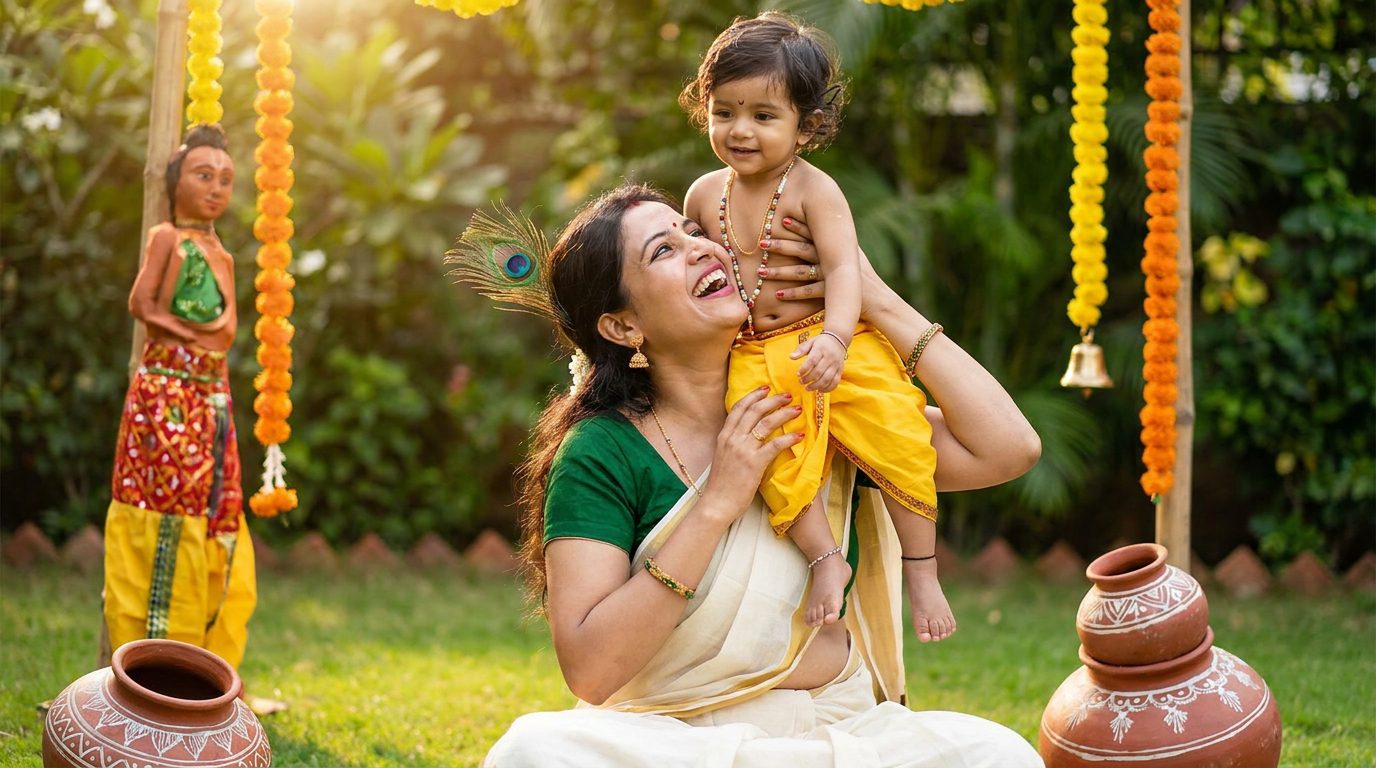
Parenthood is one of life’s most tender and transformative callings. Whether you are holding a newborn for the first time, guiding a curious child through their questions, loving a teenager through change, praying for an adult child, or longing to become a parent, the heart is invited into a deeper kind of love.
In Bhakti Yoga, the path of loving devotion to God, parenthood can become a sacred offering. It is not only about raising a child. It is also about being raised by love—softened, stretched, humbled, and drawn closer to Krishna.
Krishna is a Sanskrit name of God meaning “the all-attractive one.” In the Bhakti tradition, Krishna is loved as the Supreme Person: the source of beauty, kindness, wisdom, playfulness, and divine affection. To love Krishna is to remember that every soul belongs to God, every relationship can become holy, and every act of care can be offered with devotion.
For parents, caregivers, grandparents, mentors, and anyone who nurtures life, Bhakti offers a gentle and practical path: chanting, prayer, service, sacred stories, community, and daily remembrance. You do not need to be perfect. You do not need to know everything. You only need a sincere heart and the willingness to take one step toward divine love.
In Bhakti Yoga, service is called seva. Seva means loving service offered to God and to all living beings as beloved children of God. Parenthood is one of the most intimate forms of seva because it asks us to serve another soul day after day, often in hidden ways.
Changing diapers, cooking meals, listening to worries, setting boundaries, praying through sleepless nights, driving to school, forgiving mistakes, and showing up again and again—these can all become offerings to Krishna.
Seeing the Child as a Soul
Bhakti teaches that we are not merely bodies or personalities. We are atma, eternal souls, spiritual beings connected to God. This simple truth can gently reshape the way we parent.
A child is not our possession. A child is a soul entrusted to our care.
This does not make parenting less personal. It makes it more sacred. We love deeply, but we also remember: “This child belongs to Krishna. I am here to guide, protect, encourage, and serve.”
In the Bhagavad-gita, Krishna explains that He is the source of all living beings and the loving friend of everyone. When parents remember this, it can bring humility and relief. We are not parenting alone. God is present in the heart of the child, and God is present in our heart too.
Service in Ordinary Moments
Many parents wonder, “How can I practice spirituality when my life is so busy?”
Bhakti answers: begin where you are.
You can offer the morning routine to Krishna. You can chant while washing dishes. You can whisper a prayer before a difficult conversation. You can prepare food with love and offer it to God before sharing it with your family. You can breathe deeply and remember Krishna’s name when your patience feels thin.
In Bhakti, ordinary moments become extraordinary when they are offered with love.
The Humility of Caregiving
Parenthood humbles us. It reveals our limits. It shows us where we are impatient, afraid, controlling, or tired. This can feel discouraging, but in spiritual life, humility is not failure. Humility is a doorway.
When we see that we cannot do everything by our own strength, we become more open to grace.
A simple parent’s prayer might be:
“Krishna, please help me love this child in a way that pleases You. Please guide my words, my actions, and my heart.”
This kind of prayer turns parenting into a conversation with God.
Loving Krishna Through Loving Our Children
One of the beautiful truths of Bhakti Yoga is that love expands when it is connected to Krishna. Loving God does not mean loving others less. It means loving them more purely, more patiently, and more wisely.
When we love Krishna, we begin to see our relationships as sacred opportunities. Family life becomes a place where devotion is practiced in real time.
Love Without Possessiveness
Parents naturally feel protective. We want our children to be safe, happy, healthy, and successful. But sometimes love becomes mixed with fear or control. We may begin to think our child’s life must follow our exact plan.
Bhakti invites us into a more spacious love.
We can guide our children with care, but we also learn to trust Krishna’s presence in their journey. We can encourage them, teach them values, and provide structure, while still honoring that they are unique souls with their own relationship with God.
This is not passive parenting. It is devotional parenting. We act responsibly, but we surrender the results.
In the Bhagavad-gita, Krishna teaches the principle of offering our actions without becoming attached to the outcome. For parents, this is deeply practical. We do our best, with love, and then place our children in God’s hands.
Affection as a Reflection of Divine Love
In the sacred Bhakti texts, Krishna’s childhood in Vrindavan is cherished by devotees. Vrindavan is the holy land where Krishna’s loving pastimes are remembered. There, Mother Yashoda and Nanda Maharaja love Krishna not with distant awe, but with intimate parental affection.
Mother Yashoda feeds Krishna, bathes Him, worries about Him, scolds Him, and holds Him close. Though Krishna is the Supreme Lord, He allows Himself to be bound by her love.
This reveals something extraordinary: God is not only great and powerful. God is also tender, approachable, and moved by love.
For parents, remembering Mother Yashoda can be deeply comforting. The affection we feel for our children can remind us of the affectionate nature of Krishna. When we hold a child, soothe a child, or delight in a child’s laughter, we can remember that love itself has a divine source.
Parenting as Heart Training
Children often bring out both our love and our unfinished inner work. A child may trigger impatience, worry, or old wounds. In Bhakti, these moments can become spiritual training.
Instead of thinking, “I am a bad parent because I feel challenged,” we can think, “This is an opportunity to grow in compassion, steadiness, and prayer.”
Bhakti Yoga is not about pretending to be saintly. It is about sincerely turning toward Krishna again and again.
When we apologize to our children, we teach humility. When we forgive them, we teach mercy. When we chant together, we teach remembrance. When we choose kindness after a hard moment, we practice devotion.
Bringing Bhakti Into Family Life
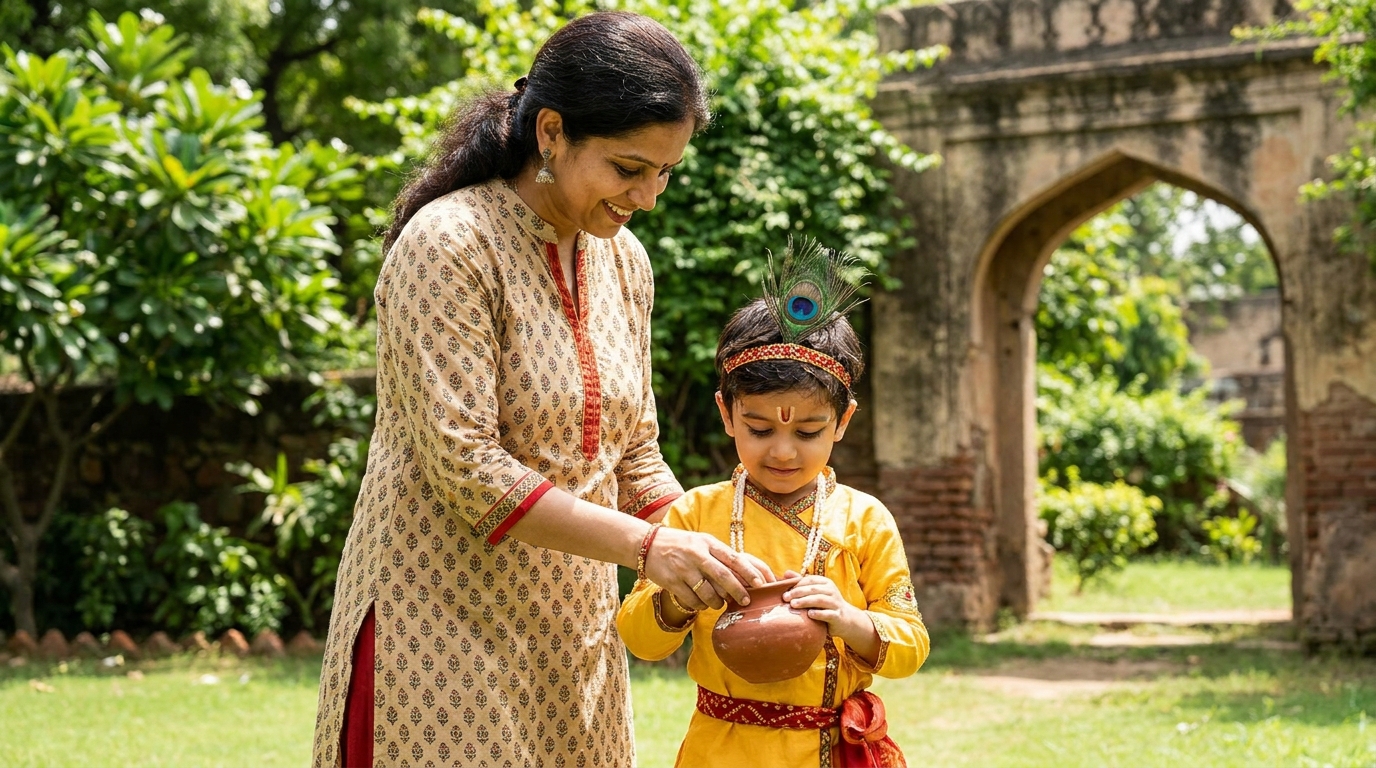
Bhakti Yoga is wonderfully practical. It does not require that every family look the same. Some families are large, some are small. Some are interfaith. Some are new to spiritual practice. Some are navigating grief, separation, adoption, blended family life, infertility, or single parenting.
Krishna meets us with compassion in our real lives.
The goal is not to create a perfect spiritual home. The goal is to create a home where love for God can gently grow.
Chanting the Holy Names
One of the central practices of Bhakti Yoga is chanting the names of God. This is called kirtan when sung together, and japa when softly repeated as a personal meditation, often on beads.
The maha-mantra, or “great mantra,” is:
Hare Krishna Hare Krishna
Krishna Krishna Hare Hare
Hare Rama Hare Rama
Rama Rama Hare Hare
“Hare” calls to God’s divine energy, “Krishna” means the all-attractive Lord, and “Rama” means the source of spiritual joy. Chanting is a prayer: “O Lord, please engage me in Your loving service.”
For families, chanting can be simple and joyful. You might sing for a few minutes before dinner, play kirtan in the car, chant softly while rocking a baby, or invite children to clap and dance.
Children do not need a long lecture to feel devotion. Often, they absorb the mood of love, music, and sincerity.
Prayer in Simple Words
Prayer does not need to be complicated. A parent can pray alone, with a partner, or with children in very simple language.
“Krishna, thank You for this day.”
“Please help us be kind.”
“Please protect our family.”
“Please help us remember You.”
“Please bless those who are suffering.”
“Please guide our hearts.”
When children hear prayer, they learn that they can speak to God personally. They learn that God is not far away. They learn that gratitude, dependence, and compassion are natural parts of life.
Offering Food With Love
In Bhakti, food prepared and offered to Krishna becomes prasadam. Prasadam means “mercy” or “grace.” It is food that has been lovingly offered to God and then received as a blessing.
Parents can make this practice very simple. Before eating, pause for a moment. Place the food before Krishna in your heart, or before a picture or altar if you have one, and say:
“Krishna, please accept this food prepared with love.”
Then share it with your family.
This practice helps children learn gratitude. It also transforms the kitchen into a sacred space. Cooking becomes service, eating becomes remembrance, and family meals become moments of grace.
Sacred Stories at Home
Children love stories, and Bhakti is filled with sacred stories that nourish the heart. Stories from the Srimad-Bhagavatam, Bhagavad-gita, Ramayana, and other devotional texts can teach courage, kindness, faith, humility, and love for God.
The Srimad-Bhagavatam is a beloved Bhakti scripture that shares the qualities, activities, and devotees of the Lord. Its stories are not meant only for information. They are meant for transformation.
A family might read a short story about Krishna and His friends, Prahlada’s faith, Dhruva’s determination, or Mother Yashoda’s love. Afterward, ask gentle questions:
“What did you notice?”
“What do you think Krishna was teaching?”
“How can we practice kindness like this today?”
The goal is not to force religion. The goal is to awaken love.
Please visit our website for more information on our articles: articles.
Learning From Mother Yashoda and Krishna’s Childhood
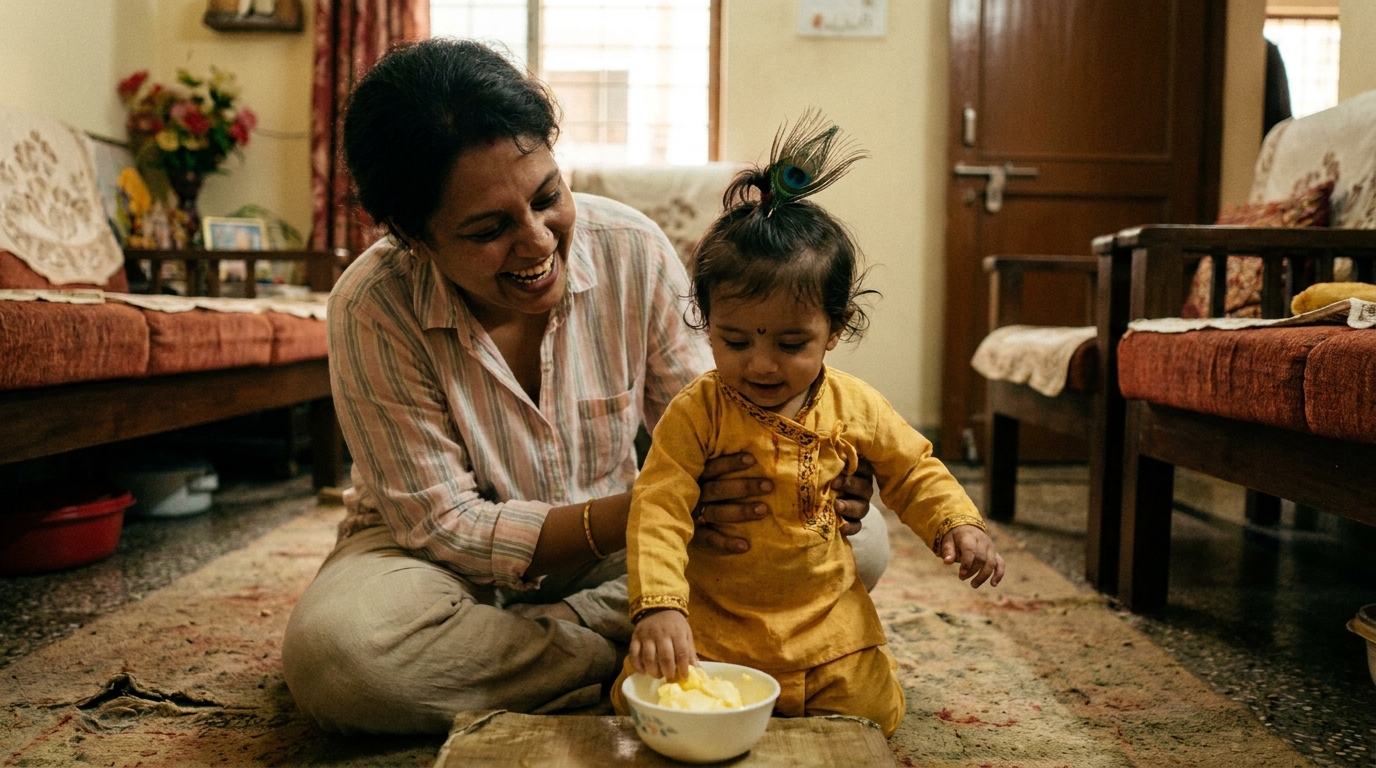
One of the sweetest parts of the Bhakti tradition is the meditation on Krishna as a child. This may be surprising for those from different spiritual backgrounds. Many traditions emphasize God’s majesty, authority, or judgment. Bhakti also honors God’s greatness, but it reveals something intimate: God enjoys loving relationships with His devotees.
In Vrindavan, Krishna is loved as a child by Mother Yashoda. Her love is called vatsalya-rasa, the devotional mood of parental affection. Rasa means a loving spiritual relationship or flavor of devotion.
The Beauty of Vatsalya-Rasa
Vatsalya-rasa shows that parenthood can reflect a sacred mood of love. Mother Yashoda does not love Krishna because He is powerful. She loves Him because He is “her” child. She worries whether He has eaten. She runs after Him when He steals butter. She binds Him with a rope when He is mischievous, not knowing fully that the whole universe rests within Him.
In one famous story from the Srimad-Bhagavatam, Mother Yashoda looks into Krishna’s mouth and sees the entire cosmic manifestation. Yet by Krishna’s loving power, her motherly affection remains. She does not become distant or formal. She continues to love Him intimately.
This teaches us that love is the highest way of knowing God.
What Parents Can Learn From Yashoda
Mother Yashoda’s love is attentive, embodied, and practical. She cooks, cleans, protects, corrects, and delights in Krishna.
Parents can learn from her that devotion is not separate from care. Spiritual life is not only meditation in silence. It is also wiping tears, preparing meals, telling the truth, holding boundaries, singing names of God, and showing affection.
Yashoda’s love also reminds us that God allows Himself to be approached through tenderness. When we care for children with devotion, we are invited into a sacred mystery: the heart becomes a temple.
Making Space for Divine Play
Krishna’s childhood pastimes are full of play. He runs with His friends, herds calves, steals butter, dances, jokes, and brings joy to everyone in Vrindavan.
This matters for parents. Sometimes spirituality can become overly serious, and family life can become overly scheduled. But children often teach us the sacredness of play.
Dancing during kirtan, laughing together, making flower garlands, painting pictures of Krishna, cooking sweets, visiting a temple, walking in nature, or acting out sacred stories can all become devotional play.
In Bhakti, joy is not a distraction from God. Joy can be a way to remember God.
Parenting Through Challenges With Faith
No family life is free from difficulty. Parenthood can include exhaustion, financial pressure, illness, behavioral struggles, anxiety, grief, loneliness, and uncertainty. Some parents carry guilt from past mistakes. Some children struggle in ways parents cannot fix.
Bhakti does not ask us to deny pain. It teaches us to bring pain into relationship with Krishna.
When You Feel Overwhelmed
If you feel overwhelmed, you are not alone. Many loving parents silently wonder if they are doing enough.
In those moments, a very small practice can help.
Pause. Breathe. Place your hand on your heart. Softly chant:
“Krishna, please help me.”
This is real spiritual life.
The Bhagavad-gita teaches that Krishna is present in the heart of all living beings. This means that even in chaos, even in tears, even in exhaustion, Krishna is near.
You may not always feel peaceful immediately. But by turning toward God, you open a channel of grace.
Letting Go of Perfection
There are no perfect parents. There are sincere parents, growing parents, praying parents, learning parents.
In Bhakti, sincerity is more important than performance. Krishna sees the heart. If you make a mistake, you can repair. If you lose patience, you can apologize. If you feel spiritually dry, you can chant one round, one mantra, or one heartfelt prayer.
Children do not need parents who never fail. They need parents who keep returning to love.
This itself is a powerful spiritual lesson.
Guiding Without Forcing
Many parents long for their children to love Krishna or walk a spiritual path. This desire can be beautiful, but it must be held with wisdom.
Bhakti grows best in an atmosphere of affection, authenticity, and freedom. Children may resist if spirituality feels like pressure, shame, or control. But when they see genuine joy, kindness, humility, and devotion, their hearts are more likely to open naturally.
Let your home be a place where Krishna is loved, not weaponized. Let chanting be inviting, not forced. Let questions be welcomed. Let faith be modeled through your character.
A child may remember less of what we said and more of how they felt around our devotion.
Creating a Krishna-Centered Home
A Krishna-centered home does not have to be elaborate. It does not require wealth, perfection, or a certain cultural background. It simply means creating reminders of God’s love and making space for devotional practice.
Every home can become a small ashram. Ashram means a place of spiritual shelter. Your home can be a shelter where people are nourished by prayer, kindness, sacred sound, and service.
A Simple Home Altar
Many Bhakti families keep a small altar with a picture of Krishna, Radha-Krishna, Lord Chaitanya, or other beloved forms of the Divine. Radha is Krishna’s eternal beloved and the highest expression of devotional love. Lord Chaitanya is Krishna appearing in the mood of a devotee, sharing the chanting of God’s names with everyone.
Your altar can be simple: a clean shelf, a picture, a candle, flowers, or a small offering bowl.
Children can help by placing flowers, drawing pictures, or offering a piece of fruit. This helps them experience devotion through their senses and actions.
Daily Rhythms of Remembrance
Small rhythms matter more than occasional intensity. A few daily practices can shape the atmosphere of a home over time.
You might try:
- Chanting one mantra together in the morning
- Offering meals before eating
- Reading one short sacred story at bedtime
- Saying one gratitude prayer each evening
- Playing kirtan while cleaning
- Visiting a temple or Bhakti gathering regularly
- Serving others as a family
These practices are seeds. With patience, they grow.
Family Service Projects
Service helps children understand that love is active. Bhakti is not only personal peace. It is care for others.
Families can serve by preparing prasadam for guests, helping at a temple, feeding people in need, caring for animals, supporting community members, writing encouragement cards, cleaning shared spaces, or offering talents in devotional service.
When children serve, they learn that spirituality is not only what we believe. It is how we live.
Raising Children With Spiritual Values
Bhakti parenting is not about creating an image of a “religious family.” It is about nurturing qualities that help the soul flourish: compassion, honesty, gratitude, humility, self-control, courage, and love for God.
These values are taught most powerfully through example.
Compassion for All Living Beings
Krishna teaches in the Bhagavad-gita that the wise see all beings with equal vision. This means every person, animal, and living being is worthy of respect because every life is connected to God.
Parents can nurture compassion by speaking kindly, caring for animals, avoiding unnecessary harm, and helping children notice the feelings of others.
When a child learns compassion, they are learning to see with spiritual eyes.
Gratitude as a Daily Practice
Gratitude softens the heart. It helps children recognize that life is a gift.
A simple family practice is to ask each day:
“What are we grateful for today?”
Then connect that gratitude to Krishna:
“Thank You, Krishna, for these blessings.”
This does not deny hardship. It trains the heart to notice grace even in ordinary life.
Truthfulness and Forgiveness
Children need to learn honesty, but they also need to know they are loved when they make mistakes. Bhakti teaches that Krishna is merciful. This means we can create homes where truth can be spoken without fear of rejection.
When parents practice forgiveness, children learn that relationships can be repaired. When parents ask forgiveness, children learn humility.
A Krishna-centered home is not one where no one makes mistakes. It is one where love keeps guiding everyone back.
Parenthood Beyond Biology
Not everyone’s experience of parenthood is biological. Some love through adoption, fostering, step-parenting, teaching, mentoring, caregiving, auntie and uncle roles, spiritual guidance, or community support. Some carry the ache of infertility, miscarriage, child loss, or unfulfilled hopes.
Bhakti honors every sincere form of nurturing love.
Spiritual Parenthood
In devotional communities, spiritual care matters deeply. When we encourage someone’s faith, feed them prasadam, teach them to chant, listen to their struggles, or help them take one step toward Krishna, we participate in spiritual nurturing.
This does not replace biological parenthood, but it reveals that the heart’s capacity to parent can be broad and sacred.
Many people need safe, loving guidance. A kind elder, teacher, mentor, or friend can become a channel of Krishna’s care.
Healing the Parent-Child Relationship
Some people come to spirituality carrying pain from their relationship with their parents or children. Bhakti does not minimize this. It invites healing with truth, boundaries, prayer, and time.
Krishna is the perfect well-wishing friend. Even when human relationships are complicated, divine love remains available.
For those grieving or healing, a gentle prayer may be:
“Krishna, please hold what I cannot fix. Please heal what I cannot reach. Please teach me to love with wisdom.”
Sometimes loving Krishna means allowing ourselves to be parented by God—comforted, guided, forgiven, and restored.
Growing as a Parent Through Bhakti Yoga
Parenthood is not only about shaping a child. It shapes the parent too. It can deepen our patience, expose our selfishness, expand our compassion, and teach us surrender.
In Bhakti Yoga, spiritual growth is not measured by how impressive we appear. It is measured by how sincerely we turn toward Krishna and how our hearts become more loving.
Chanting Through the Seasons
There will be seasons when you can chant more. There will be seasons when you can barely chant at all. A parent with a newborn, a caregiver of a child with special needs, or someone working multiple jobs may not have long hours for formal practice.
Please do not be discouraged.
Chant what you can. Offer what you can. Krishna receives sincerity.
Even one sincere repetition of the holy name can be spiritually powerful. The name of Krishna is not ordinary sound. Bhakti scriptures teach that God is present in His holy names. When we chant, we are keeping company with Krishna.
Study That Nourishes, Not Burdens
Reading scripture can support parents with wisdom and perspective. The Bhagavad-gita offers guidance for action, surrender, and devotion. The Srimad-Bhagavatam offers stories and teachings that awaken love for God. The Chaitanya-charitamrita shares the life and teachings of Lord Chaitanya, who spread the chanting of the holy names with deep compassion.
But study does not need to be heavy. Read one verse. Listen to one class. Discuss one idea with your family. Let scripture become nourishment, not another task on a long list.
Ask: “How can I live this today?”
Community Support
Spiritual community is called sanga, association with people who encourage our devotion. Parents need sanga. Children need sanga too.
A loving Bhakti community can help families feel supported, not judged. It can offer kirtan, friendship, shared meals, sacred festivals, mentorship, and examples of devotional living.
The path is easier when walked together.
A Devotional Vision for Parenthood
To embrace parenthood in love for Krishna is to see family life as a sacred field of growth. Every day brings chances to practice patience, surrender, gratitude, forgiveness, and service.
Some days will feel beautiful. Some days will feel messy. Both can be offered.
Krishna does not ask parents to become perfect before approaching Him. He invites us as we are—with tired eyes, full hearts, scattered minds, sincere prayers, and hands busy in service.
If you are a parent, caregiver, mentor, or someone who longs to nurture others, your love can become a path to God. Your home can become a place of remembrance. Your care can become worship. Your struggles can become prayers. Your child can become your teacher in humility, wonder, and unconditional love.
And if you feel you have fallen short, please remember: Bhakti is a path of grace. Begin again. Chant again. Pray again. Serve again. Love again.
Krishna is not far away. He is present in the holy name, in the heart, in sacred scripture, in prasadam, in community, and in the daily opportunities to love.
Wherever you are coming from, whatever your background, whatever your family looks like, you are welcome on this path. Take one sincere step toward God today. Sing one name of Krishna, offer one prayer, serve one person with love, or simply say, “Krishna, please guide me.” That one step matters, and Krishna lovingly meets the heart that turns toward Him.
FAQs
What is the significance of loving Krishna as a parent?
Loving Krishna as a parent is a way for devotees to develop a deep and personal relationship with the deity. It allows them to experience the joy of caring for Krishna as a child and feeling the unconditional love and devotion that comes with parenthood.
How do devotees express their love for Krishna as a parent?
Devotees express their love for Krishna as a parent through various devotional activities such as singing lullabies to Krishna, dressing and decorating Krishna as a child, and engaging in playful interactions with Krishna’s deity form.
What are the benefits of loving Krishna as a parent?
Loving Krishna as a parent allows devotees to experience a sense of intimacy and closeness with the deity. It also helps them cultivate feelings of love, care, and protection, and deepens their understanding of the divine relationship between a parent and child.
Are there specific rituals or practices associated with loving Krishna as a parent?
Yes, there are specific rituals and practices associated with loving Krishna as a parent, such as performing aarti (offering of light), offering food and sweets to Krishna, and participating in special ceremonies and festivals that celebrate Krishna’s childhood pastimes.
How does loving Krishna as a parent fit into the broader practice of Bhakti yoga?
Loving Krishna as a parent is a form of Bhakti yoga, the path of devotion. It allows devotees to express their love and devotion for Krishna through the lens of parental affection, and it is considered a deeply personal and emotional aspect of the devotional practice.

