
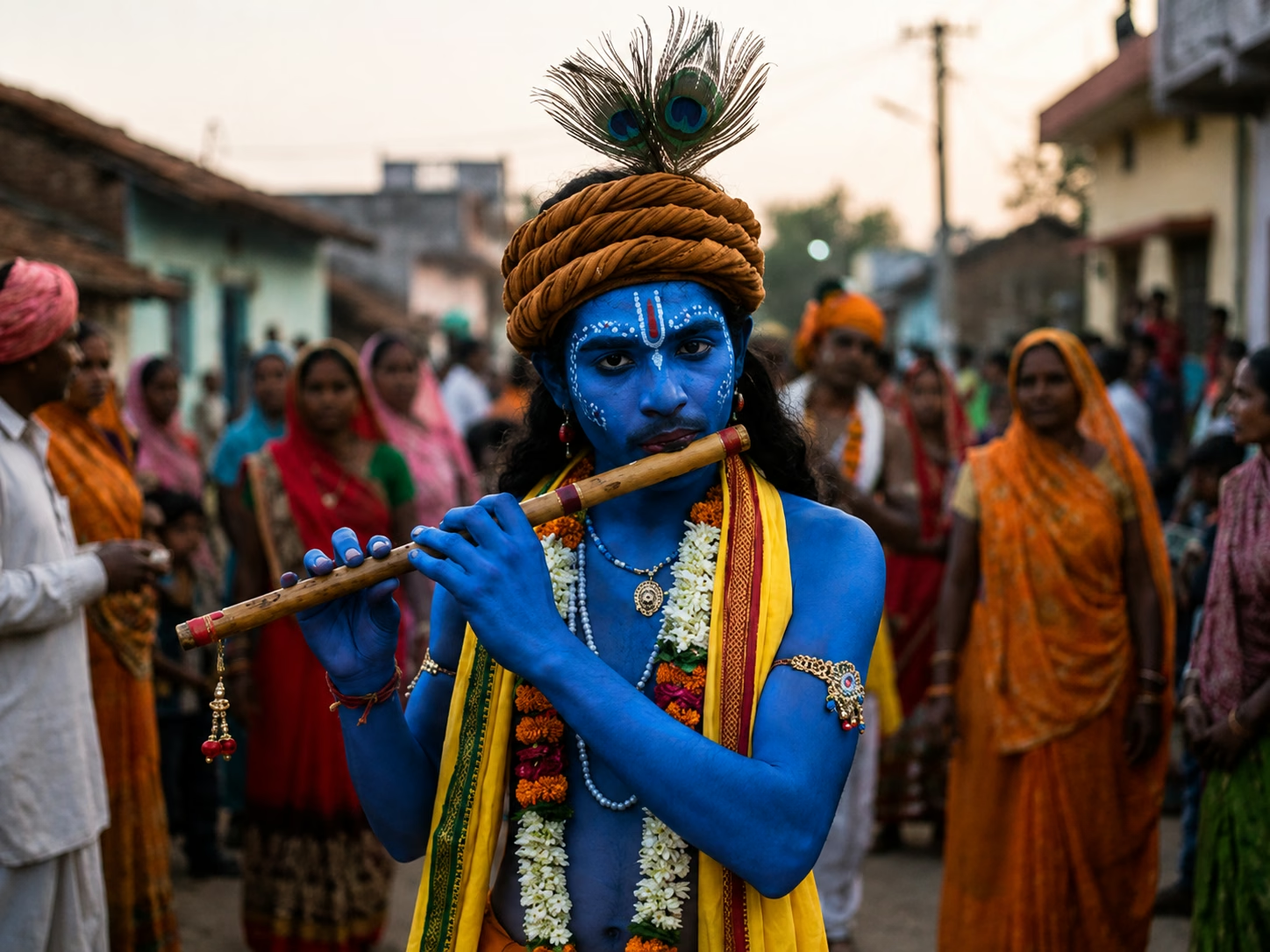
Have you ever felt a quiet longing in your heart — a pull toward something greater, something loving, something that feels like home? Across cultures, across centuries, and across sacred traditions, that longing has a name. In the Bhakti tradition, we know that presence as Krishna — the all-attractive Supreme Person whose love reaches every soul without exception.
At The Bhakti House, we believe that the divine thread of Krishna’s presence weaves through many scriptures and spiritual traditions. You don’t need a degree in theology or years of study to feel His warmth. You just need an open heart. Whether you’re new to spirituality or have been walking this path for years, we hope this exploration encourages you and brings you closer to the One who has always been close to you.
Let’s journey together through the sacred texts and discover how Krishna — the Supreme Personality of Godhead — reveals Himself in ways that are both deeply personal and universally beautiful.
Before we explore the scriptures, let’s start with the most important question: Who is Krishna?
In the Bhakti tradition, Krishna is not simply a mythological figure or a cultural symbol. He is understood as the Supreme Personality of Godhead — the original source of all creation, all love, and all existence. The name “Krishna” comes from the Sanskrit word meaning “the all-attractive one.” He attracts every living being because He is the reservoir of all beauty, all knowledge, all strength, all wealth, all fame, and all renunciation.
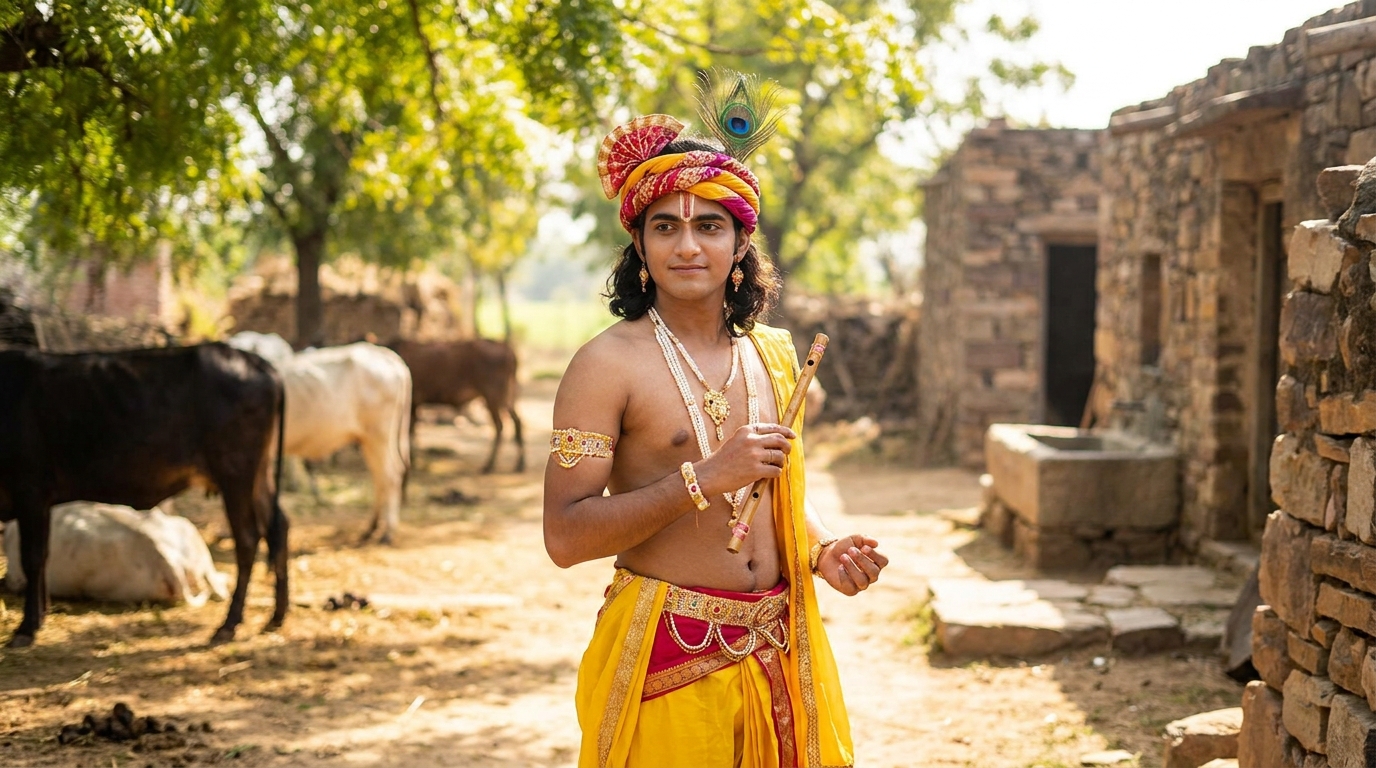
But here’s the truly beautiful part: Krishna is not distant or impersonal. He is a person — the Supreme Person — who desires a loving relationship with each and every one of us. He plays His flute. He tends cows. He dances with His devotees. He speaks heart-to-heart with His dear friend Arjuna on the battlefield of Kurukshetra.
As stated in the Brahma-saṁhitā (5.1):
> “Kṛṣṇa who is known as Govinda is the Supreme Godhead. He has an eternal blissful spiritual body. He is the origin of all. He has no other origin and He is the prime cause of all causes.”
This is the Krishna we lovingly serve, chant to, and meditate upon in Bhakti Yoga.
Krishna’s Presence in the Bhagavad Gita
The Song of God Spoken to Every Heart
The Bhagavad Gita — often called “The Song of God” — is perhaps the most widely known scripture in which Krishna directly reveals Himself. Spoken on the battlefield of Kurukshetra approximately 5,000 years ago, the Gita is a conversation between Krishna and His dear friend and devotee, Arjuna.
What makes the Gita so extraordinary is that Krishna doesn’t just speak about philosophy in abstract terms. He speaks as a loving friend, a wise teacher, and ultimately, as the Supreme Lord who cares deeply about Arjuna’s wellbeing — and ours.
In Bhagavad Gita 4.7, Krishna declares:
> “Whenever and wherever there is a decline in religious practice, O descendant of Bharata, and a predominant rise of irreligion — at that time I descend Myself.” (Bg. 4.7, vedabase.io)
This verse reveals something profoundly comforting: Krishna doesn’t abandon the world. He comes again and again, in age after age, to reestablish dharma (spiritual truth and righteousness) and to protect those who love Him.
Krishna Reveals His Universal Form
In Chapter 11 of the Bhagavad Gita, Krishna reveals His universal form (Viśvarūpa) to Arjuna, showing that everything in creation — every planet, every star, every living being — exists within Him. This awe-inspiring vision demonstrates that Krishna is not limited to one place, one time, or one tradition. He pervades everything.
Yet even after showing this magnificent form, Krishna returns to His gentle, two-armed form as Arjuna’s beloved friend. This beautifully illustrates the Bhakti understanding: God is both infinitely great and intimately personal.
A Promise of Love
Perhaps the most cherished verse of the entire Gita is found in Chapter 18:
> “Abandon all varieties of religion and just surrender unto Me. I shall deliver you from all sinful reactions. Do not fear.” (Bg. 18.66, vedabase.io)
This is not a demand — it is an invitation from a loving heart. Krishna is assuring every soul: “Come to Me. I will take care of you. You have nothing to fear.” This is the essence of Bhakti.
Krishna in the Srimad Bhagavatam: The Ripened Fruit of All Scripture
A Complete Portrait of Divine Love
If the Bhagavad Gita is the introductory conversation, then the Srimad Bhagavatam (also known as the Bhāgavata Purāṇa) is the full, detailed, and deeply intimate portrait of Krishna’s divine pastimes, qualities, and relationships.
The Srimad Bhagavatam is often described as the “ripened fruit of the tree of Vedic literature.” It is considered the natural commentary on the Vedānta-sūtra, and it dives deeply into Krishna’s childhood pastimes in Vrindavan, His loving exchanges with His devotees, and the philosophical understanding of the soul’s eternal relationship with God.
Krishna’s Childhood Pastimes
One of the most beloved sections of the Srimad Bhagavatam describes Krishna’s childhood in Vrindavan. He steals butter from the gopis (the cowherd women), He plays with His friends in the forests, He lifts Govardhana Hill to protect His devotees from a devastating rainstorm, and He enchants everyone with the sound of His flute.
These are not fairy tales. In the Bhakti tradition, they are understood as the eternal pastimes of the Supreme Lord — real, spiritual events that reveal the depth of God’s love and playfulness.
The Essence of Bhakti
In Srimad Bhagavatam 1.2.6, the great sage Sūta Gosvāmī explains the highest dharma:
> “The supreme occupation [dharma] for all humanity is that by which men can attain to loving devotional service unto the transcendent Lord. Such devotional service must be unmotivated and uninterrupted to completely satisfy the self.” (SB 1.2.6, vedabase.io)
This verse is the heartbeat of Bhakti Yoga. Our highest calling is not simply to follow rules or perform rituals, but to develop pure, selfless love for Krishna — love that flows naturally, without material motive, and without interruption.
Sure, here is the sentence with the clickable link:
Check out our website for more articles: more articles.
Krishna’s Presence in the Upanishads and Vedanta
The Ancient Vedic Roots
Long before the Bhagavad Gita and Srimad Bhagavatam were compiled, the Upanishads — the philosophical heart of the ancient Vedas — pointed toward the supreme, personal reality that Bhakti practitioners know as Krishna.
The Upanishads speak of Brahman — the Absolute Truth, the Supreme Reality from which everything emanates. While some traditions interpret Brahman as impersonal, the Bhakti tradition understands Brahman to be ultimately personal. Krishna Himself confirms this in the Bhagavad Gita:
> “And I am the basis of the impersonal Brahman, which is immortal, imperishable and eternal and is the constitutional position of ultimate happiness.” (Bg. 14.27, vedabase.io)
The Gopala Tapani Upanishad
The Gopāla-tāpanī Upaniṣad is a particularly significant Upanishadic text that directly identifies Krishna — specifically as Gopāla, the cowherd boy — as the Supreme Brahman. This text bridges the philosophical depth of the Upanishads with the personal sweetness of Bhakti, showing that the highest truth is not a void or an abstraction but a beautiful, loving person.
The Svetasvatara Upanishad
The Śvetāśvatara Upaniṣad also provides important insights. It describes the Supreme Lord as a person who is the source of all, who is full of knowledge, and who can be known through devotion. Bhakti acharyas (spiritual teachers) have long drawn upon these verses to show that personal devotion to God is not a sectarian idea but the conclusion of the most ancient Vedic wisdom.
Krishna’s Echoes in Traditions Beyond India
A Universal Divine Presence
While Krishna is most explicitly described in the Vedic and Hindu scriptures, many Bhakti practitioners and scholars have observed resonances of His divine qualities in other spiritual traditions. This is not to say that all religions are identical — each tradition has its own beauty, integrity, and revelation. But the Bhakti perspective recognizes that God is one, and that He can reveal Himself to sincere hearts everywhere.
Themes of Divine Love Across Traditions
The Christian mystics spoke of a deeply personal, loving God who desires intimate relationship with the soul. The Sufi poets of Islam — Rumi, Hafiz, and others — wrote ecstatically about the Beloved, using language strikingly similar to the devotional poetry of the Vaishnava saints. The Psalms of the Hebrew Bible overflow with longing, praise, and surrender to a personal, caring God.
Krishna Himself addresses this universal reality in the Bhagavad Gita:
> “All of them — as they surrender unto Me — I reward accordingly. Everyone follows My path in all respects, O son of Pṛthā.” (Bg. 4.11, vedabase.io)
This verse is extraordinary in its inclusiveness. Krishna does not reject anyone. Wherever there is sincere love, sincere seeking, sincere surrender — Krishna is there, responding, reciprocating, guiding.
One God, Many Names
In the Bhakti tradition, we understand that God has unlimited names — Krishna, Govinda, Rama, Hari — and that He is not limited by any single tradition’s understanding of Him. The great Bhakti saint Sri Chaitanya Mahaprabhu taught:
The holy name of the Lord can be chanted at any time, in any place, by any person. There are no hard and fast rules. This generous, open-hearted understanding is one of the most beautiful gifts of the Bhakti path.
Living with Krishna: Practical Bhakti for Everyday Life
Chanting: The Simplest and Most Powerful Practice
Of all the ways to connect with Krishna, the Bhakti tradition emphasizes chanting His holy names as the most accessible and powerful practice for our current age. The Hare Krishna maha-mantra — Hare Krishna, Hare Krishna, Krishna Krishna, Hare Hare / Hare Rama, Hare Rama, Rama Rama, Hare Hare — is a prayer of the heart, a calling out to the divine with love and sincerity.
You don’t need to be perfect. You don’t need to have all the answers. You simply need to call out with sincerity, and Krishna hears you.
Service and Kindness
Bhakti is not only about chanting and prayer — it is also about how we treat one another. When we serve others with compassion, when we share a meal, when we offer a kind word, we are expressing our love for Krishna through His children. Every act of genuine kindness is an act of devotion.
Prayer and Surrender
Prayer in Bhakti is not a formal ritual — it is an honest conversation with God. You can speak to Krishna in your own words, in your own language, from the depths of your own experience. He is not interested in eloquence; He is interested in your heart.
As the great devotee Queen Kuntī prayed in the Srimad Bhagavatam:
> “O Lord of Madhu, as the Ganges forever flows to the sea without hindrance, let my attraction be constantly drawn unto You without being diverted to anyone else.” (SB 1.8.42, vedabase.io)
What a beautiful prayer — to simply ask that our hearts flow naturally toward Krishna, like a river flowing to the ocean.
You Are Welcome Here
If there is one thing we hope you take from this article, it is this: you are welcome on this path. Krishna’s love is not reserved for the learned, the perfect, or the religious elite. It is offered freely to every soul — regardless of background, nationality, past mistakes, or current doubts.
The scriptures we’ve explored today — the Bhagavad Gita, the Srimad Bhagavatam, the Upanishads, and the echoes found across world traditions — all point to the same beautiful truth: God is real, God is personal, and God loves you.
You don’t have to take a giant leap. Just take one sincere step. Chant one round of the holy name. Read one verse of the Bhagavad Gita. Offer one prayer from the heart. Cook a meal with love and offer it to Krishna. Sit quietly and simply say, “Krishna, I’m here.”
He’s been waiting for you.
At The Bhakti House, we walk this path together — imperfectly, humbly, but with genuine love. And we’d be honored to walk alongside you.
Hare Krishna 🙏
FAQs
1. Who is Krishna in different scriptures?
Krishna is a major deity in Hinduism, known as the eighth avatar of the god Vishnu. He is a central figure in the Bhagavad Gita and is revered as a supreme being in various Hindu traditions.
2. In which scriptures is Krishna mentioned?
Krishna is prominently featured in the Mahabharata, particularly in the Bhagavad Gita, where he imparts spiritual wisdom to the warrior Arjuna. He is also mentioned in the Vishnu Purana, Bhagavata Purana, and other Hindu scriptures.
3. What are the different aspects of Krishna in different scriptures?
In different scriptures, Krishna is depicted as a divine lover, a mischievous child, a compassionate friend, and a wise teacher. His multifaceted nature is celebrated in various stories and legends.
4. How is Krishna worshipped in different scriptures?
Krishna is worshipped through various rituals, prayers, and devotional practices in different scriptures. His devotees often engage in singing and dancing, known as kirtan, to express their love and devotion to him.
5. What are the key teachings of Krishna in different scriptures?
Krishna’s teachings emphasize the importance of duty, righteousness, and devotion. In the Bhagavad Gita, he imparts wisdom on the nature of the self, the path to liberation, and the significance of performing one’s duty without attachment to the results.

