

If you are new to Bhakti Yoga, or even if you have been practicing for many years, you may have heard two beautiful words: japa and kirtan.
Both are forms of chanting. Both are ways to remember God. Both are rooted in the ancient devotional tradition of Bhakti Yoga, the path of love and devotion. And both can become steady companions in our daily spiritual life.
Still, many sincere seekers wonder: What is the difference between japa and kirtan? Is one better than the other? Do we need both? Can we practice them even if we are beginners, or if we come from a different faith background?
At The Bhakti House, we believe spiritual practice should be welcoming, practical, and rooted in love. Whether you grew up with Sanskrit mantras or are hearing them for the first time, you are welcome here. Bhakti Yoga is not about external labels. It is about turning the heart toward God with sincerity.
In this article, we will gently explore the difference between japa and kirtan, how each practice works, what scriptures say about sacred chanting, and how you can begin in a simple, meaningful way.
What Is Japa?
Japa means the personal, meditative repetition of a sacred mantra. A mantra is a spiritual sound vibration, often made of names of God, prayers, or words that help focus the heart and mind on the Divine.
In Bhakti Yoga, japa is usually practiced quietly or softly. Many practitioners use prayer beads called a mala. A mala traditionally has 108 beads, and the practitioner chants the mantra once on each bead.
Japa is often done alone. It is intimate, reflective, and steady. You may sit in a quiet room, walk slowly in nature, or chant softly in a sacred space. The goal is not performance. The goal is remembrance.
Japa as Personal Prayer
Japa can be understood as a personal conversation with God.
Sometimes we pray with many words. Sometimes we pray in silence. Japa is like a bridge between the two. We repeat a sacred name or mantra again and again, not because God needs repetition, but because our restless minds need loving redirection.
In the Bhagavad-gita, one of the central scriptures of Bhakti Yoga, Krishna says:
“Of sacrifices, I am the chanting of the holy names.”
— Bhagavad-gita 10.25
This verse points to the power of sacred repetition. In Bhakti Yoga, chanting is not seen as ordinary sound. It is a living spiritual practice that can cleanse the heart, soften pride, and awaken love.
How Japa Is Commonly Practiced
A simple japa practice may look like this:
You sit comfortably with your mala beads.
You take a few breaths and offer a simple prayer, such as, “Dear God, please help me remember You.”
You chant your chosen mantra once on each bead.
You listen carefully to the sound.
When the mind wanders, you gently bring it back.
There is no need to be harsh with yourself. The mind wanders. That is what minds do. Japa teaches us to return, again and again, with humility.
The Mood of Japa
The mood of japa is often inward, quiet, and contemplative.
It helps us notice what is happening inside. We may discover gratitude, longing, distraction, sadness, hope, or love. All of it can be brought into the practice.
Japa is not about pretending to be spiritually advanced. It is about showing up honestly before God.
Some days your japa may feel peaceful. Other days it may feel dry. Both are part of the journey. Just as a relationship grows through regular care, the heart grows through steady chanting.
What Is Kirtan?
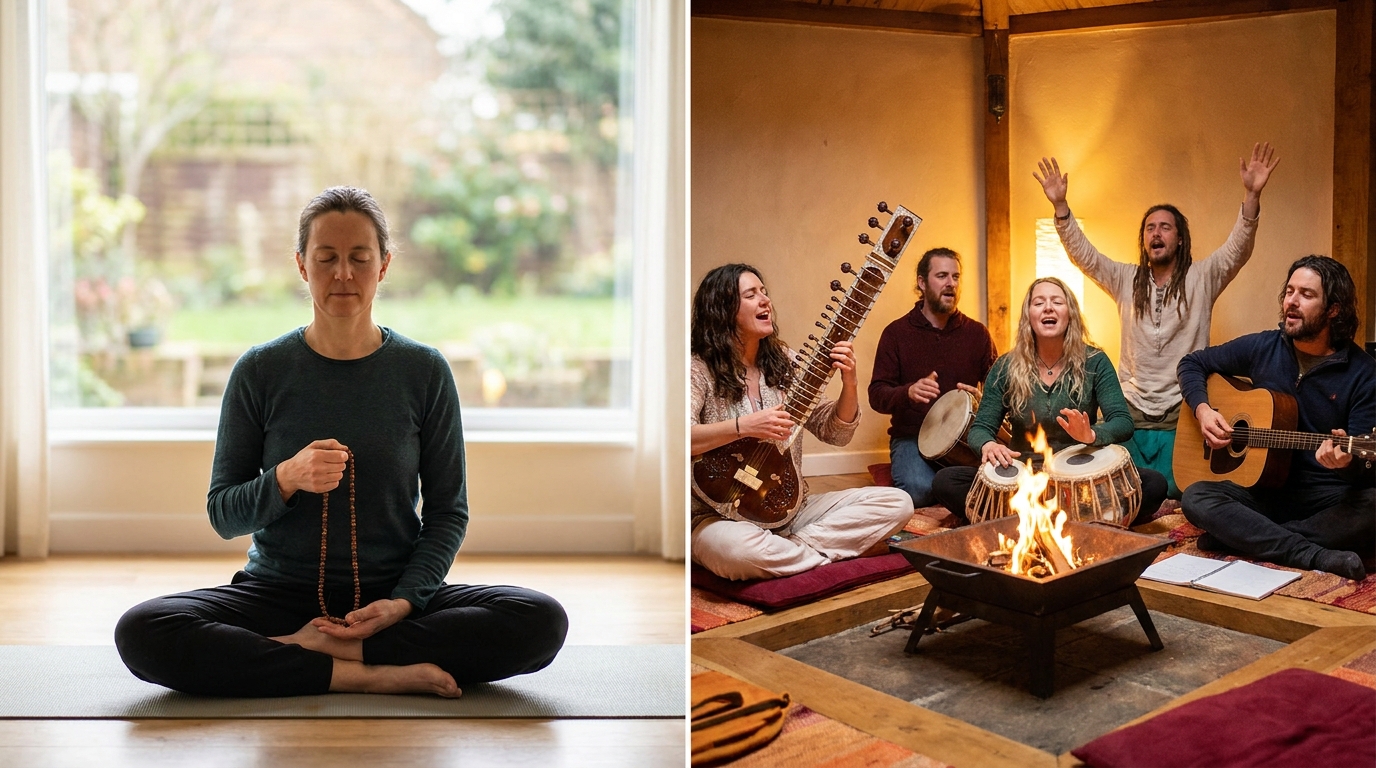
Kirtan means congregational or musical chanting of sacred names. It is usually practiced in a group, often with instruments such as harmonium, mridanga drum, kartals, guitar, or other musical accompaniment.
Kirtan is often call-and-response. One person leads a mantra, and the group responds. The melody may be simple or deeply musical. The atmosphere can be meditative, joyful, emotional, or ecstatic.
While japa is usually personal and quiet, kirtan is shared and expressive.
Kirtan as Collective Prayer
Kirtan is prayer sung together.
In a world where many people feel lonely or disconnected, kirtan brings hearts into harmony. People may come from different cultures, religions, ages, and life experiences, yet they sit together and chant the names of God.
No one needs to be a professional singer. No one needs to know Sanskrit perfectly. In Bhakti, sincerity matters more than musical skill.
The sacred sound carries us. The community supports us. The heart begins to open.
The Meaning of Sankirtan
You may also hear the word sankirtan. This means the congregational chanting of God’s names, especially when done together for the benefit of all beings.
In the Sri Chaitanya tradition of Bhakti Yoga, sankirtan is considered one of the most powerful spiritual practices for this age. Sri Chaitanya Mahaprabhu, a great saint and teacher of divine love, spread the chanting of God’s names widely and invited everyone to participate.
A famous verse from the Brihan-naradiya Purana says:
“In this age, there is no other way, no other way, no other way for spiritual progress than chanting the holy names of the Lord.”
This does not mean other forms of sincere prayer or devotion are rejected. Rather, it emphasizes that chanting is especially accessible. We can chant anywhere. We can chant with others. We can chant even when we feel unqualified.
The Mood of Kirtan
The mood of kirtan is often open-hearted, joyful, and communal.
Kirtan gives permission to participate with the whole self. We may sing softly. We may clap. We may close our eyes. We may cry. We may smile. We may feel awkward at first, and that is completely okay.
Kirtan is not a concert in the ordinary sense. It is not entertainment, though it may be beautiful. It is an offering. The musicians, the singers, and the listeners are all serving the sacred sound together.
Check out our latest articles at https://thebhaktihouse.org/blog.
Japa vs Kirtan: The Main Differences
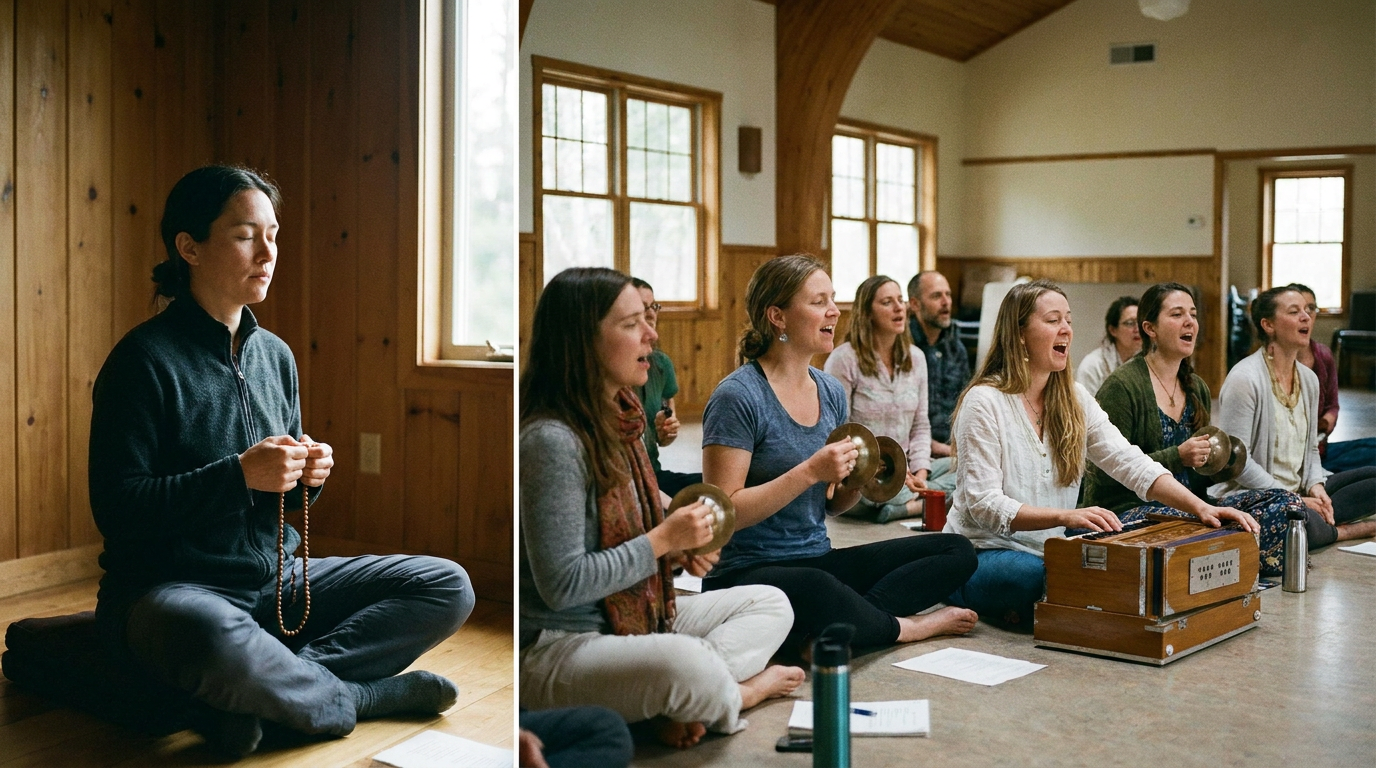
Japa and kirtan are not competitors. They are two expressions of the same devotional heart.
Still, it can be helpful to understand how they differ, especially if you are building a Bhakti Yoga practice.
Japa Is Personal; Kirtan Is Shared
Japa is usually practiced alone. It is a personal discipline that allows you to spend focused time with the mantra.
Kirtan is usually practiced with others. It creates a shared spiritual environment where the group supports each person’s remembrance of God.
Both are valuable. We need quiet personal nourishment, and we also need loving spiritual community.
Japa Is Often Quiet; Kirtan Is Often Musical
Japa may be whispered, spoken softly, or chanted silently in the mind. The emphasis is on attentive repetition.
Kirtan is sung, often with melody and rhythm. The music helps carry the mantra into the heart.
For some people, music opens devotion quickly. For others, quiet repetition brings deeper concentration. Many practitioners find that both are needed.
Japa Builds Daily Discipline; Kirtan Builds Devotional Community
Japa is a beautiful daily anchor. It trains the mind to return to God even when life is busy. A regular japa practice can bring steadiness, clarity, and inner strength.
Kirtan nourishes the heart through association. In Sanskrit, sanga means association or company. In Bhakti Yoga, spiritual company is very important because our hearts are influenced by the people and environments around us.
When we chant together, we remember that we are not alone on the path.
Japa Invites Inner Listening; Kirtan Invites Shared Expression
Japa asks us to listen inwardly. We become aware of the mantra, the breath, the mind, and the heart.
Kirtan invites us to express devotion outwardly. We offer our voice, our presence, our energy, and our willingness to be part of something sacred.
In japa, we may discover the hidden condition of our heart. In kirtan, we may discover the joy of offering that heart in community.
Why Chanting Matters in Bhakti Yoga
Bhakti Yoga is the path of loving devotion to God. The word bhakti means devotion, love, or loving service. It is not only a belief system. It is a way of living, remembering, and relating.
At the center of Bhakti Yoga is the understanding that God is a person, and that the soul’s deepest longing is to love and be loved by the Divine.
Chanting supports this relationship.
Sacred Sound Purifies the Heart
In Bhakti scriptures, the heart is often described as being covered by dust. This dust may include envy, fear, pride, selfishness, anger, and forgetfulness of God.
The chanting of God’s names is compared to a cleansing process.
Sri Chaitanya Mahaprabhu begins His famous Siksastakam, eight verses of spiritual instruction, with these words:
“Glory to the chanting of the holy names, which cleanses the mirror of the heart.”
This is a practical image. A mirror is meant to reflect clearly, but when it is covered with dust, we cannot see properly. Similarly, the soul is naturally loving and connected to God, but our awareness becomes covered.
Through japa and kirtan, the heart gradually becomes clearer.
Chanting Helps the Mind Find Shelter
The mind is often restless. It jumps from memory to worry, from desire to fear, from planning to regret. Many people come to spiritual practice feeling tired from their own thoughts.
Chanting gives the mind a sacred place to rest.
Instead of trying to force the mind into silence, Bhakti Yoga gives it something beautiful to hold: the names of God.
This is both mystical and practical. When we chant, we are not only calming ourselves. We are placing our attention on the Divine, which gradually transforms our consciousness.
The Name and the Named Are Spiritually Connected
In ordinary life, a name and a person are different. If we say “water,” our thirst is not satisfied. But in Bhakti Yoga, the names of God are understood to be spiritually non-different from God.
This is a deep teaching, and it may take time to appreciate. Simply put, when we chant God’s names with sincerity, we are entering the presence of God through sound.
This is why chanting is treated with reverence. It is not merely a technique for relaxation. It is a relationship.
Common Mantras Used in Japa and Kirtan
There are many sacred mantras in the Bhakti tradition. A mantra is received most deeply when practiced with respect, guidance, and sincerity.
One of the most widely chanted mantras in the Bhakti Yoga tradition is the Maha Mantra, which means “the great mantra”:
Hare Krishna Hare Krishna
Krishna Krishna Hare Hare
Hare Rama Hare Rama
Rama Rama Hare Hare
This mantra is made of three sacred names: Hare, Krishna, and Rama.
What Does “Hare” Mean?
“Hare” addresses the divine energy of the Lord, often understood as the compassionate, loving feminine aspect of God. In the Bhakti tradition, Hare is associated with Srimati Radharani, the highest devotee and embodiment of divine love.
When we chant “Hare,” we are calling out for spiritual grace.
What Does “Krishna” Mean?
“Krishna” means “the all-attractive one.” It is a name of God that describes the Divine as endlessly beautiful, loving, wise, and charming.
To chant “Krishna” is to call upon God as the one who attracts the soul back to its true home.
What Does “Rama” Mean?
“Rama” means “the source of spiritual joy” or “the one who gives pleasure.” It also refers to Lord Rama, a beloved form of God known for righteousness, compassion, and noble character.
When we chant “Rama,” we are praying to reconnect with the joy that comes from loving God.
A Simple Prayer Within the Maha Mantra
The Maha Mantra can be understood as a prayer:
“O Lord, O divine energy of the Lord, please engage me in Your loving service.”
This is the heart of Bhakti Yoga. We are not simply asking God to fulfill our desires. We are asking to be transformed into instruments of love.
How to Practice Japa in Daily Life
Japa becomes powerful when it becomes regular. You do not need to begin with a large commitment. Start where you are.
The most important thing is sincerity.
Choose a Time and Place
Many people practice japa in the morning because the mind is often quieter before the day becomes busy. But if morning is difficult, choose a time that works for your life.
A small sacred space can help. It may include a candle, a picture of Krishna, a Bible, a Bhagavad-gita, flowers, or anything that reminds you of God. If you come from another faith background, you are welcome to bring your sincere devotion into the practice.
Bhakti is not about rejecting your heart’s history. It is about deepening your relationship with the Divine.
Begin with a Manageable Commitment
If you are new, you might begin with five minutes a day. Or you might chant one round on a mala, which means chanting the mantra once on each of the 108 beads.
If that feels like too much, start with ten repetitions. God sees the heart.
Over time, your practice may naturally grow.
Listen While You Chant
One of the most important instructions for japa is simple: hear the mantra.
The tongue chants, and the ears listen. The mind may wander, but we gently bring it back to the sound.
Listening turns japa from mechanical repetition into prayerful attention.
Offer Your Distractions Too
Do not be discouraged if your mind wanders. In fact, japa will show us how much the mind wanders. This is not failure. This is awareness.
Each return to the mantra is an act of devotion.
You can pray, “My mind is restless, but I am still here. Please accept this small effort.”
That humility is beautiful.
How to Participate in Kirtan
Kirtan can feel natural for some people and unfamiliar for others. If you are attending your first kirtan, you may wonder what to do, how to sit, when to sing, or whether you will pronounce the words correctly.
Please take heart. Everyone begins somewhere.
You Do Not Need to Be a Singer
Kirtan is not about having a perfect voice. It is about offering the voice you have.
Some people sing loudly. Some sing softly. Some listen quietly at first. All are welcome.
In Bhakti Yoga, intention matters deeply. A simple, sincere response can be more pleasing to God than a polished performance offered with pride.
Follow the Call and Response
Most kirtans follow a call-and-response pattern. The leader sings a line, and the group repeats it.
This makes it easy to join, even if you do not know the mantra. Just listen, then respond as best you can.
Over time, the words become familiar. The melody settles in the heart.
Let the Practice Meet You Where You Are
Sometimes kirtan brings joy. Sometimes it brings tears. Sometimes it brings peace. Sometimes it brings up resistance or self-consciousness.
All of these experiences can be part of healing.
You do not need to force emotion. You do not need to imitate anyone else. Simply be present and let the sacred sound do its gentle work.
Remember That Kirtan Is an Offering
Because kirtan often includes music, it can be easy to treat it like a performance. But the deeper purpose is devotion.
The leader is serving. The musicians are serving. The participants are serving. The room becomes a shared altar of sound.
When we remember this, even a simple chant becomes sacred.
Should You Practice Japa, Kirtan, or Both?
Many people ask whether japa or kirtan is more important. The answer depends on your stage of life, your heart, and your guidance from teachers or spiritual community.
In general, Bhakti Yoga encourages both personal practice and shared practice.
The Balance of Inner and Outer Devotion
Japa gives us private time with God. Kirtan gives us shared time with God’s devotees.
Japa strengthens personal discipline. Kirtan strengthens community and enthusiasm.
Japa helps us go deep. Kirtan helps us open wide.
Together, they support a balanced spiritual life.
When Japa Feels Difficult
Some days, japa may feel hard. The mind may resist quiet practice. We may feel distracted or spiritually dry.
On those days, kirtan can help awaken the heart. Singing with others may restore inspiration and remind us why we practice.
After a powerful kirtan, japa often becomes sweeter.
When Kirtan Feels Overwhelming
For some people, group singing can feel vulnerable or emotionally intense. If you are introverted, anxious, or new to spiritual community, kirtan may take time to feel comfortable.
Japa can be a gentle beginning. You can chant privately and slowly build familiarity with the mantra.
Then, when you feel ready, you might attend kirtan simply as a listener.
A Simple Weekly Rhythm
A practical rhythm might look like this:
Practice japa for a few minutes each day.
Attend kirtan once a week or whenever possible.
Read a small passage from the Bhagavad-gita or another Bhakti scripture.
Offer one act of service to someone.
Say a simple prayer before meals, work, or sleep.
This is Bhakti Yoga in daily life: chanting, prayer, service, remembrance, and love.
The Role of Service in Chanting
In Bhakti Yoga, chanting is not separate from how we live. Sacred sound is meant to soften the heart and inspire loving action.
The Sanskrit word seva means service. In Bhakti, service means offering our time, energy, talents, and care for God and for others.
Chanting Should Make Us Kinder
A simple test of spiritual practice is this: Are we becoming more humble, patient, compassionate, and truthful?
Japa and kirtan are not meant to make us feel superior. They are meant to help us remember that every living being is a child of God.
If chanting makes us proud, we can pray for humility. If chanting makes us tender, grateful, and eager to serve, then the practice is bearing fruit.
Serving the Holy Name
In Bhakti tradition, practitioners often speak of “serving the holy name.” This means approaching the mantra not as something to control, but as a sacred presence to honor.
We serve the holy name by chanting attentively.
We serve by avoiding criticism of others.
We serve by sharing kirtan without pressure or judgment.
We serve by letting the mantra guide our actions.
Bringing Chanting Into Ordinary Life
You can carry the spirit of japa and kirtan into everyday moments.
You can chant softly while cooking.
You can listen to kirtan while driving.
You can pause before a difficult conversation and inwardly repeat God’s name.
You can offer your work as service.
You can turn anxiety into prayer.
Bhakti Yoga is not only for temples or retreats. It is for kitchens, offices, hospital rooms, classrooms, buses, and quiet bedrooms. Wherever the heart turns toward God, that place becomes sacred.
What Scriptures Teach About Chanting
Bhakti Yoga is deeply rooted in sacred texts. These scriptures are not meant to remain only on bookshelves. They are meant to guide real life, real relationships, and real spiritual growth.
The Bhagavad-gita on Devotion
In the Bhagavad-gita, Krishna teaches many paths of yoga, including meditation, wisdom, action, and devotion. Again and again, He emphasizes loving remembrance.
Krishna says:
“Always think of Me, become My devotee, worship Me, and offer your homage unto Me.”
— Bhagavad-gita 18.65
Japa and kirtan help us live this instruction. By chanting God’s names, we practice remembering God not only in theory, but with our voice, ears, mind, and heart.
The Srimad-Bhagavatam on Hearing and Chanting
The Srimad-Bhagavatam, also called the Bhagavata Purana, is a treasured Bhakti scripture filled with stories, prayers, and teachings about devotion.
It describes hearing and chanting about God as essential practices. In Sanskrit, hearing is sravanam, and chanting is kirtanam.
These are listed among the nine practices of devotional service:
hearing about God, chanting God’s names, remembering God, serving God, worshiping, praying, becoming a servant, becoming a friend, and surrendering everything.
This shows that chanting is part of a complete life of devotion.
Sri Chaitanya’s Teaching on Humility
Sri Chaitanya Mahaprabhu taught that one can chant constantly when one develops humility. In the Siksastakam, He says:
“One should chant the holy name of the Lord in a humble state of mind, thinking oneself lower than a blade of grass, more tolerant than a tree, free from false pride, and ready to offer respect to others.”
This is one of the most practical teachings in Bhakti Yoga.
Chanting is not just sound. It is also character. The more we chant sincerely, the more we are invited to become humble, forgiving, respectful, and loving.
Common Questions About Japa and Kirtan
Many sincere people have questions when beginning. Questions are welcome. Bhakti grows through honest inquiry.
Can I Chant If I Am Not Hindu?
Yes. Bhakti Yoga welcomes sincere seekers of all backgrounds.
The names of God are not limited by nationality, ethnicity, or religious label. If you come with respect, humility, and openness, you are welcome to chant.
Many people from Christian, Jewish, Muslim, Buddhist, interfaith, spiritual-but-not-religious, and secular backgrounds have found nourishment in kirtan and japa. You do not need to erase your past to begin. You can simply take one sincere step.
Do I Need a Guru to Chant?
A guru is a spiritual teacher who guides us toward God. In the Bhakti tradition, receiving guidance from authentic teachers is very important, especially as one deepens in practice.
At the same time, anyone can begin chanting God’s names sincerely. You can start with humility and prayer, and as your practice grows, you may naturally seek trusted guidance.
The path unfolds step by step.
What If I Do Not Understand Sanskrit?
Understanding helps, but the power of sacred sound does not depend only on intellectual knowledge.
Still, it is good to learn the meaning of what we chant. When we understand that the Maha Mantra is a prayer for loving service, our chanting becomes more heartfelt.
Pronunciation may improve over time. Sincerity can begin today.
Is Chanting Meditation?
Yes, chanting can be a form of meditation. In japa, the mantra becomes the focus of attention. In kirtan, the music and group response help the mind rest in sacred sound.
But in Bhakti Yoga, chanting is more than mindfulness. It is relational. We are not only watching the mind. We are calling out to God.
What If I Feel Nothing?
This is very common. Please do not be discouraged.
Spiritual growth is often gradual. A seed does not become a tree overnight. Water it daily, give it sunlight, and be patient.
Sometimes the benefits of chanting appear quietly: a little more peace, a little more patience, a softer heart, a clearer conscience, a desire to serve.
These are precious signs of grace.
Practical Tips for Deepening Your Chanting
Whether you are practicing japa, joining kirtan, or doing both, a few simple habits can help.
Create a Sacred Intention
Before chanting, pause and offer your practice.
You might pray:
“Dear God, please help me chant with sincerity.”
“Please let this practice purify my heart.”
“Please guide me toward love and service.”
A sincere intention turns chanting from routine into relationship.
Avoid Comparing Your Practice
Comparison can steal joy.
Someone else may chant more rounds, sing more beautifully, know more scripture, or appear more advanced. But God sees your unique journey.
Your offering matters.
Bhakti is not a competition. It is a path of love.
Chant with the Body, Mind, and Heart
Let your posture be respectful but comfortable.
Let your ears hear the mantra.
Let your mind return when it wanders.
Let your heart offer whatever it can.
Some days you may offer devotion. Some days you may offer struggle. Both can be sacred when offered honestly.
Keep Good Association
Spiritual community matters. Being around people who value chanting, prayer, service, and humility can strengthen your own practice.
This does not mean we reject others. It means we intentionally nourish the part of ourselves that longs for God.
Kirtan gatherings, study groups, temple programs, retreats, and devotional friendships can all help us stay inspired.
Japa and Kirtan as a Path of Love
At their heart, japa and kirtan are not techniques to master. They are invitations to love.
Japa invites us to sit with God personally.
Kirtan invites us to sing with God’s family.
Japa teaches steadiness.
Kirtan teaches shared joy.
Japa reveals the inner heart.
Kirtan opens the heart outward.
Both practices remind us that we are more than our worries, roles, wounds, or achievements. We are souls, beloved by God, meant for loving relationship.
In a noisy world, chanting gives us sacred sound.
In a distracted world, chanting gives us focus.
In a lonely world, chanting gives us connection.
In a restless world, chanting gives us shelter.
And in a world hungry for love, chanting helps awaken the love already resting within the soul.
Taking Your First Sincere Step
If you are wondering where to begin, begin simply.
You might chant the Maha Mantra once a day.
You might attend a local kirtan and simply listen.
You might hold mala beads for the first time and offer one quiet prayer.
You might read one verse from the Bhagavad-gita and ask, “How can I live this today?”
You might serve someone with kindness and silently offer that service to God.
Please remember: Bhakti Yoga is not about being perfect. It is about being sincere. God is not far away from the humble heart.
Whether you are drawn to quiet japa, joyful kirtan, or both, you are welcome. Come as you are. Bring your questions, your hopes, your doubts, your longing, and your voice.
Everyone is welcome to take one sincere step toward God.
FAQs
What is Japa?
Japa is a meditative practice in Hinduism, Buddhism, and Jainism that involves the repetition of a mantra or divine name. It is often done using a mala, a string of prayer beads, and is considered a form of meditation and devotion.
What is Kirtan?
Kirtan is a form of devotional chanting in Hinduism, Sikhism, and other Indian religions. It involves singing or chanting mantras, hymns, and other spiritual songs in a call-and-response style, often accompanied by musical instruments.
How do Japa and Kirtan differ in practice?
Japa is a solitary practice, typically done in a quiet and meditative setting, where the practitioner repeats a mantra or divine name silently or softly. Kirtan, on the other hand, is a communal practice, often performed in a group setting, where participants sing or chant together in a call-and-response format.
What are the benefits of Japa?
Japa is believed to have numerous benefits, including calming the mind, increasing focus and concentration, and deepening one’s spiritual connection. It is also thought to purify the mind and help cultivate inner peace and contentment.
What are the benefits of Kirtan?
Kirtan is said to have similar benefits to Japa, such as promoting a sense of unity and harmony, uplifting the spirit, and fostering a sense of community and connection. It is also believed to be a powerful tool for self-expression and emotional release.

