
Entering the Sacred Mood of Jagannath Puri
Jagannath Puri, often simply called Puri, is one of India’s most beloved spiritual destinations. Resting on the eastern coast of Odisha beside the Bay of Bengal, this ancient city is cherished as the home of Lord Jagannath, “the Lord of the Universe.” For countless pilgrims, seekers, saints, artists, and travelers, Puri is not only a place on a map—it is a living experience of devotion.
In the Bhakti tradition, the word bhakti means loving devotion to God. It is a path of the heart, expressed through prayer, chanting, service, remembrance, and sincere living. Jagannath Puri embodies this mood beautifully. Here, devotion is not hidden away in books or rituals alone. It is sung in the streets, cooked in temple kitchens, carried in wooden chariots, offered in simple prayers, and shared as sacred food.
People from many backgrounds come to Puri. Some arrive with deep faith. Some come with curiosity. Some are drawn by history, architecture, culture, or the sea. Some come quietly, carrying grief, questions, or hope. Jagannath welcomes all. His very form—with wide eyes, open arms, and a mysterious smile—seems to say that divine love is vast enough for every soul.
The sacred city is one of the four great Char Dham pilgrimage sites of India, along with Badrinath, Dwarka, and Rameswaram. Dham means a holy abode, a place where the presence of God is especially felt. For Vaishnavas, devotees of Lord Vishnu and Krishna, Jagannath Puri is especially dear because Lord Jagannath is understood as a merciful form of Lord Krishna, accepting the loving service of His devotees in a unique and intimate way.
To walk through Puri is to enter a world where spirituality and daily life meet. Temple bells ring in the distance. Devotees chant “Jai Jagannath!” with warmth and reverence. The scent of incense, ocean air, and temple food fills the atmosphere. The sound of kirtan—devotional singing—rises from homes, ashrams, and streets. Every corner seems to whisper: remember God, serve with love, and take one more step on the path of devotion.
The Spiritual Significance of Lord Jagannath
Lord Jagannath is one of the most recognizable and beloved forms of the Divine in India. His large round eyes, simple wooden form, and vibrant presence are unlike any other deity form. To some, He may appear unusual at first. Yet for devotees, His form is filled with deep spiritual meaning.
The Meaning of Jagannath
The Sanskrit word Jagannath comes from two words: jagat, meaning “universe,” and nath, meaning “Lord” or “protector.” Jagannath therefore means “Lord of the Universe.” This name reminds us that God does not belong to one community, caste, nation, or type of person. He is the Lord of all beings.
In the temple at Puri, Lord Jagannath is worshiped with His brother Balabhadra and His sister Subhadra. Their presence together is tender and family-like. For many devotees, this is one of the sweetest aspects of Puri: God is worshiped not only in majesty but also in relationship.
Bhakti Yoga invites us into relationship with the Divine. We may approach God as our Lord, friend, beloved, child, or shelter. In Puri, Jagannath’s open-eyed gaze feels personal. He sees us completely, and still He accepts us.
Jagannath and Lord Krishna
In many Bhakti traditions, Lord Jagannath is understood to be Lord Krishna in a deeply compassionate and ecstatic form. Krishna, whose name means “all-attractive,” is described in the Bhagavad Gita and Srimad Bhagavatam as the Supreme Person who lovingly responds to the devotion of His devotees.
The Srimad Bhagavatam, a sacred text of Bhakti Yoga, teaches that hearing and chanting about the Lord purifies the heart. This is not merely a theological idea. In practice, when we sing God’s names with sincerity, our hearts gradually soften. We remember what matters. We become more humble, grateful, and loving.
Lord Jagannath’s form expresses this spiritual truth in a powerful way. His arms appear incomplete, yet He embraces the whole universe. His eyes do not blink, as if He is always watching over His children. His smile is simple, generous, and mysterious. He is not distant. He is near.
The Lord Who Comes Out to Meet Everyone
One of the most beautiful aspects of Jagannath worship is that during the annual Ratha Yatra, the Lord leaves the temple and comes out onto the streets. This is deeply meaningful. In many temples, only certain people may enter the inner sanctum, and in Puri, the main Jagannath Temple has traditional entry restrictions. But during Ratha Yatra, Lord Jagannath comes outside for all to see.
This reveals the heart of Bhakti: God is not unreachable. He comes toward us. Even if we feel unqualified, distracted, or spiritually inexperienced, divine grace can meet us where we are.
For this reason, Jagannath is often called Patita Pavana, “the purifier of the fallen.” Patita means fallen or struggling, and pavana means purifier. The name is not meant to shame us. It is meant to comfort us. All of us struggle in some way. Jagannath’s mercy is especially for those who humbly seek shelter.
The History and Heritage of Jagannath Puri
Puri’s heritage is layered with ancient devotion, royal patronage, temple culture, scriptural memory, and living tradition. Its history cannot be understood only through dates and dynasties. It must also be understood through songs, festivals, offerings, and the faith of millions.
Ancient Roots of the Sacred City
Puri has been known by several names in sacred literature and tradition, including Purushottama Kshetra, Shankha Kshetra, and Nilachala. Purushottama is a name of the Supreme Lord, meaning “the Supreme Person.” Kshetra means a holy field or sacred place. Thus, Purushottama Kshetra means “the sacred abode of the Supreme Lord.”
The name Shankha Kshetra refers to the conch-shell shape associated with Puri’s sacred geography. In Hindu worship, the conch is a symbol of purity, auspiciousness, and divine sound. Nilachala means “Blue Mountain” or “Blue Hill,” and is another traditional name for the sacred area where Lord Jagannath resides.
The city has been a major pilgrimage center for centuries. Saints, philosophers, poets, kings, and common people have all been drawn here. The temple’s worship tradition includes influences from tribal devotion, Vedic ritual, Vaishnava theology, and regional Odia culture. This gives Puri a rare spiritual richness.
The Jagannath Temple and the Ganga Dynasty
The present Jagannath Temple is widely associated with King Anantavarman Chodaganga Deva of the Eastern Ganga dynasty, who began its construction in the 12th century. Later rulers contributed to its completion and expansion. The temple became not only a religious center but also a cultural and social heart of Odisha.
The temple’s towering structure rises above Puri as a landmark of devotion. Built in the Kalinga style of architecture, it includes the main sanctum, assembly halls, and surrounding shrines. The temple complex is enclosed by massive walls and contains many sacred spaces connected with Jagannath’s daily worship.
What makes the temple heritage especially remarkable is that worship has continued in an unbroken flow. Every day, priests, cooks, musicians, servants, pilgrims, and local residents participate in a rhythm of devotion that has been preserved across generations.
Sri Chaitanya Mahaprabhu in Puri
For followers of Gaudiya Vaishnavism, Puri is deeply connected with Sri Chaitanya Mahaprabhu, the 15th–16th century saint and avatar who spread the chanting of the holy names of God, especially the Hare Krishna maha-mantra:
Hare Krishna Hare Krishna
Krishna Krishna Hare Hare
Hare Rama Hare Rama
Rama Rama Hare Hare
Mantra means a sacred sound that helps free the mind and awaken the heart. The Hare Krishna mantra is a prayer asking to be engaged in loving service to God.
Sri Chaitanya spent many years in Jagannath Puri, absorbed in ecstatic devotion to Krishna. He would see Lord Jagannath not as a distant deity but as His beloved Lord Krishna. His life in Puri shows us that the highest spirituality is not dry or cold. It is alive with longing, humility, tears, song, friendship, and love.
The Chaitanya Charitamrita, a revered biography and theological text, describes Mahaprabhu’s deep devotion before Lord Jagannath and His ecstatic participation in Ratha Yatra. For modern seekers, this history offers a simple invitation: spiritual life is not about becoming proud or perfect. It is about becoming sincere, softened, and willing to love.
Discover a wealth of knowledge by exploring our insightful articles. Our articles cover a wide range of topics to inspire and educate. Stay informed and engaged by reading our latest articles.
The Jagannath Temple: Heart of Puri
The Jagannath Temple is the spiritual center of Puri. Even from outside its walls, one can feel its presence. The temple’s flag waves high above the city, and devotees bow their heads when they see the chakra, the sacred wheel symbol mounted on top.
Temple Architecture and Sacred Atmosphere
The main temple tower, called the vimana or deul, rises majestically above the sanctum where Lord Jagannath, Balabhadra, and Subhadra are worshiped. The temple complex includes several halls used for worship, offerings, and gatherings.
One of the striking features of the temple is the Nila Chakra, a metal wheel placed at the top of the temple. Chakra means wheel or discus, and it is associated with Lord Vishnu. The temple flag, changed daily by dedicated servants, is considered highly sacred. Many pilgrims offer respects from a distance simply by seeing the flag and chakra.
The temple is not only an architectural monument. It is a living home of the Lord. Every day, the deities are awakened, bathed, dressed, fed, honored, and offered rest. This daily care is called seva, meaning loving service. In Bhakti Yoga, seva is central. We grow spiritually by serving God, serving devotees, and serving all living beings with compassion.
The Deities of Jagannath, Balabhadra, and Subhadra
The three main deities are made of sacred wood and are periodically renewed in a special ceremony called Nabakalebara, meaning “new body.” This rare event occurs according to the traditional calendar, when the deities are ceremonially transferred into new wooden forms. The mystery and reverence surrounding Nabakalebara reflect a profound truth: the Divine appears in material form out of compassion, yet remains eternally spiritual.
Lord Jagannath stands with His brother Balabhadra, who is associated with strength, protection, and spiritual support. Their sister Subhadra stands between Them, radiating auspiciousness and grace. The family-like form of worship invites devotees to approach with affection.
In a world where many people feel lonely or disconnected, this sacred family offers comfort. Bhakti reminds us that we are not spiritually orphaned. We belong to God, and God lovingly receives us.
Darshan: Seeing and Being Seen
A central part of temple worship is darshan. This Sanskrit word means “sacred seeing.” In ordinary seeing, we look at something. In darshan, we come before the Lord with reverence, and we are also seen by Him.
Even if one cannot enter the main temple due to traditional rules, the mood of darshan is still available. Many offer prayers from outside, visit nearby temples, chant on the beach, or honor Jagannath in their hearts. The Lord’s mercy is not limited by walls.
For those who do enter, darshan can be intense and unforgettable. The crowds may be large, the movement quick, and the experience overwhelming. Yet even a brief glimpse can remain in the heart for a lifetime. Sometimes spiritual life begins with one moment of sincere seeing.
Mahaprasad: The Sacred Food of Lord Jagannath
One of the greatest treasures of Jagannath Puri is Mahaprasad, the sacred food offered to Lord Jagannath and then shared with devotees. Prasad means mercy or grace. It refers to food that has first been offered to God with love. Mahaprasad means “great mercy.”
The Temple Kitchen
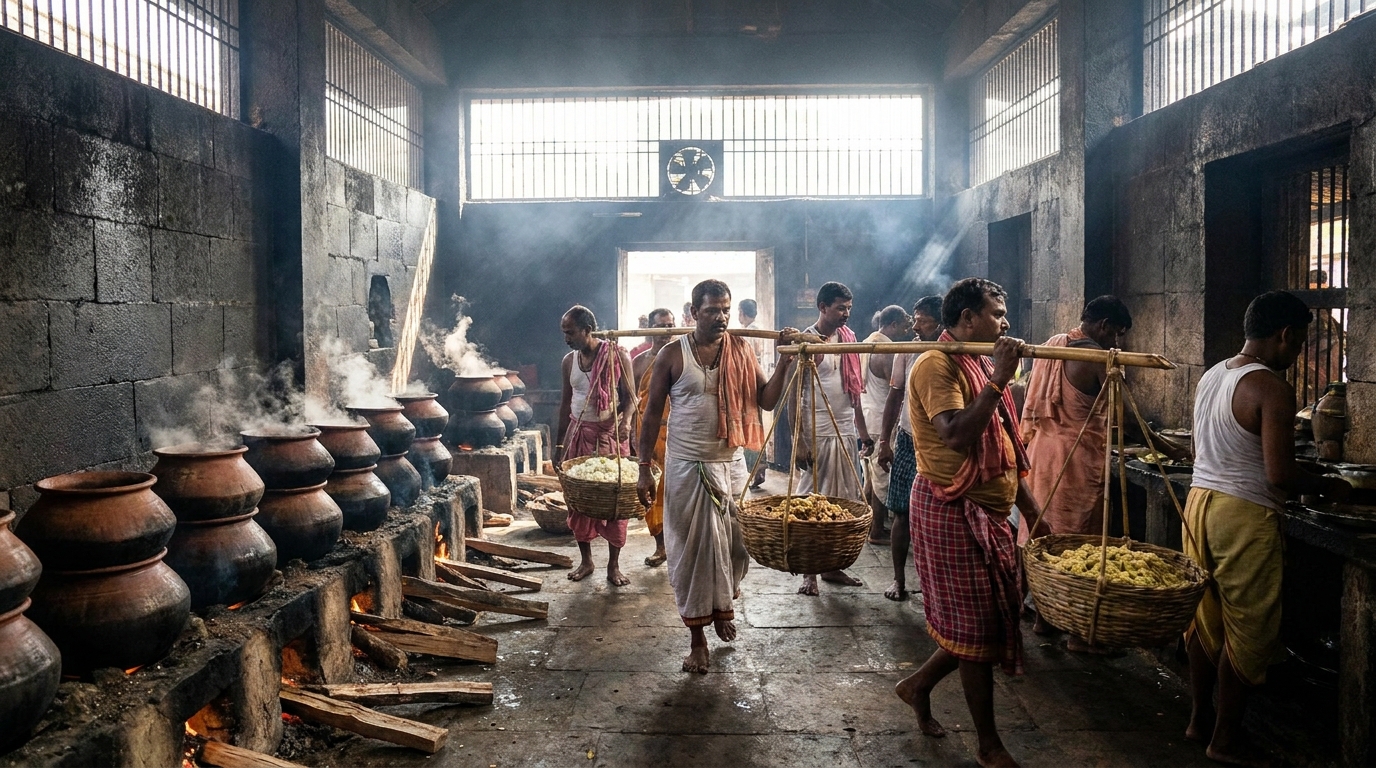
The kitchen of the Jagannath Temple is famous as one of the largest sacred kitchens in the world. Traditional accounts describe hundreds of cooks and helpers preparing many varieties of rice, dal, vegetables, sweets, and other offerings in earthen pots over wood-fired ovens.
The cooking is done according to ancient methods and devotional standards. The food is not merely prepared as a meal. It is cooked as an offering of love. This is an important teaching for all of us. In Bhakti Yoga, even ordinary actions can become sacred when offered to God. Cooking, cleaning, working, parenting, studying, and serving can become spiritual practices when done with devotion.
The Bhagavad Gita offers a simple and beautiful teaching: “If one offers Me with love and devotion a leaf, a flower, fruit, or water, I accept it.” The heart of the offering matters. Jagannath accepts the love of His devotees and returns that love as prasad.
Anand Bazaar and Sharing Mercy
Within the temple area, Mahaprasad is distributed and sold in a place known as Anand Bazaar, meaning “the market of bliss.” Devotees sit together and honor the sacred food. In Jagannath culture, Mahaprasad has a unique power to bring people together.
Food is one of the most practical ways love is shared. When we receive prasad, we are reminded that nourishment comes from God. We are not independent owners of the earth. We are caretakers, receivers, and servants. This attitude can transform how we eat and how we live.
Even outside Puri, anyone can practice this principle. Prepare vegetarian food with gratitude, offer it to God with a simple prayer, and then honor it as grace. This small daily act can bring peace into the home and devotion into the heart.
The Theology of Sacred Eating
In Bhakti, eating is not rejected as material or sinful. Rather, it is purified through offering. The tongue is powerful. It can pull us toward craving, gossip, and distraction, or it can help us grow spiritually through chanting and honoring prasad.
Jagannath Puri teaches us to spiritualize the senses. We use our voice to chant, our hands to serve, our eyes for darshan, our ears to hear sacred wisdom, and our tongue to taste prasad. This is practical Bhakti Yoga: not escaping life, but offering life.
Ratha Yatra: The Festival of the Chariots
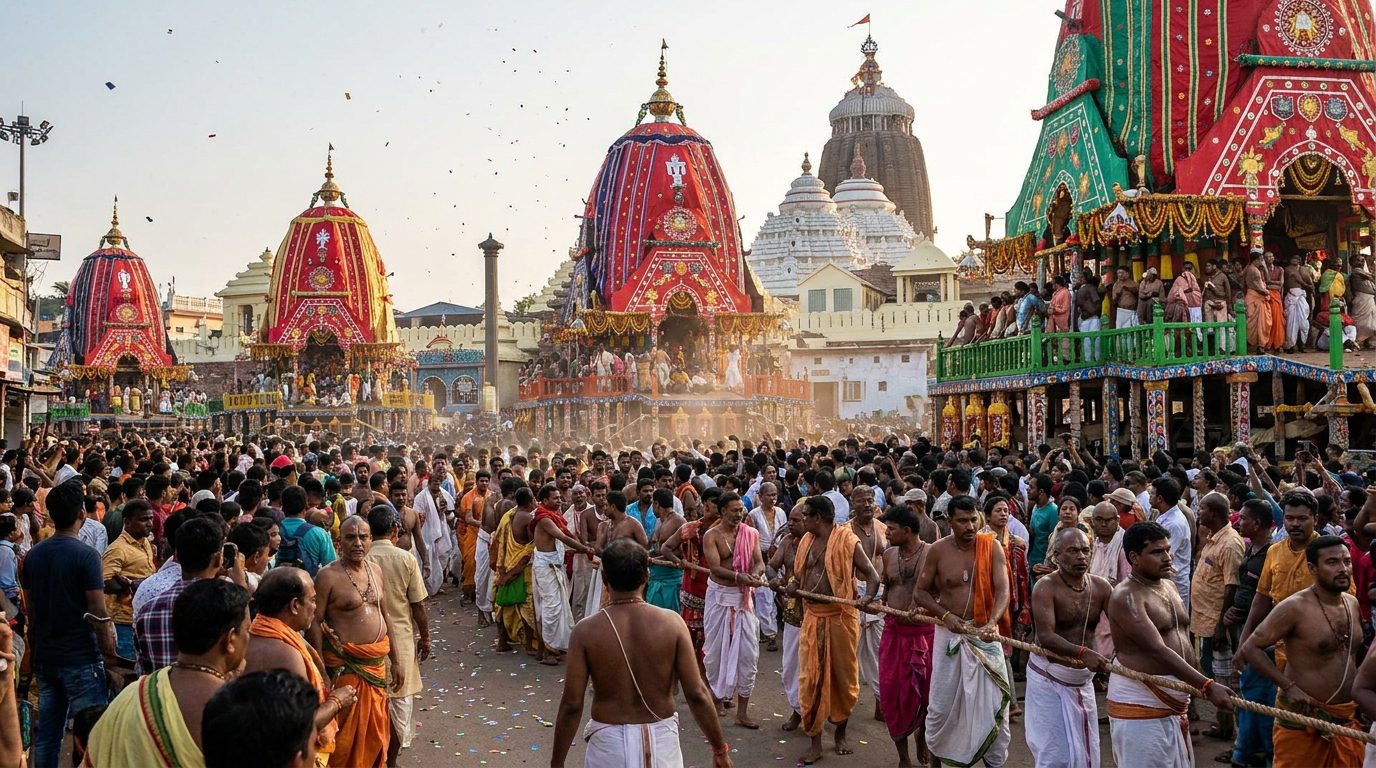
The Ratha Yatra of Jagannath Puri is one of the world’s most famous religious festivals. Every year, Lord Jagannath, Balabhadra, and Subhadra are brought out of the temple and placed on huge wooden chariots. Millions gather to see Them and pull the ropes with devotion.
The Meaning of Ratha Yatra
Ratha means chariot, and yatra means journey or pilgrimage. Ratha Yatra is the chariot journey of the Lord. On one level, it commemorates Lord Jagannath’s journey from the main temple to the Gundicha Temple. On a deeper level, it represents the Lord’s loving movement toward His devotees.
The chariots themselves are grand and colorful, rebuilt each year according to sacred tradition. Lord Jagannath’s chariot is called Nandighosha. Balabhadra’s is Taladhwaja. Subhadra’s is Darpadalana. Each has its own colors, symbols, and details.
When the ropes are pulled, devotees feel they are pulling the Lord into their hearts. This is a beautiful meditation. Our hearts may be crowded with worry, ego, and old habits. But through chanting, prayer, and service, we gently invite God to sit within.
Chaitanya Mahaprabhu and Ecstatic Kirtan
Sri Chaitanya Mahaprabhu’s participation in Ratha Yatra is remembered with great love. He danced before Lord Jagannath with tears of devotion, surrounded by devotees chanting the holy names. His example teaches that chanting is not performance. It is an offering.
Kirtan means devotional singing, often done together in call-and-response style. It is one of the most accessible practices of Bhakti Yoga. You do not need to be a scholar, priest, or perfect singer. You simply need a sincere heart.
In the current age, many Bhakti scriptures and saints recommend chanting God’s names as the most practical spiritual method. The sound vibration of the holy name gradually cleanses the heart and awakens love. In the streets of Puri during Ratha Yatra, this truth becomes visible and audible.
Ratha Yatra Around the World
Through the mercy of saints and teachers, Jagannath’s Ratha Yatra is now celebrated in cities around the world. From London to New York, from Durban to Melbourne, from small towns to large capitals, Lord Jagannath rides through the streets, giving darshan to everyone.
This global spread reflects Jagannath’s universal nature. He belongs to all. Whether someone is Indian or not, Hindu or not, experienced in spiritual practice or completely new, the sight of Jagannath’s chariot can awaken something gentle and holy within the heart.
Sacred Places to Visit in and Around Puri
While the Jagannath Temple is the heart of Puri, the sacred city and surrounding region offer many meaningful places for pilgrims and travelers. Each place carries history, beauty, and an invitation to remember God.
Gundicha Temple
The Gundicha Temple is closely connected with Ratha Yatra. During the festival, Lord Jagannath, Balabhadra, and Subhadra travel here and stay for several days. Devotees often describe Gundicha Temple as representing Vrindavan, the sacred land of Krishna’s intimate pastimes.
The journey from the main temple to Gundicha Temple can be seen as a journey from royal worship to sweet, personal love. In Bhakti, both awe and intimacy have their place. We honor God as great, and we also learn to love Him as near.
Visiting Gundicha Temple outside the festival season can be peaceful. It offers a chance to reflect on the Lord’s journey and our own journey back toward devotion.
Narendra Sarovara
Narendra Sarovara is a sacred water tank associated with the Chandana Yatra festival. During this festival, deities are taken in decorated boats, and sandalwood paste is offered to cool the Lord in the summer heat.
Water, fragrance, music, and service all come together in this celebration. It reminds us that love pays attention. Devotion is not only grand emotion; it is thoughtful care. To apply this in our own lives, we can ask: how can I serve God and others with more attentiveness today?
Swargadwar Beach
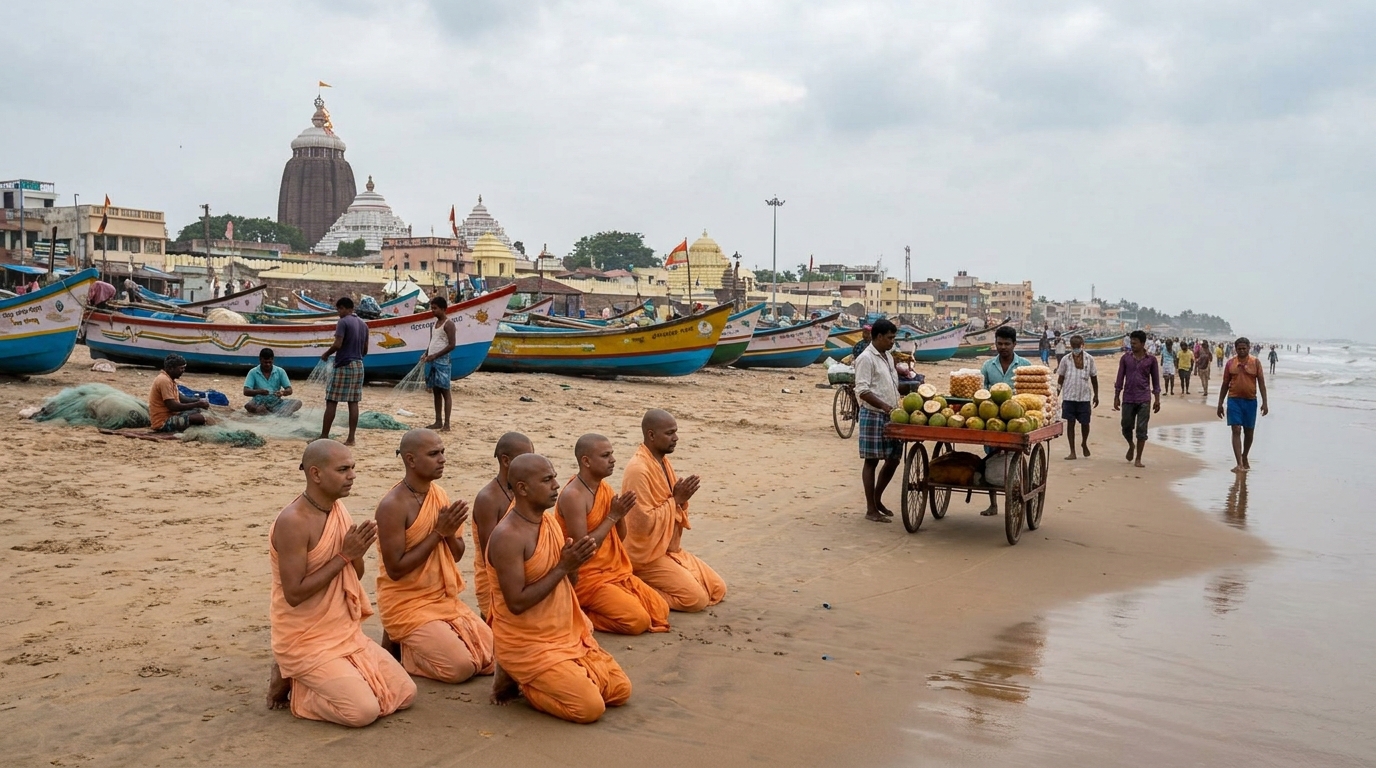
Swargadwar, meaning “gateway to heaven,” is a famous beach in Puri. It is a place of pilgrimage, remembrance, and sacred rites. Many pilgrims visit the beach at sunrise or sunset to pray, chant, and reflect on life’s temporary nature.
The ocean at Puri has a powerful presence. Its waves remind us that life is constantly moving. Joys and sorrows come and go. The soul, however, is eternal, and the loving shelter of God is steady. Sitting by the sea and chanting softly can become a simple but deep spiritual practice.
Lokanath Temple
The Lokanath Temple is dedicated to Lord Shiva, who is revered in Vaishnava tradition as a great devotee of Lord Vishnu and Krishna. In Puri’s sacred culture, different forms of worship often coexist in harmony.
For seekers from diverse backgrounds, this is meaningful. Spiritual life need not be approached with arrogance or division. We can honor sincere devotion wherever it appears. Lord Shiva’s presence in Puri reminds us of humility, renunciation, and devotion to the Supreme.
Konark and the Sun Temple
About an hour from Puri is Konark, home to the famous Sun Temple, a UNESCO World Heritage Site. Though not part of Puri city itself, it is often included in pilgrimage and heritage journeys. The temple is built like a massive chariot of the sun, with beautifully carved stone wheels and horses.
Konark speaks to India’s extraordinary artistic and spiritual heritage. Its carvings show the skill of ancient artisans who saw architecture as sacred expression. A visit to Konark can deepen appreciation for Odisha’s cultural landscape and the devotional imagination that shaped it.
Practical Travel Guide for Pilgrims and Visitors
A journey to Jagannath Puri can be deeply rewarding when approached with respect, preparation, and an open heart. Whether you are traveling as a devotee, cultural explorer, or first-time visitor, a few practical points can help make the experience smoother.
Best Time to Visit Puri
Puri can be visited throughout the year, but the experience changes with the seasons. The winter months, from approximately October to February, are generally pleasant for travel. The weather is cooler, making temple visits and walking more comfortable.
Ratha Yatra usually takes place in June or July, according to the lunar calendar. This is the most famous time to visit, but it is also extremely crowded. Pilgrims who attend should prepare for heat, heavy crowds, limited accommodation, and intense movement. For many devotees, the blessings are worth the effort, but careful planning is important.
The monsoon season brings rain and a special beauty to the coastal region. Summer can be very hot and humid, so travelers should be mindful of health, hydration, and rest.
Reaching Jagannath Puri
Puri is well connected by rail, road, and nearby air travel. The closest major airport is in Bhubaneswar, the capital of Odisha, which is around 60 kilometers from Puri. From Bhubaneswar, travelers can reach Puri by taxi, bus, or train.
Puri railway station connects to many major Indian cities. Once in Puri, local transport includes auto-rickshaws, cycle-rickshaws, taxis, and walking in certain areas. The old city around the temple can be crowded, so patience is helpful.
A pilgrimage is not only about reaching quickly. Sometimes delays, crowds, and discomfort become part of the inner journey. They teach humility and dependence on grace.
Temple Entry and Respectful Conduct
The main Jagannath Temple has traditional entry rules, and currently only Hindus are generally allowed inside. This can be sensitive, especially for sincere seekers from other backgrounds. It is helpful to approach the matter with respect, even if one feels disappointed.
Those who cannot enter may still honor Lord Jagannath in many ways. The temple’s Nila Chakra can be seen from outside. The Patita Pavana deity near the entrance is traditionally associated with giving mercy to those who cannot enter. Devotees can chant, pray, visit other accessible sacred places, attend kirtans, receive Jagannath prasad from authorized sources, and meditate on the Lord’s universal compassion.
Respectful clothing is recommended in sacred areas. Modest dress, gentle behavior, and sensitivity to local customs help preserve the sanctity of the pilgrimage. Photography may be restricted in and around certain temple areas, so always follow local rules.
Where to Stay and How to Prepare
Puri offers many types of accommodation, from simple dharmashalas and ashrams to hotels and guesthouses. During major festivals, rooms fill quickly, so advance booking is important.
Pilgrims may wish to bring comfortable footwear, light cotton clothing, a water bottle, basic medicines, and a cloth bag. If you plan to attend crowded festivals, keep valuables minimal and stay with your group.
Most importantly, prepare inwardly. Before visiting, you might chant a little each day, read about Lord Jagannath, or offer a prayer: “Please let me come not as a tourist only, but as a humble seeker. Please help me receive what You want to give.”
Bhakti Lessons from Jagannath Puri for Daily Life
The true gift of pilgrimage is not only what we see in a holy place, but how we return home changed. Jagannath Puri teaches practical lessons that can be lived anywhere.
Open the Heart Through Chanting
Puri is filled with sacred sound. The names of Jagannath, Krishna, Rama, and Hari are sung with love. Chanting is a simple practice available to everyone. You can chant softly at home, in the car, while walking, or with others in kirtan.
The Bhagavad Gita teaches that the mind can be our friend or our enemy. Chanting helps make the mind a friend by giving it a sacred focus. Even a few minutes daily can bring steadiness.
Try beginning with one sincere round of a mantra, or even five minutes of calling out God’s names. The power is not in musical skill. The power is in sincerity.
Offer Your Food and Your Work
Jagannath’s Mahaprasad teaches us to offer before we enjoy. This can transform the home into a sacred space. Prepare food with care, place it before a picture or form of the Lord, and say a simple prayer: “My Lord, please accept this offering made with love.”
Then eat with gratitude. This practice reduces greed and increases awareness of God’s kindness.
We can also offer our work. Whether we are students, parents, artists, business owners, caregivers, or workers of any kind, we can dedicate our efforts to God. Bhakti Yoga does not require us to abandon responsibility. It invites us to spiritualize responsibility.
Serve Others as Service to God
In Jagannath Puri, thousands of people serve in visible and invisible ways. Some cook. Some clean. Some sing. Some manage crowds. Some guide pilgrims. Some offer donations. Some simply fold their hands and pray.
Service softens the ego. It teaches us that love is active. We do not have to wait for a perfect opportunity. We can serve today: feed someone, listen kindly, help at a temple or community space, support spiritual education, care for the earth, or encourage someone who is struggling.
When service is connected to God, it nourishes both the giver and receiver.
Remember That God Comes Toward Us
Ratha Yatra offers one of the most comforting lessons: the Lord comes out to meet everyone. In our lives, we may feel far from God. We may think we are not pure enough, knowledgeable enough, or disciplined enough. But Jagannath’s mercy says, “Begin where you are.”
Take one step. Say one prayer. Chant one name. Offer one act of kindness. Spiritual life grows through small sincere steps repeated with faith.
The Cultural Heritage of Odisha in Puri
Jagannath Puri is not only a sacred pilgrimage center; it is also a cultural treasure. The devotion to Jagannath has shaped Odisha’s music, dance, poetry, painting, food, festivals, and identity.
Odissi Dance and Devotional Expression
Odissi, one of India’s classical dance forms, is deeply connected with temple culture and devotion. Its graceful movements, expressive storytelling, and sacred themes often honor Krishna, Jagannath, and the divine love of the soul.
In Bhakti, art is not separate from spirituality. Dance, music, painting, and poetry can become offerings. When talent is used to glorify God and uplift others, it becomes seva.
Visitors to Puri and Odisha may have opportunities to witness Odissi performances. Watching with reverence can become more than entertainment. It can become meditation through beauty.
Pattachitra and Jagannath Art
Odisha is famous for Pattachitra, traditional cloth-based scroll painting. Many Pattachitra artworks depict Lord Jagannath, Ratha Yatra, Krishna’s pastimes, and sacred stories. The bright colors and detailed patterns reflect devotion passed down through generations.
Bringing home sacred art from Puri can be a way to remember the pilgrimage. But more than decoration, such art can become a daily reminder to pause, bow the heart, and live with devotion.
Language, Poetry, and Songs of Jagannath
The Odia language carries a vast devotional heritage centered on Jagannath. Saints and poets have composed songs full of longing, surrender, and love. These songs often express a deeply personal relationship with the Lord.
Sacred poetry helps us speak to God when our own words feel limited. A simple bhajan, or devotional song, can carry the heart into prayer. In Puri, one feels that the city itself is singing.
A Gentle Guide for First-Time Spiritual Seekers
If you are new to Bhakti Yoga or unfamiliar with Jagannath Puri, you may wonder how to approach such a sacred place without feeling overwhelmed. The answer is simple: come with humility and sincerity.
You do not need to know everything. You do not need to master Sanskrit. You do not need to understand every ritual. In Bhakti, the heart’s intention matters deeply.
Simple Sanskrit Words to Know
A few words can help you feel more connected:
- Bhakti means loving devotion to God.
- Yoga means connection, especially connection with the Divine.
- Darshan means seeing the Lord and being seen by Him.
- Prasad means sacred food offered to God and received as grace.
- Seva means service offered with love.
- Kirtan means devotional singing, especially of God’s names.
- Dham means a holy place where God’s presence is especially felt.
These words are not meant to create distance. They are invitations into a living spiritual culture.
How to Pray in Puri
Prayer does not have to be complicated. You can stand before the temple, sit by the ocean, or close your eyes in your room and say:
“Dear Lord Jagannath, I do not know how to love You perfectly, but I want to begin. Please guide me. Please purify my heart. Please help me serve You and Your children.”
Such a prayer is powerful because it is honest. God hears sincerity.
Bringing Puri Home
After visiting Jagannath Puri—or even after reading about it—you can bring its mood into daily life. Create a small sacred space at home. Chant God’s names. Offer your food. Read a few verses from the Bhagavad Gita or Srimad Bhagavatam. Serve someone without expecting praise. Remember Jagannath’s wide eyes and open mercy.
A holy place is meant to awaken a holy direction. The real pilgrimage continues in how we live.
Walking Forward with Jagannath’s Mercy
Jagannath Puri is a city of deep heritage, sacred beauty, and living devotion. Its temple rises above the coastline as a reminder that God is the center. Its festivals proclaim that the Lord comes out for everyone. Its Mahaprasad teaches that grace can be tasted. Its songs and scriptures remind us that love is the highest path.
For some, Puri is the destination of a lifetime. For others, it may be a place they encounter through stories, pictures, kirtan, or the global celebration of Ratha Yatra. However we meet Jagannath, His invitation is the same: come closer.
Bhakti Yoga is practical. Chant with sincerity. Pray with honesty. Serve with humility. Offer what you can. Take shelter of sacred wisdom. Keep company with those who encourage your spiritual growth. And when you fall short, begin again.
Lord Jagannath, the Lord of the Universe, is also the Lord of the heart. His mercy is wide, patient, and compassionate. No one is too far away. No beginning is too small.
Everyone is welcome to take one sincere step toward God today—one name chanted, one prayer whispered, one act of service offered, one moment of remembrance held with love.
FAQs
1. What is the significance of Jagannath Puri?
Jagannath Puri is a sacred city in the state of Odisha, India, known for its famous Jagannath Temple dedicated to Lord Jagannath, a form of Lord Vishnu. It is one of the Char Dham pilgrimage sites for Hindus and holds great religious importance.
2. When is the best time to visit Jagannath Puri?
The best time to visit Jagannath Puri is during the winter months from October to March when the weather is pleasant and ideal for sightseeing and temple visits. The famous Rath Yatra festival in June or July is also a popular time to visit.
3. What are the main attractions in Jagannath Puri?
Aside from the Jagannath Temple, other attractions in Jagannath Puri include the Puri Beach, Gundicha Temple, Narendra Tank, Chilika Lake, and the Sun Temple at Konark. Visitors can also explore the local markets for handicrafts and traditional Odia cuisine.
4. How can one reach Jagannath Puri?
Jagannath Puri is well-connected by road, rail, and air. The nearest airport is in Bhubaneswar, approximately 60 kilometers away. Puri Railway Station is connected to major cities in India. Several state and private buses also ply to Puri from nearby cities.
5. Are there any accommodation options in Jagannath Puri?
Jagannath Puri offers a range of accommodation options to suit every budget, including luxury hotels, budget guesthouses, and dharamshalas. Many hotels are located near the Jagannath Temple and offer a comfortable stay for pilgrims and tourists.

