March 4 — Jackson, Michigan (Local Time)
Standard ISKCON-Style Observance (Online)
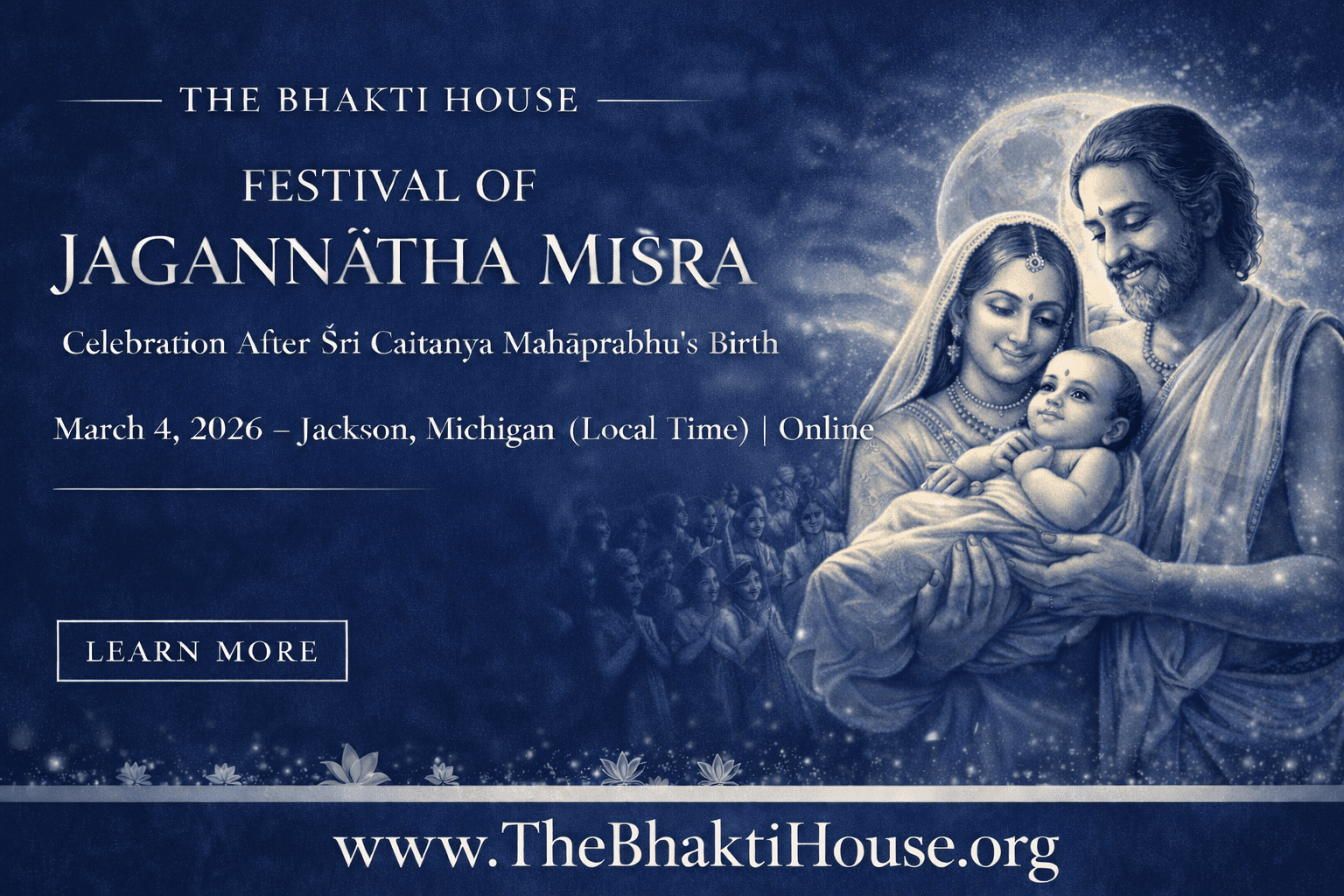
The day after Gaura Pūrṇimā, we celebrate the Festival of Jagannātha Miśra, the joyful father of Śrī Caitanya Mahāprabhu.
While Gaura Pūrṇimā honors the Lord’s divine appearance, this sacred observance celebrates the overwhelming gratitude, humility, and devotion of His father — Śrī Jagannātha Miśra.
It is a festival of family, charity, kīrtana, and sacred joy.
Scriptural Foundation
From Śrī Caitanya-caritāmṛta, Ādi-līlā Chapter 13
Composed in Bengali by Kṛṣṇadāsa Kavirāja Gosvāmī, this chapter narrates the divine appearance of Śrī Caitanya Mahāprabhu and the celebrations in the home of Jagannātha Miśra.
The Phālguna Full Moon & Lunar Eclipse
CC Ādi 13.19
Bengali
সর্বসদ্গুণপূর্ণাং তাং বন্দে ফাল্গুনপূর্ণিমাম্ ।
যস্যাং শ্রীকৃষ্ণচৈতন্যোऽবতীর্ণঃ কৃষ্ণনামভিঃ ॥ ১৯ ॥
Transliteration
sarva-sad-guṇa-pūrṇāṁ tāṁ
vande phālguna-pūrṇimām
yasyāṁ śrī-kṛṣṇa-caitanyo
’vatīrṇaḥ kṛṣṇa-nāmabhiḥ
Translation
“I offer my respectful obeisances unto the full-moon evening in the month of Phālguna, an auspicious time full of auspicious symptoms, when Lord Śrī Caitanya Mahāprabhu advented Himself with the chanting of the holy names.”
CC Ādi 13.20
Bengali
ফাল্গুনপূর্ণিমা-সন্ধ্যায় প্রভুর জন্মোদয় ।
সেইকালে দৈবযোগে চন্দ্রগ্রহণ হয় ॥ ২০ ॥
Transliteration
phālguna-pūrṇimā-sandhyāya prabhura janmodaya
sei-kāle daiva-yoge candra-grahaṇa haya
Translation
“On the full-moon evening of the month of Phālguna when the Lord took birth, coincidentally there was also a lunar eclipse.”
CC Ādi 13.21
Bengali
‘হরি’ ‘হরি’ বলে লোক হরষিত হঞা ।
জন্মিলা চৈতন্যপ্রভু ‘নাম’ জন্মাইয়া ॥ ২১ ॥
Transliteration
‘hari’ ‘hari’ bale loka haraṣita hañā
janmilā caitanya-prabhu ‘nāma’ janmāiyā
Translation
“In jubilation everyone was chanting the holy name of the Lord — ‘Hari! Hari!’ — and Lord Śrī Caitanya Mahāprabhu then appeared, after first causing the appearance of the holy name.”
The Universal Chanting & The Lord’s Advent (13.92–94)
CC Ādi 13.92
Bengali
এত জানি’ রাহু কৈল চন্দ্রের গ্রহণ ।
‘কৃষ্ণ’ ‘কৃষ্ণ’ ‘হরি’ নামে ভাসে ত্রিভুবন ॥ ৯২ ॥
Transliteration
eta jāni’ rāhu kaila candra-grahaṇa
‘kṛṣṇa’ ‘kṛṣṇa’ ‘hari’ nāme bhāse tri-bhuvana
Translation
“Considering this, Rāhu, the black planet, covered the full moon, and immediately vibrations of ‘Kṛṣṇa! Kṛṣṇa! Hari!’ inundated the three worlds.”
CC Ādi 13.93
Bengali
জয় জয় ধ্বনি হৈল সকল ভুবন ।
চমৎকার হৈয়া লোক ভাবে মনে মন ॥ ৯৩ ॥
Transliteration
jaya jaya dhvani haila sakala bhuvana
camatkāra haiyā loka bhāve mane mana
Translation
“All people thus chanted the Hare Kṛṣṇa mahā-mantra during the lunar eclipse, and their minds were struck with wonder.”
CC Ādi 13.94
Bengali
জগৎ ভরিয়া লোক বলে—‘হরি’ ‘হরি’ ।
সেইক্ষণে গৌরকৃষ্ণ ভুমে অবতরি ॥ ৯৪ ॥
Transliteration
jagat bhariyā loka bale — ‘hari’ ‘hari’
sei-kṣaṇe gaurakṛṣṇa bhūme avatari
Translation
“When the whole world was thus chanting the holy name of the Supreme Personality of Godhead, Kṛṣṇa in the form of Gaurahari advented Himself on the earth.”
The Lord inducing chanting from infancy (13.22–25)
CC Ādi 13.22
Bengali
জন্ম-বাল্য-পৌগণ্ড-কিশোর-যুবাকালে ।
হরিনাম লওয়াইল প্রভু নানা ছলে ॥ ২২ ॥
Transliteration
janma-bālya-paugaṇḍa-kaiśora-yuvā-kāle
hari-nāma laoyāila prabhu nānā chale
Translation
“At His birth, in His childhood and in His early and later boyhood, as well as in His youth, Lord Caitanya Mahāprabhu, under different pleas, induced people to chant the holy name of Hari [the Hare Kṛṣṇa mahā-mantra].”
CC Ādi 13.23
Bengali
বাল্যভাব ছলে প্রভু করেন ক্রন্দন ।
‘কৃষ্ণ’ ‘হরি’ নাম শুনি রহয়ে রোদন ॥ ২৩ ॥
Transliteration
bālya-bhāva chale prabhu karena krandana
‘kṛṣṇa’ ‘hari’ nāma śuni’ rahaye rodana
Translation
“In His childhood, when the Lord was crying He would stop immediately upon hearing the holy names Kṛṣṇa and Hari.”
CC Ādi 13.24
Bengali
অতএব ‘হরি’ ‘হরি’ বলে নারীগণ ।
দেখিতে আইসে যেবা সর্ব বন্ধুজণ ॥ ২৪ ॥
Transliteration
ataeva ‘hari’ ‘hari’ bale nārī-gaṇa
dekhite āise yebā sarva bandhu-jana
Translation
“All the friendly ladies who came to see the child would chant the holy names, ‘Hari, Hari!’ as soon as the child would cry.”
CC Ādi 13.25
Bengali
‘গৌরহরি’ বলি তারে হাসে সর্ব নারী ।
অতএব হইল তাঁরা নাম ‘গৌরহরি’ ॥ ২৫ ॥
Transliteration
‘gaurahari’ bali’ tāre hāse sarva nārī
ataeva haila tāṅra nāma ‘gaurahari’
Translation
“When all the ladies saw this fun, they enjoyed laughing and called the Lord ‘Gaurahari.’ From then on, Gaurahari became another of His names.”
Jagannātha Miśra’s joy and charity (13.107–109)
CC Ādi 13.107
Bengali
কেবা আসে কেবা যায়, কেবা নাচে কেবা গায়,
সম্ভালিতে নারে কার বোল।
খণ্ডিলেক দুঃখ-শোক, প্রমোদ-পূরিত লোক,
মিশ্র হৈল আনন্দে বিভোল ॥ ১০৭ ॥
Transliteration
kebā āse kebā yāya, kebā nāce kebā gāya,
sambhālite nāre kāra bola
khaṇḍileka duḥkha-śoka, pramoda-pūrita loka,
miśra haila ānande vibhola
Translation
“No one could understand who was coming and who was going, who was dancing and who was singing. Nor could they understand one another’s language. Yet all unhappiness and lamentation were immediately dissipated, and people became all-jubilant. Thus Jagannātha Miśra was also overwhelmed with joy.”
CC Ādi 13.108
Bengali
আচার্যরত্ন, শ্রীবাস, জগন্নাথমিশ্র-পাশ,
আসি তাঁরে করে সাবধান।
করাইল জাতকর্ম, যে আছিল বিধি-ধর্ম,
তবে মিশ্র করে নানা দান ॥ ১০৮ ॥
Transliteration
ācāryaratna, śrīvāsa, jagannātha-miśra-pāśa,
āsi’ tāṅre kare sāvadhāna
karāila jātakarma, ye āchila vidhi-dharma,
tabe miśra kare nānā dāna
Translation
“Candraśekhara Ācārya and Śrīvāsa Ṭhākura both came to Jagannātha Miśra and drew his attention in various ways. They performed the ritualistic ceremonies prescribed at the time of birth according to religious principles. Jagannātha Miśra also gave varieties of charity.”
CC Ādi 13.109
Bengali
যৌতুক পাইলা যত, ঘরে বা আছিল কত,
সব ধন বিপ্রে দিল দান।
যত নর্তক, গায়ন, ভাট, অকিঞ্চন জন,
ধন দিয়া কৈল সবার মান ॥ ১০৯ ॥
Transliteration
yautuka pāila yata, ghare vā āchila kata,
saba dhana vipre dila dāna
yata nartaka, gāyana, bhāṭa, akiñcana jana,
dhana diyā kaila sabāra māna
Translation
“Whatever riches Jagannātha Miśra collected in the form of gifts and presentations, and whatever he had in his house, he distributed among the brāhmaṇas, professional singers, dancers, bhāṭas and the poor. He honored them all by giving them riches in charity.”
This spirit of generosity and gratitude defines the mood of this festival.
Jackson, Michigan Observance
Date: March 4
Location: Jackson, Michigan (Local Time)
Format: Online
Hosted by: The Bhakti House
Standard ISKCON-Style Program
Short Reading (15–20 minutes)
Selections from Śrī Caitanya-bhāgavata describing Jagannātha Miśra’s joy and the Lord’s childhood pastimes.
Kīrtan (20–30 minutes)
Congregational chanting of the Mahāmantra and traditional Gaura bhajans.
Brief Class / Discussion (20–30 minutes)
Topics may include:
- Vātsalya-rasa (parental love of God)
- Household devotion in Gaudiya Vaishnavism
- How Lord Caitanya established kīrtana from infancy
- Bringing bhakti into family life
Closing Prayers
The Mood of This Festival
Gaura Pūrṇimā is majestic and universal.
The Festival of Jagannātha Miśra is intimate and warm.
It reminds us that:
- Bhakti lives in the home
- Gratitude sanctifies poverty
- Kīrtana transforms family life
- Divine love expresses itself through relationship
When we gather in Jackson, Michigan and chant,
We stand in Jagannātha Miśra’s courtyard.
Join Online
Festival of Jagannātha Miśra
March 4
Jackson, Michigan (Local Time)
Hosted by The Bhakti House
www.TheBhaktiHouse.org
All are welcome.