
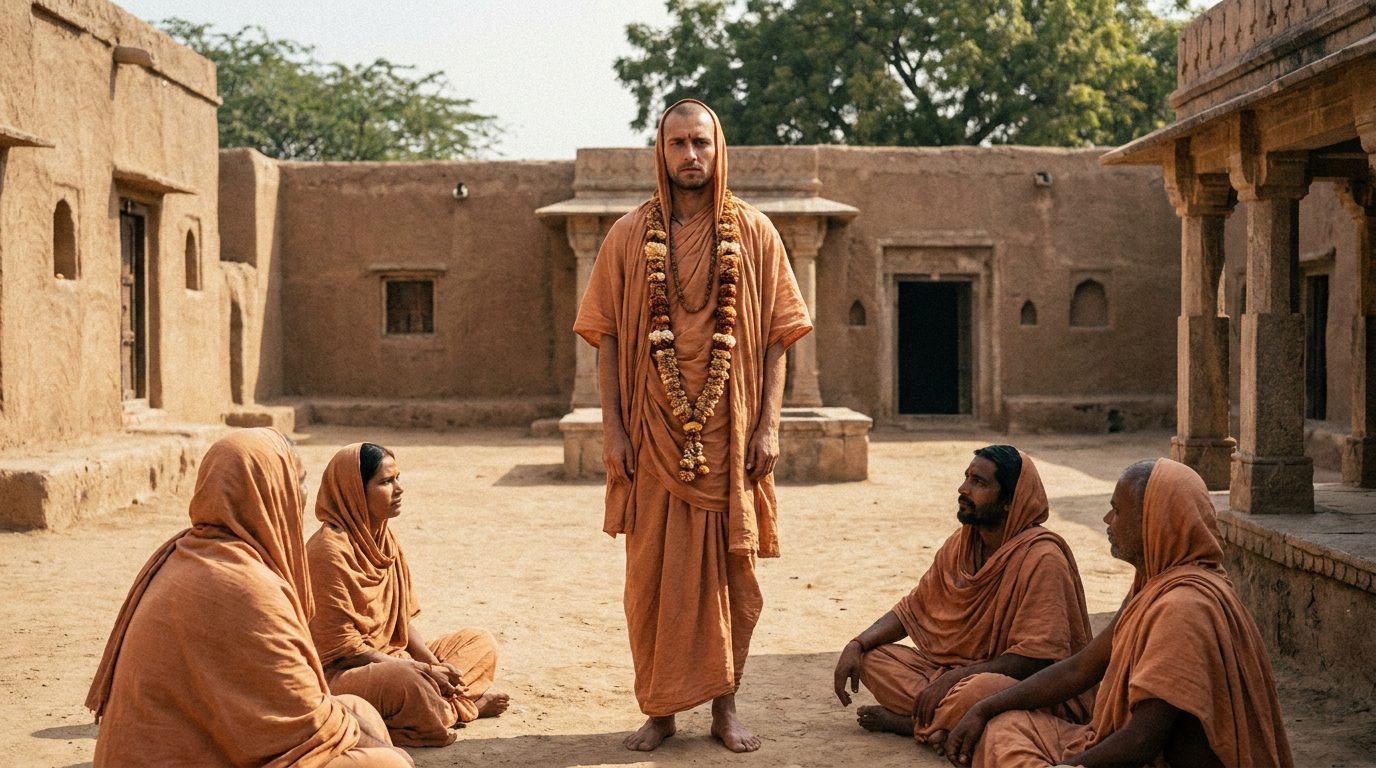
There are rare souls who walk this earth and change the spiritual landscape forever. Śrī Caitanya Mahāprabhu is one such soul. He appeared over five hundred years ago in West Bengal, India, and ignited a revolution of love, chanting, and devotion that continues to touch hearts around the world today.
Whether you are new to Bhakti Yoga or have been walking this path for years, learning about Caitanya Mahāprabhu can deepen your understanding of what it truly means to love God. His life is an open invitation — to everyone, regardless of background, caste, education, or nationality — to experience the sweetness of divine love through the simple and powerful practice of chanting God’s holy names.
At The Bhakti House, we hold His teachings close to our hearts. We believe that His message is as relevant today as it was five centuries ago, perhaps even more so. Let us explore together who He was, what He taught, and how His legacy can transform our lives.
Śrī Caitanya Mahāprabhu was born on February 18, 1486, in Navadvīpa, a town in present-day West Bengal, India. His birth name was Viśvambhara, meaning “the one who sustains the universe,” and He was also lovingly called Nimāi because He was born under a neem tree.
A Brilliant Scholar Turned Devoted Saint
From a young age, Caitanya Mahāprabhu displayed extraordinary intellectual brilliance. By His teenage years, He had already mastered Sanskrit grammar, logic, and philosophy and was running His own school. Students came from far and wide to study under Him. He was known as one of the sharpest scholars in all of Navadvīpa, which was at that time one of the greatest centers of learning in India.
But something shifted profoundly in His heart. After visiting Gayā, a sacred pilgrimage site, and receiving spiritual initiation from His guru Īśvara Purī, Nimāi underwent a dramatic transformation. The brilliant scholar became an ecstatic devotee. He would weep in love for God, chant the holy names for hours, and dance in spiritual bliss. His entire being became absorbed in devotion to Lord Kṛṣṇa.
The Golden Avatāra
Bhakti practitioners honor Caitanya Mahāprabhu as the most merciful incarnation of God — Kṛṣṇa Himself appearing in the mood of a devotee. He is often called the “Golden Avatāra” because of His radiant golden complexion. The Śrīmad-Bhāgavatam (11.5.32) describes this incarnation:
> “In the Age of Kali, intelligent persons perform congregational chanting to worship the incarnation of Godhead who constantly sings the names of Kṛṣṇa. Although His complexion is not blackish, He is Kṛṣṇa Himself. He is accompanied by His associates, servants, weapons, and confidential companions.”
This verse is understood by Bhakti scholars to be a direct reference to Caitanya Mahāprabhu — God appearing not as a mighty king or warrior, but as a humble chanter, a lover of the holy name, showing us by His own example how to approach the Divine.
The Revolutionary Teachings of Caitanya Mahāprabhu
Caitanya Mahāprabhu did not write extensive philosophical treatises. In fact, the only written work directly attributed to Him is a brief set of eight verses called the Śikṣāṣṭaka. Yet His teachings, preserved by His close associates and followers, form one of the most profound and accessible spiritual philosophies ever offered to humanity.
Acintya-Bhedābheda: Inconceivable Oneness and Difference
At the heart of Caitanya Mahāprabhu’s philosophy is a concept called acintya-bhedābheda-tattva. In simple terms, this means that God and the individual soul are simultaneously, inconceivably one and different.
Think of it this way: a ray of sunshine is one with the sun in quality — it is warm and luminous — but it is not the sun itself. Similarly, we as individual souls share a divine nature with God, but we are not God. We are His beloved parts and parcels. This understanding creates the perfect foundation for a relationship of love. After all, love requires two — the lover and the beloved.
This teaching beautifully affirms both our connection to God and our unique individuality. We don’t dissolve into nothingness or merge into an impersonal light. We get to love God, and God loves us back. That is the highest spiritual reality according to Caitanya Mahāprabhu.
The Supremacy of Love Over Rules
While Caitanya Mahāprabhu respected Vedic scriptures and spiritual disciplines, He emphasized that the goal of all spiritual practice is prema — pure, unconditional love for God. Rules, rituals, knowledge, and renunciation all serve their purpose, but they are meant to lead us to this one destination: a heart overflowing with love.
As stated in the Caitanya-caritāmṛta (Ādi 7.84):
> “Pure love for Kṛṣṇa is eternally established in the hearts of living entities. It is not something to be gained from another source. When the heart is purified by hearing and chanting, the living entity naturally awakens.”
This is such a hopeful teaching. Love for God is not something we have to manufacture. It is already within us. Our spiritual practices simply clear away the dust so that love can shine through.
The Saṅkīrtana Movement: Chanting for Everyone
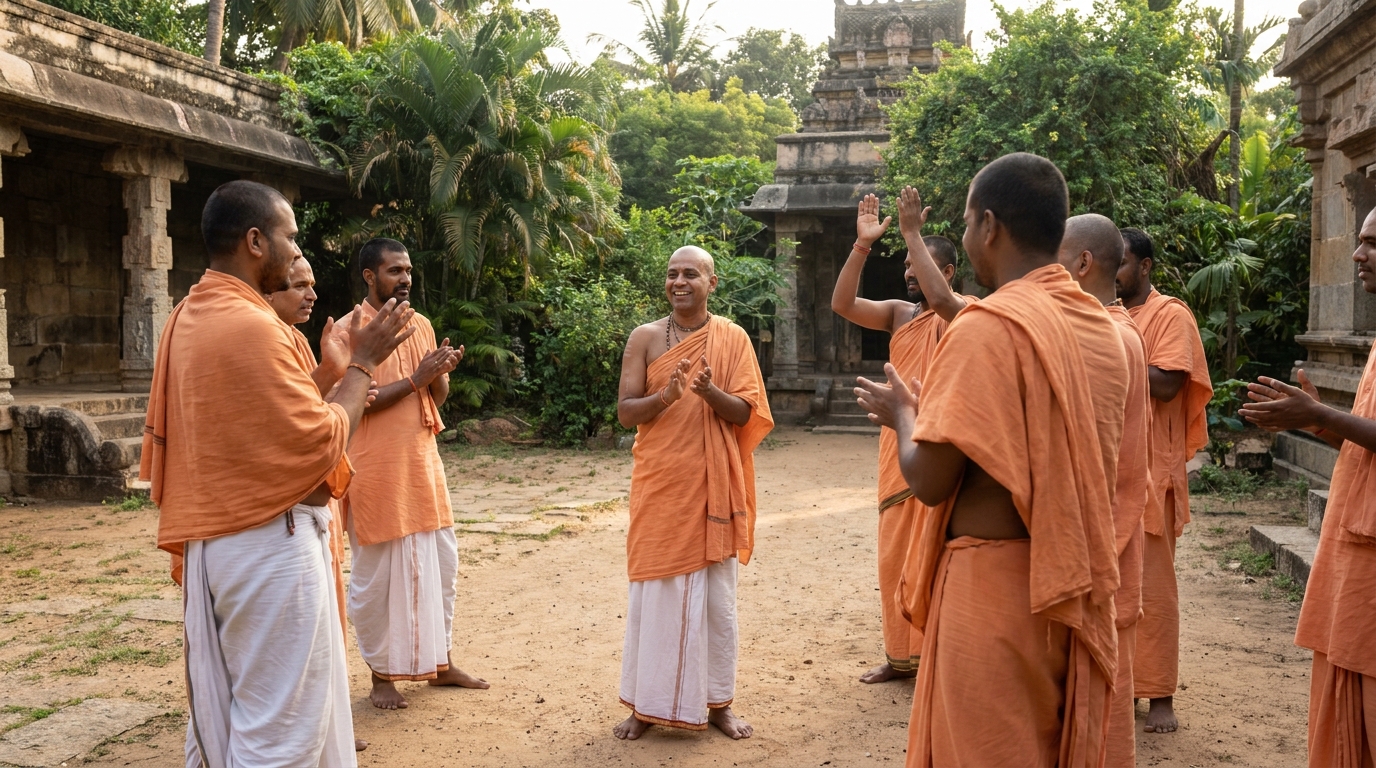
Perhaps the most visible and transformative gift of Caitanya Mahāprabhu is the saṅkīrtana movement — the congregational chanting of God’s holy names, especially the Hare Kṛṣṇa mahā-mantra:
Hare Kṛṣṇa, Hare Kṛṣṇa, Kṛṣṇa Kṛṣṇa, Hare Hare / Hare Rāma, Hare Rāma, Rāma Rāma, Hare Hare
Why Chanting Matters
Caitanya Mahāprabhu taught that in this age — called Kali-yuga, an age characterized by confusion, conflict, and spiritual forgetfulness — the most effective and accessible spiritual practice is chanting the holy names of God. You don’t need to be a scholar. You don’t need wealth. You don’t need to belong to a certain family or tradition. You simply need sincerity and a willingness to call out to the Divine.
In His Śikṣāṣṭaka (verse 1), Caitanya Mahāprabhu glorifies the holy name:
> “Glory to the Śrī Kṛṣṇa saṅkīrtana, which cleanses the heart of all the dust accumulated for years and extinguishes the fire of conditional life, of repeated birth and death. This saṅkīrtana movement is the prime benediction for humanity at large because it spreads the rays of the benediction moon. It is the life of all transcendental knowledge. It increases the ocean of transcendental bliss, and it enables us to fully taste the nectar for which we are always anxious.”
What a beautiful promise. Chanting is not merely a ritual — it is a direct experience of spiritual joy, purification, and awakening.
A Path Open to All
One of the most revolutionary aspects of Caitanya Mahāprabhu’s movement was its radical inclusivity. In 16th-century India, spiritual practices were often restricted by caste and social status. Caitanya Mahāprabhu shattered those barriers. He embraced everyone — the scholar and the illiterate, the wealthy and the poor, the socially respected and the outcast.
He famously embraced Haridāsa Ṭhākura, a saint born in a Muslim family, and declared him the Nāmācārya — the foremost teacher of the holy name. He dined with people considered untouchable. He taught that the qualification for Bhakti is not birth or status but sincerity of heart.
Check out our website for more articles: more articles.
The Six Gosvāmīs: Carrying the Torch
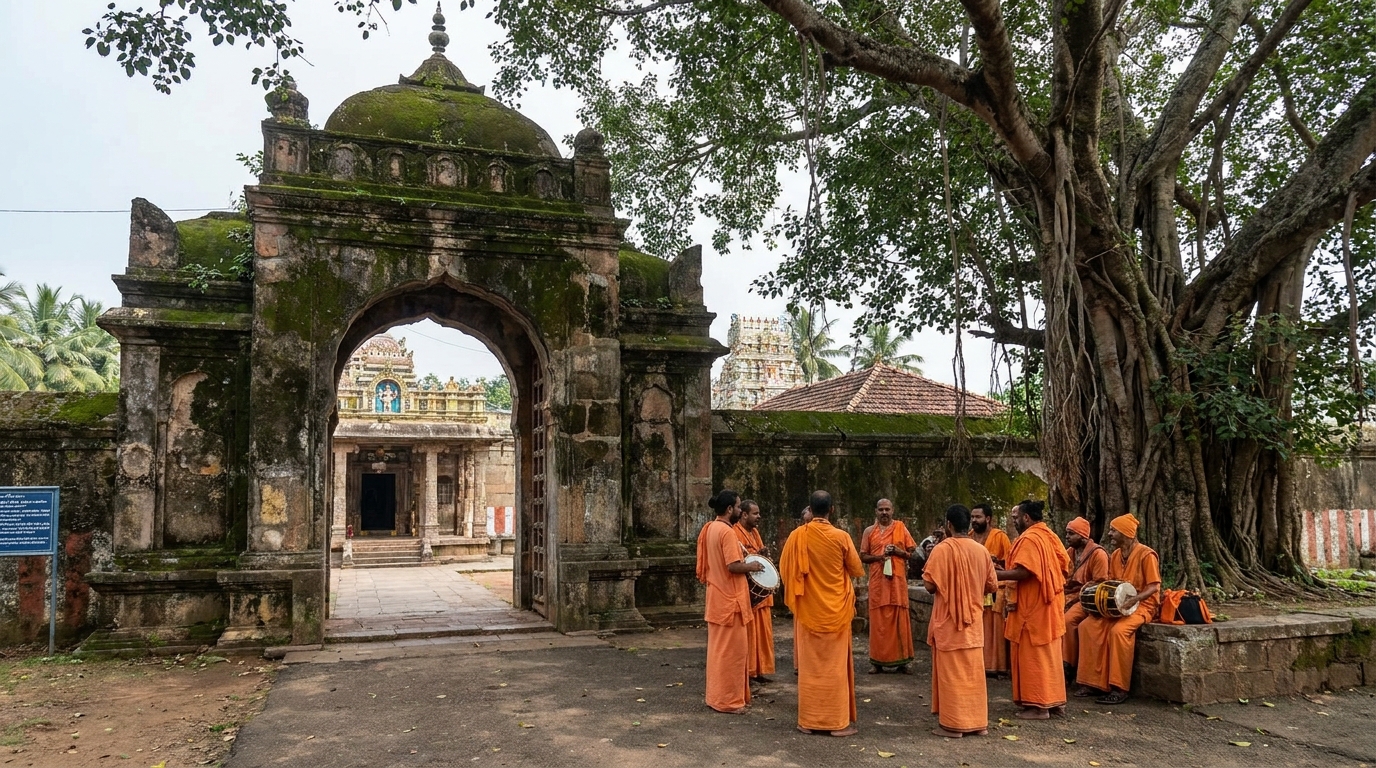
After Caitanya Mahāprabhu took the renounced order of life (sannyāsa) at just twenty-four years old, He traveled extensively throughout India, spreading the chanting of the holy names and inspiring countless souls. He eventually settled in Jagannātha Purī, Odisha, where He spent the last eighteen years of His life in deep spiritual ecstasy.
He entrusted six of His most intimate followers — known as the Six Gosvāmīs of Vṛndāvana — with the mission of systematically preserving and explaining His teachings.
Who Were the Six Gosvāmīs?
The Six Gosvāmīs were Rūpa Gosvāmī, Sanātana Gosvāmī, Raghunātha Bhaṭṭa Gosvāmī, Raghunātha dāsa Gosvāmī, Gopāla Bhaṭṭa Gosvāmī, and Jīva Gosvāmī. These extraordinary souls left behind positions of power and comfort to live as humble renunciants in Vṛndāvana, the sacred land of Kṛṣṇa’s pastimes.
They wrote extensive philosophical and devotional literature, rediscovered lost holy places, established temples, and created a systematic theology of Bhakti that is studied and cherished to this day. Without their tireless work, the depth and beauty of Caitanya Mahāprabhu’s teachings might never have been fully preserved for future generations.
Literature That Transforms Hearts
Rūpa Gosvāmī’s Bhakti-rasāmṛta-sindhu (“The Ocean of the Nectar of Devotion”) provides a comprehensive map of the stages of Bhakti, from the first seed of faith to the highest ecstasies of divine love. Jīva Gosvāmī’s Ṣaṭ-sandarbha offers a profound philosophical framework. Sanātana Gosvāmī’s Bṛhad-Bhāgavatāmṛta tells the enchanting story of a devotee’s journey through different spiritual realms in search of the highest form of God’s mercy.
These works are not dry academic texts. They are living invitations into the world of Bhakti — full of beauty, longing, and the sweetest love.
How Caitanya Mahāprabhu’s Legacy Lives On Today
The influence of Caitanya Mahāprabhu extends far beyond the boundaries of Bengal or India. His movement has become a truly global spiritual phenomenon.
The Global Spread of Bhakti
In 1966, A.C. Bhaktivedanta Swami Prabhupāda, a devoted follower in the lineage of Caitanya Mahāprabhu, brought these teachings to the Western world by founding the International Society for Krishna Consciousness (ISKCON). What began with a small storefront in New York City has grown into a worldwide community of temples, farms, schools, and outreach centers.
Today, people on every continent chant the Hare Kṛṣṇa mahā-mantra, study the Bhagavad-gītā and Śrīmad-Bhāgavatam, and practice the principles of Bhakti Yoga that Caitanya Mahāprabhu so lovingly gave. The kīrtana tradition He championed has also influenced the broader yoga and wellness communities, bringing the healing power of sacred sound to millions who might never have encountered it otherwise.
Practical Bhakti in Daily Life
Caitanya Mahāprabhu’s teachings are not meant only for monks or scholars. They are profoundly practical. Here are some simple ways His teachings can enrich your daily life:
- Chanting: Set aside time each day to chant the Hare Kṛṣṇa mahā-mantra, either softly on meditation beads (japa) or aloud with others (kīrtana). Even a few minutes of sincere chanting can shift your consciousness.
- Gratitude and Prayer: Before meals, offer your food to God with a simple prayer of thanks. This practice, called prasādam, transforms eating into an act of devotion.
- Service: Look for ways to serve others selflessly. Caitanya Mahāprabhu taught that serving God’s children is one of the most beautiful expressions of love for God.
- Study: Read from the Bhagavad-gītā, Śrīmad-Bhāgavatam, or Caitanya-caritāmṛta. Even one verse a day, reflected upon deeply, can nourish your spiritual life.
- Community: Seek out like-minded seekers. Bhakti thrives in community. Singing, sharing meals, studying together — these simple acts create profound spiritual connection.
An Invitation from the Heart
Caitanya Mahāprabhu’s message is breathtakingly simple and infinitely deep: You are loved by God. You always have been. And the path back to that love is open to you right now — through chanting, through prayer, through service, through opening your heart.
In the Caitanya-caritāmṛta (Madhya 19.151), Śrī Caitanya Mahāprabhu beautifully explains:
> “According to their karma, all living entities are wandering throughout the entire universe. Some of them are being elevated to the upper planetary systems, and some are going down into the lower planetary systems. Out of many millions of wandering living entities, one who is very fortunate gets an opportunity to associate with a bona fide spiritual master by the grace of Kṛṣṇa. By the mercy of both Kṛṣṇa and the spiritual master, such a person receives the seed of the creeper of devotional service.”
If you are reading these words right now, perhaps that seed is being planted in your heart at this very moment. You don’t need to have everything figured out. You don’t need to be perfect. You just need to take one sincere step.
At The Bhakti House, we believe that everyone is welcome on this path. Wherever you come from, whatever your story, there is a place for you here. Caitanya Mahāprabhu opened the doors of divine love to every living being, and those doors remain wide open today.
Why not take that one step? Chant a mantra. Say a prayer. Offer a kind word. Open your heart just a little. God is already reaching out to meet you.
We would love to walk beside you on this beautiful journey. 🙏
FAQs
Who was Caitanya Mahāprabhu?
Caitanya Mahāprabhu was a 16th-century Indian saint and religious leader who is considered to be a reincarnation of Lord Krishna by his followers. He is also known as Gauranga due to his fair complexion and as Nimai due to his birth in the town of Navadvipa.
What were Caitanya Mahāprabhu’s teachings?
Caitanya Mahāprabhu emphasized the chanting of the Hare Krishna mantra as the most effective means of attaining spiritual enlightenment and liberation. He also stressed the importance of devotional service, love for God, and the dissemination of the teachings of the Bhagavad Gita and the Srimad Bhagavatam.
What is the significance of Caitanya Mahāprabhu in Hinduism?
Caitanya Mahāprabhu is considered to be a major figure in the Bhakti movement, a devotional form of Hinduism that emphasizes the worship of a personal god through loving devotion. His teachings and influence have had a lasting impact on the development of Vaishnavism, a major tradition within Hinduism.
What is the Gaudiya Vaishnavism tradition associated with Caitanya Mahāprabhu?
Caitanya Mahāprabhu is closely associated with the Gaudiya Vaishnavism tradition, which considers him to be a combined incarnation of Radha and Krishna. This tradition places a strong emphasis on the worship of Krishna as the supreme personality of Godhead and the practice of devotional service.
What is Caitanya Mahāprabhu’s legacy?
Caitanya Mahāprabhu’s legacy includes the establishment of the sankirtan movement, the widespread propagation of the Hare Krishna mantra, and the founding of the International Society for Krishna Consciousness (ISKCON) by his followers in the 20th century. His teachings continue to inspire millions of devotees around the world.

