
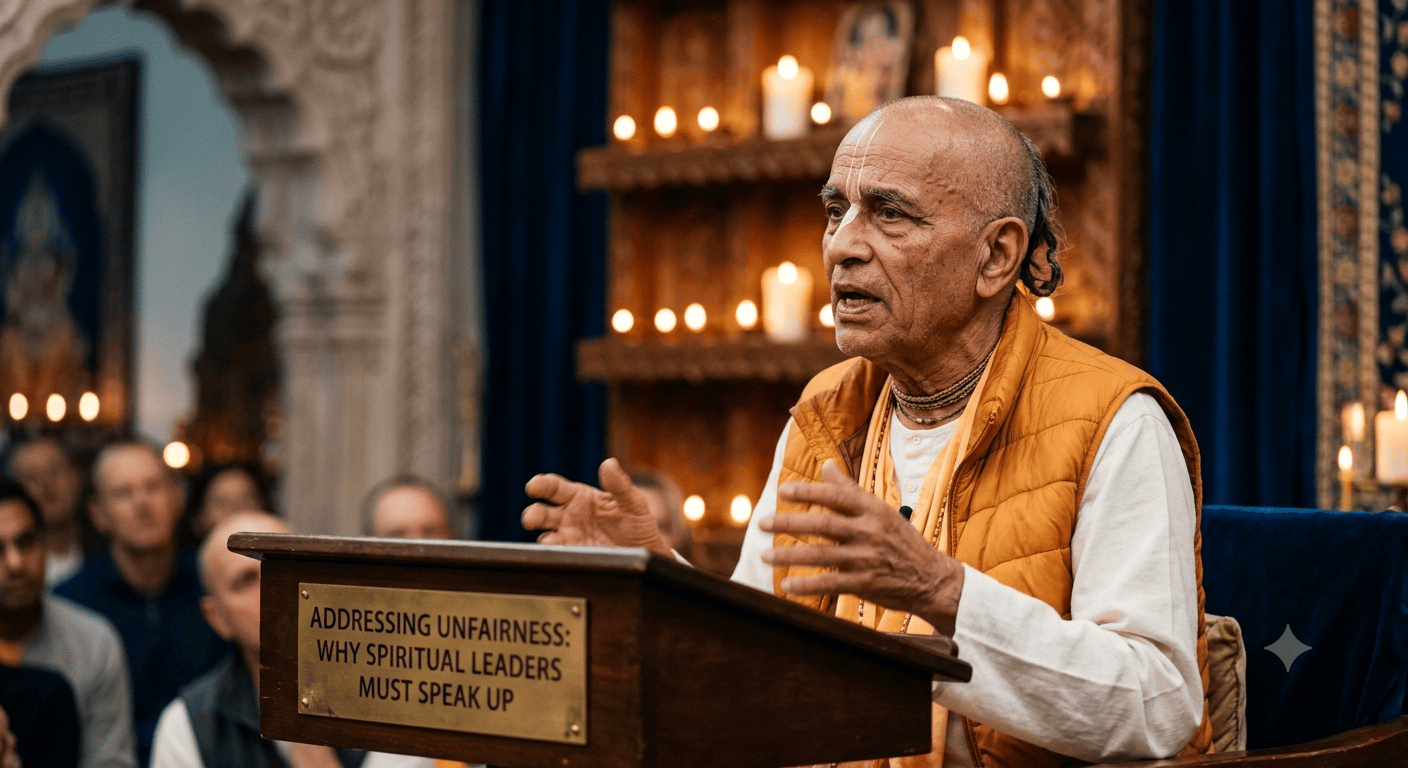
There is a beautiful verse in the Bhagavad Gita where Lord Krishna tells Arjuna that whenever righteousness declines and injustice rises, the Divine intervenes to restore balance (Gita 4.7). This is not just a cosmic promise — it is also a call to each of us, especially those who walk the path of devotion, to stand for what is right.
At The Bhakti House, we believe that love for God and love for people are inseparable. Bhakti Yoga — the yoga of devotion — is not just about closing our eyes in prayer. It is also about opening our eyes to the suffering of others. When we chant the holy names, when we offer our hearts in kirtan (devotional singing), we are connecting with a God who deeply cares about every living being. And if God cares, shouldn’t we?
This article is a gentle but honest exploration of why spiritual leaders have a sacred responsibility to address unfairness — and how Bhakti wisdom lights the way.
Dharma: The Foundation of Righteous Action
In the Bhakti tradition, the word dharma means much more than religion. It points to righteousness, sacred duty, and the moral order that holds the universe together. When unfairness goes unchallenged, dharma is disturbed. And when dharma is disturbed, suffering multiplies.
The Srimad Bhagavatam, one of the most beloved Bhakti scriptures, is filled with stories of devoted souls who stood up against injustice — not out of anger, but out of compassion. Prahlad Maharaj, a young boy devoted to Lord Vishnu, peacefully resisted the cruelty of his own father, the tyrant Hiranyakashipu. His resistance was not political. It was spiritual. It came from a heart so full of God’s love that it simply could not stay silent in the face of wrong.
This is the Bhakti way. We do not speak up because we are bitter. We speak up because we love.
Every Soul Is Sacred
One of the most foundational teachings in Bhakti philosophy is that every living being carries a spark of the Divine within them. The Bhagavad Gita (5.18) describes a truly wise person as one who sees with equal vision — the learned scholar, the humble laborer, the animal, and even the outcast.
When a spiritual leader truly absorbs this teaching, silence in the face of injustice becomes impossible. If every soul is sacred, then every act of unfairness — whether it is discrimination, exploitation, neglect, or abuse — is an offense against the Divine presence within that person. Spiritual leaders who understand this cannot look away.
Why Silence Can Become Complicity
The Danger of Comfortable Spirituality
It can be tempting to keep spirituality “comfortable.” Many communities prefer talks about peace, gratitude, and inner bliss — and those things are genuinely important. But when spiritual spaces avoid difficult conversations about unfairness, they risk becoming places of privilege rather than places of transformation.
The great Bhakti saint Chaitanya Mahaprabhu, who appeared in 16th-century India, did not stay in his comfort zone. He openly challenged the rigid caste system of his time by embracing people from all backgrounds and inviting everyone — regardless of birth, status, or past mistakes — into the practice of congregational chanting (sankirtana). His movement was revolutionary precisely because it was devotional. Love, he showed, is the most powerful force for justice.
When spiritual leaders remain silent about unfairness, their silence can unintentionally communicate that God does not care. And that message is deeply harmful.
When Leaders Stay Quiet, People Feel Unseen
Many people come to spiritual communities carrying real wounds — experiences of prejudice, marginalization, financial hardship, or emotional abuse. They come seeking not only solace but also solidarity. They come hoping that the people who speak about God’s love will also reflect God’s love in practical, courageous ways.
When leaders avoid addressing the very injustices that cause these wounds, devotees can feel invisible. They may begin to wonder: “Is this love real? Does it extend to people like me? Does it extend to people outside these walls?”
A spiritual community that only offers mantras without also offering moral courage is incomplete. As the saying goes, the tongue that chants God’s name should also be the tongue that speaks truth with compassion.
What Bhakti Scripture Teaches About Speaking Truth
The Example of Lord Krishna Himself
Lord Krishna, the Supreme Person in the Bhakti tradition, is the ultimate example of a leader who addresses unfairness. In the Mahabharata, He does not passively observe as the Pandavas are cheated, humiliated, and exiled. He acts. He counsels. He advocates. He intervenes.
When Draupadi is publicly dishonored in the court of the Kauravas, Krishna responds — not with indifference, but with protection and eventually with accountability. His message is clear: God does not ignore injustice, and neither should those who claim to follow Him.
In the Bhagavad Gita (18.66), Krishna invites Arjuna to surrender to Him completely, promising to deliver him from all sinful reactions. But this surrender is not passive. It comes in the middle of a battlefield where Arjuna is called to take righteous action. Surrender and action, devotion and courage — in Bhakti, these are not opposites. They are partners.
The Voice of the Bhakti Saints
Throughout history, the great Bhakti saints have been voices for the voiceless. Mirabai defied patriarchal control to follow her devotion freely. Tukaram spoke boldly against hypocrisy among religious elites. Ravidas, born into a community considered “untouchable,” proclaimed the equal dignity of all people through his devotional poetry.
These saints did not separate their love for God from their love for justice. Their kirtan was a protest. Their prayers were proclamations. Their very lives declared that no system of unfairness can stand against the power of sincere devotion.
Sure, here is the sentence with the clickable link:
Check out our website for more bhakti articles.
Practical Ways Spiritual Leaders Can Address Unfairness
Create Safe Spaces for Honest Conversation
One of the simplest yet most powerful things a spiritual leader can do is create space for people to share their experiences honestly. This might look like community discussions after kirtan, reflective circles during retreats, or one-on-one pastoral conversations where people feel truly heard.
In Bhakti, we call this satsanga — the association of truthful, devoted people. Real satsanga is not just about hearing philosophy. It is about creating an atmosphere where truth can be spoken and received with love.
Teach the Full Message of Scripture
It is easy to cherry-pick scriptures that make everyone feel good. But a responsible spiritual leader also teaches the verses that challenge us — the passages about duty, compassion, standing for dharma, and seeing God in every living being.
When leaders teach the Bhagavad Gita’s message of equal vision (sama-darshana), they give their communities a spiritual foundation for addressing bias and inequality. When they share stories of saints who challenged injustice, they give devotees role models for courageous compassion.
Use Your Platform with Humility and Courage
Spiritual leaders often have platforms — whether that is a stage at a temple, a podcast, a social media following, or simply the trust of a small community. Using that platform to name unfairness, to amplify marginalized voices, and to call for righteous action is not “being political.” It is being faithful.
Of course, this must be done with humility. Bhakti is not about self-righteous grandstanding. It is about serving the truth with a heart full of love. A spiritual leader who speaks about injustice should do so with tears of compassion, not with fists of ego.
Model Accountability Within Your Own Community
Before speaking about unfairness in the wider world, spiritual leaders must be willing to address it within their own communities. Are all people truly welcome? Are leadership structures fair and transparent? Are concerns taken seriously? Is power shared appropriately?
The Bhakti path asks us to be honest with ourselves first. As the saying attributed to many wise teachers goes, “Charity begins at home.” A community that models fairness internally becomes a credible voice for justice externally.
Partner with Others Working for Good
Bhakti does not require us to work alone. Spiritual leaders can partner with other organizations, interfaith groups, nonprofits, and community advocates who are already doing the work of justice. This kind of collaboration reflects the Bhakti spirit of humility — recognizing that God works through many hands and many hearts.
Service, or seva, is one of the nine limbs of Bhakti described by Prahlad Maharaj in the Srimad Bhagavatam (7.5.23). When we serve others — especially those who are suffering from unfairness — we are serving God directly.
Overcoming the Fear of Speaking Up
Trust That God Supports Righteous Action
One of the reasons spiritual leaders hesitate to address unfairness is fear — fear of controversy, fear of losing followers, fear of being misunderstood. These fears are human and understandable. But the Bhagavad Gita reminds us again and again that when we act in alignment with dharma, Krishna Himself stands with us.
“Wherever there is Krishna, the master of all mystics, and wherever there is Arjuna, the supreme archer, there will certainly be opulence, victory, extraordinary power, and morality” (Gita 18.78). This verse is not just about a battlefield. It is about every moment when a devoted soul chooses righteousness over comfort.
Start Small, Stay Sincere
You do not have to become an activist overnight. Sometimes addressing unfairness starts with a single honest conversation, a prayer offered on behalf of someone who is suffering, or a quiet act of inclusion that no one else notices.
In Bhakti, sincerity matters more than scale. God sees the heart. A spiritual leader who takes even one sincere step toward justice — with devotion, humility, and love — sets an example that ripples far beyond what they can see.
An Invitation for Every Heart
Wherever you are on your journey, whatever your background, whatever your tradition — you are welcome here. The path of Bhakti Yoga teaches us that love is the most powerful force in creation, and that love naturally moves us toward truth, compassion, and courageous action.
If you are a spiritual leader, we gently encourage you: do not let fear silence the love that lives in your heart. Speak up for those who are treated unfairly. Let your chanting, your prayer, your teaching, and your service reflect the full beauty of a God who cares about every single soul.
And if you are someone who has been hurt by unfairness, please know this: you are seen. You are valued. You carry the Divine within you, and no injustice can ever diminish that sacred light.
Take one sincere step today. Chant one prayer. Speak one truth. Offer one act of kindness. God receives every offering of the heart — no matter how small — with infinite love.
You are welcome at The Bhakti House, just as you are.

