
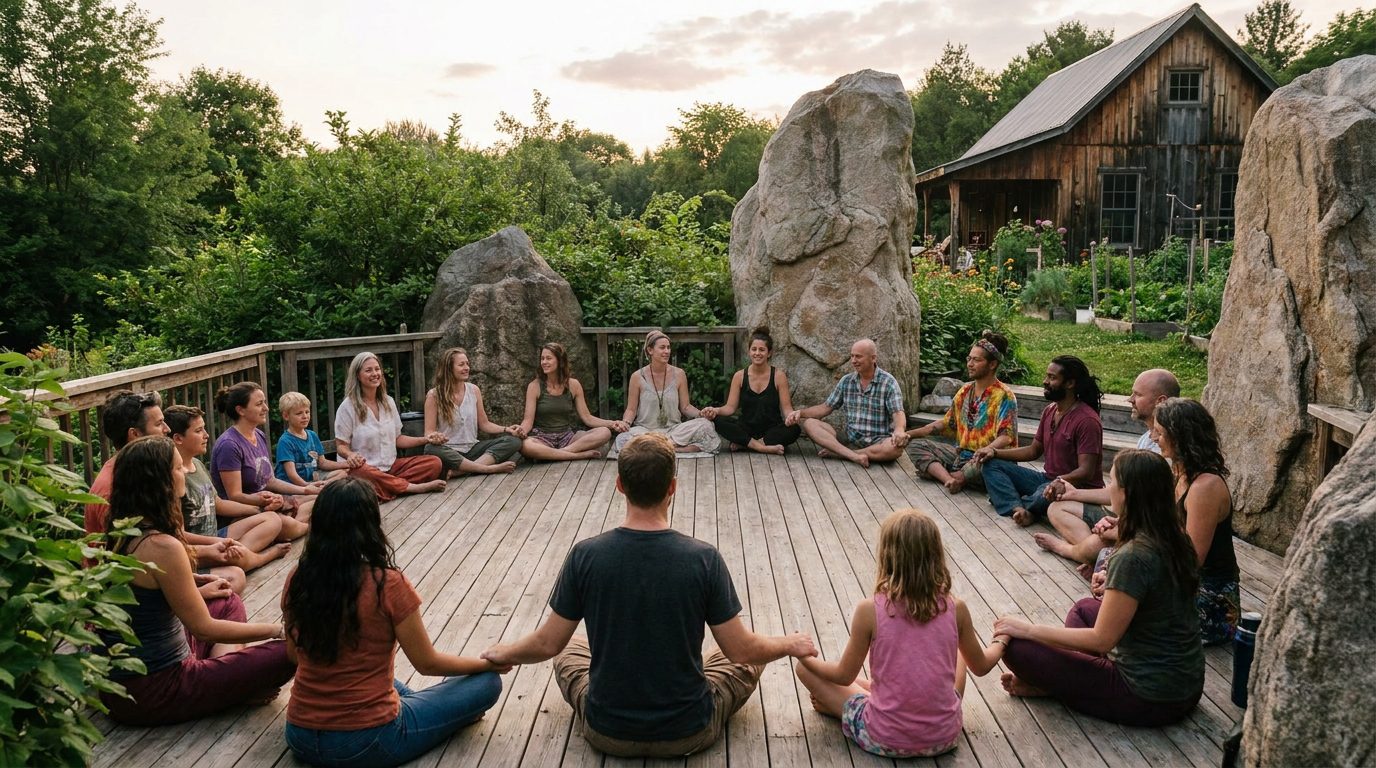
There is a beautiful verse in the Bhagavad Gita (10.9) where Lord Krishna describes the nature of His devoted community:
“Mac-cittā mad-gata-prāṇā, bodhayantaḥ parasparam, kathayantaś ca māṁ nityaṁ, tuṣyanti ca ramanti ca.”
“With their minds absorbed in Me, their lives surrendered to Me, enlightening one another and always speaking about Me, they feel deep satisfaction and joy.”
This is the picture of a spiritual community at its most alive — not a community built on obligation or hierarchy, but one built on mutual love, shared purpose, and joyful contribution. At The Bhakti House, we believe this kind of community isn’t a relic of ancient India. It’s something we can create right here, right now, wherever we are.
Whether you’re new to spirituality or you’ve been walking this path for years, you have something precious to offer. A contributory spiritual community isn’t about a few people doing everything while others watch. It’s about every single person bringing their unique gifts, their sincere heart, and their willingness to serve — and discovering that in giving, we receive the deepest fulfillment.
Let’s explore what this looks like in practice.
A contributory spiritual community is one where every member actively participates in the life, growth, and well-being of the group. Rather than being passive consumers of spiritual content, each person becomes a living part of something greater than themselves.
In the Bhakti tradition, this kind of community is often called saṅga — spiritual association. The word saṅga literally means “connection” or “association,” and it carries the understanding that who we spend time with deeply shapes who we become. The Śrīmad-Bhāgavatam (11.2.30) teaches that saṅga with devotees is the gateway to the path of liberation and love.
But saṅga isn’t just about being in the same room. It’s about being in the same heart space — caring for one another, lifting one another up, and contributing to a shared spiritual atmosphere.
The Difference Between Consuming and Contributing
In our modern world, we’re often trained to be consumers. We attend events, listen to talks, stream content, and absorb information. There’s nothing wrong with receiving — we all need nourishment. But when receiving is all we do, something essential is missing.
A contributory community invites us into a different posture. Instead of asking, “What can I get from this?” we begin to ask, “What can I offer?” This shift is at the very heart of Bhakti Yoga, the path of devotion. Bhakti is, by its nature, about giving — giving our attention to God, giving our love, giving our time and energy in service to others.
When everyone in a community makes this shift, even in small ways, something truly magical happens. The community comes alive. It becomes self-sustaining, nourishing, and deeply joyful.
Spiritual Community in the Bhakti Tradition
The great Bhakti saints, such as Śrī Caitanya Mahāprabhu, demonstrated that spiritual life is not meant to be practiced in isolation. Caitanya Mahāprabhu would gather people from every walk of life — scholars and simple villagers, wealthy merchants and those with nothing — and invite them all to chant the holy names together. No one was excluded. Everyone was valued.
His movement was inherently contributory. Some people cooked, some swept the temple, some led kīrtana (devotional chanting), some offered counsel, and some simply showed up with an open heart. Each contribution mattered. Each person was essential.
This is the model we aspire to at The Bhakti House.
Why Community Matters on the Spiritual Path
It can be tempting to think of spirituality as a solo endeavor. And yes, there are deeply personal dimensions of our relationship with God — our private prayers, our quiet moments of meditation, the still small voice of the Divine speaking to our hearts.
But the Bhakti tradition consistently emphasizes that we need each other. We need community not as a luxury, but as a lifeline.
Protection and Encouragement
The spiritual path isn’t always easy. There are times of doubt, dryness, and struggle. In those moments, community becomes a shelter. When your faith wavers, someone else’s steady devotion can carry you. When you feel alone, the warmth of spiritual friends reminds you that you are deeply connected.
The Śrīmad-Bhāgavatam (3.25.25) explains that association with saintly persons opens the door to the path of liberation. Simply being around others who sincerely love God has a purifying and uplifting effect on our own hearts.
Accountability and Growth
A contributory community also provides gentle accountability. When we commit to showing up — whether it’s for a weekly kīrtana gathering, a service project, or a study group — we grow in ways we never would on our own. Others see our blind spots with compassion. Others celebrate our progress. Others help us stay on track when the distractions of the world pull at our attention.
Modeling Love in Action
Perhaps most importantly, spiritual community gives us a place to practice love. It’s one thing to feel devotion during meditation. It’s another to practice patience with a fellow community member, to serve someone who is struggling, or to offer forgiveness when misunderstandings arise. Community is where our spirituality is tested, refined, and made real.
Practical Ways to Build a Contributory Spiritual Community
Building this kind of community doesn’t require a large temple, a big budget, or perfect conditions. It requires sincerity, humility, and a willingness to start where you are.
Start With Shared Spiritual Practices
The foundation of any Bhakti community is shared practice. This can be as simple as gathering in someone’s living room for kīrtana — the devotional chanting of God’s holy names. Kīrtana is one of the most powerful and accessible Bhakti practices. You don’t need to be a musician. You don’t need to have a beautiful voice. You just need a willing heart.
You might also gather for bhajana (devotional songs), japa meditation (quietly chanting on beads), or reading and discussing sacred texts like the Bhagavad Gita or the Śrīmad-Bhāgavatam. The key is regularity. Even meeting once a week or twice a month creates a rhythm that people can count on.
Create Opportunities for Service
Sevā — selfless service — is one of the pillars of Bhakti Yoga. A contributory community thrives when there are meaningful opportunities for people to serve. This might include cooking and sharing prasādam (food offered to God with love), helping organize events, maintaining a gathering space, mentoring newcomers, or serving the wider community through charitable work.
When you invite people to serve, you’re not burdening them. You’re honoring them. You’re saying, “Your hands, your heart, your time — they matter. You are needed here.” This is one of the most powerful gifts you can give another person.
Encourage Everyone’s Unique Gifts
Not everyone will lead kīrtana. Not everyone will cook. Not everyone will teach. And that’s perfectly beautiful. A truly contributory community recognizes and celebrates the diversity of gifts that each person brings.
Some people have a gift for listening and offering comfort. Some are natural organizers. Some bring artistic beauty into sacred spaces. Some have a quiet, steady presence that calms everyone around them. Every gift is a form of devotion when it’s offered with love.
As leaders or organizers, our role is to help people discover their gifts and find meaningful ways to offer them. Ask people what they love to do. Invite them into roles that fit their nature. Watch them light up.
Practice Radical Hospitality
One of the hallmarks of a Bhakti community is that everyone is welcome. The Bhagavad Gita (9.32) makes this astonishingly clear — Lord Krishna says that regardless of background, anyone who takes shelter in Him can attain the supreme destination. There are no prerequisites, no entrance exams, no required qualifications.
This means our communities must be places where newcomers feel genuinely embraced. Where people who are different from us are treated with respect and warmth. Where the door is always open and the heart is always ready to receive another soul seeking the Divine.
Hospitality in the Bhakti tradition is not just a nice gesture. It is a spiritual practice. When we welcome another person, we are welcoming God Himself, who resides in every heart.
Sure, here is the sentence with the clickable link:
You can find more bhakti articles here.
Navigating Challenges in Community Life
Let’s be honest — community is not always easy. Wherever people gather, there will be misunderstandings, disagreements, and imperfections. This is not a sign that something is wrong. It’s a sign that we are human beings learning to love.
Handling Conflict With Humility
The Bhakti path teaches us to cultivate humility — amāninā, as Caitanya Mahāprabhu taught, meaning to offer respect to others without expecting respect for oneself. When conflict arises, this principle is our anchor. We can choose to listen before reacting. We can choose to assume good intentions. We can choose to speak the truth with gentleness rather than harshness.
Conflict handled well can actually deepen community bonds. It builds trust. It teaches us that love doesn’t mean the absence of difficulty — it means the presence of commitment even in difficulty.
Avoiding Burnout Among Contributors
In many communities, a small number of dedicated souls end up carrying most of the weight. This leads to exhaustion and resentment, and it’s the opposite of a truly contributory model. Building a healthy community means distributing responsibilities widely, checking in with those who serve regularly, and creating a culture where it’s okay to rest.
Even God rests, as the scriptures playfully describe. We can too.
Keeping the Center on God
The most important thing in any spiritual community is that God remains at the center. When a community revolves around a single personality, a social agenda, or any purpose other than sincere devotion, it loses its spiritual potency. But when everything points back to the Lord — the chanting, the service, the relationships, the celebrations — a community becomes a living temple, a place where the Divine is tangibly present.
Growing Together in Love and Devotion
A contributory spiritual community is not a finished product. It is a living, breathing, ever-evolving expression of collective devotion. It grows as its members grow. It deepens as their love deepens. It becomes more beautiful as each person offers more of their authentic self.
Celebrating the Journey
Take time to celebrate together. Celebrate festivals like Janmāṣṭamī (the appearance of Lord Krishna) and Gaura Pūrṇimā (the appearance of Caitanya Mahāprabhu). Celebrate personal milestones — someone’s first kīrtana, a year of daily japa, a newborn child, a life transition navigated with faith. These celebrations bind us together and remind us that the spiritual path, while serious, is also full of sweetness and joy.
Passing the Flame
One of the most beautiful aspects of a contributory community is that it naturally reproduces. When people are nourished and empowered, they carry the flame to others. They start their own gatherings. They invite their friends. They become the welcoming hand that reaches out to the next searching soul.
This is how the Bhakti tradition has always spread — not through force or argument, but through the contagious beauty of love lived in community.
Your Invitation to Begin
Wherever you are today, whatever your background, whatever your experience with spirituality — you are welcome here. You don’t need to have all the answers. You don’t need to be perfect. You don’t even need to know a single Sanskrit word.
All you need is a sincere desire to connect with something greater than yourself and a willingness to take one small step.
That step might be showing up to a kīrtana for the first time. It might be offering to help cook a meal for a gathering. It might be simply reaching out and saying, “I’d like to be part of this.”
Whatever your step looks like, know this: it matters. You matter. Your presence, your heart, your unique gifts — they are exactly what this community needs.
As the Bhagavad Gita (6.30) promises, for one who sees God everywhere and sees everything in God, the Lord is never lost, and that person is never lost to the Lord.
You are never lost. You are always welcome. And together, one sincere step at a time, we can build a community that reflects the love at the heart of all creation.
With warmth and devotion,
The Bhakti House �DigestAnchor

