
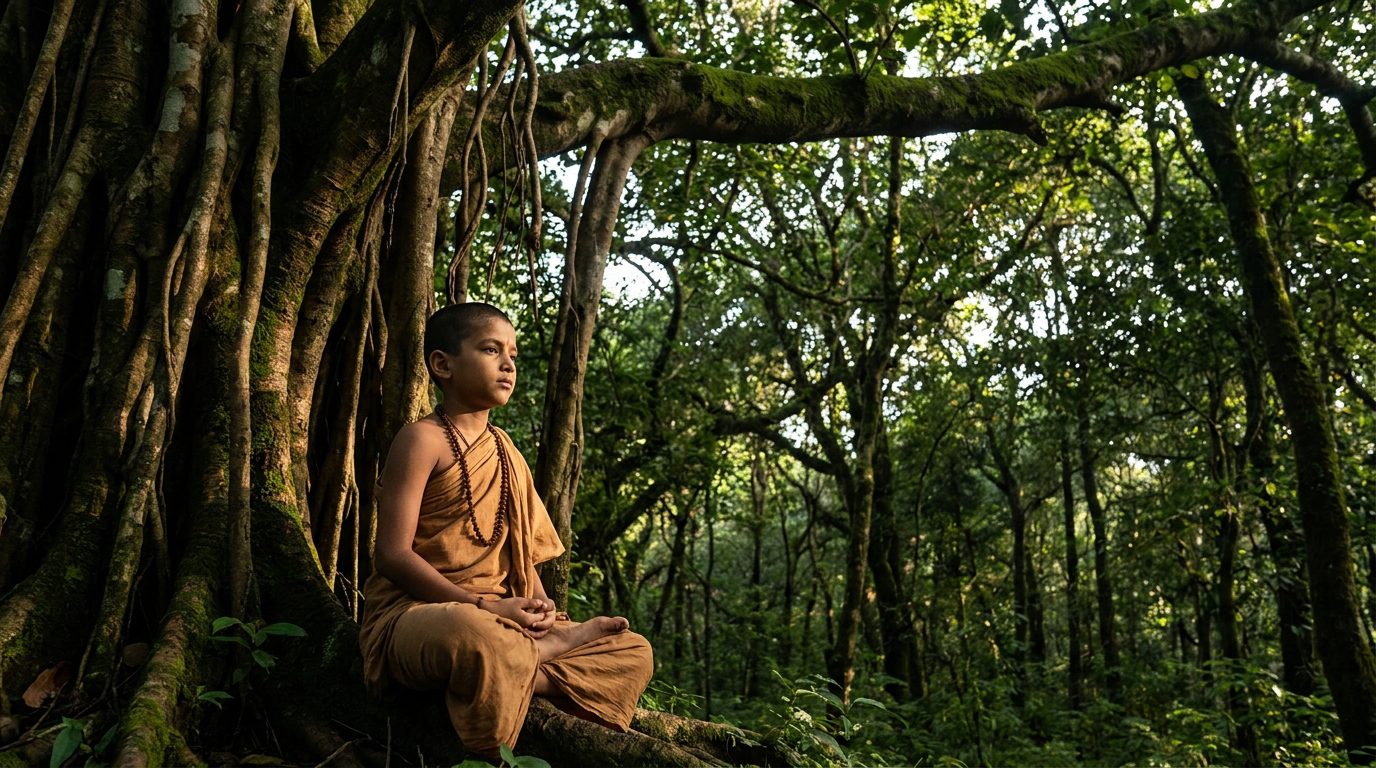
Have you ever felt overlooked, unappreciated, or pushed aside by someone who should have loved you? If so, the story of Dhruva Mahārāja might speak to your heart in a way you never expected.
This ancient account from the Śrīmad-Bhāgavatam (Canto 4, Chapters 8–12) tells us about a five-year-old prince who left his palace, entered a dangerous forest, and performed devotion so sincere that the Supreme Lord Himself appeared before him. What began as a quest fueled by hurt feelings became one of the most beloved stories of spiritual transformation in the entire Bhakti tradition.
Whether you’re new to Bhakti Yoga or have been walking this path for years, Dhruva’s journey holds timeless lessons about prayer, determination, the power of the holy name, and the incredible grace that meets us when we take even one sincere step toward God.
Let’s walk through this beautiful story together.
The Painful Rejection That Started Everything
A Child’s Broken Heart
Dhruva was the son of King Uttānapāda and his first queen, Sunīti. The king, however, had another wife named Suruci, who was proud and favored by the king. One day, young Dhruva saw his half-brother Uttama sitting on their father’s lap. Naturally, as any small child would, Dhruva wanted to climb up and sit on his father’s lap too.
But Queen Suruci stopped him. She spoke words that would cut any child to the core. She told Dhruva that if he wanted to sit on the king’s throne, he should have been born from her womb, not from Sunīti’s. She cruelly told him to go and pray to the Lord if he wanted such a blessing.
The Śrīmad-Bhāgavatam describes young Dhruva’s reaction vividly. He was breathing hard with anger and hurt, and his lips were trembling. He looked at his father’s face for some sign of comfort or defense, but the king remained silent — too attached to Suruci to speak up for his own son.
Dhruva ran to his mother, crying.
A Mother’s Gentle Wisdom
Sunīti, though heartbroken herself, did not speak bitterly about Suruci or the king. Instead, she offered her son the most powerful advice a devotee could give. She told Dhruva that Queen Suruci’s words, though harsh, actually contained truth — that one should indeed take shelter of the Supreme Lord.
She encouraged her little boy to meditate on the lotus feet of the Lord, saying that only He could remove the pain in Dhruva’s heart.
This is a powerful moment for all of us. Sometimes the people who hurt us accidentally point us in the right direction. Sunīti’s humility and devotion transformed a moment of cruelty into a doorway to God.
Dhruva’s Journey into the Forest
Meeting the Sage Nārada
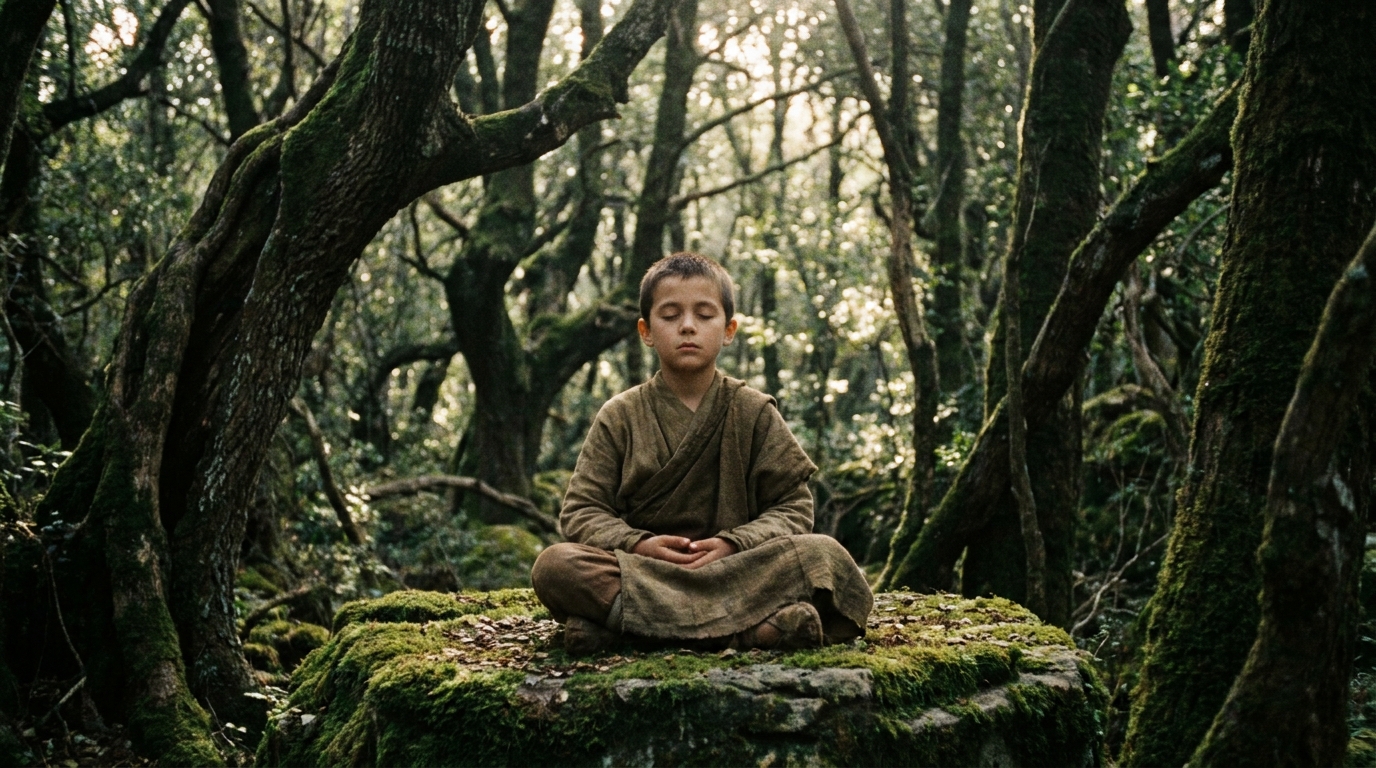
With a heart full of determination, five-year-old Dhruva left the palace and headed for the forest. Along the way, the great sage Nārada Muni appeared before him. Nārada — who is known throughout Bhakti literature as a devoted servant of God who travels the universe chanting and inspiring others — tested the boy’s resolve.
Nārada gently tried to dissuade Dhruva, telling him that he was too young, that the path of spiritual practice is difficult even for grown men and seasoned yogīs. He suggested that Dhruva simply go home and try again when he was older.
But Dhruva’s determination was unshakable.
Seeing the boy’s sincerity, Nārada’s heart melted. He then instructed Dhruva to go to Madhuvana, a sacred forest on the bank of the Yamunā River. He taught the boy how to meditate, how to control his breath, and most importantly, he gave him the sacred mantra:
oṁ namo bhagavate vāsudevāya
This twelve-syllable mantra — meaning “I offer my respectful obeisances unto the Supreme Lord, Vāsudeva (Kṛṣṇa)” — is one of the most powerful mantras in the Bhakti tradition. Nārada instructed Dhruva to meditate on the beautiful form of the Lord while chanting this mantra with devotion.
The Intensity of Dhruva’s Practice
What Dhruva did next is almost beyond belief. This small child went into the forest of Madhuvana and began practicing austerities and meditation with a focus that astonished even the celestial beings (the demigods).
The Śrīmad-Bhāgavatam (4.8.79) describes how Dhruva progressively intensified his practice:
In the first month, he ate only fruits and berries every three days. In the second month, he ate only dry grass and leaves every six days. In the third month, he drank only water every nine days. In the fourth month, he inhaled air only every twelve days. By the fifth month, he had completely controlled his breathing and stood on one leg, meditating on the Lord with unwavering concentration.
The Bhāgavatam (4.8.78) states:
“dhruva uvāca — sa vai dhiyā yoga-vipāka-tīvrayā / hṛt-padma-kośe sphuritaṁ taḍit-prabham”
His meditation became so deep and powerful that the entire universe began to tremble. The demigods became alarmed and approached Lord Viṣṇu, asking Him to intervene.
This part of the story is not meant to intimidate us. We are not being asked to stand on one leg in a forest! Rather, it shows us the power of sincere determination. Dhruva was just a child, but his heart was fully absorbed. In Bhakti Yoga, it is the sincerity of the heart — not the outward austerity — that attracts God’s grace.
Check out our website for more articles: more articles.
The Lord Appears: Grace Beyond Imagination
When God Comes to His Devotee
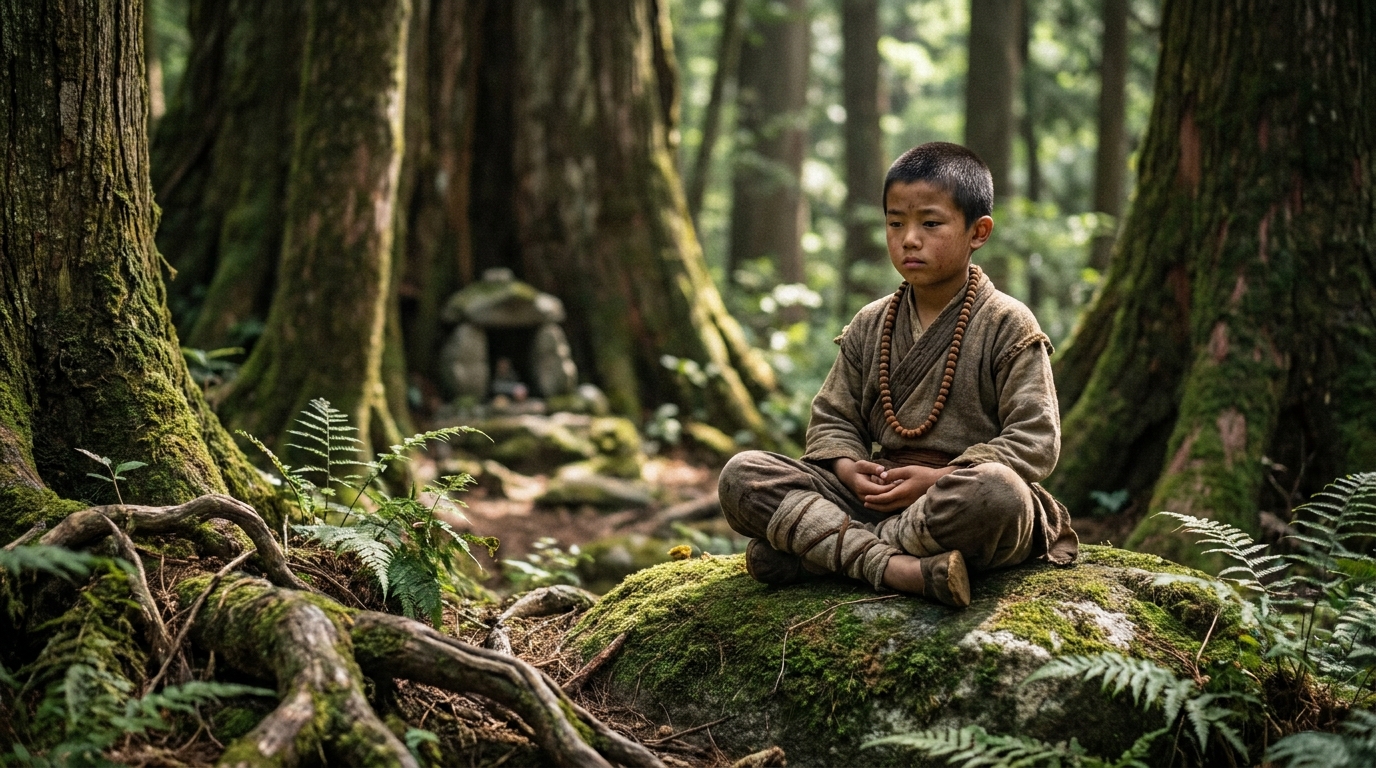
Pleased by Dhruva’s devotion, the Supreme Lord Viṣṇu personally appeared before the boy. Imagine this scene — a small child, standing alone in the forest, and the all-beautiful, all-powerful Lord of the universe arrives before him in His four-armed form, radiant and compassionate.
The Bhāgavatam describes that Dhruva had been meditating on the Lord within his heart, and when the form suddenly disappeared from his inner vision, he opened his eyes — and there was the same Lord standing right in front of him.
Dhruva fell to the ground, overwhelmed. He wanted to offer prayers, but he was just a five-year-old boy. He didn’t have the words. In one of the most tender moments in all of scripture, the Lord touched His conchshell to Dhruva’s cheek, and immediately, divine knowledge and eloquence awakened within the child.
Dhruva then spoke prayers of extraordinary beauty and depth. In Śrīmad-Bhāgavatam 4.9.6, he prays:
“sthānābhigamāt tapaso ‘bhitapyamānānāṁ sthitīnāṁ…”
He glorified the Lord as the source of everything, the one who exists within every heart, and the supreme shelter of all beings.
The Transformation: From Material Desire to Pure Love
Here is where the story reaches its deepest turning point. Dhruva had originally gone to the forest to gain a kingdom greater than his father’s — to prove his stepmother wrong. His motivation, at first, was mixed with material desire and wounded pride.
But after seeing the Lord face to face, everything changed.
Dhruva spoke one of the most famous and moving verses in the Śrīmad-Bhāgavatam (4.9.35):
“svaṁ rājyam anvīkṣamāṇasya… paraṁ padam āsādya”
He expressed deep regret, saying that he had approached the Lord seeking broken pieces of glass (material blessings) when the Lord was ready to offer him the most precious jewel (pure devotional love). He compared himself to a man who goes before a great emperor and asks only for a few grains of rice.
This is such a relatable human experience. How often do we approach God with small, self-centered requests when He is ready to give us something infinitely greater — a loving relationship with Him? Dhruva’s honest regret teaches us that it’s okay to come to God with imperfect motives. The beauty of Bhakti is that even impure motives get purified along the way.
As Śrīla Prabhupāda, the founder-ācārya of ISKCON, writes in his commentary: the process of devotional service is so powerful that even if one begins with material desires, the contact with the Supreme Lord purifies the heart completely.
Lessons from Dhruva’s Story for Our Daily Lives
Sincerity Matters More Than Perfection
Dhruva was not a perfected yogī. He was a hurt, angry little boy. Yet his sincerity attracted the mercy of God. This is one of the most encouraging truths in Bhakti Yoga: you don’t have to be perfect to begin. You just have to be sincere.
In your own life, you can start right where you are. Chant a simple prayer. Sing God’s names. Offer a flower or a glass of water with love. The Lord sees the heart, not the presentation.
Pain Can Become a Doorway
Dhruva’s journey began with rejection and pain. Many of us come to spiritual life in the same way — through loss, heartbreak, or a feeling that something is missing. Dhruva’s story reminds us that our struggles are not meaningless. They can become the very force that pushes us toward the divine.
The Power of the Holy Name
Nārada gave Dhruva a mantra, and it was through chanting and meditating on that mantra that Dhruva achieved perfection. In the Bhakti tradition, the chanting of God’s names — especially the mahā-mantra, Hare Kṛṣṇa, Hare Kṛṣṇa, Kṛṣṇa Kṛṣṇa, Hare Hare / Hare Rāma, Hare Rāma, Rāma Rāma, Hare Hare — is considered the most accessible and powerful spiritual practice for our current age.
You don’t need to go to a forest. You can chant in your living room, on your morning walk, or in your car. The holy name carries the same power today that it carried for Dhruva thousands of years ago.
Good Association Changes Everything
Without Nārada Muni’s guidance, Dhruva might have wandered the forest aimlessly. The sage gave him direction, a mantra, and encouragement. In the same way, having the association of sincere devotees — people who chant, serve, and share their love of God — can transform our spiritual journey. This is one of the beautiful gifts of community in Bhakti.
God Gives More Than We Ask For
Dhruva asked for a kingdom. God gave him Himself — the highest blessing in all of existence. The Lord also granted Dhruva a kingdom as a bonus, but Dhruva’s heart had been changed. He ruled his kingdom as a loving servant of God, not as a proud monarch.
This teaches us to trust that when we offer our hearts to God, He knows what we truly need — and He gives abundantly beyond our imagination.
Dhruva’s Legacy: The Pole Star of Devotion
After a long and righteous life of devotion and service, Dhruva Mahārāja was elevated to Dhruvaloka — the polestar, that fixed, unwavering star around which all other stars appear to revolve. In the Bhakti tradition, this is understood not merely as an astronomical reference, but as a symbol of Dhruva’s unshakable devotion.
Just as the polestar remains fixed while everything else moves, Dhruva’s love for God became the immovable center of his existence. The Śrīmad-Bhāgavatam (4.12.36) describes his glorious departure from this world, accompanied by celestial beings and divine aircraft, ascending to his eternal abode.
His story has inspired millions of seekers across centuries. In India, children grow up hearing about “Dhruva the boy devotee,” and his example continues to ignite faith in people of every age and background.
You Are Welcome on This Path
If Dhruva’s story stirs something in your heart — even a small spark of curiosity, hope, or longing — please know that you are welcome here. Bhakti Yoga is not reserved for scholars, monks, or people who were born into a particular tradition. It is a path of love, and love has no prerequisites.
You don’t need to be perfect. You don’t need to have all the answers. You don’t even need to fully understand what you’re feeling right now.
Like Dhruva, all you need to do is take one sincere step. Pick up a set of japa beads and chant. Listen to a beautiful kīrtana (devotional song). Offer a simple prayer from your heart. Read a verse from the Śrīmad-Bhāgavatam. Visit your nearest Bhakti community and share a meal with devotees.
The same Lord who appeared before a five-year-old boy in the forest is present right now, within your heart, waiting patiently for you to turn toward Him.
As Śrīla Prabhupāda often reminded us: “The Lord is never far from those who sincerely call upon Him.”
Take that one step today. You might be surprised at what — or Who — comes to meet you.
With love and encouragement from all of us at The Bhakti House. 🙏
FAQs
What is the story of Dhruva Mahārāja?
Dhruva Mahārāja was a young prince who sought to earn the love and respect of his father and stepmother. After being mistreated by his stepmother, he sought the guidance of a sage and embarked on a journey of intense meditation and devotion to Lord Vishnu. His dedication and penance earned him the status of a celestial being and a place in the heavens as the pole star.
What are the teachings of Dhruva Mahārāja’s story?
The story of Dhruva Mahārāja teaches the importance of determination, devotion, and perseverance in the pursuit of spiritual growth and self-realization. It also emphasizes the power of sincere prayer and meditation in achieving one’s goals and earning the grace of the divine.
What is the significance of Dhruva Mahārāja in Hindu mythology?
Dhruva Mahārāja is revered as a symbol of unwavering devotion and determination in Hindu mythology. His story is often cited as an example of the transformative power of spiritual practice and the rewards of steadfast faith in the divine.
How is Dhruva Mahārāja honored in Hindu culture?
Dhruva Mahārāja is honored through the recitation of his story in religious texts, as well as through devotional songs and prayers dedicated to him. His example is also used to inspire individuals in their own spiritual pursuits and to emphasize the importance of dedication and perseverance.
What are the key lessons that can be learned from Dhruva Mahārāja’s story?
The story of Dhruva Mahārāja teaches the importance of humility, determination, and unwavering faith in the pursuit of spiritual growth. It also emphasizes the transformative power of sincere devotion and the rewards of perseverance in the face of adversity.

