
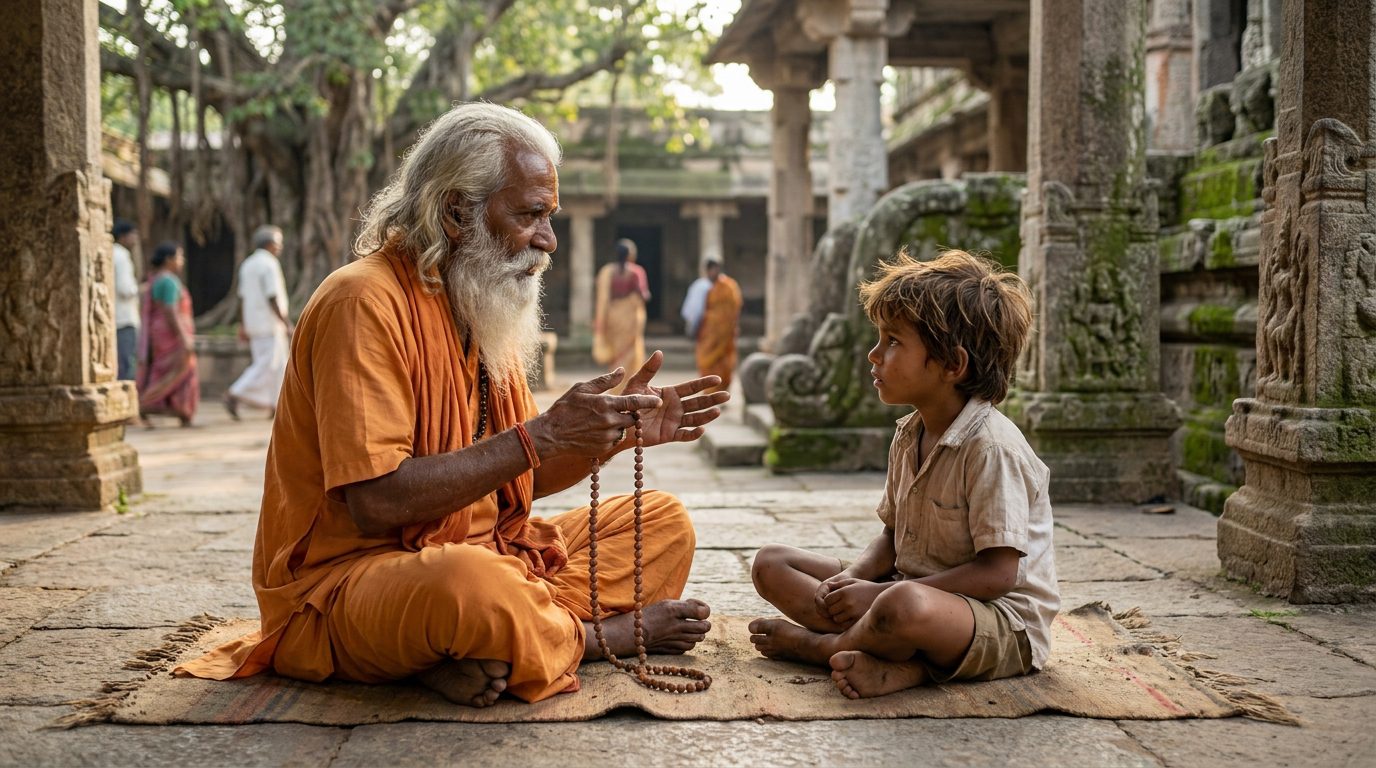
There are stories that stay with us — stories that light up something deep inside, reminding us that love is stronger than fear, and that the Divine never abandons those who call out with a sincere heart.
The story of Prahlāda Mahārāja is one of those stories.
Whether you’re new to the path of Bhakti (devotional love for God) or you’ve been walking it for years, the life of this extraordinary child-saint has something powerful to offer you. Prahlāda’s story isn’t just ancient history — it’s a living teaching about courage, surrender, and the unshakable power of a heart devoted to God.
Let’s walk through it together.
Prahlāda Mahārāja was a young boy born into one of the most unlikely circumstances for a devotee. His father was Hiraṇyakaśipu — a powerful demon king who had conquered the three worlds through severe austerities and who harbored a deep, burning hatred for Lord Viṣṇu (the Supreme Lord, the preserver and sustainer of all creation).
Hiraṇyakaśipu wanted everyone in his kingdom — including his own son — to worship him as God. But Prahlāda, even as a small child, had an unshakable love for Lord Viṣṇu. No matter what his father did to him, Prahlāda could not be moved from his devotion.
A Soul Awakened Before Birth
What makes Prahlāda’s devotion so remarkable is that it began even before he was born. While his mother was pregnant, the great sage Nārada Muni (a wandering saint and devoted servant of God) instructed her in the science of devotion. The baby in her womb absorbed every word.
This is a beautiful reminder that devotion doesn’t require a certain age, education, or social status. The seed of bhakti can be planted anywhere — even in the womb — and it can blossom in the most extraordinary ways.
A Child Among Demons
Imagine being a gentle, God-loving child in a household — indeed, an entire kingdom — that was hostile to everything you held sacred. Prahlāda didn’t grow up in a temple or an āśrama (spiritual community). He grew up surrounded by those who saw devotion to God as the ultimate threat.
Yet his love for the Lord only grew stronger.
The Unbreakable Faith of a Young Devotee
What truly sets Prahlāda apart is not that he knew about God — it’s that he trusted God completely. His faith wasn’t intellectual. It was the faith of a child’s heart, pure and unconditional.
In the Śrīmad-Bhāgavatam (7.9.19), Prahlāda himself speaks with such beautiful humility:
> “My dear Lord, O Supreme Personality of Godhead, because of my association with material desires, one after another, I was gradually falling into a blind well full of snakes, following the general populace. But Your servant Nārada Muni kindly accepted me as his disciple and instructed me how to achieve this transcendental position. Therefore, my first duty is to serve him. How could I leave his service?”
> — Śrīmad-Bhāgavatam 7.9.28 (vedabase.io)
This verse reveals something essential about Bhakti Yoga: devotion often begins through the mercy of another devotee. Prahlāda credits Nārada Muni — not his own greatness — for his spiritual awakening. This humility is the hallmark of a true bhakta (devotee).
Teaching His Classmates
One of the most touching aspects of Prahlāda’s story is that he didn’t keep his devotion to himself. Whenever he had the chance — during recess at school, away from his teachers — he would gather his classmates and share the glories of the Lord with them.
He taught them about the nine processes of Bhakti Yoga. In the Śrīmad-Bhāgavatam (7.5.23), Prahlāda explains:
> “Hearing and chanting about the transcendental holy name, form, qualities, paraphernalia and pastimes of Lord Viṣṇu, remembering them, serving the lotus feet of the Lord, offering the Lord respectful worship, offering prayers to the Lord, becoming His servant, considering the Lord one’s best friend, and surrendering everything unto Him — these nine processes are accepted as pure devotional service.”
> — Śrīmad-Bhāgavatam 7.5.23 (vedabase.io)
These nine limbs of devotion are the very heart of Bhakti Yoga, and they are as practical today as they were thousands of years ago. Chanting God’s names, praying, serving others, offering friendship to the Divine — these are things any of us can do, right where we are.
The Trials of Prahlāda: When Devotion Is Tested
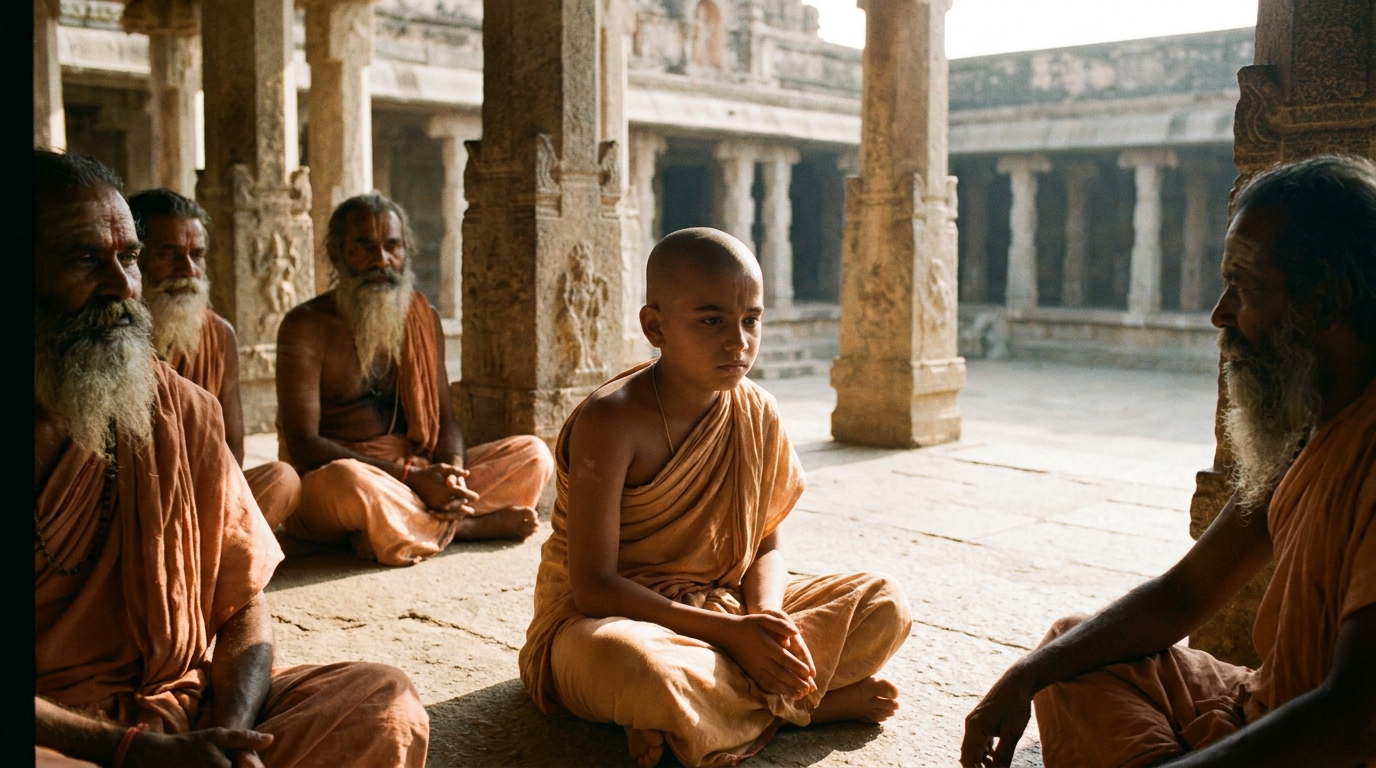
Prahlāda’s devotion was not tested once or twice — it was tested again and again in the most terrifying ways imaginable. His own father, Hiraṇyakaśipu, enraged that his son refused to stop worshiping Viṣṇu, ordered Prahlāda to be killed.
Thrown Before Elephants and Serpents
Hiraṇyakaśipu ordered wild elephants to trample Prahlāda. He had venomous serpents released upon him. But in each case, the boy remained unharmed. He simply continued chanting the Lord’s holy names, his heart peaceful, his mind fixed on God.
Cast into Fire and Off Cliffs
Prahlāda was thrown from the tops of mountains. He was placed in boiling oil. He was locked in a room and set on fire. His father’s sister, Holika — who had a boon that fire could not burn her — sat with Prahlāda in a blazing fire, trying to destroy him. But it was Holika who perished, and Prahlāda who emerged unscathed.
Each of these trials is a powerful metaphor for our own spiritual journey. We may not face literal fire, but we all face moments when the world around us pressures us to give up our faith, our values, or our connection to the Divine. Prahlāda’s example tells us: hold on. God is closer than you think.
The Secret of His Fearlessness
Where did Prahlāda’s courage come from? It wasn’t willpower or stubbornness. It was love. He wasn’t fighting against his father so much as he was resting in God. His fearlessness came from a deep inner knowing that the Lord was always with him.
In the Śrīmad-Bhāgavatam (7.9.43), Prahlāda prays:
> “O best of the great personalities, I am not at all afraid of material existence, for wherever I stay I am fully absorbed in thoughts of Your glories and activities. My concern is only for the fools and rascals who are making elaborate plans for material happiness and maintaining their families, societies and countries.”
> — Śrīmad-Bhāgavatam 7.9.43 (vedabase.io)
This is extraordinary. Prahlāda doesn’t pray for his own safety or comfort. He prays for others — for those who have forgotten God and are suffering because of it. This selfless compassion is one of the highest expressions of Bhakti.
Check out our website for more articles: more articles.
The Appearance of Lord Nṛsiṁhadeva: God Comes for His Devotee
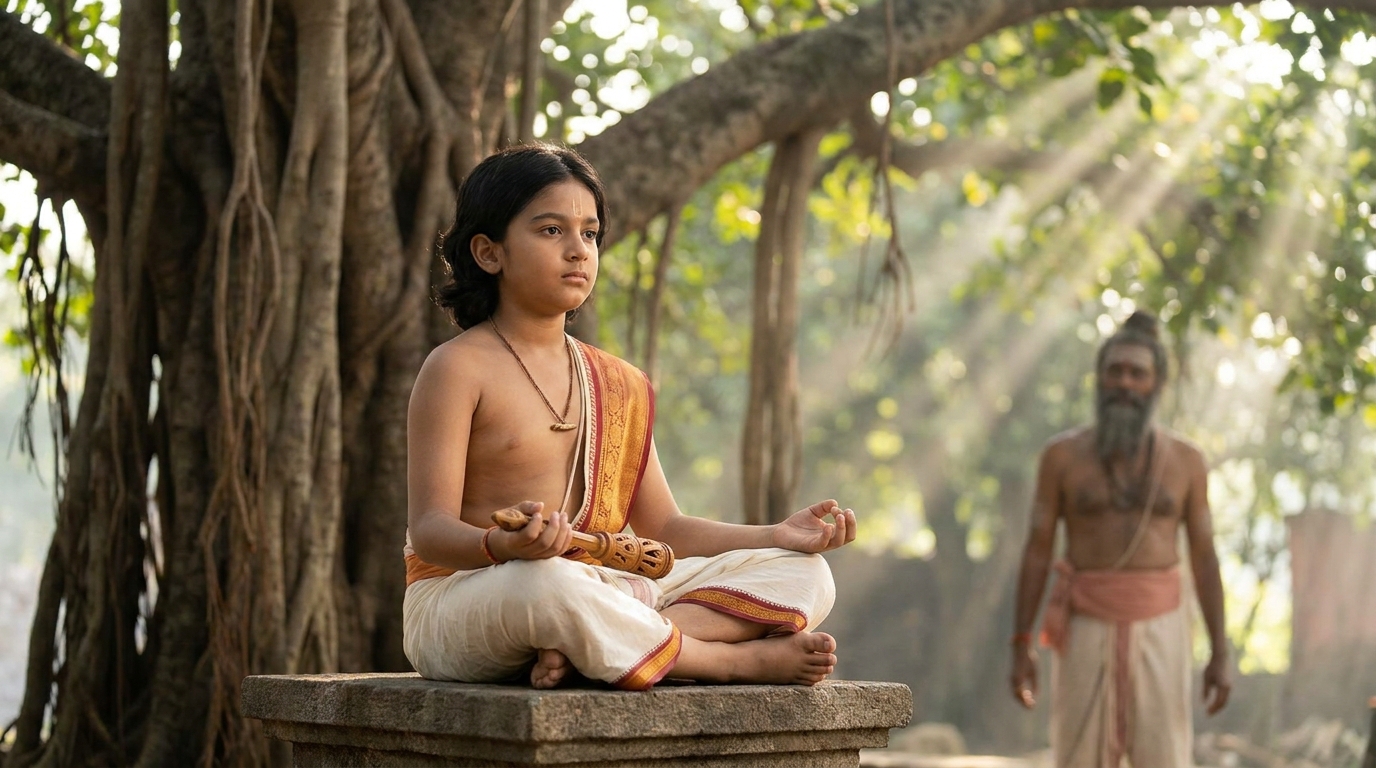
The climax of Prahlāda’s story is one of the most dramatic moments in all of Bhakti literature.
Hiraṇyakaśipu, arrogant and furious, challenged Prahlāda one final time: “Where is your God? Is He in this pillar?”
Prahlāda calmly replied that yes, the Lord is everywhere — even in a pillar.
Hiraṇyakaśipu struck the pillar with his fist, and in that moment, the Lord Himself burst forth in the extraordinary form of Lord Nṛsiṁhadeva — half-lion, half-man — a form no one had ever seen before. This unique form appeared specifically to protect Prahlāda and to fulfill the terms of the various boons that had made Hiraṇyakaśipu feel invincible.
Why This Form?
Hiraṇyakaśipu had received benedictions that he could not be killed by man or beast, indoors or outdoors, during the day or at night, on the earth or in the sky, by any weapon. Lord Nṛsiṁhadeva — who was neither fully man nor fully beast — appeared at twilight (neither day nor night), on the threshold of a doorway (neither indoors nor outdoors), placed Hiraṇyakaśipu on His lap (neither on the earth nor in the sky), and used His divine nails (no weapon) to end the demon’s reign.
This teaches us something beautiful: God’s creativity in protecting His devotees is infinite. There is no obstacle, no trap, no impossible situation that the Lord cannot navigate on behalf of those who love Him.
Prahlāda Calms the Lord
After Hiraṇyakaśipu was slain, Lord Nṛsiṁhadeva was still blazing with transcendental anger. The demigods (celestial beings) were terrified. Even Goddess Lakṣmī (the Lord’s eternal consort) hesitated to approach. But little Prahlāda walked forward without fear, placed his hands together, and began to offer prayers.
The Lord was immediately pacified by the love of His devotee.
This moment shows us the intimate, tender nature of the Divine. God is not a distant, impersonal force. He responds to love. He is moved by sincerity. A child’s pure prayer can calm the Lord of all creation.
What Prahlāda’s Story Teaches Us Today
Devotion Can Flourish Anywhere
You don’t need a perfect environment to practice Bhakti. Prahlāda blossomed spiritually in the most hostile conditions imaginable. If you feel like your surroundings aren’t supportive of your spiritual life, take heart. The Lord sees your effort, and He meets you where you are.
Chanting Is Our Shelter
Throughout every trial, Prahlāda’s constant practice was chanting the holy names of the Lord. This is the most accessible and powerful form of Bhakti Yoga available to us in this age. Whether you chant the Hare Kṛṣṇa mahā-mantra — Hare Kṛṣṇa, Hare Kṛṣṇa, Kṛṣṇa Kṛṣṇa, Hare Hare / Hare Rāma, Hare Rāma, Rāma Rāma, Hare Hare — or simply call out to God in whatever name resonates with your heart, that calling is heard.
Compassion Is the Fruit of True Devotion
Prahlāda didn’t seek liberation for himself. His deepest prayer was for the welfare of all living beings. As quoted earlier, his concern was for those lost in material suffering. Real Bhakti naturally gives rise to compassion — a desire to share the sweetness of God’s love with everyone.
Humility Opens the Door
Despite being the greatest devotee, Prahlāda considered himself ordinary. He credited his spiritual master, Nārada Muni, for everything. This humility is not weakness — it is the very quality that allows divine grace to flow into our lives.
In the Śrīmad-Bhāgavatam (7.9.12), Prahlāda says:
> “My dear Lord, I am certainly not fit to offer prayers to You. I am a small child, born in a family of asuras (demons). Yet even brāhmaṇas and great sages have difficulty offering You suitable prayers. How then is it possible for me?”
> — Śrīmad-Bhāgavatam 7.9.12 (vedabase.io)
And yet, the Lord chose to be pacified by this very child’s prayers. Humility doesn’t disqualify us — it qualifies us.
You Are Welcome on This Path
Prahlāda’s story isn’t just about one remarkable boy who lived long ago. It’s about you. It’s about every person who has ever felt alone in their faith, who has faced opposition for following their heart, or who has wondered if God really hears them.
He does.
You don’t need to be perfect. You don’t need to know all the Sanskrit terms or have read every scripture. You don’t even need to be sure of everything. You just need to take one sincere step — one honest prayer, one heartfelt chant, one moment of opening your heart to the Divine.
At The Bhakti House, we believe that the path of devotion is open to everyone, regardless of background, belief, or experience. Just as Prahlāda showed that love for God can bloom in the most unlikely places, your own journey of bhakti can begin right here, right now.
Take that one step. Chant one name. Offer one prayer. The Lord is already reaching out to meet you.
Hare Kṛṣṇa 🙏
FAQs
What is the significance of Prahlāda Mahārāja in Hindu mythology?
Prahlāda Mahārāja is a significant figure in Hindu mythology as he is known for his unwavering devotion to Lord Vishnu, despite facing opposition from his father, the demon king Hiranyakashipu. His story is often cited as an example of steadfast faith and the triumph of good over evil.
What are the key events in the life of Prahlāda Mahārāja?
Prahlāda Mahārāja’s life is marked by his devotion to Lord Vishnu, his conflict with his father Hiranyakashipu, and his miraculous protection by Lord Vishnu from various attempts on his life by his father and other demons.
What teachings can be derived from the story of Prahlāda Mahārāja?
The story of Prahlāda Mahārāja teaches the importance of unwavering faith, devotion, and righteousness in the face of adversity. It also emphasizes the ultimate victory of good over evil and the protection offered by the divine to those who are devoted.
How is Prahlāda Mahārāja revered in Hindu culture?
Prahlāda Mahārāja is revered as a symbol of devotion and righteousness in Hindu culture. His story is often recited in religious texts, and he is celebrated during festivals and religious ceremonies as an embodiment of faith and divine protection.
What are some popular temples or pilgrimage sites associated with Prahlāda Mahārāja?
There are several temples and pilgrimage sites in India that are associated with Prahlāda Mahārāja, including the Prahlāda Varadhan Temple in Kerala and the Prahlāda Narasimha Temple in Andhra Pradesh. These sites are visited by devotees seeking blessings and inspiration from the story of Prahlāda Mahārāja.

