

Japa is the sacred practice of softly repeating a mantra, usually on beads, with prayerful attention. The word japa comes from Sanskrit and simply means “to repeat” or “to chant quietly.” In Bhakti Yoga, japa is not only a meditation technique. It is a loving conversation with God.
A mantra is a spiritual sound vibration. The Sanskrit word mantra can be understood as “that which frees the mind.” Man refers to the mind, and tra means to protect or liberate. When we chant a mantra, we are inviting the mind to rest in something holy, steady, and full of grace.
In the Bhakti tradition, the most widely practiced mantra for japa is the Hare Krishna Maha Mantra:
Hare Krishna Hare Krishna
Krishna Krishna Hare Hare
Hare Rama Hare Rama
Rama Rama Hare Hare
Maha means “great,” so the Maha Mantra means “the great mantra.” It is a prayer calling out to God and God’s loving energy. “Hare” addresses the divine energy of the Lord, “Krishna” means the all-attractive Supreme Person, and “Rama” means the source of spiritual joy.
At its heart, japa is simple: we chant, we listen, and we offer our heart.
You do not have to be born in a particular tradition, know Sanskrit perfectly, or feel spiritually advanced to begin. Japa is open to everyone. It is a practical path of love for people with busy lives, sincere questions, and hearts longing for peace.
Why Practice Japa?
Japa gives the soul a daily place to come home.
Many of us live with constant noise. Our phones call for attention. Our responsibilities pile up. Our minds replay worries about the past and fears about the future. Japa gently turns us back toward the present moment, where God is waiting with kindness.
In Bhakti Yoga, the goal is not to empty the heart, but to fill it with loving remembrance. The Sanskrit word bhakti means devotion, loving service, or spiritual love. Bhakti Yoga is the path of reconnecting with God through love—by chanting, prayer, service, study, community, and living with compassion.
Japa is one of the most accessible ways to practice Bhakti Yoga every day.
Japa Purifies the Mind
The mind can be restless, scattered, and easily pulled toward fear or desire. In the Bhagavad Gita, Krishna says:
“From wherever the mind wanders due to its restless and unsteady nature, one must certainly withdraw it and bring it back under the control of the self.”
— Bhagavad Gita 6.26
This verse is very practical. It does not shame us for having a wandering mind. It simply teaches us to bring the mind back again and again. That is japa.
Each time the mind wanders and we return to the mantra, we are strengthening our spiritual muscles. We are choosing remembrance over distraction. We are choosing love over anxiety.
Japa Awakens the Heart
In Bhakti scriptures, the name of God is understood to be spiritually powerful and non-different from God. This means that when we chant sincerely, we are not merely repeating ordinary sound. We are entering divine association.
The Srimad Bhagavatam, a treasured Bhakti scripture, describes hearing and chanting about God as a cleansing process for the heart:
“Hearing and chanting the glories of the Lord cleanses the heart of the desire to enjoy separately from Him.”
— based on Srimad Bhagavatam 1.2.17
In simple words, chanting helps remove what covers our natural love. We may begin with a restless mind, but over time the heart becomes softer. We become more patient, more grateful, more compassionate, and more aware of God’s presence in daily life.
Japa Creates a Sacred Rhythm
A daily japa practice creates spiritual rhythm. Just as the body needs food, rest, and movement, the soul needs remembrance. Japa becomes a steady offering, a way to begin or end the day with God.
Even a few minutes of sincere chanting can change the atmosphere of the heart.
How to Chant Japa
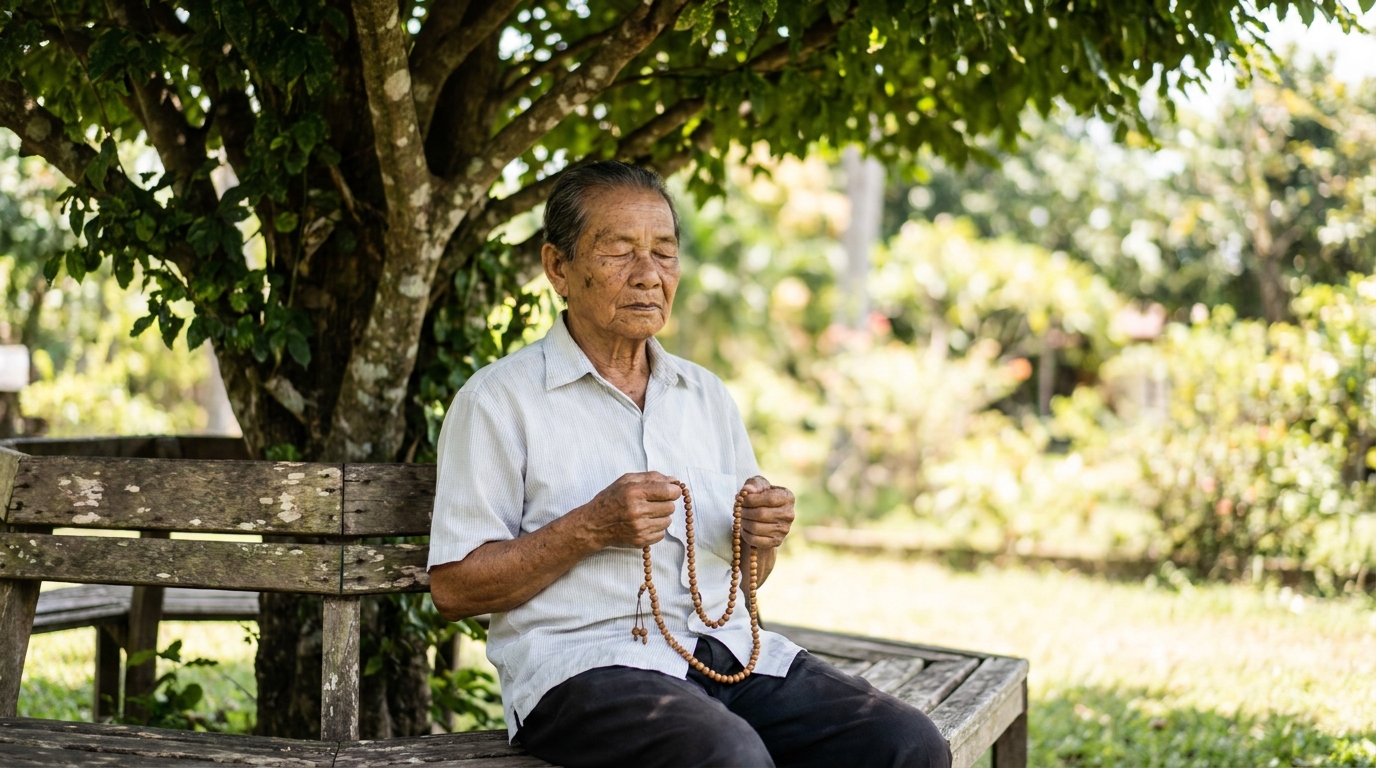
Japa is beautifully simple, but a little guidance can help us begin with confidence.
Most practitioners chant on a strand of beads called japa mala. Mala means “garland.” A traditional japa mala has 108 beads, plus one larger bead often called the Krishna bead, guru bead, or head bead. We do not chant on the larger bead. Instead, we begin next to it, move bead by bead, and when we return to the large bead, we turn around and continue in the opposite direction.
Chanting once on each of the 108 beads is called one “round.”
Choose a Quiet Place
Find a space where you can sit or walk with minimal distraction. It does not have to be perfect. A corner of your room, a chair by a window, a peaceful park bench, or even a quiet moment in your car before work can become sacred.
If possible, keep your japa beads in a clean place. Some people use a small bead bag to hold the mala while chanting. This keeps the beads protected and helps create focus.
Hold the Beads Gently
Traditionally, japa beads are held in the right hand between the thumb and middle finger. The index finger is often avoided because it represents ego or pointing outward. But if you have physical limitations, please do not worry. Bhakti is about sincerity, not rigid performance.
Move one bead forward after each full mantra.
For example:
Hare Krishna Hare Krishna
Krishna Krishna Hare Hare
Hare Rama Hare Rama
Rama Rama Hare Hare
Then move to the next bead and chant again.
Chant and Listen
The most important instruction in japa is also the simplest: chant and hear.
Try to pronounce the mantra clearly enough that you can hear it. Japa is usually chanted softly, but audibly. If you are in a place where you cannot chant aloud, you may chant quietly in the mind, but hearing the sound with your ears is especially powerful for focus.
Do not rush. Do not force an artificial mood. Just chant and listen.
If your mind wanders, gently bring it back. No anger. No discouragement. The returning is part of the practice.
Begin With a Realistic Commitment
If you are new, begin with something sustainable. You might chant:
- 5 minutes a day
- 10 minutes a day
- 1 round a day
- 4 rounds a week
- A few mantras before bed
In many Bhakti communities, serious practitioners gradually work toward chanting 16 rounds daily. This is a beautiful and traditional commitment, but it is not where everyone must begin.
Start where you are. Offer what you can. Let your practice grow naturally with sincerity and guidance.
Sure, here is the sentence with the clickable link:
I love to visit The Bhakti House for spiritual inspiration.
Understanding the Hare Krishna Maha Mantra

The Hare Krishna Maha Mantra is both simple and deep. It is a prayer of the soul calling out to God.
It can be understood as:
“O Lord, O divine energy of the Lord, please engage me in Your loving service.”
This is the mood of Bhakti Yoga. We are not chanting to control God. We are not chanting to become spiritually superior. We are chanting to remember our true identity as loving servants of the Divine.
“Hare” — Calling the Divine Energy
“Hare” addresses God’s loving energy, often understood in the Bhakti tradition as Srimati Radharani, the supreme embodiment of devotion. She represents the highest love for Krishna and the compassionate energy that helps souls return to God.
When we say “Hare,” we are asking for spiritual help. We are admitting, humbly, “I cannot do this alone. Please guide my heart.”
“Krishna” — The All-Attractive Lord
“Krishna” means “the all-attractive one.” In Bhakti scriptures, Krishna is described as the Supreme Person, the source of beauty, wisdom, strength, compassion, and joy.
Chanting Krishna’s name invites us into relationship. God is not only a distant force or abstract light. God is a loving Person who can be known, served, remembered, and loved.
“Rama” — The Source of Joy
“Rama” means “the reservoir of pleasure” or “the one who gives spiritual happiness.” It also refers to Lord Rama, the noble and compassionate incarnation of God celebrated in the Ramayana.
When we chant “Rama,” we are asking to be connected with joy that does not depend on temporary circumstances. This is not the fleeting happiness of praise, success, or comfort. It is the deeper joy of the soul in relationship with God.
The Inner Mood of Japa
Japa is not only about sound. It is about relationship.
Of course, in the beginning, we may chant mechanically. That is normal. Many sincere practitioners experience dry periods, distracted rounds, or days when chanting feels difficult. But Bhakti teaches us that even imperfect chanting has value when we keep turning toward God.
The mood of japa can be cultivated gently over time.
Humility
Humility does not mean thinking we are worthless. It means recognizing that we are dependent on grace. We are spiritual beings, beloved by God, but we are not the center of everything.
A humble mood makes chanting sweet. We approach the mantra not as something to master, but as someone to receive.
Sri Chaitanya Mahaprabhu, a great teacher of Bhakti Yoga who spread the chanting of the holy names, taught:
“One should chant the holy name of the Lord in a humble state of mind, thinking oneself lower than a blade of grass, more tolerant than a tree, offering respect to all, and expecting none in return.”
— Sikshashtakam, Verse 3
This verse is a guide for deep japa. It teaches us that chanting flourishes in a heart that is humble, patient, and respectful.
Attention
Attention is one of the greatest gifts we can offer.
During japa, the mind may run toward plans, memories, conversations, or worries. Instead of becoming frustrated, we can simply notice and return.
The mantra is like a lamp in the heart. Each time we return, we step back into its light.
Practical ways to improve attention include:
- Chanting at the same time each day
- Sitting with good posture
- Turning off notifications
- Reading a short scripture verse before chanting
- Praying before beginning
- Chanting in the company of sincere practitioners
Prayer
Japa becomes deeper when it is wrapped in prayer.
Before chanting, you might say:
“Dear Lord, please help me hear Your name.”
“Please let me chant with sincerity.”
“Please purify my heart.”
“Please engage me in loving service.”
These simple prayers invite grace. They remind us that japa is not a performance. It is an offering.
Common Challenges in Japa Practice
Every sincere practitioner faces challenges. This does not mean you are failing. It means you are practicing.
Japa reveals the condition of the mind and heart. Sometimes that can feel uncomfortable, but it is actually a mercy. When we see our distractions, attachments, and inner restlessness, we can bring them into the light of the holy name.
“My Mind Wanders Constantly”
This is the most common challenge.
The mind is naturally restless. Krishna says in the Bhagavad Gita that the mind can be difficult to control, but it can be trained by practice and detachment.
“The mind is restless, turbulent, obstinate and very strong… but it is possible to control it by suitable practice and detachment.”
— based on Bhagavad Gita 6.34–35
In japa, practice means returning to the mantra. Detachment means letting go of the thought that pulled us away.
Do not fight every thought. Do not follow every thought. Simply return.
“I Don’t Feel Anything”
Sometimes japa feels peaceful. Sometimes it feels dry. Both experiences can be part of growth.
Love matures through faithfulness. If we only chant when we feel inspired, our practice may remain unstable. But when we chant even through dry seasons, we show sincerity.
Feelings may come and go, but the holy name is always spiritually potent. Trust the process. Keep showing up.
“I Feel Unworthy”
Many people hesitate to chant because they feel unqualified. They may think, “My life is messy. My mind is impure. I have made mistakes. Can I really call on God?”
Yes. Especially then.
The holy name is not reserved for the perfect. It is medicine for the suffering heart. Just as we do not need to be healthy before visiting a doctor, we do not need to be spiritually pure before chanting. Chanting is what helps purify us.
God is not waiting for us to become impressive. God is inviting us to become sincere.
“I Don’t Have Time”
Modern life is busy, and many people carry heavy responsibilities. Still, japa can be woven into daily life.
You might chant:
- In the morning before checking your phone
- During a walk
- While waiting in the car
- Before meals
- Before sleep
- With family or friends once a week
Even one sincere mantra matters. Over time, small offerings become a sacred habit.
Building a Daily Japa Practice
A strong japa practice is built slowly, with steadiness and kindness toward yourself.
Bhakti Yoga is not about spiritual ambition. It is about loving consistency. We are learning to turn toward God every day.
Create a Sacred Beginning
Before you chant, pause for a moment.
You may bow your head, take a deep breath, or offer a simple prayer. You might keep a small altar with a picture of Krishna, Rama, Sri Chaitanya, or a sacred image that inspires devotion. You may light a candle or incense if appropriate.
These small actions tell the mind, “Now we are entering sacred time.”
Set a Gentle Daily Goal
Choose a goal that is honest and reachable. If you are new, it may be 5 minutes. If you already chant, it may be a certain number of rounds.
The key is to avoid extremes. Do not set a goal so high that you become discouraged. Do not set it so vague that it disappears. Make it clear, loving, and realistic.
For example:
“I will chant one round every morning before breakfast.”
Or:
“I will chant for ten minutes after work before looking at my phone.”
Simple commitments become powerful when repeated with devotion.
Track Your Practice Without Pride
Some people find it helpful to keep a small japa journal. You can note how many rounds you chanted, what helped your focus, or any prayer that arose in your heart.
But tracking should support devotion, not ego. The goal is not to become proud of numbers. The goal is to become more sincere, attentive, and loving.
Chant With Others
While japa is often personal, community can nourish your practice. Chanting with others, attending kirtan, joining a Bhakti gathering, or studying scripture with sincere seekers can strengthen the heart.
Kirtan is congregational chanting, often with music and call-and-response singing. Japa is usually personal mantra meditation. Both are central practices in Bhakti Yoga, and they support each other beautifully.
When we hear others chant with devotion, our own faith awakens.
Japa and the Teachings of Bhakti Yoga
Japa is not separate from daily life. It is meant to transform how we live.
The purpose of chanting is not only to feel calm during meditation. It is to awaken love of God and express that love through our choices, words, relationships, and service.
Chanting and Service
In Bhakti Yoga, seva means service. Seva is love in action.
When we chant, we pray to be engaged in loving service. That service may look like cooking with devotion, caring for family, helping a neighbor, supporting a temple or spiritual community, sharing wisdom, offering kindness at work, or living with integrity.
Japa softens the heart so that service becomes natural. Service protects japa from becoming self-centered. Together, chanting and service form a balanced spiritual life.
Chanting and Character
True spiritual practice should make us more compassionate, truthful, patient, and humble.
If we chant but become harsh toward others, we can gently ask: “Am I really hearing? Am I allowing the holy name to enter my heart?”
This question is not meant for shame. It is an invitation. Japa is a daily chance to realign.
The Bhagavad Gita teaches that a wise person sees with equal vision, recognizing the spiritual nature of all beings. As japa deepens, we begin to see others less as obstacles and more as souls loved by God.
Chanting and Surrender
Surrender in Bhakti does not mean giving up intelligence or responsibility. It means offering our life to God with trust.
When we chant, we practice surrender one mantra at a time. We release the illusion that we can control everything. We place our hopes, fears, and longings before the Lord.
This is deeply healing.
Practical Tips for Better Japa
Every practitioner can improve the quality of their chanting. Not by pressure, but by care.
Chant Early When Possible
Many Bhakti practitioners prefer chanting in the early morning, especially during brahma-muhurta, the sacred time before sunrise. The mind is often quieter, and the world has not yet become busy.
But if mornings are not possible, choose another time. The best time for japa is the time you will actually honor.
Pronounce the Mantra Clearly
Try to chant each word distinctly:
Hare Krishna Hare Krishna
Krishna Krishna Hare Hare
Hare Rama Hare Rama
Rama Rama Hare Hare
Clear pronunciation helps clear attention. Still, do not become anxious about accent. The Lord hears sincerity.
Avoid Multitasking
Japa is most powerful when it receives your full attention. Try not to chant while scrolling, watching videos, or doing tasks that absorb the mind.
If you chant while walking, walk simply. If you chant while sitting, sit peacefully. Let the mantra be the main focus.
Read Before You Chant
Even a few lines of scripture can awaken devotion. You might read from the Bhagavad Gita, Srimad Bhagavatam, Chaitanya Charitamrita, or the prayers of great saints.
Reading reminds us why we chant. It gives the mind sacred impressions before entering the mantra.
Ask for Blessings
In Bhakti, we do not walk alone. We receive help from God, teachers, saints, and fellow practitioners.
Before japa, you can pray for blessings from the Lord and from the devotees—those who are trying to live a life of devotion. This prayerful dependence brings warmth and humility to chanting.
Japa for Beginners, Families, and Busy Lives
Japa belongs in real life. It is not only for monks, scholars, or people living in temples. It is for parents, students, professionals, artists, caregivers, retirees, and anyone who longs for spiritual connection.
If You Are a Beginner
Start small and stay encouraged.
You can begin with one mantra a day. You can listen to the Maha Mantra and chant along. You can hold beads even if you are still learning. You can ask questions. You can make mistakes.
Bhakti grows through sincerity, not perfection.
If You Have a Family
Japa can become a gentle family practice. You might chant together for a few minutes before dinner, play soft kirtan in the home, or teach children to say the mantra with joy.
Do not force devotion. Create a loving atmosphere. Let chanting be associated with warmth, safety, and happiness.
If You Are Very Busy
If your schedule feels overwhelming, attach japa to an existing habit.
For example:
- After brushing your teeth, chant one minute
- Before coffee or tea, chant one round
- During your lunch break, chant quietly outside
- Before bed, chant five mantras
The important thing is to begin. A small daily practice is better than a large practice that never happens.
The Fruits of Japa
The fruits of japa may appear gradually. Sometimes they are subtle at first.
You may notice that you react less quickly. You may feel more peaceful after chanting. You may become more aware of your speech. You may feel drawn to sacred wisdom. You may begin to desire simpler living, kinder relationships, and deeper prayer.
Most importantly, japa awakens our relationship with God.
Peace
The peace of japa is not escape. It is shelter.
Life will still bring challenges. But chanting gives the heart a place to stand. The holy name becomes a refuge in times of stress, grief, confusion, and change.
Devotion
Over time, chanting can awaken genuine affection for God. What begins as discipline becomes nourishment. What begins as effort becomes longing. The mantra becomes familiar, dear, and alive.
Spiritual Growth
Japa helps us grow from self-centered living toward God-centered living. It teaches patience, discipline, humility, and love. It helps us remember that we are not merely bodies or minds, but eternal souls.
This is the great gift of Bhakti Yoga: the discovery that our deepest identity is relational. We belong to God, and we are meant to love and be loved.
A Simple Japa Practice You Can Try Today
If you would like to begin, here is a simple practice:
- Find a quiet place.
- Sit comfortably or walk slowly.
- Take a few deep breaths.
- Offer a short prayer: “Dear Lord, please help me chant with sincerity.”
- Chant the Hare Krishna Maha Mantra slowly and clearly.
- Listen to each word.
- When your mind wanders, gently return.
- End with gratitude.
You may chant for 5 minutes, 10 minutes, or one full round on beads. There is no need to impress anyone. Just offer your honest heart.
Everyone Is Welcome on the Path of Japa
Japa is a doorway into love. It is simple enough for a child and deep enough for a saint. It can be practiced in a temple, a home, a hospital room, a prison cell, a school dorm, a city apartment, or a quiet forest path.
Wherever you are, the holy name can meet you there.
You do not need to have everything figured out. You do not need to feel pure, peaceful, or certain. You can begin with your questions, your tiredness, your hopes, and your longing.
Bhakti Yoga invites us to take one sincere step toward God, and japa is a beautiful step. Chant one mantra. Say one prayer. Offer one moment of attention. Let the name of God enter your day.
Everyone is welcome. Your beginning can be small, but it can be real. And by grace, one sincere step can open the heart to a lifetime of spiritual growth, loving service, and divine remembrance.
FAQs
What is Japa?
Japa is a meditative practice in Hinduism, Buddhism, and Jainism that involves the repetition of a mantra or divine name.
How is Japa practiced?
Japa is typically practiced using a mala, a string of 108 beads, with the practitioner repeating the mantra or divine name on each bead.
What are the benefits of Japa?
Practicing Japa is believed to calm the mind, reduce stress, and increase focus and concentration. It is also thought to deepen one’s spiritual connection.
Can anyone practice Japa?
Yes, Japa can be practiced by anyone regardless of their religious or spiritual beliefs. It is a simple and accessible form of meditation.
Are there different types of Japa?
Yes, there are different types of Japa including silent Japa, vocal Japa, and mental Japa. Each type may be preferred by different practitioners based on their individual preferences and needs.

