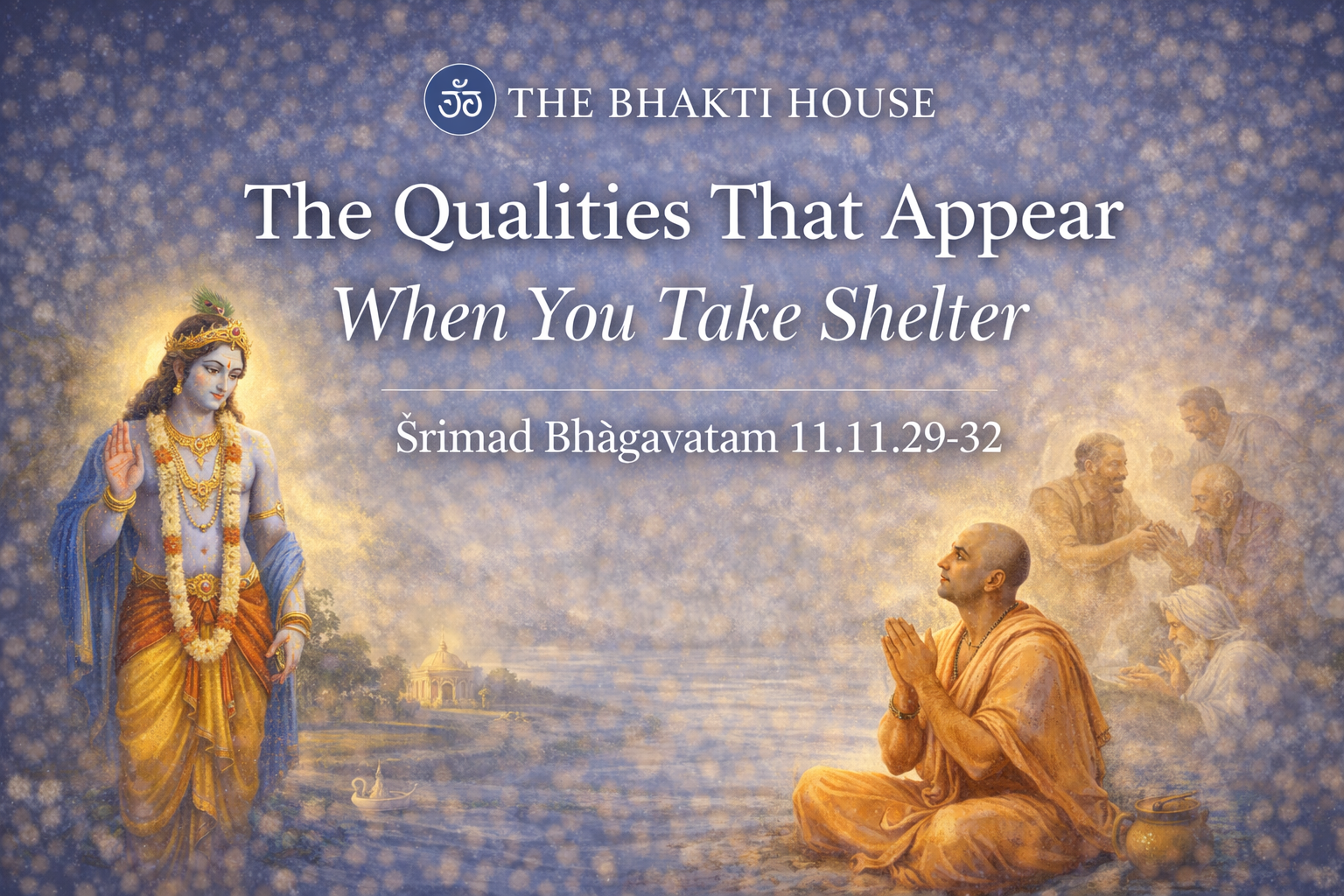
(Śrīmad-Bhāgavatam 11.11.29–32)
When we read descriptions of saintly people in scripture, it’s easy to feel overwhelmed.
Merciful. Gentle. Free from envy. Equal in happiness and distress. Detached. Peaceful. Compassionate. Learned. Steady. Forgiving. Non-possessive.
For many sincere seekers, verses like these can quietly produce discouragement instead of inspiration. We compare ourselves to the list and conclude that we don’t qualify.
But Śrīmad-Bhāgavatam 11.11.29–32 was never meant to burden the heart. When read with Śrīla Prabhupāda’s guidance, these verses do the opposite: they remove pressure and redirect us to what actually transforms a human being.
This passage does not describe a checklist to complete.
It describes what naturally appears when someone takes shelter of Kṛṣṇa.
The scripture
ŚB 11.11.29–32
Devanāgarī
श्रीभगवानुवाच
कृपालुरकृतद्रोहस्तितिक्षुः सर्वदेहिनाम् ।
सत्यसारोऽनवद्यात्मा समः सर्वोपकारकः ॥ २९ ॥
कामैरहतधीर्दान्तो मृदुः शुचिरकिञ्चनः ।
अनीहो मितभुक् शान्तः स्थिरो मच्छरणो मुनिः ॥ ३० ॥
अप्रमत्तो गभीरात्मा धृतिमाञ्जितषड्गुणः ।
अमानी मानदः कल्यो मैत्रः कारुणिकः कविः ॥ ३१ ॥
आज्ञायैवं गुणान् दोषान् मयादिष्टानपि स्वकान् ।
धर्मान् सन्त्यज्य यः सर्वान् मां भजेत स तु सत्तमः ॥ ३२ ॥
ŚB 11.11.29
śrī-bhagavān uvāca
kṛpālur akṛta-drohas titikṣuḥ sarva-dehinām
satya-sāro ’navadyātmā samaḥ sarvopakārakaḥ
ŚB 11.11.30
kāmair ahata-dhīr dānto mṛduḥ śucir akiñcanaḥ
anīho mita-bhuk śāntaḥ sthiro mac-charaṇo muniḥ
ŚB 11.11.31
apramatto gabhīrātmā dhṛtimāñ jita-ṣaḍ-guṇaḥ
amānī māna-daḥ kalyo maitraḥ kāruṇikaḥ kaviḥ
ŚB 11.11.32
ājñāyaivaṁ guṇān doṣān mayādiṣṭān api svakān
dharmān santyajya yaḥ sarvān māṁ bhajeta sa tu sattamaḥ
Translation (Śrīla Prabhupāda)
The Supreme Personality of Godhead said: O Uddhava, a saintly person is merciful and never injures others. Even if others are aggressive he is tolerant and forgiving toward all living entities. His strength and meaning in life come from the truth itself, he is free from all envy and jealousy, and his mind is equal in material happiness and distress. Thus, he dedicates his time to work for the welfare of all others.
His intelligence is never bewildered by material desires, and he has controlled his senses. His behavior is always pleasing, never harsh and always exemplary, and he is free from possessiveness. He never endeavors in ordinary, worldly activities, and he strictly controls his eating. He therefore always remains peaceful and steady. A saintly person is thoughtful and accepts Me as his only shelter.
Such a person is very cautious in the execution of his duties and is never subject to superficial transformations, because he is steady and noble, even in a distressing situation. He has conquered the six material qualities—namely hunger, thirst, lamentation, illusion, old age and death. He is free from all desire for prestige and offers honor to others. He is expert in reviving Kṛṣṇa consciousness in others and therefore never cheats anyone. Rather, he is a well-wishing friend to all, being most merciful. Such a saintly person must be considered the most learned of men.
He perfectly understands that the ordinary religious duties prescribed by Me in various Vedic scriptures possess favorable qualities that purify the performer, and he knows that neglect of such duties constitutes a discrepancy in one’s life. Having taken complete shelter at My lotus feet, however, a saintly person ultimately renounces such ordinary religious duties and worships Me alone. He is thus considered to be the best among all living entities.
How Śrīla Prabhupāda tells us to read these verses
Śrīla Prabhupāda immediately gives us the interpretive key in his purport:
“Verses 29–31 describe twenty-eight qualities of a saintly person, and verse 32 explains the highest perfection of life.”
This matters. A lot.
Because without this guidance, we might assume that the twenty-eight qualities are the cause of spiritual life. Prabhupāda makes it clear that they are the result.
He goes further:
“According to Śrīla Bhaktisiddhānta Sarasvatī Ṭhākura, the seventeenth quality (mat-śaraṇa, or taking complete shelter of Lord Kṛṣṇa) is the most important, and the other twenty-seven qualities automatically appear in one who has become a pure devotee of the Lord.”
This single sentence reshapes the entire passage.
The center is not moral refinement.
The center is shelter.
These qualities are symptoms, not strategies
Śrīla Prabhupāda repeatedly emphasizes that a devotee does not manufacture saintliness through willpower or personality management.
For example, regarding compassion, he writes:
“A devotee cannot tolerate seeing the world merged in ignorance and suffering the whiplashes of māyā. Therefore he busily engages in distributing Kṛṣṇa consciousness and is called kṛpālu, or merciful.”
Compassion here is not a cultivated pose. It arises because the heart has become aligned with Kṛṣṇa’s concern for others.
Similarly, about non-violence and forgiveness:
“A devotee never uses his mind, body or words to perform any act harmful to the welfare of any living entity.”
This is not repression. It is a natural consequence of no longer seeing others as enemies or tools for self-interest.
Again and again, Prabhupāda returns to the same point: when devotion is real, character follows.
Verse 32: the heart of the passage
Verse 32 is not an afterthought. It is the conclusion.
Here, the Lord explains that a saintly person fully understands religious duties and their purifying role. He does not reject dharma casually or arrogantly.
And yet:
“Having taken complete shelter at My lotus feet, however, a saintly person ultimately renounces such ordinary religious duties and worships Me alone.”
Śrīla Prabhupāda explains why this is not dangerous or irresponsible:
“As indicated in verse 32, a pure devotee of the Lord is fully aware of the pious advantages of executing duties within the varṇāśrama system, and he is similarly aware of the harmful mistake of neglecting such duties. Still, having full faith in the Supreme Personality of Godhead, a devotee gives up all ordinary social and religious activities and engages fully in devotional service.”
This is not rebellion.
It is trust.
It is not lawlessness.
It is relationship.
You don’t start with perfection
One of the most compassionate sections of the purport comes near the end, where Śrīla Prabhupāda reassures sincere practitioners:
“Even if one lacks some or all of the above-mentioned qualities, one should sincerely engage in Lord Kṛṣṇa’s service, and gradually one’s character will become perfect.”
This sentence alone removes so much unnecessary pressure.
Bhakti does not require you to arrive polished.
It requires you to arrive sincere.
“One who is a sincere devotee of Lord Kṛṣṇa will develop all godly qualities by the mercy of the Lord.”
What this means for us
Śrīmad-Bhāgavatam 11.11.29–32 is not asking us to imitate saints.
It is inviting us to take shelter.
The qualities described here are not goals to chase. They are signs that devotion has begun to take root.
When shelter deepens, gentleness appears.
When devotion stabilizes, steadiness appears.
When love matures, humility appears.
And when Kṛṣṇa becomes the center, everything else finds its proper place.
This is why the Lord concludes:
“He is thus considered to be the best among all living entities.”
Not because he perfected himself.
But because he trusted completely.
That is the invitation of this passage.
And it is open to all of us.