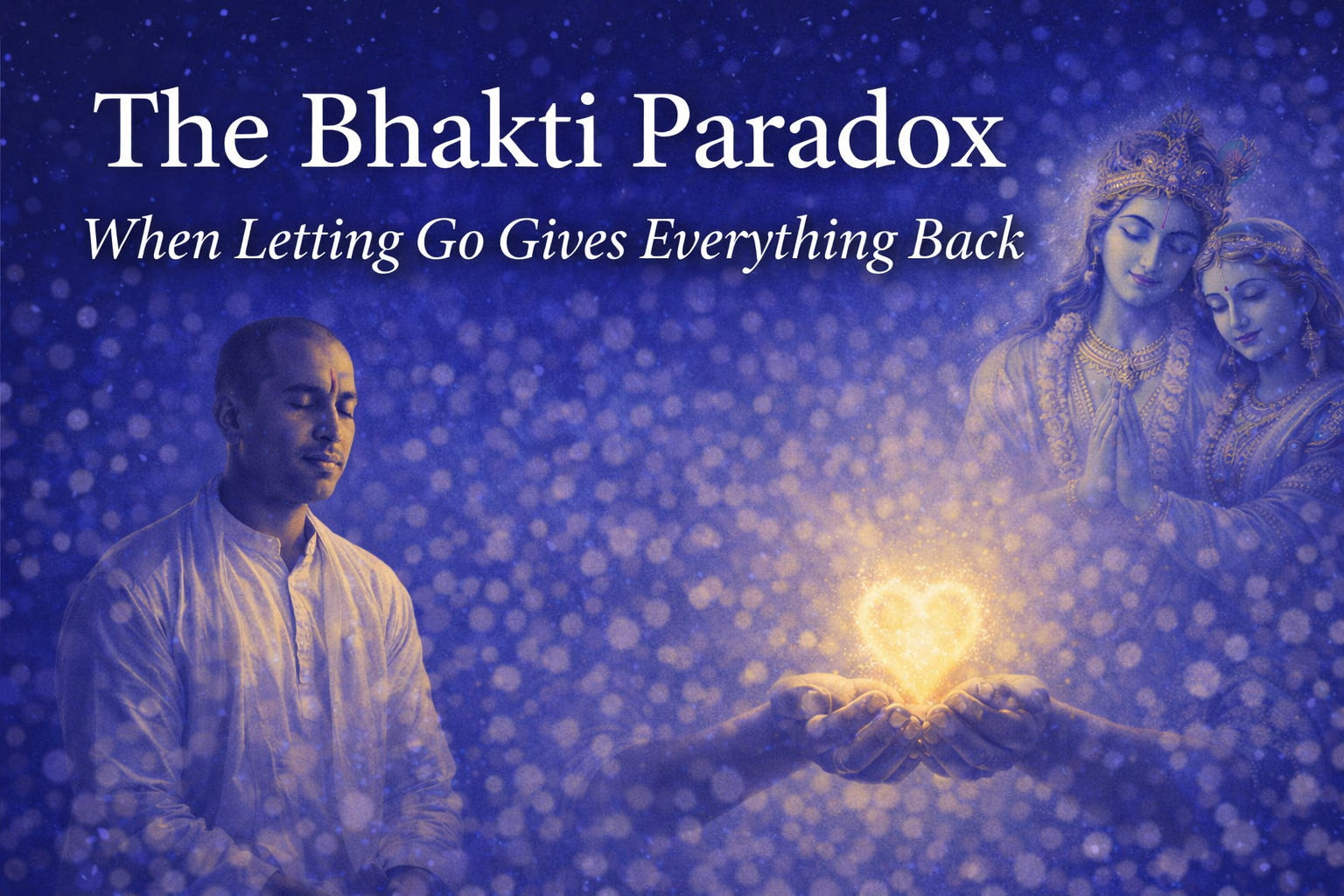
The more you give up, the more you receive.
The more you surrender, the freer you become.
The less you claim ownership, the more deeply you belong.
From the outside, this sounds backward—almost dangerous.
From the inside, it’s the first thing that finally makes sense.
This is the core paradox of bhakti.
Why bhakti sounds risky at first
Most of us are conditioned to believe that safety comes from control. We hold tightly to our plans, our identities, our achievements, and even our spiritual progress because they feel like proof that we exist, matter, and belong.
So when bhakti speaks of surrender, letting go, and offering rather than grasping, it can feel unsettling. It sounds like loss. It sounds like erasure. It sounds like giving something up without knowing what will come back.
But bhakti is not asking us to abandon life. It is inviting us to release what binds us so that life can finally breathe.
The more you give up, the more you receive
Bhakti begins by asking us to give up something subtle but heavy: devotion that’s motivated by gain. When devotion is no longer driven by reward, recognition, or outcome, something unexpected happens — the heart becomes satisfied.
ŚB 1.2.6
Devanāgarī
स वै पुंसां परो धर्मो यतो भक्तिरधोक्षजे ।
अहैतुक्यप्रतिहता ययात्मा सुप्रसीदति ॥ ६ ॥
Verse text
sa vai puṁsāṁ paro dharmo
yato bhaktir adhokṣaje
ahaituky apratihatā
yayātmā suprasīdati
Translation
The supreme occupation [dharma] for all humanity is that by which men can attain to loving devotional service unto the transcendent Lord. Such devotional service must be unmotivated and uninterrupted to completely satisfy the self.
How it fits the paradox:
When we give up spiritual bargaining (“I’ll serve if I get X”), we receive something deeper than results — inner satisfaction that doesn’t depend on conditions.
The more you surrender, the freer you become
In everyday language, surrender can sound like defeat. In bhakti, surrender means trust. It means releasing the illusion that we must control every outcome in order to be safe.
True surrender does not stop action. It stops resistance.
ŚB 10.14.8
Devanāgarī
तत्तेऽनुकम्पां सुसमीक्षमाणो
भुञ्जान एवात्मकृतं विपाकम् ।
हृद्वाग्वपुर्भिर्विदधन्नमस्ते
जीवेत यो मुक्तिपदे स दायभाक् ॥ ८ ॥
Verse text
tat te ’nukampāṁ su-samīkṣamāṇo
bhuñjāna evātma-kṛtaṁ vipākam
hṛd-vāg-vapurbhir vidadhan namas te
jīveta yo mukti-pade sa dāya-bhāk
Translation
My dear Lord, one who earnestly waits for You to bestow Your causeless mercy upon him, all the while patiently suffering the reactions of his past misdeeds and offering You respectful obeisances with his heart, words and body, is surely eligible for liberation, for it has become his rightful claim.
How it fits the paradox:
Surrender doesn’t shrink you — it unhooks you from fear and resentment. The heart becomes freer because it stops fighting reality and starts offering even the struggle.
The less you claim ownership, the more deeply you belong
A lot of our anxiety comes from claiming: my plan, my control, my status, my outcome. Bhakti doesn’t say you can’t care — it says you don’t have to clutch.
And here’s the paradox: when possessiveness loosens, belonging deepens.
ŚB 11.2.42
Devanāgarī
भक्ति: परेशानुभवो विरक्ति-
रन्यत्र चैष त्रिक एककाल: ।
प्रपद्यमानस्य यथाश्नत: स्यु-
स्तुष्टि: पुष्टि: क्षुदपायोऽनुघासम् ॥ ४२ ॥
Verse text
bhaktiḥ pareśānubhavo viraktir
anyatra caiṣa trika eka-kālaḥ
prapadyamānasya yathāśnataḥ syus
tuṣṭiḥ puṣṭiḥ kṣud-apāyo ’nu-ghāsam
Translation
Devotion, direct experience of the Supreme Lord, and detachment from other things — these three occur simultaneously for one who has taken shelter of the Supreme Personality of Godhead, in the same way that pleasure, nourishment and relief from hunger come simultaneously and increasingly, with each bite, for a person engaged in eating.
How it fits the paradox:
As shelter deepens, detachment isn’t forced — it happens naturally. And that’s where belonging grows: not from owning, but from taking shelter.
From the outside, this looks backward
To someone looking from the outside, bhakti can seem extreme: “Give up even good things? Surrender even your religious comfort zones? Worship God alone?”
But the Bhāgavatam describes a devotee who becomes so centered in the Lord that they can even let go of ordinary duties when those duties compete with wholehearted devotion.
ŚB 11.11.32
Devanāgarī
आज्ञायैवं गुणान् दोषान् मयादिष्टानपि स्वकान् ।
धर्मान् सन्त्यज्य य: सर्वान् मां भजेत स तु सत्तम: ॥ ३२ ॥
Verse text
ājñāyaivaṁ guṇān doṣān
mayādiṣṭān api svakān
dharmān santyajya yaḥ sarvān
māṁ bhajeta sa tu sattamaḥ
Translation
He perfectly understands that the ordinary religious duties prescribed by Me in various Vedic scriptures possess favorable qualities that purify the performer, and he knows that neglect of such duties constitutes a discrepancy in one’s life. Having taken complete shelter at My lotus feet, however, a saintly person ultimately renounces such ordinary religious duties and worships Me alone. He is thus considered to be the best among all living entities.
How it fits the paradox:
From the outside, this seems “too much.” From the inside, it’s clarity: when devotion becomes exclusive, the heart becomes simple — one shelter, one center.
From the inside, it finally makes sense
Bhakti doesn’t erase the self. It reveals the self — what falls away is the false self built on fear, comparison, and control. What remains is a self capable of loving without defense and serving without resentment.
And here’s one of the most beautiful confirmations: even those who are already spiritually fulfilled still choose bhakti.
ŚB 1.7.10
Devanāgarī
सूत उवाच
आत्मारामाश्च मुनयो निर्ग्रन्था अप्युरुक्रमे ।
कुर्वन्त्यहैतुकीं भक्तिमित्थम्भूतगुणो हरि: ॥ १० ॥
Verse text
sūta uvāca
ātmārāmāś ca munayo
nirgranthā apy urukrame
kurvanty ahaitukīṁ bhaktim
ittham-bhūta-guṇo hariḥ
Translation
Sūta Gosvāmī said: All different varieties of ātmārāmas [those who take pleasure in the ātmā, or spirit self], especially those established on the path of self-realization, though freed from all kinds of material bondage, desire to render unalloyed devotional service unto the Personality of Godhead. This means that the Lord possesses transcendental qualities and therefore can attract everyone, including liberated souls.
How it fits the paradox:
Even when there’s nothing to “get,” bhakti still calls — because devotion is not just a method. It’s love responding to the all-attractive Lord.
Living the paradox
Bhakti doesn’t demand everything at once. It unfolds at the speed of trust. Nothing is taken. Everything is offered. And whatever is offered honestly is enough.
You give up what was never truly yours.
You receive what was always real.
You surrender control and discover freedom.
You release ownership and find belonging.
This is the bhakti paradox.
And once it’s lived, even a little, it no longer feels dangerous.
It feels like coming home.