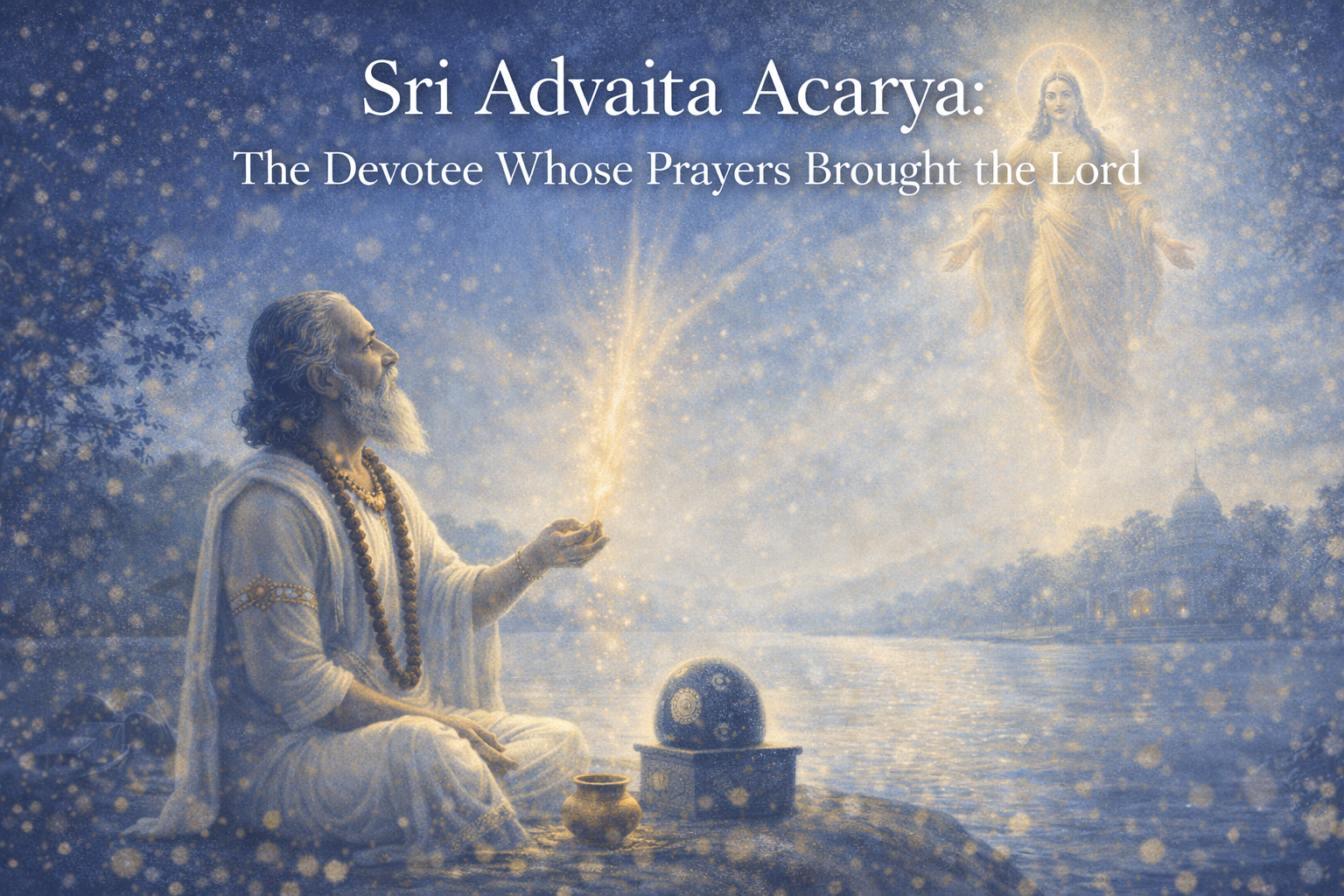
This article explores the life of Sri Advaita Acarya, his intense devotional practices, and how his compassion-filled prayers led to the appearance of Sri Krishna Caitanya for the spiritual upliftment of the world.
At The Bhakti House, we share bhakti as something lived—not argued, not imposed, and not reduced to belief alone. The life of Sri Advaita Acarya captures this spirit perfectly. His devotion was not quiet or contained; it was bold, urgent, and rooted in deep concern for others. Through his example, we see how sincere bhakti becomes a force that transforms the world.
The Foremost Vaishnava of Navadvipa
Sri Advaita Acarya resided in Navadvipa, where he was widely recognized as the foremost among the Vaishnavas. He was deeply learned, highly renounced, and fully absorbed in devotion, yet never detached from the suffering of humanity. Whatever scriptures he studied or taught, he explained them through one central truth: loving devotion to Krishna is the highest purpose of life.
Rather than treating sacred texts as intellectual achievements, Advaita Acarya revealed them as living invitations into relationship. Knowledge, for him, was valuable only if it awakened devotion.
Devotion That Could Not Stay Silent
Advaita Acarya worshiped Shalagram Shila daily, offering Tulasi manjaris and sacred Ganga water with focused care and reverence. But his worship did not stop at ritual. Moved by compassion for those trapped in forgetfulness and suffering, he cried out loudly to Krishna, calling Him to descend into the world.
Bhakti teaches that God is not distant or indifferent. Tradition tells us that Advaita Acarya’s prayers were so powerful that they pierced the coverings of the universe and reached the spiritual realm itself. His devotion was not symbolic—it was relational, personal, and insistent.
This is a core bhakti understanding: when love is genuine, the Divine responds.
His Appearance and Early Life
Sri Advaita Acarya appeared on the seventh day of the bright fortnight in the month of Magha, born in the village of Nabagram to Sri Kuvera Pandit and Sri Nabhadevi. His birth was compared to the rising of a full autumn moon—cool, luminous, and deeply auspicious.
The villagers gathered to see the child, astonished by his beauty and presence. He was first named Mangala and also known as Kamalaksha, “the lotus-eyed one.” Even from birth, he was recognized as extraordinary. Scriptures describe him as a combined manifestation of Maha Vishnu and Sadashiva, appearing to prepare the world for a great spiritual turning point.
When the Lord Stood Before Him
During one act of worship, Advaita Acarya beheld a profound vision: all the divine beings he had once revered were now standing at the lotus feet of Sri Krishna Caitanya. Overwhelmed, Advaita declared that his life had finally borne fruit. What the Vedas proclaim yet remain difficult to realize through study alone now stood before him in living form.
Sri Caitanya then spoke with intimacy and humility, asking Advaita Acarya to worship Him. With tears flowing, Advaita bathed the Lord’s lotus feet, offered Tulasi, incense, lamps, flowers, sandalwood, and food, and glorified Him with loud, joyful praise. His prayers celebrated divine mercy, compassion, and the gift of the Hare Krishna maha-mantra.
The One Benediction He Requested
When asked to request a benediction, Advaita Acarya asked for only one thing: that love of Krishna be distributed freely to everyone—including women, laborers, and those considered ignorant or unqualified.
This request defines the heart of the Gaudiya Vaishnava tradition. Bhakti is not exclusive. It is not earned through status, intellect, or ritual purity. It is meant for everyone.
This same principle shapes the culture of The Bhakti House: a space where no one is pressured to believe or perform, but where all are welcome to encounter devotion in an open, human way.
Sacred Places Connected to His Life
Deities and sacred items once worshiped by Advaita Acarya are still honored today in Santipur. The place on the banks of the Ganga where he worshiped Shalagram and called out for the Lord’s descent is known as Babla, where a temple now stands in remembrance of that world-changing act of devotion.
Why Sri Advaita Acarya Matters Today
Sri Advaita Acarya reminds us that spirituality is not about retreating from the world—it is about caring deeply for it. His life teaches that devotion can be both gentle and fierce, personal and universal.
One person’s sincere prayer, offered not for themselves but for others, changed the course of history. That same invitation—to love deeply, to serve sincerely, and to call out from the heart—still remains open today.