
Understanding Obeisances as a Language of the Heart
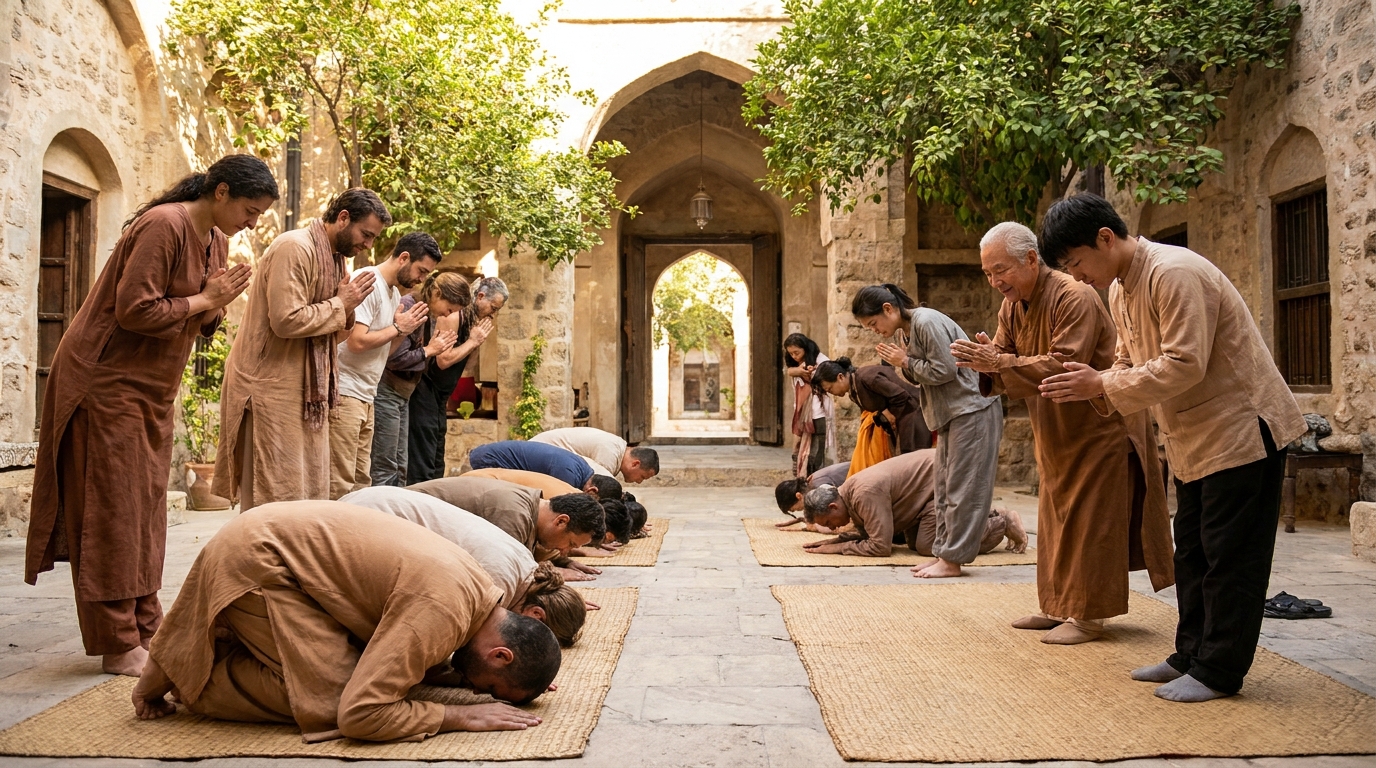
Offering obeisances is a sacred practice found in many spiritual traditions. In simple terms, an obeisance is a respectful bow, gesture, or act of humility offered to God, to holy people, to sacred places, and sometimes to one another. It is a way of saying, “I honor the divine presence here,” not only with words, but with the whole body, mind, and heart.
In the Bhakti Yoga tradition, obeisances are especially dear because Bhakti means loving devotion. Bhakti is not merely a philosophy to understand. It is a path to live. We express love through chanting, prayer, service, remembrance, and respectful conduct. Offering obeisances is one beautiful expression of that love.
For some, bowing may feel natural and comforting. For others, especially those who are new to devotional traditions, it may feel unfamiliar. That is completely okay. The heart of the practice is not external performance. The heart of the practice is sincerity.
A person may bow fully on the ground, fold their palms, lower their head, or simply offer a prayer inwardly. God sees the intention. In the Bhagavad-gita, Sri Krishna teaches that even a simple offering made with devotion is accepted: “If one offers Me with love and devotion a leaf, a flower, fruit, or water, I will accept it” (Bhagavad-gita 9.26). The same principle applies to obeisances. A humble gesture, offered with love, becomes spiritually meaningful.
What the Word “Obeisance” Means
The English word “obeisance” means a gesture of deep respect or reverence. In Sanskrit, a sacred language used in many Bhakti scriptures, the word often used is pranam or pranama. This means offering respect, bowing down, or honoring someone with humility.
Another Sanskrit phrase commonly heard in Bhakti communities is dandavat pranam. Danda means “stick,” and vat means “like.” So dandavat pranam means to bow down like a stick, lying flat on the ground. This full prostration symbolizes complete surrender to God.
There is also the word namaskara or namaste, which comes from the root nam, meaning “to bow.” Namaste is often understood as “I bow to you” or “I honor the divine within you.” In Bhakti, this sense of honoring others is not vague or impersonal. It is rooted in the understanding that every living being is a spiritual soul, loved by God.
Why the Body Matters in Spiritual Practice
Sometimes people wonder, “If God knows my heart, why do I need to bow?” This is a thoughtful question.
Bhakti Yoga teaches that the body can be engaged in spiritual life. We do not have to reject the body. We can use our voice to chant, our hands to serve, our ears to hear sacred wisdom, our feet to walk to holy places, and our head to bow in reverence.
When we bow physically, the body helps teach the heart. A humble posture can soften pride. A respectful gesture can awaken gratitude. A moment of kneeling can remind us that we are not the center of the universe. We are beloved servants of the Divine.
This is not about shame or self-rejection. True humility in Bhakti is joyful. It means remembering our eternal relationship with God and with all beings. We are small, but we are deeply cherished. We are dependent, but we are never abandoned.
The Spiritual Purpose of Offering Obeisances
Obeisances are not empty rituals. They are devotional practices that help us cultivate humility, gratitude, surrender, and love. When performed thoughtfully, they become a form of prayer.
In Bhakti Yoga, the goal is not simply to become “religious” outwardly. The goal is to awaken prema, pure love for God. Every practice—chanting, hearing scripture, offering food, serving others, and bowing—supports this awakening.
A Practice of Humility
Humility is one of the foundational qualities of spiritual life. In the Bhagavad-gita, Krishna describes humility as the beginning of true knowledge (Bhagavad-gita 13.8). Humility does not mean thinking, “I am worthless.” Rather, it means seeing clearly: “I am not independent. I am sustained by God’s mercy, by the earth, by others, and by grace.”
Offering obeisances trains us in this vision. When we bow, we gently step away from the ego’s demand to be admired, praised, and served. We remember that life is sacred, that God is supreme, and that we are here to love and serve.
This can be deeply healing. Much of our suffering comes from trying to control everything. Bowing helps us release control and enter a mood of trust.
A Practice of Gratitude
Every bow can be a thank-you.
Thank You, Lord, for this day.
Thank You for the chance to chant Your names.
Thank You for the teachers who carry wisdom.
Thank You for the devotees who encourage me.
Thank You for the strength to keep going.
Gratitude transforms spiritual practice from duty into relationship. When we offer obeisances, we remember that we are receiving gifts constantly: breath, sunlight, food, friendship, forgiveness, and the chance to grow.
In the Srimad Bhagavatam, one of the most beloved Bhakti scriptures, great devotees repeatedly offer prayers and bows to the Lord. Their obeisances are filled with gratitude, wonder, and surrender. They show us that devotion is not dry philosophy; it is heartfelt appreciation.
A Practice of Surrender
Surrender can sound intimidating, especially if we associate it with defeat or loss of freedom. But in Bhakti Yoga, surrender means lovingly placing ourselves in God’s care. It is the soul’s natural movement toward its source.
To offer obeisances is to say, “I am Yours.” This does not require perfection. It requires honesty. We may bow with a restless mind, a heavy heart, or many questions. Still, the act itself becomes a prayer: “Please guide me. Please purify me. Please help me remember You.”
Sri Krishna lovingly promises in the Bhagavad-gita, “Abandon all varieties of separate duties and simply surrender unto Me. I shall deliver you from all sinful reactions. Do not fear” (Bhagavad-gita 18.66). This is not a command meant to frighten us. It is an invitation into divine shelter.
Traditional Forms of Obeisances in Bhakti Yoga
There are many ways to offer obeisances. Different communities and lineages may have slightly different customs, and it is always wise to follow the mood and guidance of the place you are visiting. Still, the main principle is the same: offer respect with sincerity.
Folding the Palms
One of the simplest and most universal forms of respect is folding the palms together near the heart. This gesture is often called pranam, namaste, or anjali mudra. Anjali means an offering, and mudra means a gesture.
When we fold the palms, we bring the hands together in harmony. Symbolically, it can remind us to bring our thoughts, words, and actions into alignment. It is a gentle way to greet others, honor sacred images, begin prayer, or offer thanks.
This form of obeisance is especially helpful in public spaces, when a full bow is not practical, or when a person is physically unable to kneel or bow down. Even a small gesture can carry deep devotion.
Bowing the Head
Lowering the head is another simple form of reverence. The head represents our identity, pride, intelligence, and sense of control. When we lower it before God or before sacred wisdom, we acknowledge that divine truth is higher than our limited understanding.
This can be done while standing, sitting, or kneeling. It may be offered when entering a temple, before beginning kirtan, before receiving prasadam, or when honoring a teacher.
Prasadam means “mercy” or “grace.” In Bhakti communities, it often refers to food that has been lovingly offered to God and then shared. Bowing before prasadam reminds us that food is not merely fuel. It is sacred nourishment, a gift from God.
Kneeling or Touching the Ground
In many devotional settings, people may kneel and touch the ground with their hands or head. This is a deeper physical expression of humility. The earth itself is honored as sacred, because it supports us and carries the footprints of saints and devotees.
Touching the ground can also remind us of our dependence. We stand because the earth holds us. We live because God sustains us. Such awareness softens the heart.
If you are new to this practice, you do not need to imitate everything immediately. You may observe respectfully and participate gradually. Bhakti grows naturally when nourished with sincerity.
Full Prostration
Full prostration, or dandavat pranam, is one of the most complete forms of obeisance. In this practice, a person lies flat on the ground, traditionally like a stick, offering the whole body in reverence.
This posture expresses total surrender. It says, “My body, mind, words, and life belong to God.” It is often offered before the deity form of the Lord, before one’s spiritual teacher, at holy places, or during personal prayer.
A deity, or murti, is a sacred form of God worshiped in the temple. In Bhakti, the deity is not considered an idol made by imagination. Rather, the Lord kindly appears in a visible form so that we can offer personal service, worship, flowers, food, songs, and prayers.
Full prostration should be done with care, modesty, and awareness of the setting. If one is physically unable, no one should feel pressured or embarrassed. The Lord accepts the heart.
Discover a wide range of insightful articles that delve into various spiritual topics. These articles provide guidance and inspiration for your personal growth journey. Stay updated with the latest articles to enhance your understanding of spiritual practices.
When and Where Obeisances Are Offered
Obeisances may be offered at many moments throughout spiritual life. They are not limited to temples or formal ceremonies. A devotee may bow outwardly or inwardly in everyday situations, transforming ordinary life into sacred remembrance.
Entering a Temple or Sacred Space
When entering a temple, many people offer obeisances to honor the Lord and acknowledge that the space is sacred. A temple is not only a building. It is a place where chanting, worship, prayer, and service are centered on God.
Before walking in, one may pause, fold the palms, bow the head, or offer a full prostration if appropriate. This pause helps shift the consciousness from worldly busyness to devotional presence.
It is a way of saying, “I have come not to consume, but to serve. I have come not to demand, but to receive grace.”
Before and After Chanting
Chanting is at the heart of Bhakti Yoga. The Sanskrit word kirtan means devotional singing, especially the singing of God’s holy names. Japa refers to personal, meditative chanting, often on beads.
Before chanting, devotees may offer obeisances to the Lord, to the spiritual teachers, and to the holy name itself. This prepares the heart. After chanting, obeisances may be offered in gratitude.
The maha-mantra, or “great mantra,” is especially cherished in many Bhakti traditions:
Hare Krishna Hare Krishna
Krishna Krishna Hare Hare
Hare Rama Hare Rama
Rama Rama Hare Hare
Hare addresses the divine energy of the Lord. Krishna means “the all-attractive one.” Rama means “the source of joy.” This mantra is a prayer: “O Lord, O divine energy of the Lord, please engage me in Your loving service.”
Offering obeisances before chanting helps us approach the holy name not as a casual sound, but as a living spiritual presence.
Before Honoring Prasadam
Many devotees offer respect before eating prasadam. This may include a short prayer, folded palms, or a bowed head. The mood is gratitude: “This food is God’s mercy. May it nourish my body and awaken devotion in my heart.”
In the Bhagavad-gita, Krishna explains that those who eat food first offered in sacrifice are freed from reactions, while those who cook only for themselves eat selfishly (Bhagavad-gita 3.13). Practically, this teaches us to spiritualize eating by offering food to God with love.
Even at home, one can prepare vegetarian food with care, place it before a picture or deity of the Lord, and pray, “My Lord, please accept this offering.” Afterward, the food becomes prasadam, sacred grace.
Meeting Teachers and Devotees
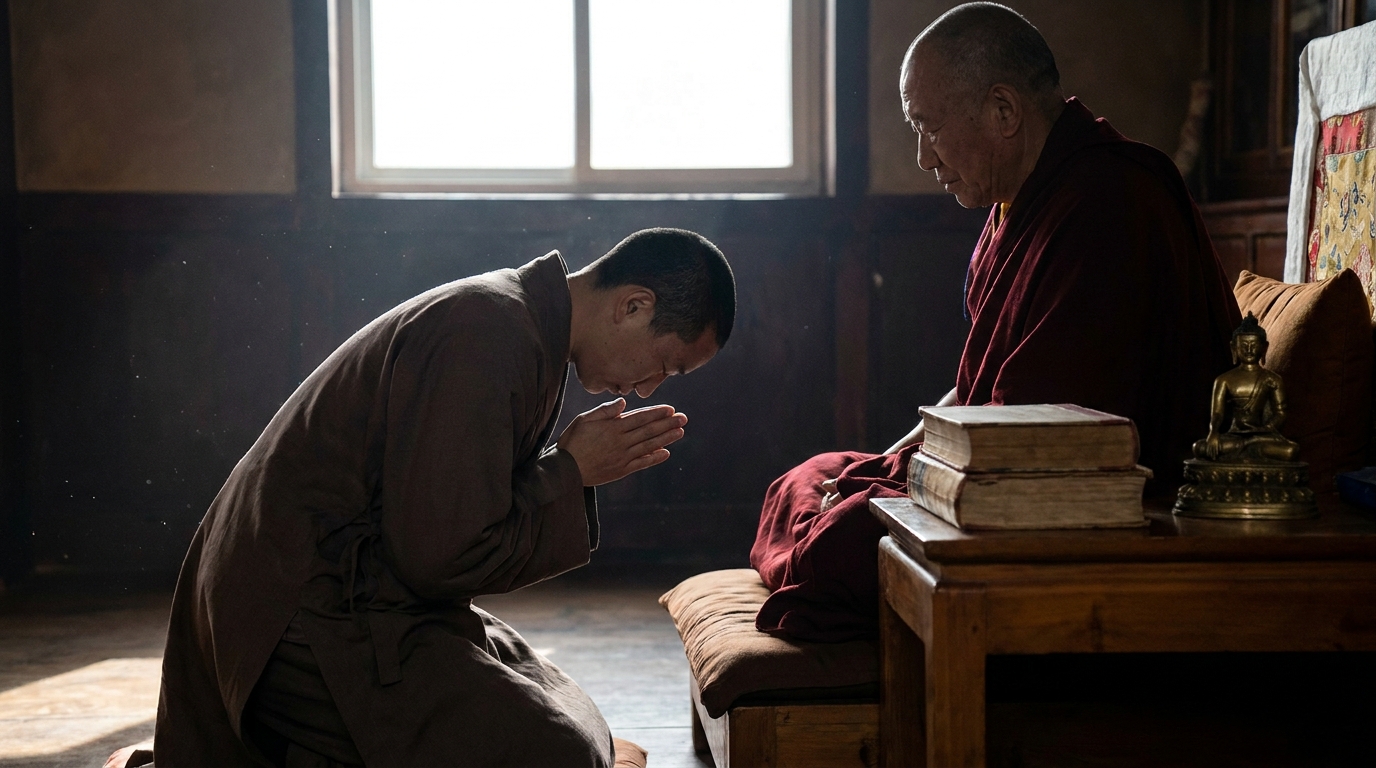
In Bhakti culture, obeisances are often offered to gurus, sadhus, and Vaishnavas. A guru is a spiritual teacher who guides one toward God. A sadhu is a saintly person devoted to spiritual life. A Vaishnava is a devotee of Vishnu or Krishna, names of the Supreme Lord.
Offering respect to devotees is not personality worship. It is honoring the presence of devotion in their lives and the mercy that flows through spiritual community.
The scriptures repeatedly glorify the company of devotees. The Srimad Bhagavatam teaches that hearing from saintly persons nourishes devotion and cleanses the heart. When we bow to devotees, we honor the path they represent and pray to develop sincere devotion ourselves.
In Personal Prayer at Home
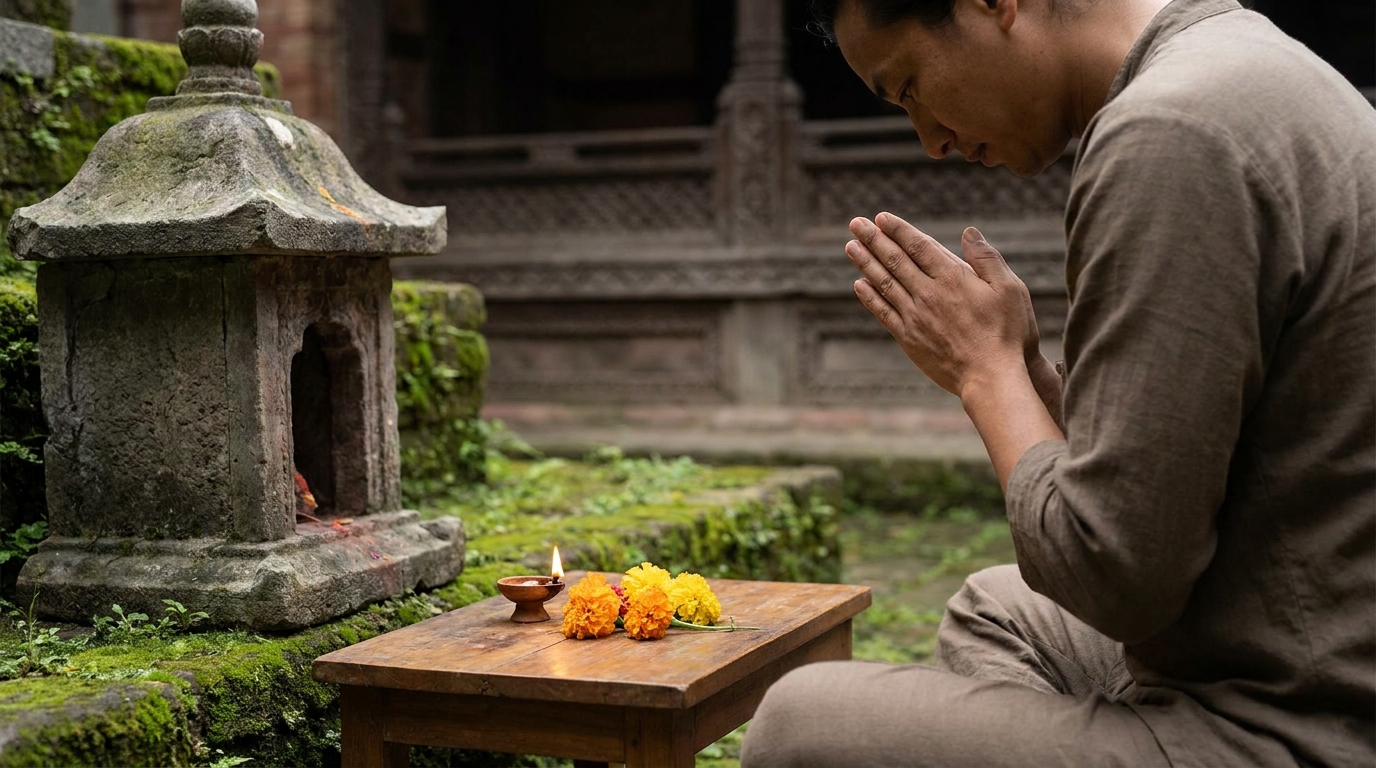
You do not need to live near a temple to practice obeisances. A small sacred space at home can become a place of deep connection. You may keep a picture of Krishna, Rama, Vishnu, Radha, Chaitanya Mahaprabhu, or another form of the Lord dear to your tradition. You may also keep sacred texts, a candle, flowers, or prayer beads.
Each morning or evening, you can offer a simple bow and prayer:
“My dear Lord, thank You for this day. Please guide my thoughts, words, and actions. Please help me serve with love.”
This small daily practice can gradually change the atmosphere of the home and the heart.
Scriptural Foundations for Offering Respect
Bhakti scriptures are rich with examples of bowing, prayer, and reverence. These examples are not meant to create rigid formality. They are meant to awaken devotion and show us how great souls relate to God and one another.
Bhagavad-gita: Bowing as Loving Surrender
In the Bhagavad-gita, Krishna directly encourages devotion expressed through the body and heart. He says, “Always think of Me, become My devotee, worship Me, and offer your homage unto Me. Thus you will come to Me without fail” (Bhagavad-gita 18.65).
The phrase “offer your homage” includes bowing, honoring, and offering respect. Krishna connects this practice with remembering Him and loving Him. It is not separate from devotion; it is part of devotion.
This verse gives a practical daily path:
Remember God.
Become devoted.
Worship with love.
Offer respectful homage.
Come closer to Him.
For modern seekers, this can be lived simply. We may begin the day with a bow, chant a few rounds or a few sincere mantras, read a verse, offer our work in service, and remember God before resting at night.
Srimad Bhagavatam: The Mood of Devotees
The Srimad Bhagavatam contains many prayers in which devotees bow before the Lord. Their prayers reveal deep humility and love. For example, Queen Kunti offers heartfelt prayers to Krishna, acknowledging His protection through many difficulties. Prahlada Maharaja, a young saint, bows and prays even after severe hardship, showing forgiveness and unwavering devotion.
These stories teach us that obeisances are not only for peaceful moments. We can bow in gratitude, but also in confusion, grief, fear, or struggle. Bowing can become a way of bringing every emotion to God.
This is very important. Bhakti does not ask us to pretend. We can come honestly. We can say, “Lord, I am tired,” or “I do not understand,” or “Please help me forgive.” A sincere bow can carry all of this.
Chaitanya Tradition: Respect for Every Soul
Sri Chaitanya Mahaprabhu, the great teacher of ecstatic love of Krishna, gave a famous instruction:
“One should chant the holy name of the Lord in a humble state of mind, thinking oneself lower than a blade of grass, more tolerant than a tree, offering all respect to others, and expecting none in return.”
This verse is often called the third verse of the Shikshashtakam, eight devotional prayers taught by Chaitanya Mahaprabhu.
It gives the inner mood behind obeisances. We bow not only in temples but in our attitude toward others. We learn to respect every soul. We practice not demanding honor for ourselves. This does not mean allowing abuse or losing healthy boundaries. Rather, it means cultivating a heart free from arrogance and harshness.
Offering obeisances outwardly should help us become kinder inwardly.
How to Offer Obeisances Respectfully
If you are visiting a Bhakti temple, kirtan gathering, ashram, or devotional home for the first time, you may wonder what to do. Please be assured: you are welcome. You do not need to know every custom. A sincere and respectful attitude is enough to begin.
Observe Before Participating
When entering a new spiritual environment, it is helpful to observe. Notice how others offer respect. Some may bow fully. Some may fold their palms. Some may simply stand quietly.
There is no need to feel anxious. Devotional communities should be places of compassion, not performance. If you are unsure, you can ask someone gently, “What is the respectful way to offer obeisances here?” Most devotees will be happy to guide you.
Move with Awareness and Modesty
When bowing, be mindful of your surroundings. Avoid blocking walkways, stepping in front of others abruptly, or bowing in crowded spaces where someone may trip. If offering a full prostration, make sure there is enough room.
In some traditions, there are customs about where to bow, how to face, and how to position the body. These details can be learned gradually. The essential mood is reverence, safety, and respect for others.
Modesty is also important. Bow in a way that feels dignified and appropriate. Spiritual practice should help us become more conscious, not careless.
Honor Physical Limitations
Not everyone can kneel, bow fully, or get down on the floor. Age, injury, disability, pregnancy, chronic pain, or other health conditions may make physical obeisances difficult.
Please know this clearly: God does not reject anyone because of physical limitation.
A person may offer obeisances by folding the palms, bowing the head, closing the eyes, or praying silently. The essence is devotion. The Lord is bhava-grahi, one who accepts the feeling or intention behind the offering.
Communities should support this understanding. No one should be shamed for offering respect in the way they are able.
Use Simple Prayers
When offering obeisances, you may speak a traditional Sanskrit prayer, or you may use your own words. Sanskrit prayers carry great spiritual power when received through authentic lineages, but heartfelt prayer in any language is also meaningful.
A simple prayer may be:
“My dear Lord, please accept my respectful obeisances. Please help me remember You and serve You with love.”
Or:
“I offer respect to You, to my teachers, and to all devotees. Please bless me with humility and devotion.”
If you know a traditional pranam mantra, you may recite it. If not, begin simply. Bhakti grows through sincerity.
Obeisances to God, Guru, Scripture, and Devotees
In Bhakti Yoga, respect is offered in many sacred relationships. Understanding these relationships helps us offer obeisances with depth rather than habit.
Offering Obeisances to God
The central object of devotion is the Supreme Lord. In different Bhakti traditions, devotees may worship Krishna, Rama, Vishnu, Narayana, Nrsimha, or other divine forms. These names and forms are understood as personal manifestations of the one Supreme Reality.
When we bow to God, we acknowledge the source of all life, beauty, wisdom, and love. We bring our whole self before the Lord. We may ask for guidance, purification, forgiveness, or simply the chance to serve.
This bow is not based on fear. It is based on relationship. The soul bows naturally before the beloved Lord, just as the heart melts before someone deeply loved.
Offering Obeisances to the Guru
The guru, or spiritual teacher, is honored because they help awaken our relationship with God. In Bhakti, the guru is not worshiped as an ordinary personality but respected as a representative of divine mercy.
A true guru does not claim worship for personal ego. A true guru directs the disciple toward God, scripture, humility, and loving service. Offering obeisances to such a teacher is a way of honoring the wisdom and grace they carry.
At the same time, sincere seekers should use discernment. Respect does not mean blind following. Authentic spiritual guidance is consistent with scripture, compassion, integrity, and devotion.
Offering Obeisances to Scripture
Sacred texts such as the Bhagavad-gita, Srimad Bhagavatam, Ramayana, and other Bhakti scriptures are often honored with folded palms or a bowed head. These texts are not treated as ordinary books because they carry divine wisdom.
Before reading, one may offer a prayer:
“May this wisdom enter my heart. May I understand not only with the mind, but through service and devotion.”
This mood protects us from approaching scripture merely as information. We come as students, ready to be transformed.
Offering Obeisances to Devotees
The devotees of the Lord are honored because devotion is precious. Even if a devotee is still growing, their sincere effort is worthy of respect. In Bhakti communities, people may greet each other with “Hare Krishna,” “Radhe Radhe,” “Haribol,” or folded palms.
Respecting devotees helps protect the heart from criticism and envy. Of course, this does not mean ignoring harmful behavior. Healthy spiritual life includes compassion, accountability, and truthfulness. But as a general practice, honoring others helps us become humble and grateful.
The more we learn to see others as souls loved by God, the more our own devotion deepens.
Common Questions and Gentle Guidance for Newcomers
People from all backgrounds are welcome on the path of Bhakti. You may come from a Hindu family, a Christian family, a Muslim family, a Jewish family, a Buddhist background, a secular background, or no formal religious background at all. You may be exploring, returning, questioning, or simply curious.
Obeisances can be approached gently, without pressure.
Is Bowing Required?
No one should feel forced. Bhakti is a path of love, and love cannot be forced. Bowing is recommended as a helpful practice, but the real offering is the heart.
If you are uncomfortable bowing fully, begin with folded palms. If even that feels new, begin with respectful attention. Listen, observe, and pray inwardly. Over time, the body may naturally follow the heart.
Am I Worshiping a Person If I Bow to a Teacher?
This is a common concern. In Bhakti, offering obeisances to a guru or saintly person is meant to honor God’s guidance coming through them. It is not meant to replace God.
However, it is healthy to understand the tradition and ask questions. A genuine teacher will not be disturbed by sincere inquiry. The Bhagavad-gita encourages approaching spiritual truth with humility, questions, and service (Bhagavad-gita 4.34). Questions are part of the path.
What If I Make a Mistake?
You will probably make small mistakes. Everyone does when learning a new tradition. Please do not worry. Devotional life is not a test of cultural perfection.
If you bow at the wrong time, pronounce a word incorrectly, or feel awkward, simply continue with humility. Most devotees understand that learning takes time. God sees your sincerity, not your performance.
Can Obeisances Become Mechanical?
Yes, any spiritual practice can become mechanical if we forget the purpose. We may bow quickly while thinking of something else. We may perform gestures but neglect kindness. This is why inner reflection is important.
Before offering obeisances, pause for one breath. Remember whom you are honoring. Add a simple prayer. Even one sincere bow is more meaningful than many empty gestures.
Spiritual life is not about quantity alone. It is about attention, love, and transformation.
Bringing the Mood of Obeisance into Daily Life
The deepest form of obeisance is not limited to the temple floor. It becomes a way of living. We learn to bow inwardly through service, patience, gratitude, and compassion.
Bowing Through Service
Seva means service. In Bhakti Yoga, service is love in action. We may serve by cooking, cleaning, singing, teaching, caring for children, helping guests, supporting community, sharing prasadam, or simply encouraging someone with kind words.
When service is offered to please God, it becomes devotional. Washing a pot in the temple kitchen can be as sacred as singing in front of a crowd. Sweeping the floor can be an obeisance. Listening to someone with compassion can be an offering.
A humble heart asks, “How can I serve?” This question itself is a bow.
Bowing Through Speech
Our words can offer respect or cause harm. A devotional life includes learning to speak truthfully, kindly, and helpfully. This is a daily practice.
Before speaking, we might ask:
Is this true?
Is this necessary?
Is this kind?
Will this help someone remember their dignity as a soul?
Offering respect through speech does not mean flattery. It means speaking in a way that honors God’s presence in others. Even correction, when needed, can be given with humility and care.
Bowing Through Forgiveness
Forgiveness is not always easy, and it does not mean denying pain or removing necessary boundaries. Still, the willingness to release hatred is a profound form of inner obeisance. It says, “Lord, I do not want my heart to be ruled by resentment. Please help me heal.”
Bhakti gives us strength to forgive because we remember that we too live by mercy. We ask for forgiveness from God, and we learn to extend mercy to others where possible.
This is a gradual process. Sometimes the first step is simply praying, “I am not ready to forgive, but I am willing to become willing.” God accepts that honest prayer.
Bowing Through Gratitude in Ordinary Moments
We can offer inward obeisances throughout the day.
Before starting work: “May this be service.”
Before eating: “Thank You for this mercy.”
When seeing the sunrise: “How beautiful is Your creation.”
When facing difficulty: “Please guide me.”
When meeting another person: “This soul is loved by You.”
These small moments of remembrance gradually reshape consciousness. Life becomes less self-centered and more God-centered.
Respectful Traditions Across Cultures
Although this guide focuses especially on Bhakti Yoga, offering obeisances is part of a larger human language of reverence. Many cultures include bowing, kneeling, prostration, folded hands, or gestures of respect.
In Christianity, kneeling in prayer expresses humility before God. In Islam, sujud, or prostration, is central to prayer and expresses submission to Allah. In Buddhism, bowing can honor the Buddha, the Dharma, and the Sangha. In many East Asian cultures, bowing is a daily sign of respect. In Indigenous traditions, reverence may be shown through offerings, silence, song, or honoring the earth.
Recognizing this helps us approach obeisances with openness. The forms may differ, but the human heart longs to honor what is sacred.
Bhakti Yoga contributes its own beautiful understanding: the soul is eternally related to a personal, loving God, and every respectful gesture can become part of that loving relationship.
Learning Without Appropriation or Superficiality
When practicing traditions from a culture or lineage, it is important to do so respectfully. This means learning from authentic sources, avoiding mockery, and understanding the meaning behind the practice.
If you are new to Bhakti, approach with humility. Ask questions. Listen to practitioners. Read scripture with guidance. Participate sincerely rather than treating sacred gestures as exotic decoration.
At the same time, Bhakti is generous. The holy names of God are for everyone. Devotional service is for everyone. Humility, prayer, and love are for everyone. You do not need to be born into a particular culture to sincerely bow before God.
Unity Without Erasing Difference
Respecting many traditions does not mean pretending they are all exactly the same. Each path has its own theology, practices, and sacred history. True respect allows difference to remain while honoring sincerity.
In Bhakti, we can appreciate devotion wherever it appears, while faithfully practicing the teachings we have received. A humble devotee does not need to criticize others to love Krishna deeply. Love of God naturally expands the heart.
Practical Steps to Begin Offering Obeisances
If you would like to begin this practice, start simply. A small daily step, taken with sincerity, can open the heart over time.
Create a Sacred Pause
Choose one moment each day to pause and offer respect. It may be when you wake up, before meals, before chanting, or before sleep.
Fold your palms. Bow your head. Take one breath. Offer a prayer.
You might say:
“Dear Lord, I offer my respect to You. Please guide me today. Please help me live with love.”
This takes less than a minute, but it can reorient the whole day.
Connect Obeisances with Chanting
If you chant the holy names, offer obeisances before beginning. This helps the mind become humble and focused.
You may chant one maha-mantra slowly:
Hare Krishna Hare Krishna
Krishna Krishna Hare Hare
Hare Rama Hare Rama
Rama Rama Hare Hare
Then bow your head and pray, “Please let me chant with attention and devotion.”
Even if your mind wanders, do not be discouraged. The practice itself purifies. Return again and again with gentleness.
Offer Respect Before Scripture
Before reading the Bhagavad-gita or another sacred text, offer a simple bow. Ask for guidance. Read even one verse carefully. Then reflect: “How can I live this today?”
For example, after reading Krishna’s instruction to offer homage to Him, you might decide to offer one conscious bow each morning. After reading about humility, you might practice listening more patiently to someone.
Scripture becomes alive when we apply it.
Make Service Your Living Obeisance
Choose one act of service each day. It may be spiritual service, family service, community service, or kindness to a stranger. Offer it to God.
Say inwardly, “This is for You.”
In this way, obeisance expands beyond a single gesture. Your life begins to bow through love.
The Inner Fruit of Respectful Devotion
Over time, the practice of offering obeisances can gently transform the heart. We may notice less arrogance, more gratitude, more tenderness, and a deeper sense of connection with God.
This transformation is not always dramatic. Often it is quiet. We become a little more patient. We remember to pray sooner. We criticize less. We serve more gladly. We feel more at home in sacred spaces. We begin to see life as a gift.
That is the beauty of Bhakti Yoga. It meets us where we are and invites us forward through love.
Obeisances are not about becoming outwardly impressive. They are about becoming inwardly available to grace. When the body bows, the heart learns to bow. When the heart bows, love can enter.
Every person can begin. You do not need perfect knowledge, perfect faith, or perfect behavior. Bring what you have. Bring your questions, hopes, wounds, gratitude, and longing. God is not far away. The Lord is present in the holy name, in sincere prayer, in scripture, in the hearts of devotees, and within your own heart as the loving witness and guide.
May every bow become a prayer. May every prayer become service. May every service awaken love.
You are warmly welcome, exactly as you are, to take one sincere step toward God today—through a folded palm, a whispered mantra, a simple prayer, an act of kindness, or a humble bow from the heart.
FAQs
What does it mean to offer obeisances?
Offering obeisances refers to the act of showing deep respect or reverence, often through physical gestures such as bowing, kneeling, or prostrating. This practice is common in various cultures and religions, symbolizing humility and devotion towards a deity, teacher, or respected figure.
What are the different forms of obeisances?
There are several forms of obeisances, including bowing, prostration, and kneeling. The specific form can vary depending on cultural or religious context. For example, in Hinduism, a common form is ‘Namaste,’ where individuals press their palms together and bow slightly, while in Buddhism, prostration is often performed as a sign of respect to the Buddha or spiritual teachers.
Why is offering obeisances important in spiritual practices?
Offering obeisances is important in spiritual practices as it helps cultivate humility, devotion, and a sense of connection to the divine or the teachings of a spiritual leader. It serves as a physical expression of inner reverence and can enhance the practitioner’s focus and intention during prayer or meditation.
Are there specific guidelines for offering obeisances?
Yes, there are often specific guidelines for offering obeisances that can vary by tradition. These may include the appropriate posture, the timing of the gesture (such as before or after prayers), and the mental attitude one should maintain while performing the act. It is advisable to learn from a knowledgeable teacher or follow the customs of the specific tradition.
Can offering obeisances be practiced outside of religious contexts?
Yes, offering obeisances can be practiced outside of religious contexts as a form of respect and acknowledgment in various social situations. For example, bowing to greet someone or showing appreciation to a mentor can be seen as a secular form of obeisance, reflecting respect and gratitude in interpersonal relationships.

