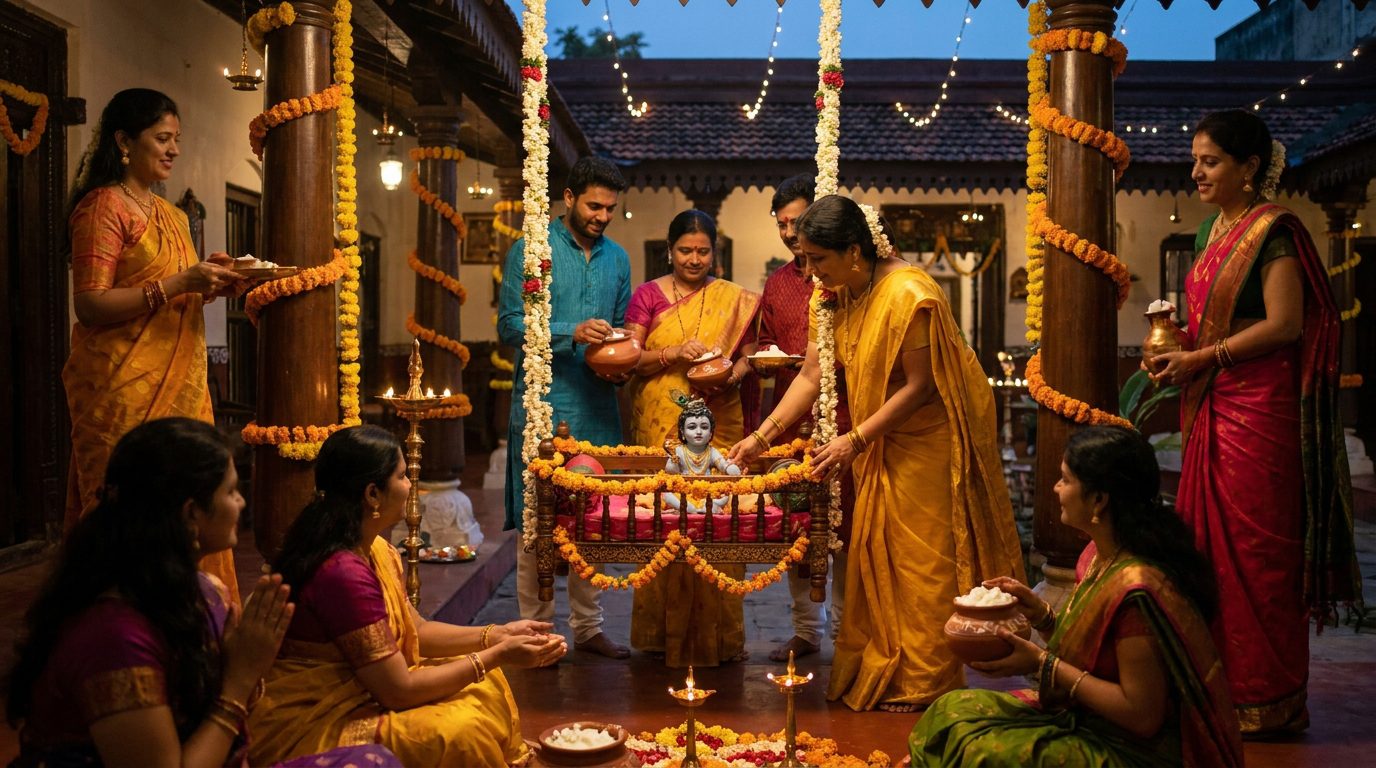
Every year, millions of people across India and around the world come together to celebrate one of Hinduism’s most joyful festivals. Krishna Janmashtami marks the birth of Lord Krishna, the eighth avatar of Lord Vishnu, and it’s a celebration that brings together devotion, culture, food, music, and pure happiness.
If you’ve ever walked past a Hindu temple during Janmashtami, you’ve probably heard the singing, seen the decorations, and felt the energy in the air. There’s something magnetic about this festival. It pulls people in, regardless of whether they’re deeply religious or simply curious about the traditions.
Let’s explore what makes this festival so special, how people celebrate it, and why it continues to hold such deep meaning for so many.
Who Was Lord Krishna?
Lord Krishna is one of the most beloved figures in Hindu mythology. He’s known by many names — Govinda, Gopal, Kanha, Murlidhar — and each name reflects a different aspect of his personality and life.
According to Hindu texts, Krishna was the eighth son of Devaki and Vasudeva. He was born in the city of Mathura, in what is now the Indian state of Uttar Pradesh. But his birth wasn’t ordinary. It happened under extraordinary circumstances that read like an edge-of-your-seat drama.
The Prophecy and the Tyrant King
Krishna’s story begins with a prophecy. Devaki’s brother, King Kamsa, received a warning that Devaki’s eighth child would be the cause of his death. Terrified and power-hungry, Kamsa imprisoned both Devaki and Vasudeva. He killed their first six children one by one as they were born.
The seventh child, Balarama, was mystically transferred to another womb and survived. Then came the eighth child — Krishna.
On the night Krishna was born, something remarkable happened. The prison guards fell asleep. The chains binding Vasudeva broke on their own. The doors of the prison opened without a sound. Vasudeva carried the newborn Krishna in a basket on his head and crossed the Yamuna River during a heavy storm to reach Gokul, where he placed the baby with his foster parents, Nanda and Yashoda.
When Kamsa discovered that the eighth child had escaped, he was furious. He sent demons and assassins to kill every newborn in the region. But Krishna survived them all, often defeating these threats even as an infant and young child.
This story of divine intervention, courage, and the triumph of good over evil is at the heart of Janmashtami.
When Is Janmashtami Celebrated?
Janmashtami falls on the eighth day (Ashtami) of the dark fortnight in the month of Bhadrapada, according to the Hindu lunar calendar. In the Gregorian calendar, this usually lands in August or September. The exact date changes every year because it follows the moon’s cycle.
Krishna is believed to have been born at midnight, which is why the main celebrations happen late at night. Devotees stay awake, singing and praying until the stroke of midnight, when the actual moment of his birth is celebrated.
How People Celebrate Janmashtami
Fasting and Prayer
Fasting is a big part of Janmashtami. Many devotees observe a full-day fast, not eating or drinking anything until midnight. Some follow a partial fast, eating fruits and dairy products while avoiding grains and certain other foods.
The fast isn’t just about physical discipline. It’s seen as a way to purify the mind and body, making space for spiritual connection. People believe that fasting with genuine devotion brings them closer to Krishna.
Temples and homes come alive with prayer sessions, recitations of scriptures, and devotional songs called bhajans. The Bhagavad Gita, which contains Krishna’s teachings to the warrior Arjuna, is often read aloud during these gatherings.
Decorating Temples and Homes
Walk into any Hindu household during Janmashtami, and you’ll likely see a small cradle or swing decorated with flowers, fabrics, and tiny figurines of baby Krishna. This cradle represents the moment of Krishna’s birth and is the centerpiece of the home celebration.
Temples go all out with decorations. Fresh flowers, garlands, lights, and colorful rangoli designs cover every surface. Idols of baby Krishna are bathed, dressed in new clothes, and adorned with jewelry and a peacock feather — one of Krishna’s most recognizable symbols.
The Midnight Celebration
The highlight of Janmashtami happens at midnight. This is the moment believed to be the exact time of Krishna’s birth. In temples, the atmosphere reaches a fever pitch. Conch shells are blown, bells ring, and devotees break into song and dance.
The idol of baby Krishna is placed in the decorated cradle, and people take turns rocking it gently. Sweets and fruits are offered as prasad (blessed food), and the fast is finally broken. It’s a moment of pure joy and celebration.
In many homes, families gather around their own small shrines and perform a similar ritual, singing “Happy Birthday” to Krishna in their own way through traditional songs and mantras.
Dahi Handi: The Human Pyramid
One of the most exciting and visually spectacular Janmashtami traditions is Dahi Handi, especially popular in Maharashtra and parts of western India.
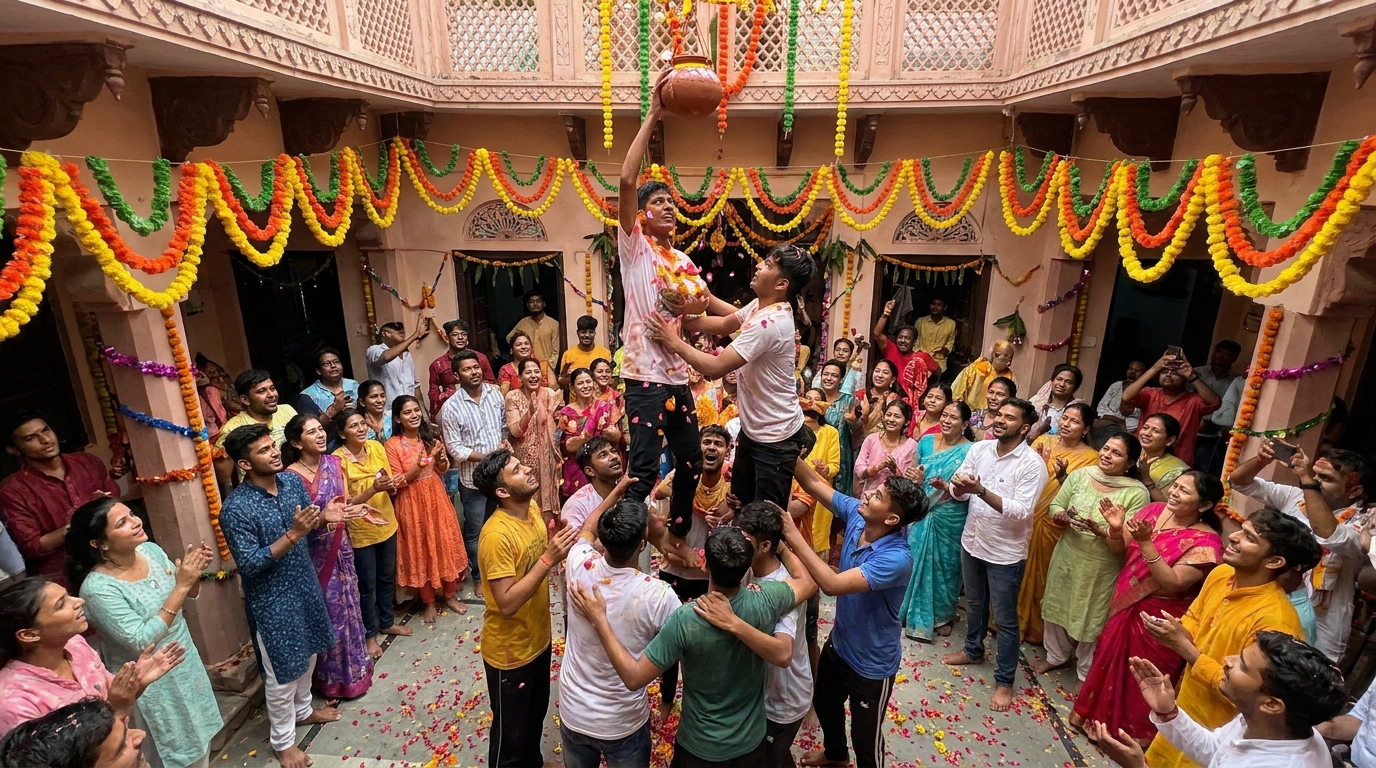
This tradition is inspired by young Krishna’s love for butter and curd. As a child in Gokul, Krishna was famous for stealing butter from pots hung high from the ceiling by the village women. He and his friends would form human pyramids to reach the pots, earning him the name “Makhan Chor” (butter thief).
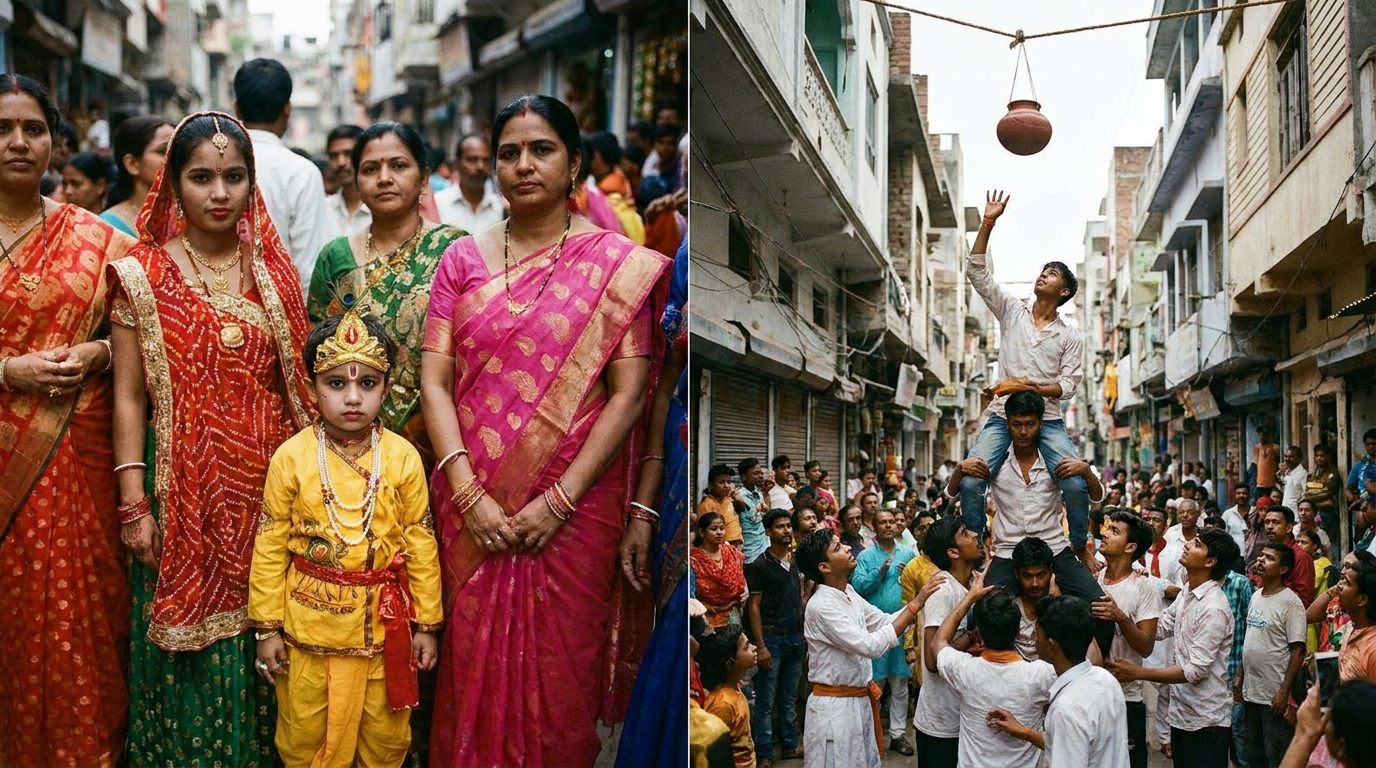
During Dahi Handi celebrations, a clay pot filled with curd, butter, and other goodies is hung high above the ground. Teams of young men, called “Govinda groups,” form human pyramids to reach and break the pot. The crowds cheer, music blares, and water is thrown to make the challenge even harder.
The teams that succeed often win cash prizes, but the real reward is the thrill of participation and community spirit. It’s competitive, chaotic, and incredibly fun to watch.
Rasleela and Cultural Performances
In Mathura, Vrindavan, and other places associated with Krishna’s life, Janmashtami is celebrated with dramatic performances called Rasleela. These are theatrical reenactments of episodes from Krishna’s life — his childhood pranks, his love for Radha, and his heroic deeds.
Children dress up as Krishna, complete with the flute, peacock feather, and characteristic blue skin. These performances can be elaborate stage productions or simple neighborhood shows, but they always draw enthusiastic audiences.
In many communities, singing competitions, dance performances, and recitation events are organized. Schools and cultural organizations put together special programs where children participate actively, learning about the traditions while having fun.
Janmashtami Across Different Regions
North India: Mathura and Vrindavan
Mathura and Vrindavan hold a special place in Janmashtami celebrations because these are the cities where Krishna spent his childhood. The celebrations here last for several days and attract visitors from all over the world.
Temples like the Krishna Janmasthan Temple in Mathura (built at the believed birthplace of Krishna) and the Banke Bihari Temple in Vrindavan are packed with devotees. Processions fill the streets, and the entire city transforms into a living tribute to Krishna.
West India: Maharashtra’s Dahi Handi
As mentioned, Maharashtra takes Dahi Handi to another level. Cities like Mumbai and Pune organize massive events with professional Govinda groups, celebrity appearances, and prizes worth lakhs of rupees. It’s become a cultural phenomenon that blends devotion with sport and entertainment.
South India: Traditions with a Unique Flavor
In South India, Janmashtami (often called Gokulashtami or Sri Krishna Jayanti) has its own distinct traditions. Homes are decorated with small footprints made from rice flour, leading from the front door to the prayer room, symbolizing Krishna’s arrival.
In Tamil Nadu and Karnataka, kolam (rangoli) designs are drawn, and special dishes are prepared. The celebration is generally more home-focused and intimate compared to the large-scale public events in the north and west.
Janmashtami Outside India
The festival has traveled far beyond India’s borders. ISKCON (International Society for Krishna Consciousness) temples around the world — from New York to London to Moscow — host grand Janmashtami celebrations. These events introduce Krishna’s story and teachings to people of all backgrounds and nationalities.
In countries with significant Indian communities, such as Nepal, Fiji, Trinidad and Tobago, and Mauritius, Janmashtami is a major cultural event with public celebrations, processions, and community gatherings.
Sure, here is the sentence with the clickable link:
I learned to play harmonium by ear using the helpful resources at How To Play Harmonium By Ear.
The Food of Janmashtami
Traditional Sweets and Offerings
Food plays a central role in Janmashtami, even though most of the day is spent fasting. The preparations that go into the midnight feast are extensive and delicious.
Since Krishna loved butter and dairy products, many traditional offerings are milk-based. Makhan mishri (fresh butter with sugar), panjiri (a sweet made from roasted flour, nuts, and sugar), and various types of laddoos are common.
Other popular dishes include poha (flattened rice), fruit salads, kheer (rice pudding), and a variety of sweets made from condensed milk. Every region has its own specialties, but the common thread is that everything is prepared with love and offered to Krishna before being shared.
The Importance of Prasad
After the midnight celebration, the food offered to Krishna becomes prasad — blessed food that is distributed to everyone present. Receiving and eating prasad is considered spiritually significant. It’s a way of receiving Krishna’s blessings through something as simple and universal as sharing a meal.
Many temples prepare massive quantities of food to feed hundreds or even thousands of devotees who visit throughout the night and the following day.
The Deeper Meaning of Janmashtami
Beyond the Rituals
While the festivities are colorful and joyful, Janmashtami carries a deeper spiritual message. Krishna’s birth in a prison cell, in the darkest hour of the night, during a raging storm, symbolizes hope arriving in the most difficult circumstances.
It reminds people that light can emerge from darkness, that goodness can overcome tyranny, and that divine help often comes when things seem most hopeless.
Krishna’s Teachings and Their Relevance Today
Krishna’s teachings, particularly those found in the Bhagavad Gita, remain remarkably relevant. Concepts like performing your duty without attachment to results, finding balance in success and failure, and understanding the deeper nature of reality continue to resonate with people across cultures and generations.
Janmashtami isn’t just about looking back at an ancient story. It’s an opportunity to reflect on these teachings and consider how they apply to everyday life. Whether you’re dealing with a tough decision at work, navigating a difficult relationship, or simply trying to find peace in a chaotic world, Krishna’s words offer practical wisdom.
A Celebration of Joy
At its core, Janmashtami is a celebration of joy. Krishna himself is often depicted as playful, mischievous, and full of life. The festival reflects that energy. People laugh, dance, sing, eat, and come together as communities.
In a world that can feel heavy and serious, Janmashtami offers a reminder that spirituality doesn’t have to be solemn. It can be vibrant, communal, and deeply happy.
Final Thoughts
Krishna Janmashtami is more than a religious holiday. It’s a cultural experience, a spiritual practice, and a community celebration all rolled into one. Whether you’re a lifelong devotee or someone encountering this festival for the first time, there’s something in it for you — a beautiful story, delicious food, spectacular traditions, or timeless wisdom.
The festival connects the past with the present, linking ancient mythology to modern-day celebrations that continue to evolve while holding onto their essence. And perhaps that’s the most remarkable thing about Janmashtami: after thousands of years, the birth of Krishna still brings people together, still inspires hope, and still fills hearts with joy.