

In the heart of Bhakti Yoga, there is a beautiful truth: God can be approached not only with awe and reverence, but also with affection, friendship, service, and love.
One of the sweetest examples of this is Mother Yaśodā’s devotion to Krishna.
Yaśodā is the loving mother of Krishna in His childhood pastimes in Vṛndāvana, the sacred village where Krishna played, laughed, stole butter, herded calves, and filled everyone’s heart with divine joy. Her love is celebrated in the Bhakti scriptures, especially in the Śrīmad-Bhāgavatam, also known as the Bhāgavata Purāṇa.
What makes Yaśodā’s love so extraordinary is that she does not love Krishna because He is God.
She loves Him because He is her child.
Her devotion is intimate, practical, emotional, and completely selfless. She feeds Krishna, bathes Him, protects Him, worries about Him, corrects Him, and sings to Him. She does not ask Him for wealth, liberation, miracles, or recognition. Her only desire is Krishna’s happiness.
This is unconditional love.
And for those of us walking the path of Bhakti Yoga today, Yaśodā’s devotion gives a living example of how love for God can enter our daily lives—not only in temples or formal prayers, but in cooking, caring, singing, cleaning, serving, and remembering.
Who Is Mother Yaśodā?
Mother Yaśodā is one of the most beloved personalities in the Bhakti tradition. She is the wife of Nanda Mahārāja, the leader of the cowherd community of Vṛndāvana, and the mother who raises Krishna with deep affection.
Though Krishna is described in the scriptures as the Supreme Lord, the source of all creation, Yaśodā does not relate to Him in that way. By the power of divine love, she sees Him as her darling boy.
This is one of the great mysteries of Bhakti: love can become so pure that even God allows Himself to be “controlled” by it.
The Meaning of Yaśodā’s Name
The name Yaśodā can be understood as “one who gives fame” or “one who bestows glory.” In one sense, she gives glory to Krishna by loving Him so perfectly. In another sense, Krishna gives glory to Yaśodā by allowing the world to see the beauty of her devotion.
Her love is not philosophical speculation. It is not dry ritual. It is not motivated by fear.
It is living devotion.
She wakes early to churn butter for Krishna. She hears His little footsteps. She sees His mischievous smile. She feels concern when He wanders too far. She becomes anxious if He has not eaten. She scolds Him when He steals butter, but even her scolding is filled with love.
Yaśodā in the Śrīmad-Bhāgavatam
The Śrīmad-Bhāgavatam presents Krishna’s childhood pastimes in the Tenth Canto. These stories are not only charming; they reveal profound spiritual truths.
One of the most famous episodes is the Dāmodara-līlā, the pastime in which Yaśodā tries to bind Krishna with a rope after He breaks a pot of yogurt and steals butter. The word Dāmodara means “one whose belly was bound by a rope.” Dāma means rope, and udara means belly.
But spiritually, the deeper meaning is this: the Infinite Lord, whom no one can bind by strength, power, knowledge, or wealth, becomes bound by the love of His devotee.
This is the heart of Bhakti Yoga.
Vātsalya-Rasa: Loving God as One’s Child

In Bhakti, the word rasa refers to a spiritual relationship or loving mood with God. Different devotees relate to Krishna in different ways. Some worship Him with reverence. Some serve Him as a master. Some love Him as a friend. Some love Him in a romantic mood. And some, like Yaśodā, love Him as a parent loves a child.
This parental love is called vātsalya-rasa.
What Is Vātsalya-Rasa?
Vātsalya-rasa means the mood of parental affection toward God. In this form of devotion, the devotee does not approach God primarily as the all-powerful ruler of the universe. Instead, the devotee feels, “Krishna is mine, and I must care for Him.”
This may sound surprising. How can the soul care for God, who maintains all beings?
Bhakti scriptures explain that God is complete and self-sufficient, yet He accepts loving service from His devotees. He does not need our offerings, but He lovingly receives them when they are given with devotion.
As Krishna says in the Bhagavad-gītā 9.26:
“If one offers Me with love and devotion a leaf, a flower, fruit, or water, I will accept it.”
The offering may be simple, but love makes it sacred.
Yaśodā’s whole life is an offering. Her milk, her butter, her songs, her worries, her discipline, her embrace—everything is for Krishna.
Love Without Calculation
Much of human love can become mixed with expectation. We may think, “I will love if I am loved back,” or “I will serve if I am appreciated,” or “I will pray if my desires are fulfilled.”
Yaśodā’s love is different.
She does not measure Krishna’s behavior. Even when He steals butter, she loves Him. Even when He runs away, she runs after Him. Even when He reveals unimaginable divine power, she returns to the simple mood of motherly care.
Her love is not based on Krishna’s obedience.
It is based on belonging.
This teaches us something very tender: real devotion is not a business exchange. Bhakti is not, “God, I will give You worship if You give me what I want.” Bhakti is, “Beloved Lord, I want to love You, serve You, remember You, and grow closer to You.”
Check out our latest articles at https://thebhaktihouse.org/blog.
The Dāmodara-Līlā: When Love Binds the Infinite
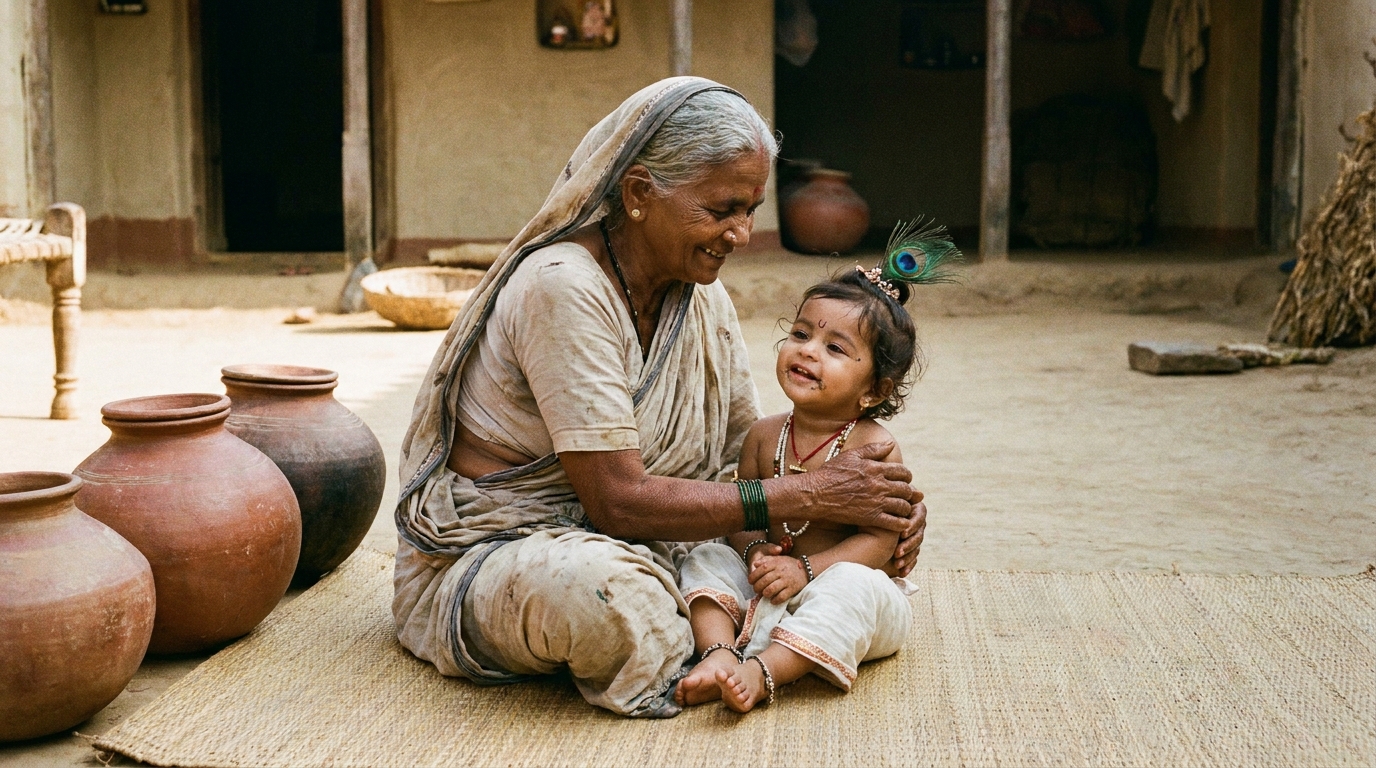
The Dāmodara-līlā is one of the most cherished stories in all of Bhakti. It is especially remembered during the sacred month of Kārtika, when devotees sing the Dāmodarāṣṭakam prayers and offer lamps to Krishna.
This pastime shows the sweetness of Yaśodā’s devotion and the humility of Krishna, who allows Himself to be bound by love.
Krishna Steals Butter
One day, Mother Yaśodā was personally churning yogurt into butter while singing songs about Krishna. Her mind was absorbed in Him. Her hands were working, her voice was singing, and her heart was full.
Krishna came to her, wanting her attention and milk. Yaśodā stopped churning and began to feed Him. But when milk on the stove began to boil over, she gently put Krishna down and went to save it.
Krishna, feeling neglected in His childlike mood, became upset. He broke the yogurt pot, stole butter, and began feeding it to the monkeys.
When Yaśodā returned and saw the mess, she understood what had happened. Taking a small stick—not to harm Him, but to lovingly correct Him—she went to find Krishna.
Yaśodā Runs After God
Krishna saw His mother coming and ran away in fear, like a small child who knows he has done something naughty. Yaśodā chased Him.
Here is a deeply moving image: the Supreme Lord, who is faster than the mind, who creates and sustains all universes, is running from His mother.
And Yaśodā, with her hair loosening and flowers falling from her braid, runs after Him with great effort.
The Bhāgavatam describes that Krishna allowed Himself to be caught. This is important. No one can capture God by force. But love attracts Him.
Yaśodā catches Krishna, sees His fearful eyes, and her heart softens. She throws away the stick. Still, wanting to teach Him not to steal, she decides to tie Him to a wooden grinding mortar.
The Rope Is Always Two Fingers Too Short
Mother Yaśodā brings a rope to tie Krishna, but the rope is too short. She adds more rope, but it is still too short. Again and again, no matter how much rope she adds, it remains two fingers short.
The great teachers of Bhakti explain that these “two fingers” represent two things: our sincere effort and Krishna’s mercy.
We cannot reach God by effort alone. And yet, we should not become passive or hopeless. We offer our effort—chanting, prayer, service, study, humility—and Krishna responds with grace.
When Yaśodā becomes tired, Krishna sees her love and allows Himself to be bound.
This is not a defeat of God. It is the victory of love.
What Yaśodā Teaches Us About Unconditional Love
Mother Yaśodā’s devotion is not distant from our lives. Although her love is spiritually perfect, her example can guide us in practical ways.
Many of us are trying to love better. We want to be more patient, more forgiving, more present, more prayerful. We want to serve without resentment. We want to trust God more deeply.
Yaśodā shows us that devotion is not only a feeling. It is a way of living.
Love Is Expressed Through Care
Yaśodā’s love appears in simple actions. She cooks. She cleans. She churns butter. She dresses Krishna. She protects Him from danger. She listens for His voice.
In Bhakti Yoga, ordinary actions can become offerings when done with loving intention.
Cooking can become devotion when we prepare food with gratitude and offer it to God. Parenting can become devotion when we see children as souls entrusted to our care. Work can become devotion when we act with honesty and service. Cleaning can become devotion when we prepare a sacred space for prayer or for others.
Bhakti does not require us to abandon life. It invites us to spiritualize life.
Love Includes Gentle Discipline
Sometimes people think unconditional love means never correcting, never guiding, and never setting boundaries. Yaśodā teaches something more complete.
She loves Krishna unconditionally, but she still corrects Him when He steals butter and makes a mess. Her discipline is not driven by ego, anger, or cruelty. It comes from care.
For us, this is an important lesson. Love is not passive. True love seeks the growth and well-being of the beloved. In spiritual life, this also means we accept guidance, correction, and humility.
Sometimes God’s mercy comes as comfort. Sometimes it comes as a lesson.
Both can be love.
Love Is Personal
Yaśodā’s devotion is deeply personal. She does not love an abstract idea. She loves Krishna as a real person.
Bhakti Yoga teaches that the Divine is not merely a distant force, but the Supreme Person, full of beauty, kindness, intelligence, and love. We may call God by different names according to our tradition or background, but Bhakti invites us into relationship.
We can speak to God. We can sing to God. We can offer our food, our time, our grief, our gratitude, and our hopes.
Even if our faith is small, we can begin personally: “Dear Lord, please guide me. Please help me remember You. Please teach me how to love.”
Seeing God Beyond Power and Fear
Many people first approach God with fear, duty, or need. This is natural. When life becomes difficult, we pray. When we feel small, we seek shelter. When we are grateful, we give thanks.
But Bhakti gently leads us deeper.
Yaśodā’s love shows a stage of devotion where God is not approached only as the Almighty, but as the beloved center of the heart.
The Universal Form in Krishna’s Mouth
One famous pastime tells how Krishna, as a child, was accused of eating dirt. Mother Yaśodā asked Him to open His mouth. When He did, she saw the entire universe inside—planets, stars, elements, time, space, all beings, and even herself looking into His mouth.
For a moment, Yaśodā saw Krishna’s divine majesty.
But then, by Krishna’s own loving arrangement, her motherly affection covered that awe. She returned to thinking, “This is my child.”
This is not ignorance in an ordinary sense. It is a higher spiritual intimacy. Yaśodā’s love is so pure that she does not need God to impress her.
She does not love Krishna because He contains the universe.
She loves Him because He is Krishna.
From Awe to Intimacy
Awe has its place in spiritual life. It is healthy to feel wonder before the vastness of creation and the greatness of God. But Bhakti also tells us that the soul longs for intimacy.
We do not only want to know that God is powerful. We want to know that God is loving.
Yaśodā’s devotion assures us that God receives personal love. Our prayers matter. Our songs matter. Our small offerings matter. Our tears matter.
The Lord of the universe can be touched by the sincerity of the heart.
Practicing Bhakti in the Mood of Yaśodā
We may not be on the level of Mother Yaśodā, but we can learn from her mood. Bhakti Yoga is practical. It gives us ways to cultivate love every day.
The word bhakti means devotion, loving service, or heartfelt connection with God. Yoga means union or connection. So Bhakti Yoga is the path of connecting with God through love.
This path is open to everyone.
You do not need to be born in a certain culture. You do not need to know Sanskrit. You do not need to have a perfect life. You do not need to pretend to be advanced.
You can begin where you are.
Chanting the Holy Names
One of the central practices of Bhakti Yoga is chanting God’s names. In the Bhakti tradition, names of God are understood to carry divine presence. Chanting helps cleanse the heart and awaken love.
Many devotees chant the Hare Krishna mahā-mantra:
Hare Krishna Hare Krishna
Krishna Krishna Hare Hare
Hare Rama Hare Rama
Rama Rama Hare Hare
“Hare” calls upon the divine energy of the Lord. “Krishna” means the all-attractive one. “Rama” means the source of spiritual joy.
You can chant softly, sing with others, or repeat the mantra on beads. The mood matters more than performance. Even a few minutes of sincere chanting can bring peace and remembrance.
Offering Food With Love
Yaśodā’s devotion is full of cooking and feeding Krishna. We can follow her example by preparing simple vegetarian food and offering it to God before eating.
You might place the food before a picture of Krishna or simply close your eyes and pray:
“Dear Lord, thank You for this food. Please accept this offering made with love. May it nourish my body and help me serve with kindness.”
Food offered to Krishna is called prasāda, meaning mercy or grace. Eating prasāda reminds us that life is a gift and that nourishment is sacred.
Serving Others as Service to God
Yaśodā’s love is active. She serves Krishna through care. We can serve Krishna by serving His children—all living beings.
This may look like feeding someone, listening compassionately, volunteering, caring for family, helping at a temple or community gathering, protecting animals, or offering encouragement to someone in pain.
Service becomes spiritual when we offer it with humility: “May this be pleasing to You, Lord.”
Bhakti is not only what we do in private prayer. It is how we treat others.
The Healing Power of Motherly Devotion
Many people carry wounds around love. Some have felt abandoned, judged, unseen, or valued only for what they can produce. Because of this, the idea of unconditional love can feel beautiful but difficult to trust.
Yaśodā’s devotion offers healing because it reveals a love that is steady, tender, and personal.
Learning to Receive Love
In spiritual life, we often focus on loving God. But we also need to learn how to receive God’s love.
Krishna’s childhood pastimes show that the Divine is not cold or unreachable. Krishna laughs, plays, accepts food, responds to affection, and enters relationships.
This can soften the heart.
We can pray, “Krishna, I do not yet know how to love purely. I may be guarded or distracted. But please help me receive Your love and share it with others.”
Such a prayer is already a step on the path.
Bringing Devotion Into Family Life
Yaśodā’s example is especially meaningful for parents, caregivers, teachers, and anyone who serves quietly behind the scenes.
So much love in this world is hidden. Meals prepared, clothes washed, rides given, tears wiped, prayers whispered at night—these may seem ordinary, but in Bhakti they can become sacred offerings.
If you care for others, your service matters.
If you are tired, God sees you.
If you feel unnoticed, Krishna knows your heart.
Mother Yaśodā reminds us that love expressed in daily care is deeply spiritual.
Softening the Heart Through Prayer
Unconditional love does not mean we become perfect overnight. It grows through practice and grace.
We can pray:
“Dear Krishna, please make my heart softer. Help me love without selfishness. Help me serve without pride. Help me forgive. Help me remember You in my home, my work, my relationships, and my struggles.”
Prayer is not about eloquence. It is about sincerity.
A simple prayer from the heart can open a door.
Yaśodā’s Love and Our Spiritual Growth
The path of Bhakti Yoga is both sweet and transformative. It does not ask us to deny our humanity. It invites us to offer our humanity.
Our emotions, relationships, work, creativity, and daily responsibilities can all become part of our spiritual journey when connected to Krishna.
From Self-Centered Love to God-Centered Love
Most of us begin with mixed motives. We want comfort, success, security, affection, and relief from pain. These desires are understandable.
But as we practice Bhakti, our love gradually becomes purified.
We begin to ask not only, “What can God do for me?” but “How can I serve? How can I remember? How can I become an instrument of compassion?”
Yaśodā’s devotion is completely God-centered. Her joy is Krishna’s joy. Her life is Krishna’s service. Her heart has no separate agenda.
This is the direction Bhakti gently points us toward.
The Beauty of Dependence on Grace
In the Dāmodara-līlā, Yaśodā tries again and again to bind Krishna. Her effort alone is not enough. But when Krishna sees her sincere love, He allows Himself to be bound.
This gives hope to all of us.
We may feel our chanting is distracted. Our prayers may feel small. Our service may be imperfect. Our minds may wander. Still, if we keep offering ourselves sincerely, Krishna sees.
Bhakti is not a path of harsh perfectionism. It is a path of sincere returning.
Again and again, we return to the holy name. We return to prayer. We return to service. We return to the desire to love.
And Krishna responds.
Unconditional Love in a Conditional World
We live in a world where love is often tied to achievement, appearance, usefulness, or agreement. People may feel they must earn affection or prove their worth.
Yaśodā’s devotion reveals another kind of love.
She does not love Krishna because He performs miracles. She does not need Him to display greatness. She loves Him in His muddy feet, His butter-covered hands, His playful mischief, His childlike tears.
This kind of love gives us a glimpse of divine reality.
Love That Sees the Soul
Bhakti teaches that every living being is an eternal soul, a beloved part of God. When we begin to see others in this way, our relationships change.
We become less interested in using people and more interested in honoring them.
We become more patient with weakness because we know we also need mercy.
We become more willing to serve because we see service as sacred.
Yaśodā sees Krishna with total affection. By her example, we can pray to see others with more compassion and less judgment.
Love That Keeps Showing Up
Unconditional love is not always dramatic. Often, it means showing up.
Showing up to chant when the mind is restless.
Showing up to pray when the heart feels dry.
Showing up to serve when no one notices.
Showing up to forgive, to listen, to begin again.
Mother Yaśodā’s devotion is steady. Day after day, she cares for Krishna. This steadiness is a form of spiritual strength.
In our lives too, small consistent acts of devotion can transform the heart.
Taking One Step Toward Krishna
Yaśodā’s love for Krishna is beyond ordinary measure, yet it is not meant to make us feel distant or unqualified. It is meant to invite us.
Her devotion says: God is lovable. God is personal. God accepts simple service. God is moved by sincere affection.
You can begin with one small step.
Chant one round of the Hare Krishna mantra, or chant for five minutes.
Offer one meal with gratitude.
Read one verse from the Bhagavad-gītā or Śrīmad-Bhāgavatam.
Light a candle or lamp and say a simple prayer.
Serve someone with the intention of pleasing God.
Speak to Krishna honestly, as you are.
No step is too small when it is sincere.
The path of Bhakti Yoga is a path of love, and love grows by practice. Like Mother Yaśodā, we can learn to make our homes, our work, our relationships, and our daily actions offerings to the Divine.
Wherever you are from, whatever your background, whatever your level of faith, you are welcome. Krishna is not looking for perfection; He is looking for the heart.
May Mother Yaśodā’s unconditional love inspire us to love more deeply, serve more humbly, chant more sincerely, and remember that God can be approached with tenderness.
Everyone is welcome to take one sincere step toward God today.
FAQs
1. Who is Yaśodā in Hindu mythology?
Yaśodā is a beloved figure in Hindu mythology, known as the foster mother of Lord Krishna. She is revered for her unconditional love and devotion to Krishna.
2. What is the significance of Yaśodā’s love for Krishna?
Yaśodā’s love for Krishna is considered a symbol of pure, selfless maternal love. Her nurturing and caring nature towards Krishna exemplifies the bond between a mother and child in Hindu culture.
3. How is Yaśodā’s love for Krishna depicted in Hindu scriptures and folklore?
Yaśodā’s love for Krishna is depicted in various Hindu scriptures and folklore, particularly in the Bhagavata Purana and other texts related to the life and adventures of Lord Krishna. These stories often highlight Yaśodā’s endearing and playful interactions with Krishna.
4. What are some popular stories that showcase Yaśodā’s love for Krishna?
One of the most popular stories is the “Damodara Lila,” where Yaśodā tries to tie up Krishna with a rope after he is caught stealing butter. Another well-known tale is the “Makhan Chor Lila,” which narrates Krishna’s mischievous acts of stealing butter and Yaśodā’s attempts to discipline him with love.
5. How does Yaśodā’s love for Krishna inspire devotion and reverence in Hindu culture?
Yaśodā’s love for Krishna serves as a source of inspiration for devotees, emphasizing the importance of selfless love and devotion in one’s relationship with the divine. Her nurturing and affectionate nature towards Krishna is revered and celebrated in Hindu culture as an embodiment of pure, maternal love.

