
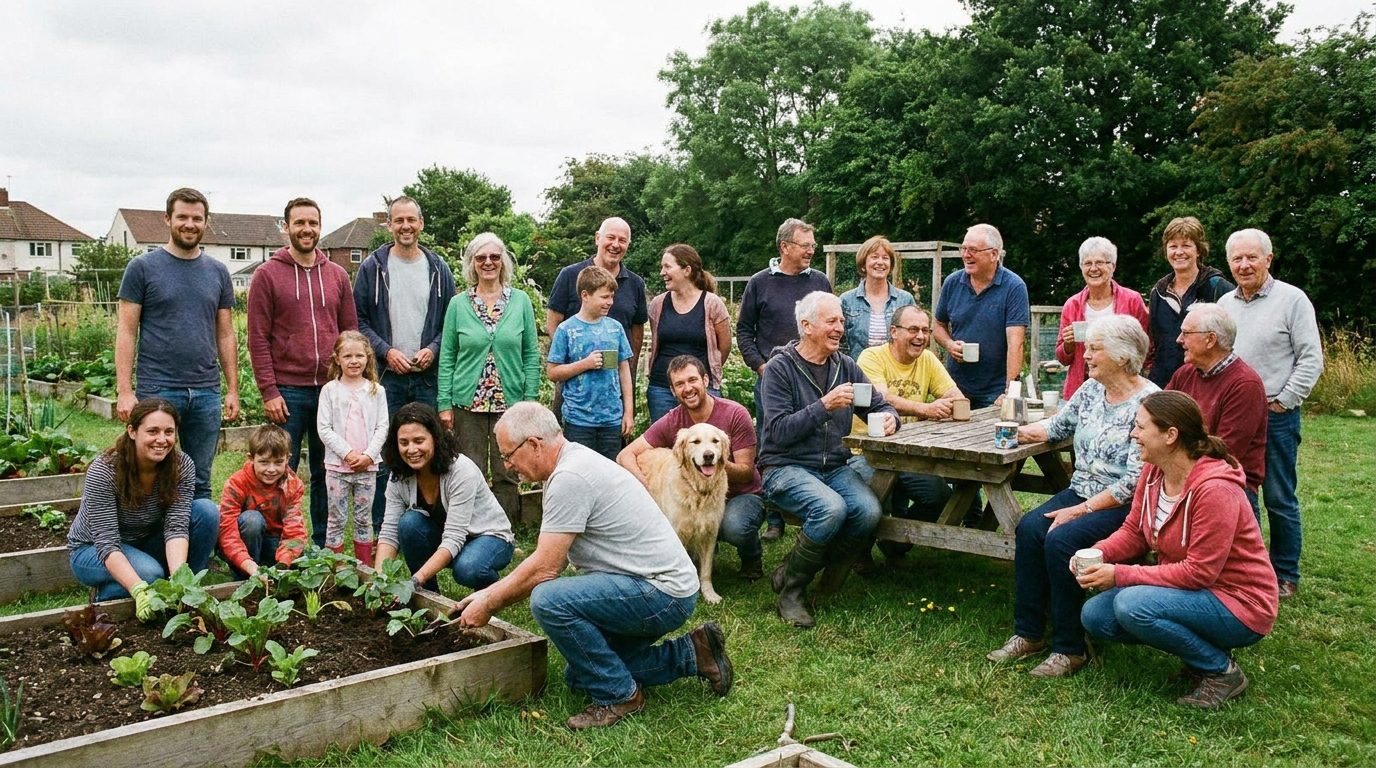
Every spiritual community, no matter how sincere or devoted, will eventually face moments that test its foundation. When difficult situations arise with community members, these moments are not punishments or signs of failure. They are invitations — sacred opportunities for growth, deeper self-reflection, and a more honest relationship with God and one another.
At The Bhakti House, we believe that the path of Bhakti Yoga — the yoga of loving devotion — is not practiced in isolation. It unfolds in the beautiful, messy, and transformative space of community, known in Sanskrit as sangha. And within that community, challenges with people are often the very catalysts that reveal where our leadership needs strengthening, where our boundaries need clarity, and where our organizational structures need love and attention.
If you’ve ever been part of a spiritual community, a church, a temple, a meditation group, or any gathering of souls seeking something higher, you know this truth: people are wonderfully complex. And sometimes, that complexity creates friction. Let’s walk through this topic together with open hearts, practical wisdom, and the understanding that every challenge is an opportunity to grow closer to the Divine.
In the Bhagavad Gita (Chapter 2, Verse 14), Lord Krishna gently reminds Arjuna that the experiences of happiness and distress come and go like the changing seasons. They are temporary. The wise person, Krishna says, is not disturbed by them.
This teaching is profoundly relevant to community life. When a community member becomes a source of conflict — whether through gossip, power struggles, emotional reactivity, or simply a clash of personalities — our first instinct might be frustration, avoidance, or even resentment. But Bhakti wisdom invites us to pause and look deeper.
Difficult community members often serve as mirrors. They reflect back to us the areas where we, as leaders and participants, have left things unclear, unspoken, or unexamined. They expose the gaps in our structures and the softness in our boundaries — not to shame us, but to help us build something stronger and more loving.
Seeing the Person, Not Just the Problem
One of the most important principles in Bhakti Yoga is seeing the divine spark (atma) in every living being. The Bhagavata Purana teaches that a true devotee sees God in the heart of all creatures and all creatures in the heart of God.
This doesn’t mean we ignore harmful behavior. It means we respond to difficult situations from a place of spiritual maturity rather than emotional reactivity. We can hold someone in compassion while also holding firm to what is healthy and right for the community.
The Lesson Behind the Disruption
Often, the most disruptive moments in a community reveal the most important lessons. Perhaps communication has been unclear. Perhaps expectations were never formally established. Perhaps leaders have been avoiding a conversation that needed to happen months ago. The disruption is not the disease — it is the symptom pointing toward what needs healing.
Leadership Is Tested in the Fire, Not in the Calm
It is easy to lead when everything is harmonious. When the kirtan (devotional chanting) is sweet, when everyone is smiling, when the community feels like a warm embrace — leadership feels effortless. But true leadership is forged in the moments of tension, disagreement, and discomfort.
In the Bhakti tradition, leadership is not about authority or control. It is about service. The Sanskrit word seva means selfless service, and a genuine spiritual leader embodies this quality. A leader in a Bhakti community is not someone who sits above others but someone who kneels beside them, willing to do the hard work of holding space, having honest conversations, and making decisions that serve the greater good — even when those decisions are uncomfortable.
Humility as the Foundation of Leadership
The great Bhakti saint Chaitanya Mahaprabhu taught a verse that is foundational to devotional life:
“One should be more humble than a blade of grass, more tolerant than a tree, ready to offer all respect to others, and expecting no respect for oneself.”
This is not a call to be a doormat. It is a call to lead from a place of inner strength and humility. When a difficult community member tests a leader’s patience, humility allows the leader to respond rather than react. It creates space for wisdom to enter the situation.
Accountability Is an Act of Love
Some leaders in spiritual communities shy away from accountability because they fear it contradicts the message of love and acceptance. But accountability, when delivered with compassion and clarity, is one of the highest expressions of love.
If a community member is causing harm — whether emotional, spiritual, or practical — and leadership remains silent, that silence does not protect love. It erodes trust. The other members of the community are watching. They need to know that the space they’ve trusted is being cared for with integrity.
A loving leader says, “I see you. I care about you. And I also care about this community enough to be honest about what’s happening.”
Boundaries Are Not Walls — They Are Sacred Containers
One of the most common issues that difficult community members expose is a lack of clear, compassionate boundaries. In many spiritual spaces, there is a beautiful but sometimes misguided belief that boundaries are somehow “unspiritual” — that a truly loving community should have no limits, no rules, no structures.
But consider this: a mandala (sacred geometric design) is beautiful precisely because of its structure. A mala (prayer beads) is useful because each bead has its place. Structure does not oppose devotion. Structure supports it.
What Healthy Boundaries Look Like in a Spiritual Community
Healthy boundaries in a Bhakti community might include:
- Clear expectations for behavior during gatherings, events, and online interactions
- A written code of conduct that reflects the values of respect, devotion, and compassion
- Defined roles and responsibilities for leaders, volunteers, and participants
- A transparent process for addressing grievances and conflicts
- Guidelines around communication — how feedback is given, how concerns are raised, and who to approach when something doesn’t feel right
These are not bureaucratic formalities. They are acts of seva — service to the community’s well-being. When boundaries are clear, people feel safe. And when people feel safe, they open their hearts more fully to God, to the practice, and to one another.
The Courage to Enforce Boundaries with Love
Setting boundaries is one thing. Enforcing them is another. This is where many communities falter. A boundary that is stated but never upheld becomes meaningless — and it actually creates more distrust than having no boundary at all.
Enforcing a boundary might mean having a private, respectful conversation with someone whose behavior has been disruptive. It might mean limiting someone’s participation for a period of time. In rare and serious cases, it might mean asking someone to step away from the community altogether.
None of these actions are easy. But they are necessary. And when done with sincerity, prayer, and genuine care for all involved, they become acts of deep spiritual courage.
Sure, here is the sentence with the clickable link:
You can find more bhakti articles here.
Organizational Clarity Is a Form of Devotion
Behind every thriving spiritual community is a structure — not one that stifles the spirit, but one that gives the spirit room to breathe and grow. Difficult community members often expose the cracks in this structure, revealing places where organizational clarity is desperately needed.
Building Systems That Serve the Mission
A Bhakti community exists for a sacred purpose: to help people cultivate their loving relationship with God through chanting, prayer, service, and fellowship. Every system, process, and organizational decision should serve that purpose.
This might include:
- Regular leadership meetings where challenges are discussed openly and prayerfully
- A mentorship or support structure for new community members, helping them understand the culture and values of the space
- Documentation of policies and procedures — not as cold formalities, but as living documents that reflect the community’s heart
- Training for leaders and volunteers on communication, conflict resolution, and pastoral care
- Feedback loops that allow community members to share their experiences and concerns in a safe and constructive way
When There Is No Structure, There Is No Safety
Without organizational clarity, communities often default to personality-driven leadership. Decisions become inconsistent. Conflicts are handled differently depending on who is involved. And when a particularly challenging individual enters the scene, the lack of structure becomes painfully apparent.
The solution is not to become rigid or corporate. The solution is to build a framework rooted in devotional values — one that is flexible enough to accommodate the organic nature of spiritual community but strong enough to protect the people within it.
Growing Together Through Conflict: The Bhakti Perspective on Community Challenges
In the Srimad Bhagavatam, there is a beautiful concept that devotees grow not in spite of challenges but through them. The path of Bhakti is not a path of spiritual bypassing — pretending that everything is fine when it is not. It is a path of honest, open-hearted engagement with life as it is.
When a community faces a difficult situation with a member, it is an invitation to come together in prayer, to seek guidance from scripture and wise mentors, and to respond with both compassion and courage.
Forgiveness and Firmness Can Coexist
One of the most powerful lessons in Bhakti is that forgiveness does not mean the absence of consequences. We can forgive someone and still recognize that a particular behavior cannot continue. We can hold love for a person and still protect the community from harm.
This is not a contradiction. It is spiritual maturity.
The Role of Prayer in Navigating Conflict
Before any difficult conversation, before any leadership decision, before any boundary is set or enforced — pray. Chant the holy names. Sit quietly and ask God for guidance. The Bhakti tradition teaches that the Lord dwells in the hearts of all beings (Bhagavad Gita 18.61) and that when we sincerely seek guidance, it comes.
Prayer doesn’t remove the difficulty. But it transforms the way we walk through it.
Moving Forward with Love, Clarity, and Devotion
If your spiritual community is currently navigating a difficult situation, please know this: you are not alone. Every community that has ever existed — from the earliest gatherings of Bhakti saints to modern-day temples and home sanghas — has faced these challenges.
The fact that you are reading this, thinking about these issues, and seeking a more loving and organized approach is itself a sign of deep devotion. You care. And that caring is the beginning of transformation.
Here are a few simple steps you can take today:
- Pause and pray. Before reacting to any situation, take it to God first.
- Have the honest conversation. Avoidance only deepens the wound.
- Review your boundaries. If they don’t exist in writing, now is the time to create them.
- Strengthen your organizational structure. Even small improvements make a significant difference.
- Seek counsel. Talk to trusted mentors, other community leaders, or spiritual guides who have walked this path before.
- Lead with both love and firmness. They are not opposites. They are partners.
Remember, the goal is not a perfect community. The goal is a sincere community — one where people feel safe to grow, to stumble, to learn, and to love God together.
As the great Bhakti teachers remind us, the path of devotion is walked one step at a time. You don’t have to have all the answers today. You just need to take one sincere step — toward God, toward honesty, toward love.
And wherever you are on your journey, whatever your background, whatever tradition you come from or don’t come from — you are welcome here. The Bhakti House is a home for every heart that is willing to love.
Take that one step today. God is already reaching out to meet you.

