
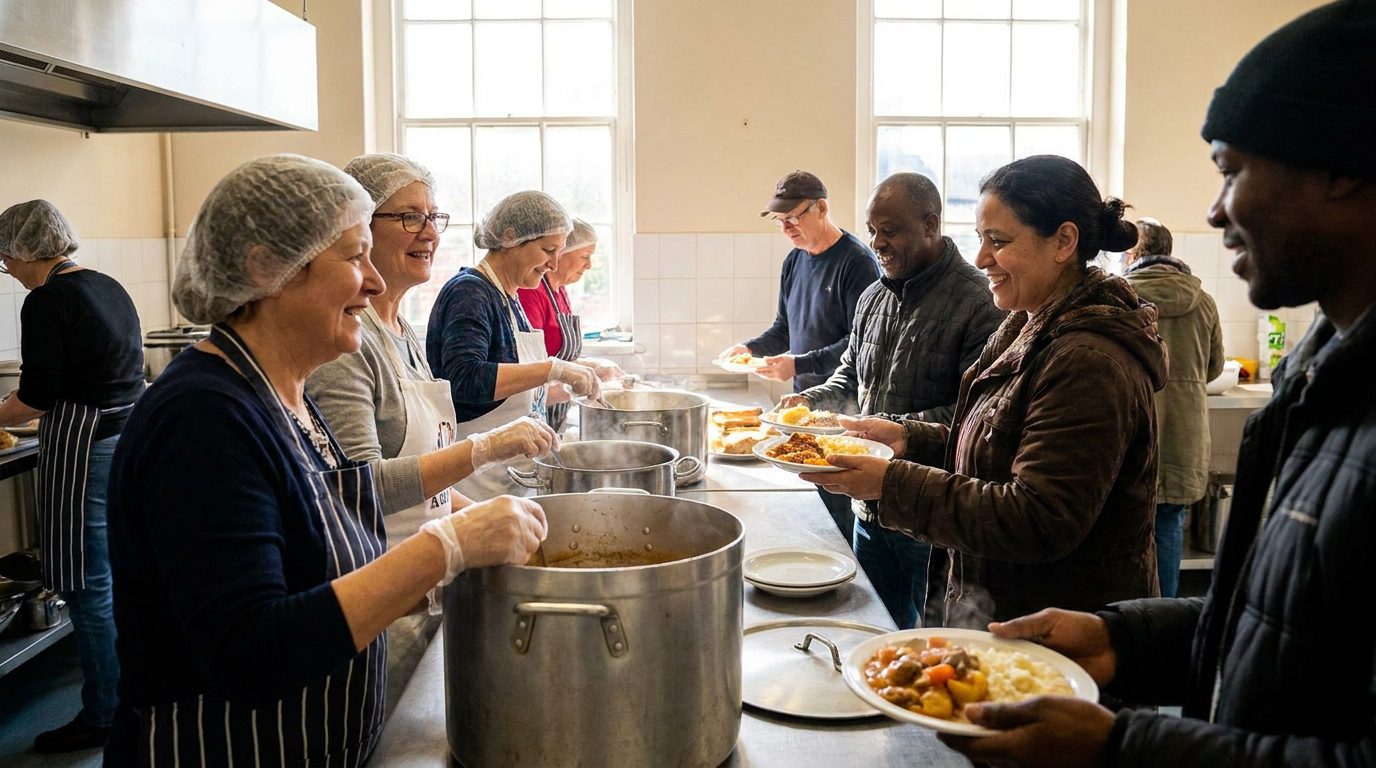
Welcome, dear friend. Whether you’ve just walked through the doors of a Bhakti community for the first time or you’ve been chanting the holy names for years, there’s something beautiful and sometimes challenging that comes with sharing spiritual life alongside others. Community life is one of the greatest gifts on the Bhakti path, and it’s also one of the greatest teachers.
Living, serving, and growing together requires more than just showing up. It asks us to open our hearts, roll up our sleeves, and learn how to love in very practical, sometimes unglamorous ways. This article is for anyone who wants to understand how seva (selfless service), shared responsibilities, and the everyday rhythms of community life weave together to deepen our relationship with God and with one another.
No matter where you come from or what tradition shaped you, these principles speak to the universal human longing to belong, to serve something greater, and to grow in love.
What Is Seva, Really?
Seva is a Sanskrit word that simply means “service.” But in the Bhakti tradition, it carries a deeper meaning. Seva is service offered with love, without expectation of reward, recognition, or personal gain. It is the natural expression of a heart that is falling in love with God.
In the Bhagavad Gita (Chapter 9, Verse 27), Lord Krishna lovingly invites us:
“Whatever you do, whatever you eat, whatever you offer or give away, and whatever austerities you perform — do that as an offering to Me.”
This beautiful instruction transforms the most ordinary tasks into sacred acts. Washing dishes becomes an offering. Sweeping the temple floor becomes a prayer. Cooking a meal for others becomes an act of worship. Seva isn’t reserved for grand gestures or special occasions. It lives in the small, quiet moments of daily life.
Seva Is Not About Perfection — It’s About Sincerity
One of the most common misunderstandings about seva is that we need to be experts or perfectly qualified to serve. The truth is far more encouraging. God doesn’t need our perfection. He cherishes our sincerity. A meal cooked with love, even if it’s simple, nourishes more deeply than a gourmet feast prepared with ego.
When we approach seva with humility, something remarkable happens. The service itself begins to purify our hearts. We start to notice our attachments, our need for praise, our frustration when things don’t go our way. And in noticing these things, we’re given the chance to grow beyond them.
Different Forms of Seva in Community Life
Seva shows up in countless forms within a Bhakti community:
- Cooking and distributing prasadam (sacred food offered to God and shared with others)
- Cleaning and maintaining shared spaces so others can worship and gather in beauty and order
- Welcoming newcomers with warmth and genuine care
- Organizing events, kirtans, and festivals that bring people together in celebration
- Offering skills and talents — whether that’s music, art, writing, gardening, accounting, or carpentry
- Simply being present for someone who needs a listening ear or a kind word
Every single one of these acts matters. No seva is too small when it is offered with a sincere heart.
Building a Culture of Shared Responsibility
Moving Beyond “Someone Else Will Do It”
One of the most honest challenges in any community is the tendency to assume that someone else will handle things. The kitchen needs cleaning? Someone will get to it. The garden needs watering? Surely someone has that covered. The new visitor looks a little lost? Someone will welcome them.
But here’s the gentle truth: we are that someone. Shared responsibility means each person takes ownership of the community’s well-being, not because they’re assigned a task, but because they care. When everyone carries a small piece of the load, no one is crushed under the weight of it.
The Bhakti tradition teaches that we are all interconnected — not just spiritually, but practically. The Srimad Bhagavatam beautifully illustrates through countless stories how devotees supported one another, how kingdoms functioned when everyone contributed according to their nature and capacity, and how even God Himself, when He appeared on this earth, engaged in service to others.
Practical Ways to Share the Load
Building a culture of shared responsibility doesn’t happen by accident. It requires intentionality, communication, and a lot of grace. Here are some practical approaches that Bhakti communities around the world have found helpful:
- Create clear and rotating seva schedules so no single person or small group carries everything
- Match people’s natural strengths and interests to specific areas of service — someone who loves to cook will thrive in the kitchen, while someone with organizational skills might shine in event planning
- Hold regular community meetings where needs, concerns, and appreciations can be openly and lovingly shared
- Celebrate contributions publicly — not for ego, but to show genuine gratitude and encourage others
- Be flexible and compassionate when someone can’t fulfill a commitment due to health, family needs, or personal struggles
When Responsibility Feels Like a Burden
Let’s be honest. There are seasons when seva and shared responsibility can feel heavy. Maybe you’re going through a difficult time personally. Maybe you feel like you’re giving more than you’re receiving. Maybe the same few people always seem to do the work while others coast along.
These feelings are valid, and they don’t make you a bad devotee. They make you human.
In moments like these, it’s important to remember that Bhakti is not about gritting your teeth and pushing through out of obligation. It’s about returning again and again to the source of your strength — your relationship with God. Chanting, prayer, honest conversation with trusted friends, and sometimes simply resting are all part of the journey.
The great Bhakti saint Rupa Goswami taught that devotional service should be performed with enthusiasm, confidence, and patience (utsahan nischayad dhairyat). Notice that patience is included. Growth takes time, and so does learning to serve joyfully in community.
Navigating Relationships and Differences in Community
We Don’t Choose Our Spiritual Family — And That’s the Point
One of the most transformative aspects of community life is that it brings together people we might never have chosen as friends on our own. Different backgrounds, personalities, communication styles, life experiences, and even different understandings of spiritual practice all converge under one roof.
This can be incredibly enriching. It can also be incredibly challenging.
But here’s the deeper invitation: the people around us in community are not obstacles to our spiritual growth. They are catalysts for it. Every moment of friction is an opportunity to practice patience. Every misunderstanding is a chance to practice compassion. Every disagreement is an invitation to practice humility.
Communication: The Bridge That Holds Community Together
So much of the difficulty in community life comes down to communication — or the lack of it. Assumptions go unchecked. Expectations go unspoken. Small hurts pile up into resentment.
Healthy Bhakti communities prioritize honest, kind, and courageous communication. This means:
- Speaking up early when something is bothering you, rather than letting it fester
- Listening to understand, not just to respond
- Assuming good intentions until clearly shown otherwise
- Apologizing sincerely when you’ve caused harm, even unintentionally
- Forgiving generously, knowing that everyone is on their own journey of growth
The Bhagavad Gita (Chapter 17, Verse 15) describes speech that is truthful, pleasing, beneficial, and not agitating as an austerity of speech. What a beautiful standard to aspire to in our daily interactions.
Handling Conflict with Grace
Conflict is not a sign that a community is failing. It’s a sign that real people with real feelings are trying to do something meaningful together. What matters is not whether conflict arises, but how it’s handled.
In a Bhakti community, conflict resolution is ideally grounded in mutual respect, a shared commitment to spiritual principles, and the willingness to put relationships above being right. Sometimes this means involving a trusted elder, mentor, or community leader who can offer perspective and guidance.
And sometimes, it simply means sitting with someone over a cup of chai and saying, “I value you. Let’s work through this together.”
Sure, here is the sentence with the clickable link:
Check out our website for more bhakti articles.
The Role of Spiritual Practice in Sustaining Community Life
Chanting Together: The Glue of Bhakti Community
If there is one practice that holds a Bhakti community together more than any other, it is kirtan — the congregational chanting of God’s holy names. When we chant together, something extraordinary happens. The walls we build around our hearts begin to soften. Differences that seemed so important start to dissolve. We remember why we’re here.
Lord Chaitanya, the great saint who inaugurated the modern Bhakti movement over 500 years ago, emphasized that the chanting of the holy names is the most powerful practice for this age. He said it cleanses the heart, extinguishes the fire of material suffering, and spreads the moonlight of divine love.
When a community gathers regularly to chant — whether in a grand kirtan or a quiet morning japa circle (personal meditation on God’s names using prayer beads) — that shared practice becomes the foundation upon which everything else is built.
Personal Practice Supports Community Health
It’s worth noting that the health of a community is deeply connected to the health of its individual members. When each person is nourished by their own personal practice — their chanting, their prayer, their study of scripture, their time in quiet devotion — they show up to community life from a place of fullness rather than emptiness.
You cannot pour from an empty cup. Taking care of your own spiritual nourishment is not selfish. It is one of the most generous things you can do for your community.
Growing Together: The Long and Beautiful Road
Patience With Ourselves and Each Other
Community life is not a sprint. It’s a long, winding, beautiful, sometimes bumpy road that we walk together. There will be seasons of incredible closeness and joy. There will be seasons of misunderstanding and growing pains. Both are part of the journey.
The Bhakti path teaches us that spiritual growth is gradual and that God is infinitely patient with us. If God can be patient with our stumbling, imperfect attempts at love, surely we can extend that same patience to one another — and to ourselves.
Celebrating the Small Victories
In the busyness of community life, it’s easy to focus on what’s not working and forget to celebrate what is. Take time to notice the small victories. The newcomer who felt welcomed. The festival that came together beautifully because dozens of people contributed. The friendship that deepened through honest conversation. The child who learned their first Sanskrit prayer.
These moments are sacred. They are the fruit of seva, shared responsibility, and love in action.
Everyone Has a Place at the Table
Perhaps the most important thing to remember about Bhakti community life is this: everyone belongs. You don’t need to have all the answers. You don’t need to be the most skilled, the most knowledgeable, or the most experienced. You just need to be willing to show up with an open heart and a sincere desire to serve and grow.
The Srimad Bhagavatam reminds us that God does not see the external qualifications of a person. He sees the love in their heart. And love, offered sincerely, is always enough.
A Gentle Invitation
Wherever you are on your journey — whether you’ve never set foot in a Bhakti community or you’ve been part of one for decades — know that you are welcome. Know that your presence matters. Know that your unique gifts, your unique challenges, and your unique heart are needed.
Community life is not about perfection. It’s about walking toward God together, one sincere step at a time.
So if you feel the call, take that step. Show up to a kirtan. Offer to help in the kitchen. Sit next to someone new and ask them about their day. Pick up a pair of japa beads and chant one round of the holy names. Whatever your one step is, take it.
God is already walking toward you.
With love and encouragement from all of us at The Bhakti House — you are always welcome here.

