
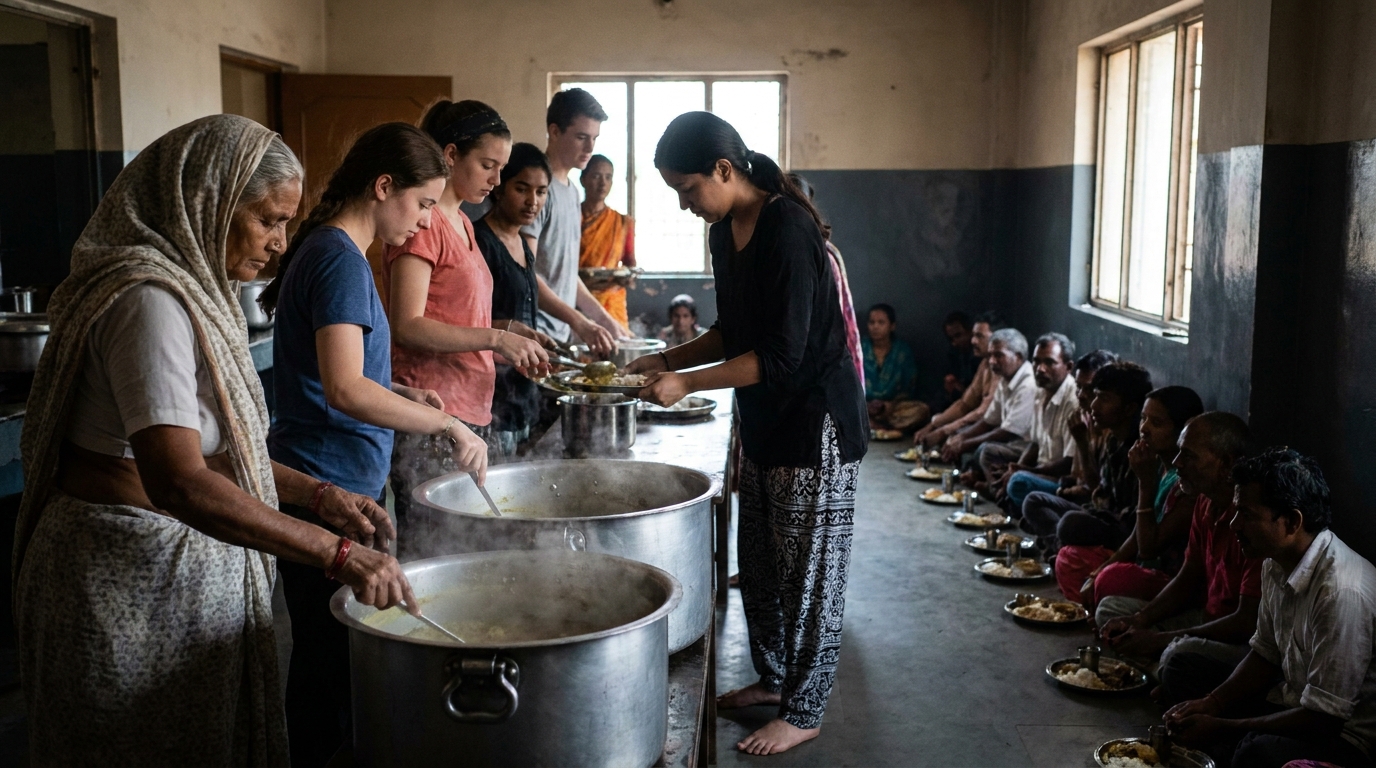
If you’ve ever spent time in a spiritual community — whether a temple, an ashram, a meditation center, or a gathering of devotees — you’ve probably heard the word seva. In Sanskrit, seva simply means “selfless service.” It’s the act of offering your time, energy, and love in service to God, to the community, and to all living beings without expecting anything in return.
But seva is so much more than just volunteering or checking tasks off a list. In the Bhakti tradition, seva is considered one of the most beautiful and transformative spiritual practices available to us. It’s a way of saying to God, “I love You, and I want to express that love through my actions.”
The Bhagavad Gita (Chapter 9, Verse 27) offers this timeless invitation:
“Whatever you do, whatever you eat, whatever you offer or give away, and whatever austerities you perform — do that as an offering to Me.”
This verse reminds us that every single act can become sacred when it’s offered with love. Washing dishes, sweeping a floor, cooking a meal, greeting someone at the door — all of it becomes a prayer when it’s done as seva.
At its heart, seva is love in action. And in spiritual communities, it’s often the invisible thread that holds everything together.
Why Spiritual Communities Expect Seva From Their Members
Building Something Together
Every spiritual community, no matter how large or small, depends on the willing hands and open hearts of its members. Temples don’t run themselves. Festivals don’t organize themselves. Meals don’t cook themselves. The lights stay on, the altar stays beautiful, and the doors stay open because real people show up and offer their service.
When a community sets an expectation of seva, it’s not about creating a workforce or placing demands on anyone. It’s about building something sacred together. There’s a special kind of joy that comes from knowing you helped create the space where someone else experienced God’s love for the first time. That joy is one of the quiet gifts of seva.
Seva as a Spiritual Practice
In Bhakti Yoga, we understand that the spiritual path isn’t only about what happens during meditation or kirtan (devotional chanting). Growth happens in how we live, how we treat others, and how we offer ourselves in service.
The great Bhakti saint Chaitanya Mahaprabhu taught that serving the devotees of God is one of the most powerful ways to deepen our own devotion. When we serve alongside others who love God, something beautiful happens inside us. Our ego softens. Our hearts open. We begin to experience the truth that we’re all connected — all part of one spiritual family.
The expectation of seva in a community is really an invitation to practice love in a very tangible, grounded way. It’s spirituality with its sleeves rolled up.
The Exchange of Love and Gratitude
When we receive spiritual nourishment from a community — through teachings, kirtan, fellowship, and sacred space — seva becomes a natural expression of gratitude. It’s not a transaction. It’s a relationship. Just as you might lovingly tend a garden that feeds your family, you lovingly tend the community that nourishes your soul.
The Srimad Bhagavatam, one of the most beloved texts in the Bhakti tradition, describes how devotees naturally feel inspired to serve when their hearts are touched by divine love. Seva isn’t forced. It flows from a grateful heart.
The Different Forms Seva Can Take
One of the most beautiful things about seva is that it meets you exactly where you are. You don’t need special skills, a certain level of education, or years of spiritual experience to serve. You just need a willing heart.
Physical Service
This is often the most visible form of seva. It includes things like:
- Cleaning and maintaining the temple or gathering space
- Cooking and serving prasadam (sacred food offered to God and then shared with everyone)
- Setting up for events, kirtans, and celebrations
- Gardening, decorating the altar, or arranging flowers
- Helping with construction, repairs, or practical projects
Physical seva is a humble offering of the body, and there’s deep spiritual beauty in it. When you’re on your knees scrubbing a temple floor, something in your heart quietly surrenders. The ego has a harder time puffing itself up when your hands are in dishwater.
Service Through Skills and Talents
Maybe you’re a musician who can lead or support kirtan. Maybe you’re a graphic designer, a writer, a photographer, an accountant, or a teacher. Every talent you have can become an offering to God when shared with your spiritual community.
This form of seva reminds us that God has given each of us unique gifts — not just for our own benefit, but to be shared for the upliftment of everyone.
Emotional and Relational Service
Sometimes the most meaningful seva is simply being present for another person. Listening to someone who’s struggling. Welcoming a newcomer who feels nervous walking through the door for the first time. Offering a kind word, a warm smile, or a patient ear.
In Bhakti, we recognize that every living being is a beloved child of God. When we serve each other with kindness and compassion, we’re serving God directly. As the Bhagavad Gita (Chapter 6, Verse 30) beautifully states:
“For one who sees Me everywhere and sees everything in Me, I am never lost, nor is that person ever lost to Me.”
When we see God in the person standing in front of us, service becomes worship.
Behind-the-Scenes Service
Not all seva happens in the spotlight. Some of the most important service in any community is the work that nobody sees — the early morning preparations, the late-night cleanup, the quiet administrative work, the person who makes sure there are enough chairs, the one who remembers to buy more incense.
This hidden seva is especially precious because it’s offered purely for love, without any recognition or applause.
Sure, here is the sentence with the clickable link:
Check out our website for more bhakti articles.
Navigating the Challenges Around Seva Expectations
While seva is a beautiful practice, it’s important to be honest about the challenges that can arise when spiritual communities set expectations around service. A healthy community addresses these challenges with compassion and wisdom.
When Seva Feels Like Obligation Instead of Love
If seva starts to feel like a burden, a chore, or a source of guilt, something has gone off balance. True seva should uplift the giver as much as it serves the community. If you’re feeling drained, resentful, or pressured, it’s okay to pause, reflect, and have an honest conversation with community leaders.
A loving spiritual community will never make you feel that your worth depends on how much you serve. Your worth comes from being a beloved soul — period.
Respecting Individual Capacity
Not everyone can serve in the same way or to the same degree. Some people are navigating health challenges, family responsibilities, financial pressures, or emotional struggles. A compassionate community recognizes that each person’s capacity is different and that even a small offering made with a sincere heart is deeply valuable.
The Bhagavad Gita (Chapter 9, Verse 26) says:
“If one offers Me with love and devotion a leaf, a flower, a fruit, or water, I will accept it.”
God doesn’t measure the size of our offering. God measures the love behind it. A spiritual community should reflect that same spirit.
Avoiding Burnout and Unhealthy Dynamics
It’s common in spiritual communities for a small number of people to carry a disproportionate share of the seva. This can lead to burnout, frustration, and even quiet resentment. Healthy communities work to distribute service fairly, check in with their most dedicated servers, and create a culture where it’s safe to say, “I need a break.”
Leaders in spiritual communities carry a special responsibility here. They should model sustainable service, express genuine appreciation, and never use guilt or spiritual pressure to compel anyone to serve beyond their healthy capacity.
Seva Should Never Be Used for Manipulation
In any spiritual setting, it’s important that seva remains what it truly is — a voluntary offering of love. If service is ever used as a tool for control, manipulation, or to create unhealthy power dynamics, that is not authentic seva. That is a distortion of something sacred.
A trustworthy spiritual community will always honor your boundaries, respect your autonomy, and value you as a person — not just as a worker.
How Seva Transforms Us From the Inside Out
Softening the Ego
One of the greatest gifts of seva is the way it gently dissolves the ego. When we serve without seeking recognition, when we take on humble tasks, when we put the needs of others before our own comfort, something shifts deep inside. We begin to loosen our grip on the “I, me, mine” mentality that keeps us feeling separate from God and from each other.
This doesn’t happen overnight. It’s a gradual, tender process. But over time, consistent seva polishes the heart the way a river polishes a stone — slowly, gently, and beautifully.
Deepening Our Connection to God
Every act of service done with love is a conversation with God. It’s a living prayer. When we approach seva with devotion and awareness, we begin to feel God’s presence not only on the altar but in the kitchen, in the garden, in the eyes of the person we’re serving beside.
This is one of the great promises of Bhakti Yoga — that God can be found everywhere, in everything, through love.
Creating Real Community
Seva binds people together in ways that casual social interaction simply can’t. When you’ve cooked a feast with someone, cleaned a temple with someone, stayed up late preparing for a festival with someone — you’ve shared something real. You’ve built a bond rooted in shared devotion and mutual care.
These bonds are the foundation of authentic spiritual community. They’re what turn a group of individuals into a family.
Developing Qualities That Matter
Through regular seva, we naturally develop qualities like patience, humility, generosity, reliability, and compassion. These aren’t just nice personality traits — they’re the qualities of the soul. They’re the qualities that draw us closer to God.
The more we serve, the more we become the kind of person who reflects divine love into the world. And that, ultimately, is the whole point of the spiritual path.
A Gentle Invitation to Begin
If you’re new to the idea of seva, or if you’ve been part of a spiritual community for years and want to deepen your practice, here’s a simple encouragement: start where you are, with what you have, and offer it with love.
You don’t need to do everything. You don’t need to be everything. You just need to take one sincere step.
Maybe that step is showing up early to help set up chairs. Maybe it’s offering to cook a simple meal. Maybe it’s just asking, “How can I help?” Those three words can open doors you never imagined.
In the Bhakti tradition, we believe that God sees every offering, no matter how small. A sincere heart is the most beautiful thing you can bring to any act of service. And when you serve with love — even imperfectly, even nervously, even clumsily — something sacred is happening.
You are welcome here. Exactly as you are. With whatever you have to offer. Whether you’ve been walking the spiritual path for decades or you’re just beginning to feel the first stirrings of devotion in your heart — you belong.
Take one step. Offer one prayer. Lend one hand. And trust that God meets you in that offering with more love than you could ever imagine.
We’re in this together, and every sincere step you take toward God is a step that blesses us all.
With love and gratitude,
The Bhakti House �DiContainer

