
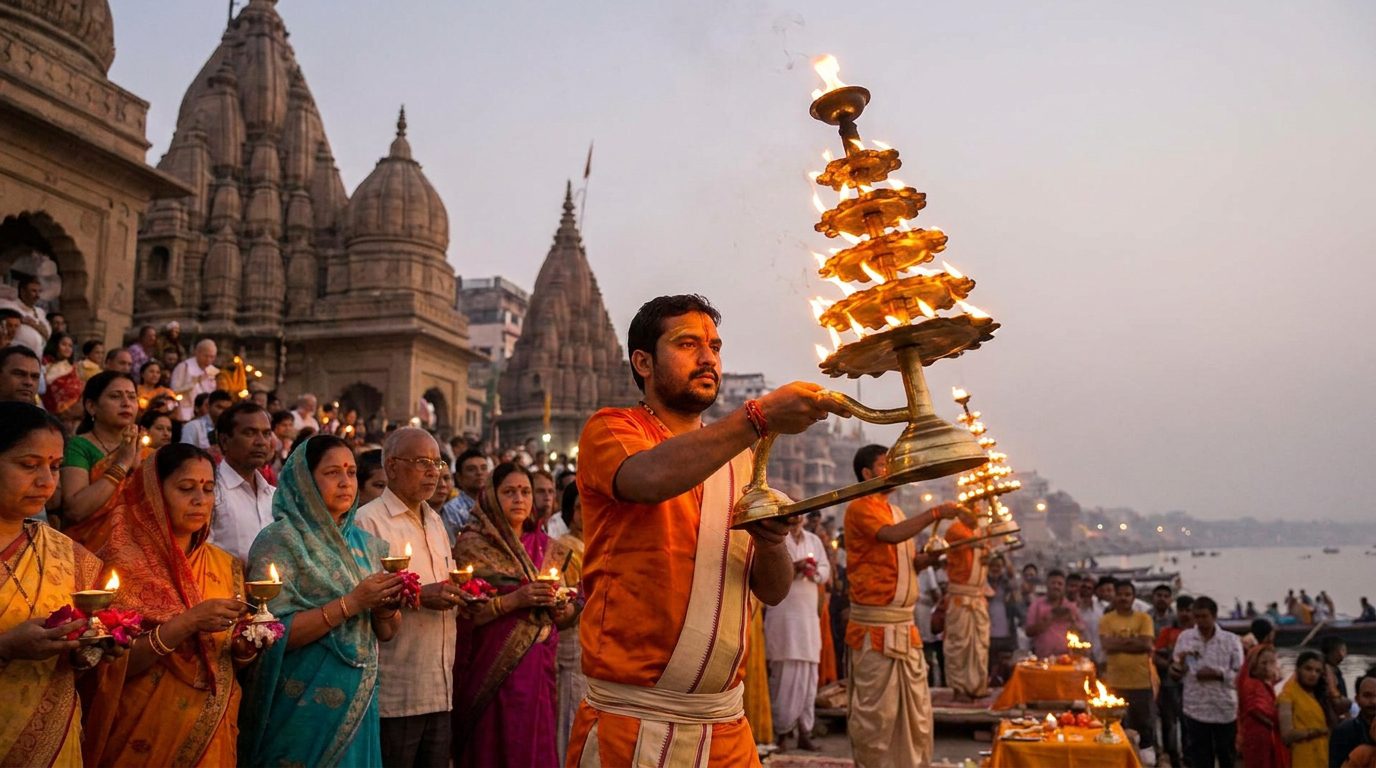
Sandhya Arati is the sacred evening worship offered to the Lord with lamps, incense, music, prayer, and devotion. The word sandhya means “junction” or “twilight,” especially the meeting point between day and night. Arati means a loving offering of light, often made with a ghee lamp, accompanied by kirtan, bells, and heartfelt prayers.
In the Bhakti Yoga tradition, Sandhya Arati is not simply a ritual. It is a loving appointment with God.
As the day comes to a close, our minds may be full of responsibilities, conversations, worries, and desires. Sandhya Arati invites us to pause, breathe, and return our hearts to the Divine. It is a time to offer gratitude for the day, ask for guidance, and remember that we are spiritual beings meant for loving relationship with the Supreme.
At The Bhakti House, we welcome people of all backgrounds—whether you are new to Bhakti Yoga, returning after some time away, or already practicing daily. Sandhya Arati is a beautiful doorway into devotion because it engages the whole person: the voice in chanting, the ears in hearing sacred sound, the eyes in seeing the lamp, the hands in offering service, and the heart in prayer.
The Meaning and Purpose of Sandhya Arati
A Sacred Pause at Twilight
Twilight has always been considered a spiritually powerful time. The energy of the day is shifting. The world grows quieter. The sky changes color. Nature itself seems to slow down and reflect.
In Vedic culture, these transition times are honored as opportunities for spiritual remembrance. The Bhagavad-gita, one of the most beloved scriptures of Bhakti Yoga, teaches that the mind can become peaceful when it is connected with the Divine. Lord Krishna says:
“Always think of Me, become My devotee, worship Me, and offer your homage unto Me.”
— Bhagavad-gita 18.65
Sandhya Arati is a practical way to live this teaching. Rather than only thinking about spirituality as an idea, we bring it into the rhythm of daily life. We light a lamp. We sing. We bow. We offer our attention.
Offering Light to the Source of Light
During arati, a lamp is offered before the form of the Lord, often on an altar. In Bhakti temples, this may be offered to Krishna, Radha-Krishna, Gaura-Nitai, Jagannath, or other worshipable forms of the Divine.
Someone may wonder, “Why offer light to God, who is already the source of all light?”
This is a beautiful question. In Bhakti, the offering is not about God needing something from us. The Lord is complete. Rather, the offering is for our purification and awakening. Just as a child may offer a small flower to a loving parent, we offer what we can with sincerity.
The lamp represents the light of our consciousness. By offering it to God, we are saying, “May my thoughts, words, and actions be illumined by divine love.”
Returning the Heart to Devotion
The Sanskrit word bhakti means devotion, loving service, or the natural love of the soul for God. Bhakti Yoga is the path of awakening that love through practical spiritual activities such as chanting, prayer, worship, study, and service.
Sandhya Arati helps us gently turn away from forgetfulness and return to remembrance. It is not about perfection. It is about sincerity.
Even if the mind wanders, even if the heart feels dry, even if the day was difficult, we can still come before the Lord and offer a small flame of devotion.
The Traditional Elements of Sandhya Arati

The Altar: A Place of Loving Focus
An altar is a sacred space where we focus our devotion. It may be simple or elaborate. In a temple, the altar is often decorated with flowers, cloth, lamps, and pictures or Deity forms of the Lord. At home, it may be a small shelf with a picture of Krishna, Lord Chaitanya, or a beloved spiritual teacher.
The altar reminds us that God is not far away. The Divine can be invited into our home, our schedule, and our heart.
For beginners, a home altar can be very simple:
- A clean space
- A sacred image
- A small candle or ghee lamp
- Fresh water or flowers
- A prayerful intention
The most important ingredient is devotion.
The Lamp: The Offering of Light
The lamp is central to arati. Traditionally, a ghee lamp is used, made with clarified butter and a cotton wick. Ghee is considered pure and auspicious in Vedic worship. However, if ghee is not available, a clean candle can also be used with respect.
The lamp is waved in circular motions before the Lord. In many temples, the lamp is offered to different parts of the Lord’s form, such as the feet, navel, face, and whole body. This expresses loving attention and reverence.
After the lamp is offered, it is often brought to the gathered devotees. They may cup their hands over the flame and touch that warmth to their head or eyes. This symbolizes receiving divine blessings and carrying the light of devotion within.
Incense, Water, Cloth, Flowers, and Fan
In traditional arati, several items may be offered:
- Incense, representing fragrance and purification
- A lamp, representing light and devotion
- Water, representing refreshment and hospitality
- Cloth, representing respect and care
- Flowers, representing beauty and love
- A fan or chamara, representing comfort and service
Each item is offered not as a mechanical act but as loving service. In Sanskrit, this mood is called seva, which means service offered with devotion.
In Bhakti Yoga, service is not lower than meditation. Service is meditation in action. When we clean the altar, prepare flowers, cook vegetarian food for offering, or play an instrument during arati, we are practicing devotion through the body and heart.
Bells, Conch, and Sacred Sound
The ringing of bells and blowing of the conch shell are traditional parts of arati. These sounds help gather attention and create an atmosphere of sacredness.
The conch, called shankha in Sanskrit, is often associated with purity and divine victory. Bells awaken the mind and invite us to listen deeply.
Most importantly, Sandhya Arati is filled with sacred chanting. In Bhakti, sound is not just sound. Sacred sound, or mantra, carries spiritual presence. The word mantra means a sound vibration that protects and liberates the mind.
The most widely practiced mantra in the Bhakti tradition is the Hare Krishna maha-mantra:
Hare Krishna Hare Krishna
Krishna Krishna Hare Hare
Hare Rama Hare Rama
Rama Rama Hare Hare
Maha-mantra means “great mantra.” This chant is a prayer asking the Divine energy and the Lord to engage us in loving service.
Please visit our website for more information on our articles: articles.
The Role of Kirtan in Sandhya Arati

What Is Kirtan?
Kirtan means devotional singing, especially singing the names of God together. It is one of the most joyful and accessible practices of Bhakti Yoga.
During Sandhya Arati, devotees often sing traditional songs while instruments such as harmonium, mridanga drum, kartals, and hand cymbals accompany the chanting. But kirtan is not a performance. It is a shared offering.
Some people sing loudly. Some sing softly. Some simply listen. All are welcome.
The heart of kirtan is participation, not musical skill.
Why Chanting Opens the Heart
The Srimad Bhagavatam, a treasured Bhakti scripture, describes hearing and chanting about the Lord as a powerful way to cleanse the heart. It says:
“Hearing and chanting about the transcendental holy name, form, qualities, and pastimes of the Lord is the natural spiritual process for awakening devotion.”
This means that when we chant sincerely, something begins to shift inside us. The mind may become calmer. The heart may become softer. We may feel a sense of connection, humility, or hope.
Not every kirtan will feel emotionally powerful, and that is okay. Bhakti is not dependent on dramatic feelings. The practice itself is sacred. Like watering a seed, chanting nourishes the soul over time.
The Evening Mood of Devotional Song
Sandhya Arati has a special sweetness because it comes at the end of the day. The singing can feel like a spiritual homecoming.
We may arrive carrying the weight of work, family duties, or inner struggles. But as the kirtan begins, the atmosphere changes. The holy names fill the room. The lamp glows. The community sings. Slowly, the heart remembers: “I belong to God. I am not alone.”
This is the beauty of evening arati. It helps us end the day not in distraction, but in devotion.
How Sandhya Arati Is Practiced in a Temple
Gathering Before the Altar
In a Bhakti temple or devotional community, Sandhya Arati usually begins with devotees gathering before the altar. The curtains may open, revealing the Deities beautifully dressed and decorated.
Everyone stands, sits, sings, or bows according to their ability and comfort. If you are visiting for the first time, you do not need to know everything. You can simply observe respectfully, listen to the chanting, and follow along as you feel inspired.
Bhakti is not about social pressure. It is about the sincere movement of the heart.
The Priest or Devotee Makes the Offering
A trained devotee or priest offers the arati items to the Lord. This person may wave incense, a lamp, water, cloth, flowers, and other items while the kirtan continues.
In traditional temple worship, there are guidelines for cleanliness, timing, mantras, and the order of offerings. These details help create an atmosphere of care and reverence. But the essence remains love.
The Bhagavad-gita gives a simple and universal teaching:
“If one offers Me with love and devotion a leaf, a flower, fruit, or water, I will accept it.”
— Bhagavad-gita 9.26
This verse reveals the heart of arati. God accepts the love behind the offering.
Receiving the Blessings
After the arati lamp is offered to the Lord, it is brought to the assembly. Devotees receive the warmth of the lamp as a blessing. Sometimes flower petals, sacred water, or other blessed items may also be distributed.
This reminds us that devotion is reciprocal. We offer something to God, and by divine grace, we receive spiritual strength in return.
Often, the arati concludes with prayers, bowing, or further kirtan. In many communities, there may also be a short talk from scripture or distribution of prasadam.
Prasadam means “mercy.” It usually refers to vegetarian food that has been prepared with devotion and offered to God. After being offered, it is honored as sacred nourishment.
How to Practice Sandhya Arati at Home
Begin Simply and Sincerely
You do not need a large altar or many items to begin practicing Sandhya Arati at home. A simple daily practice can be deeply transformative.
You might begin with:
- Lighting a candle before a sacred image
- Offering a flower or a small cup of water
- Chanting the Hare Krishna maha-mantra
- Reading one verse from the Bhagavad-gita
- Saying a personal prayer of gratitude
Even five or ten minutes can become a sacred anchor in your day.
The key is regularity. When we create a daily time to remember God, our inner life becomes more steady.
Prepare a Clean and Peaceful Space
Before beginning, you may wish to clean the altar area and wash your hands. Cleanliness supports clarity. It is not about judgment or fear; it is about creating a respectful environment for worship.
If possible, turn off unnecessary distractions. Put your phone away. Let your family or housemates know that this is a quiet devotional time. If you have children, you can include them in simple ways—ringing a bell, offering a flower, or singing along.
A home arati does not have to be perfect. It can be alive, natural, and loving.
A Simple Home Sandhya Arati Practice
Here is one gentle way to practice:
- Sit or stand before your altar.
- Take a few deep breaths and offer your intention.
- Light a candle or ghee lamp.
- Offer the lamp in small circles before the Lord’s picture or form.
- Chant the Hare Krishna maha-mantra or another sacred name of God.
- Offer a short prayer in your own words.
- Read a verse from scripture.
- Bow your head and ask for guidance.
- Carry the mood of devotion into the evening.
You may say something as simple as:
“My Lord, thank You for this day. Please help me remember You. Please guide my words, my actions, and my heart. May I serve You and all beings with love.”
Such a prayer, offered sincerely, is precious.
If You Are New or From Another Faith Background
Bhakti Yoga honors the sincere search for God. People come to devotional practice from many cultures, religions, and life experiences. Sandhya Arati is not meant to erase anyone’s background. It is an invitation to deepen our relationship with the Divine through love, sound, service, and remembrance.
If you understand God as Krishna, Christ, Allah, the Divine Mother, the Supreme Being, or the loving source of all existence, you can approach with humility and sincerity.
In Bhakti, the essence is loving devotion. Names and forms may be understood in different ways, but the heart’s longing for divine connection is universal.
The Inner Symbolism of Sandhya Arati
The Lamp and the Heart
The flame of the arati lamp can remind us of the soul’s eternal nature. In the Bhagavad-gita, Krishna explains that the soul is not destroyed by the body’s changes. The soul is spiritual, conscious, and eternal.
When we gaze at the lamp, we may remember: “I am not only this body. I am not only my thoughts and worries. I am a soul, meant for loving service.”
The lamp also reveals. In a dark room, one small flame can change everything. Similarly, even a small practice of devotion can begin to illuminate our inner life.
The Evening as Surrender
Evening naturally teaches surrender. The day is ending. Whatever we completed or did not complete must be placed in God’s hands.
Sandhya Arati gives us a sacred way to release the day. We can offer our successes without pride and our mistakes without despair. We can ask forgiveness where needed and pray for strength to do better tomorrow.
This is a gentle but powerful practice. Instead of carrying the whole day into sleep, we place it at the feet of the Lord.
Community as Sacred Support
When Sandhya Arati is practiced in community, it becomes especially nourishing. Bhakti grows in the company of devotees, called sanga. Sanga means spiritual association—being with people who encourage our higher self and remind us of God.
In the Chaitanya-charitamrita, Lord Chaitanya Mahaprabhu, who widely shared the practice of chanting the holy names, taught the importance of humility, compassion, and constant chanting. One famous prayer says:
“One should chant the holy name of the Lord in a humble state of mind, thinking oneself lower than a blade of grass, more tolerant than a tree, and ready to offer respect to all.”
This mood is the heart of true community. We come together not to compete spiritually, but to support one another in devotion.
Benefits of Sandhya Arati for Daily Spiritual Growth
It Brings Peace to the Mind
Modern life is often fast, noisy, and demanding. Sandhya Arati gives the mind a sacred rhythm. The repetition of mantra, the beauty of the lamp, and the atmosphere of prayer help calm inner restlessness.
This peace is not merely relaxation. It is spiritual grounding. We remember that God is present, that life has purpose, and that we can choose love even in difficulty.
It Strengthens Devotional Discipline
Spiritual growth often comes through small, repeated choices. A daily or weekly Sandhya Arati practice strengthens our devotional muscles.
We may not always feel inspired at first. But by showing up, we learn faithfulness. Over time, the practice becomes less like an obligation and more like nourishment.
Just as the body needs food daily, the soul needs remembrance.
It Deepens Gratitude
Evening worship naturally invites gratitude. We can look back on the day and notice blessings we might have missed: a kind word, a meal, protection, a lesson, a moment of beauty.
Gratitude softens the heart. It helps us see life not as something to control, but as a sacred gift to be offered back in service.
It Purifies the Home Atmosphere
When we chant, pray, and offer worship at home, the atmosphere changes. Sacred sound has a cleansing effect. Family members, guests, and even our own minds can feel the difference.
A home where God is remembered becomes a place of refuge.
This does not mean life becomes free from challenges. But it means challenges are held within a deeper spiritual context. The home becomes centered around devotion, compassion, and higher purpose.
It Connects Worship With Service
Sandhya Arati should not remain only at the altar. The real test of worship is how we treat others afterward.
If we offer a lamp to God but speak harshly to the people around us, our devotion is incomplete. Bhakti invites us to carry the light of arati into our relationships.
After evening worship, we can ask:
- How can I serve my family with more patience?
- How can I speak more truthfully and kindly?
- How can I help someone tomorrow?
- How can I remember God in my work?
In this way, Sandhya Arati becomes practical spirituality.
Common Questions About Sandhya Arati
Do I Need to Be Hindu to Attend or Practice Sandhya Arati?
No. Sandhya Arati is rooted in the Bhakti tradition, but sincere seekers from all backgrounds are welcome. You do not have to identify with a particular label to chant, pray, listen, or learn.
Respect, openness, and humility are enough to begin.
What Should I Wear to Sandhya Arati?
If you are visiting a temple or Bhakti center, modest and clean clothing is appropriate. Some devotees wear traditional clothing, but it is not required. The main idea is to dress in a way that supports respect and sacred focus.
If you are practicing at home, simply wear something clean and comfortable.
What If I Do Not Know the Songs?
That is completely fine. Many people begin by listening. Over time, the melodies and words become familiar.
Kirtan is forgiving. You can join with one word, one mantra, or even silent attention. The Lord sees the sincerity of the heart.
Can I Practice Sandhya Arati Without Instruments?
Yes. Instruments are beautiful, but not necessary. You can chant softly with your voice alone. You can play a recording and sing along. You can ring a small bell if you have one.
The essential offering is devotion.
What If My Mind Wanders During Arati?
The mind wanders for almost everyone. When you notice it, gently bring your attention back to the lamp, the mantra, or your prayer. Do not become discouraged.
Bhakti is a path of patience. Each time we return to God, that return is meaningful.
Sandhya Arati and the Teachings of Bhakti Scriptures
The Bhagavad-gita: Worship With Love
The Bhagavad-gita teaches that devotion is available to everyone. Krishna does not ask for wealth, status, or complicated qualifications. He asks for love.
When Krishna says He accepts a leaf, flower, fruit, or water offered with devotion, He shows that the heart of worship is relationship. Sandhya Arati gives us a daily opportunity to make that relationship real.
We may offer a lamp, but inwardly we are offering ourselves.
The Srimad Bhagavatam: Hearing and Chanting
The Srimad Bhagavatam emphasizes sravanam and kirtanam—hearing and chanting about God. These are two of the main practices of Bhakti Yoga.
Sandhya Arati includes both. We hear sacred sound, and we chant. We hear prayers, and we respond with our own hearts. This hearing and chanting gradually cleanses the mirror of consciousness, helping us see ourselves and God more clearly.
Lord Chaitanya’s Gift: The Holy Name
Lord Chaitanya Mahaprabhu taught that in this age, the chanting of God’s holy names is the most accessible and powerful spiritual practice. He shared kirtan widely, inviting everyone—regardless of social position, education, gender, or background—to participate.
Sandhya Arati continues in this spirit. It is not a private treasure for a few. It is a public invitation into divine love.
When people gather and chant together, the atmosphere becomes spiritually charged. The holy name does not belong to one nation or community. It is the sound of the soul calling out to God.
Bringing the Mood of Sandhya Arati Into Everyday Life
Make Your Evening Sacred
Even if you cannot perform a full arati every night, you can make your evening sacred in small ways.
Before dinner, offer your food to God with gratitude. Before sleep, chant one round of the maha-mantra or say a sincere prayer. Light a candle and remember the Lord for a few moments. Read one verse of scripture and reflect on how to live it.
Small devotional habits can reshape the heart.
Offer the Day’s Results
Many of us carry stress because we feel responsible for everything. Bhakti teaches us to act sincerely but offer the results to God.
At Sandhya Arati, we can mentally place the day’s work before the Lord:
“This is what I tried to do. Some things went well, some did not. Please accept my efforts. Please purify my intentions. Please guide me tomorrow.”
This simple act brings humility and relief.
Serve Someone After Worship
One practical way to honor Sandhya Arati is to do one act of kindness afterward. Call someone who is lonely. Help clean the kitchen. Speak gently to a family member. Donate to a service project. Feed someone prasadam.
Bhakti is love in action. The lamp we offer at the altar should become compassion in the world.
A Simple Sandhya Arati Meditation
Sit With the Flame
If you are practicing alone, you may sit quietly before the lamp after chanting. Let the flame remind you of God’s presence.
You can reflect:
“May this light remove ignorance from my heart. May I see others with compassion. May my words bring peace. May my life become an offering.”
Do not rush. Let the prayer become personal.
Chant With Meaning
When chanting the Hare Krishna maha-mantra, you may understand it as a heartfelt prayer:
“O Lord, O Divine Energy of the Lord, please engage me in Your loving service.”
You do not need to force emotion. Simply chant with attention and openness. The holy name is merciful.
End With Gratitude
Before closing, offer thanks.
Thank God for the day. Thank your teachers, family, and community. Thank the Lord for giving you another chance to remember, grow, and serve.
Gratitude turns ordinary life into sacred life.
Everyone Is Welcome to Begin
Sandhya Arati is one of the most beautiful practices of Bhakti Yoga because it brings together so many expressions of love: chanting, prayer, light, service, scripture, community, and surrender.
It can be grand in a temple, with drums and singing voices filling the room. It can also be simple at home, with one candle and one sincere prayer. Both can be pleasing to the Lord when offered with devotion.
Wherever you are on your spiritual journey, you are welcome. You do not need to have everything figured out. You do not need to be perfect. You do not need to know every mantra or custom. Just bring your heart.
This evening, or whenever you feel called, take one sincere step toward God. Light a small lamp. Chant one holy name. Offer one prayer. Serve one person with love. The path of Bhakti begins and deepens through these humble offerings, and the Lord lovingly receives every sincere step.
FAQs
What is Sandhya arati?
Sandhya arati is a Hindu ritual of worship that takes place at sunset. It involves offering prayers, singing devotional songs, and waving lighted wicks in front of the deity.
What is the significance of Sandhya arati?
Sandhya arati is considered a way to seek blessings from the deity and to express gratitude for the day that has passed. It is also believed to purify the mind and soul of the worshipper.
How is Sandhya arati performed?
Sandhya arati is typically performed at a designated place of worship, such as a temple or home shrine. It involves lighting a lamp or candle, offering flowers, and reciting prayers and mantras.
What are the benefits of participating in Sandhya arati?
Participating in Sandhya arati is believed to bring peace of mind, spiritual upliftment, and blessings from the deity. It is also seen as a way to cultivate devotion and gratitude.
Is Sandhya arati only performed in Hinduism?
Yes, Sandhya arati is a ritual specific to Hinduism and is not practiced in other religious traditions. It is an important part of daily worship for many Hindus.

